
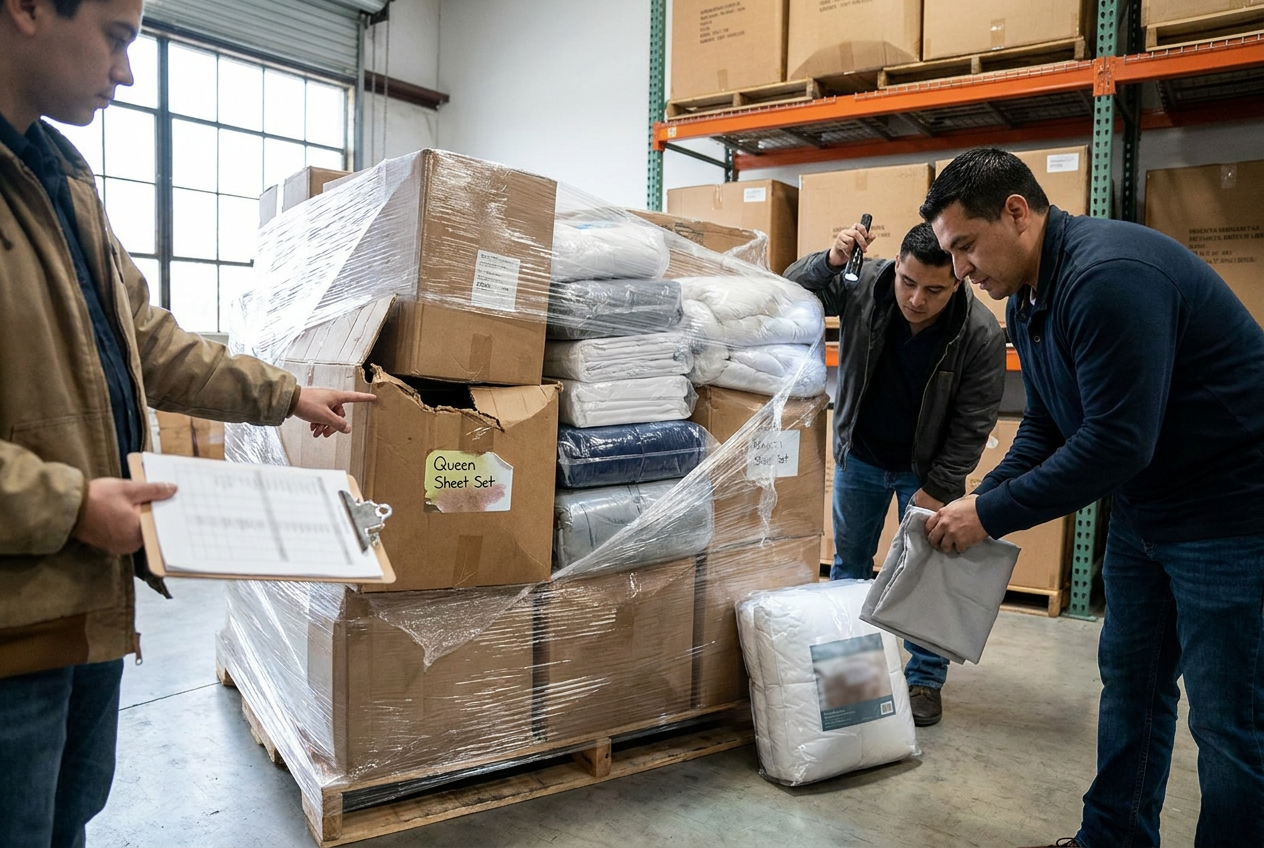
Bedding liquidation pallets can contain sheets, pillowcases, comforters, duvet covers, quilts, blankets, shams and other sleep-related textiles. For an independent reseller, the important question is not simply how many packages are on a pallet. It is how many identifiable, usable products remain after checking size, contents, condition and hygiene.
A queen sheet set missing its fitted sheet is not equivalent to a complete queen set. A crushed comforter bag does not necessarily mean the comforter is damaged. And bedding linens are not mattresses: their inspection, storage and resale considerations differ. This guide explains how to evaluate the assortment without treating every textile package as a ready-to-list item.
Understand the load before comparing offers
A liquidation pallet is a bulk resale lot, not a promise that every item shares the same size, source or condition. A truckload expands that purchasing unit to multiple pallets or a full trailer, increasing both the inventory and the sorting work. Start with the liquidation pallets hub and the guide to types of liquidation pallets if you need to compare formats.
Bedding offers generally require three separate checks:
- Assortment: Bedding-only, broader textiles or general merchandise containing some bedding.
- Documentation: A manifested lot has an item list; a category-level lot may describe the mix without identifying every item.
- Condition: Overstock, shelf pulls, customer returns or salvage describe different histories and risks.
A manifest does not automatically establish set completeness or sanitation. Likewise, “textiles” can include bath towels, curtains and decorative cushions, not just bed linens.
Compare general merchandise loads with the broader truckloads category. Product pages such as the Macy’s Textile Truckload and Amazon General Merchandise Truckload are starting points for reviewing individual offers, not evidence that either contains a particular bedding mix. Verify the current description and available documentation.
PalletCove is an independent reseller and is not affiliated with, endorsed by or sponsored by any retailer named.
Evaluate bed-size distribution and product fit
Request a size breakdown by product type, not just a count of “bedding units.” Forty pillowcases and forty comforter sets represent very different storage, inspection and listing workloads. Separate unknown sizes instead of allocating them to the most likely category.
The measurements below are common U.S. mattress dimensions used as a reference for sheet fit. They are not dimensions for comforters, duvet covers or every manufacturer's finished linens.
| Bed size | Common mattress dimensions | Bedding inspection priority |
|---|---|---|
| --- | --- | --- |
| Twin | 38 × 75 inches | Distinguish standard twin from twin XL fitted sheets |
| Twin XL | 38 × 80 inches | Check fitted-sheet length, especially on combined twin labels |
| Full | 54 × 75 inches | Do not assume full/queen top bedding includes a full fitted sheet |
| Queen | 60 × 80 inches | Verify fitted-sheet size and pocket depth |
| King | 76 × 80 inches | Confirm standard king versus California king |
| California king | 72 × 84 inches | Avoid substituting standard king fitted sheets |
Flat sheets and top-of-bed products can carry combined size labels because coverage varies by design. Fitted sheets depend more directly on mattress width, length and depth. A “deep pocket” description should be supported by the label's stated dimensions rather than a guess.
Record pillowcase and sham sizes separately. Standard, queen, king and Euro formats are not interchangeable descriptions. Also check whether an oversized comforter will fit the duvet cover it is being paired with.

Compare the resulting distribution with your own sales history and available storage. A large quantity in one size may suit a specialist reseller but create slow-moving inventory for a seller whose customers need a broader assortment.
Read the manifest and verify complete sets
For manifested bedding liquidation pallets, request the available item description, UPC or SKU, quantity, size, condition information and package configuration. Clarify whether quantity means retail packages, individual textile pieces or cases. A four-piece set may be one selling unit, not four independently packaged products.
Build a receiving worksheet with these fields:
- Manifest line or item identifier.
- Product type, size, color and pattern.
- Expected contents from the package label.
- Actual contents after inspection.
- Packaging and textile condition.
- Final disposition: complete set, accurately described separates, further review or unsuitable for resale.
Common missing components include pillowcases, shams, fitted sheets and decorative pillows. A duvet cover is not a duvet insert; shams are not filled pillows. Read the contents panel rather than relying on the styled bedroom photograph.
If the label identifies a six-piece set, account for all six listed components. Some sets count decorative accessories, while others include extra pillowcases. Matching colors alone does not prove that loose pieces belong together: check pattern, dimensions, fiber content and care instructions.
Use the guide to matching liquidation items by UPC and SKU when packaging and manifest descriptions disagree. Codes help identify a product, but they cannot verify that everything originally supplied remains inside.
Key takeaway: Count complete, identifiable selling units—not just packages—and keep unknown size, missing-piece and hygiene issues separate.
Separate condition grades, packaging damage and hygiene
A condition grade is a screening tool, not a substitute for inspection. Definitions can vary by offer, so ask what the stated grade includes and whether it describes the whole load or individual items.
- Overstock: Unsold excess inventory; packaging and storage condition still need checking.
- Shelf pulls: Merchandise removed from selling space, potentially carrying handling wear, stickers or opened packaging.
- Customer returns: Returned goods that may be unused, incomplete, used, damaged or incorrectly repacked.
- Salvage: Merchandise requiring substantial recovery work or potentially unsuitable for ordinary resale.
Packaging damage versus textile damage
A torn zipper bag, scuffed carton or missing paper insert can be a presentation problem without being a fabric defect. Examine exposed areas for snagging, abrasion, moisture or dirt. Conversely, an intact outer package does not establish that a returned item is unused or complete.
Check seams, elastic, zippers, quilting, fill distribution, discoloration and damaged backing. Preserve fiber-content, size and care labels. If the package and sewn label conflict, hold the item for identification rather than selecting the more marketable description.
Hygiene concerns require a separate decision
Isolate items with stains, strong odors, dampness, visible mold, pest evidence or unknown residue. Do not mix suspect textiles into clean stock or assume that laundering makes every item appropriate for resale. Follow applicable state and local rules, marketplace policies and the item's care instructions.
Opened packaging alone does not prove prior use, but it also does not justify an “unused” claim. Avoid describing merchandise as sanitized, hypoallergenic or bedbug-free without a valid basis. Where condition or safe handling cannot be established, exclude the item from ordinary sale.
Mattresses, foundations and upholstered sleep products are outside this linen-focused evaluation. Pillows and other filled bedding can also be subject to specific labeling or sanitation requirements; check requirements for the product and jurisdiction involved.
Understand pricing and your processing costs
Read the offer to establish whether the listed price covers one pallet, several pallets or a truckload. Do not infer a fixed piece count from pallet height or compare two loads solely by package count.
At PalletCove, freight is included in the listed price. Free shipping is the only delivery option, on every order, to all 48 contiguous states. Sales tax on qualifying orders is covered by PalletCove.
Your internal budget should still account for receiving labor, inspection, storage, replacement packaging, photography, marketplace expenses and disposal where necessary. Washing, when appropriate and permitted, adds labor and must follow care instructions; it should not be assumed to resolve every condition issue.
A useful planning calculation is:
Acquisition and processing cost per saleable unit = purchase price plus your processing expenses, divided by the units actually approved for resale.
Before inspection, that denominator is an estimate. Test several scenarios rather than treating every manifest line as saleable. Suggested retail figures, when supplied, are reference data—not expected selling prices or guaranteed resale value. All merchandise is sold as-is for resale, and no profit or condition outcome is promised.
Order with documentation and receiving capacity in mind
Use the buying liquidation pallets guide to organize your first purchase. Before paying, confirm the exact offer, included quantity, available manifest, condition description and any unknowns about size distribution or completeness. Ask whether photographs show the specific lot or are representative.
Provide accurate business, delivery and receiving-contact information. Have your resale certificate available if requested for account or tax documentation; certificate requirements vary by jurisdiction. Payment methods are credit/debit card, ACH bank transfer and domestic bank wire.
Handling takes 1–3 business days after payment clears. Transit from Dallas is typically 3–7 business days, separate from handling time. Review the shipping policy and plan for delivery communications rather than promising your customers a fixed arrival date.
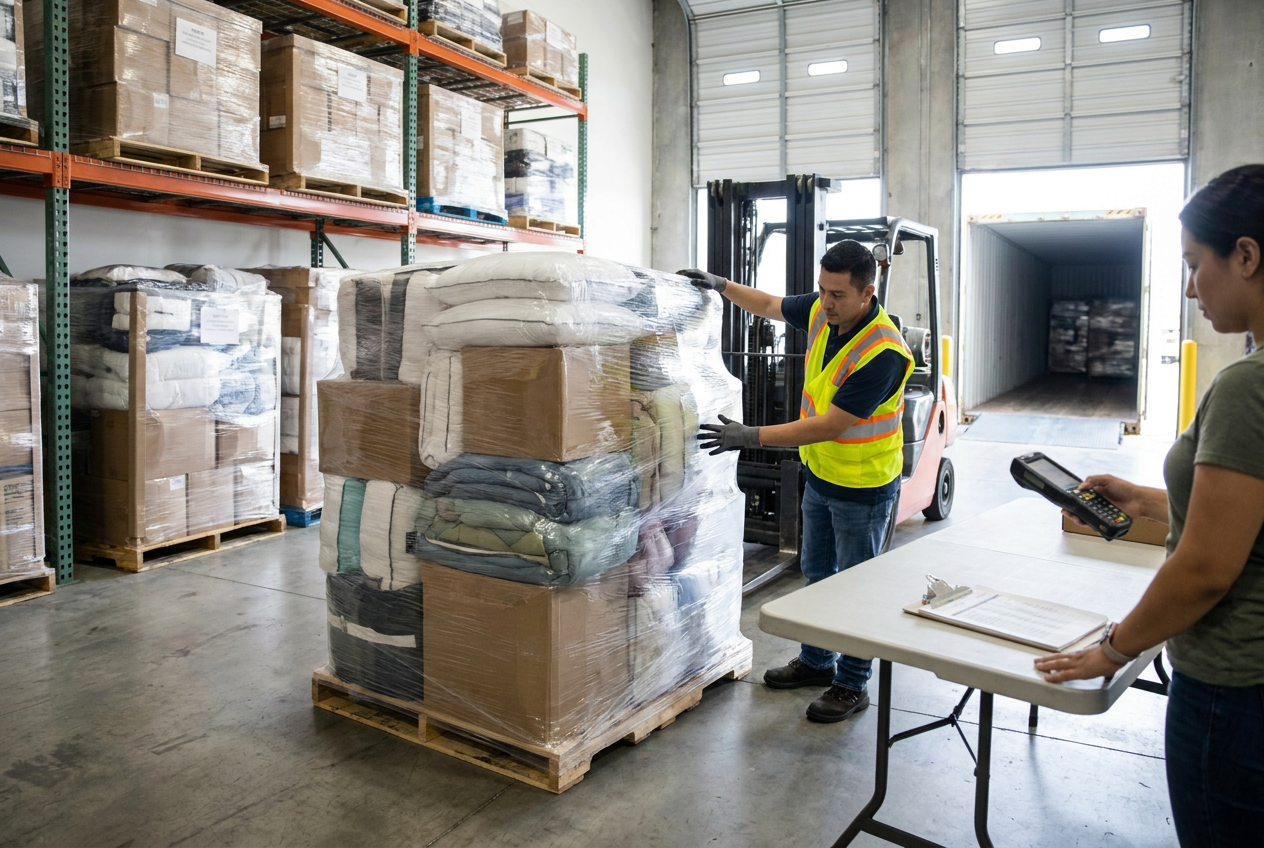
Pallet shipments may move by LTL, while larger orders may use a full trailer. Confirm the shipment format and your site's unloading arrangements before ordering. Receiving space, equipment and labor matter even when freight is included.
Buyers comparing liquidation pallets in Texas and liquidation pallets in Florida receive the same free-shipping delivery option. Allow for the stated transit window when planning inventory availability.
Inspect delivery and document potential claims
Prepare a clean, dry receiving area with room to separate inspected bedding from unopened stock. On delivery day:
- Compare the shipment identification and pallet count with the delivery paperwork.
- Photograph the load before removing wrap, including labels, exposed cartons and visible damage.
- Record visible shortages or damage on the delivery receipt where applicable; keep a copy.
- Photograph affected packaging and contents during unpacking, retaining relevant labels and materials.
- Reconcile received items with the available manifest and document discrepancies by line item.
Distinguish transportation damage from preexisting liquidation condition. A wet carton and an incomplete customer-return set may require different evidence. Documentation supports review but does not establish an entitlement to a refund or replacement.
Read the refund and claims policy before purchasing. All merchandise is sold as-is for resale; do not assume retail-style returns or coverage for every missing piece. Follow the policy's current eligibility, reporting and evidence requirements, and report concerns promptly without inventing a deadline or assuming an outcome.
Avoid common bedding buying mistakes
The most expensive errors often begin with an unsupported assumption:
- Buying by package count: A bag may contain one blanket or an incomplete multi-piece set.
- Ignoring unknown sizes: Unidentified fitted sheets require measurement and additional handling.
- Calling everything new: Overstock history, packaging appearance and verified unused condition are different facts.
- Rebuilding sets without disclosure: Separates should not be represented as the original complete manufacturer set.
- Treating all textiles alike: Bedding, bath linens, window treatments and mattresses need different evaluation.
- Skipping a processing plan: Bulky comforters can consume storage before smaller items are listed.
Keep inspected stock dry, protected and organized by product, size and status. Preserve traceability from manifest line to resale listing so questions about missing pieces or descriptions can be resolved accurately.
Frequently asked questions
Are bedding liquidation pallets the same as mattress pallets?
No. Bedding pallets generally concern linens and related textiles, while mattress loads involve different bulky products and inspection requirements. Verify the actual contents because broad home-goods descriptions can include unrelated categories.
Does a manifest guarantee complete bedding sets?
No. A manifest can identify the original product and quantity without confirming that all components remain in the package. Compare the contents panel with the physical pieces during receiving.
Can I sell an incomplete sheet or comforter set?
Potentially, if the remaining pieces are suitable for resale and your selling channel permits it. Describe each included component, its size and condition accurately, and disclose missing pieces rather than using the original complete-set description.
Is free shipping available on every order?
Yes. Free shipping is PalletCove's only delivery option on every order to all 48 contiguous states, with freight included in the listed price. Handling is 1–3 business days after payment clears, and transit is typically 3–7 business days from Dallas.
What should I do with bedding that has an odor or stains?
Separate it from other inventory and evaluate the concern before handling it further or listing it. Do not assume washing establishes safety or acceptable resale condition. Follow relevant product-care instructions, legal requirements and marketplace rules.
Talk to PalletCove Liquidation
Discuss available documentation, assortment details and receiving requirements with PalletCove Liquidation LLC before selecting a load. Bring your questions about bed sizes, set completeness and condition disclosures to contact our order desk, or review current inventory.
- Address: 4820 Cove Industrial Blvd, Dallas, TX 75236
- Phone: (713) 819-3904
- Email: sales@palletcoveliquidation.com
- Hours: Mon–Fri 8:00 AM – 6:00 PM CT, Sat 9:00 AM – 2:00 PM CT, Sun closed