

A crushed carton can contain an undamaged item. A clean, sealed-looking carton can contain a defective, incomplete, or previously used product. For a reseller, understanding box damage vs product damage starts with separating what packaging reveals from what only an item-level inspection can establish.
PalletCove Liquidation supplies manifested and category-level liquidation pallets and full truckloads from Dallas, Texas. All merchandise is sold as-is for resale. Packaging descriptions help buyers plan inspections, but they do not establish working condition, completeness, safety, or suitability for a particular resale channel.
This guide explains how to read condition language, evaluate evidence, budget for processing, and document delivery issues without treating a cosmetic description as a product guarantee.
What box damage vs product damage actually means
Box damage is physical deterioration of packaging: scuffed printing, torn cardboard, dented corners, crushed panels, broken handles, or damaged wrapping. Distinguish the outer shipping carton from the retail package and the protective inserts inside it. Damage to one layer does not necessarily mean damage to another.
Product damage affects the merchandise itself. Examples include cracked housings, bent frames, chipped surfaces, torn fabric, corrosion, or broken connectors. Functional defects are a separate concern: an item can look intact but fail during operation. Missing accessories are another distinct issue, even when neither the packaging nor the product looks damaged.
| Observation | What it establishes | What remains unknown |
|---|---|---|
| --- | --- | --- |
| Scuffed outer carton | Packaging has surface wear | Product appearance and operation |
| Crushed corner | Packaging experienced compression or impact | Whether protection absorbed the force |
| Puncture through carton | Something penetrated the packaging | Whether it reached the product |
| Water staining | Packaging shows evidence of moisture exposure | Internal moisture, corrosion, or contamination |
| Split tape or resealing | The closure is disturbed or replaced | Who opened it and why |
| Intact retail box | No obvious exterior damage at inspection | Completeness, prior use, and function |
A packaging description describes packaging—not a test result. Treat working condition as unknown unless specific, relevant testing is documented.

How load types and condition grades change the question
Inventory source, condition grade, and shipment size describe different things. None should be substituted for the others. Our guide to liquidation pallet types provides a framework for distinguishing inventory groupings.
- Overstock: Inventory that exceeded selling needs. The label alone does not verify storage history, completeness, or current function.
- Shelf pulls: Merchandise removed from sales floors or displays. Expect to investigate handling wear, labels, packaging changes, and display use.
- Customer returns: Merchandise returned for reasons that may include preference, missing parts, damage, or malfunction. A return reason is not necessarily a verified diagnosis.
- Salvage: Inventory generally requiring substantial assessment for repair, parts recovery, recycling, or disposal. Confirm the seller's definition.
Terms such as “open box,” “box damage,” and letter or numbered grades are not universally standardized. Ask what the grade covers, who assigned it, and whether it applies to every item or the load overall. Do not interpret a numbered tier as a universal quality scale.
A liquidation pallet is a handling unit, not a quality designation. A truckload increases volume without removing uncertainty. Category-level loads identify a merchandise grouping; they do not necessarily provide item-level detail. Manifested loads provide a list, but that list is not automatically a testing record.
Compare the liquidation pallets hub, general merchandise inventory, and truckload inventory according to your receiving capacity and inspection skills—not packaging appearance alone.
What a manifest can and cannot verify
A manifest may list descriptions, model numbers, quantities, identifiers, and reference retail figures. Fields and accuracy vary by offering. Request the available manifest for the specific lot, and establish whether it is final, preliminary, or illustrative before relying on it.
Check these details:
- Identity: Do model numbers, UPCs, sizes, and variants match the descriptions?
- Quantity: Does a listed unit mean one item, a multipack, a case, or a component?
- Condition: Are notes item-specific, or repeated across an entire batch?
- Testing: Does “tested” identify the procedure, result, date, and tested item?
- Completeness: Are required adapters, hardware, batteries, lids, remotes, and instructions addressed?
- Exceptions: Are missing items, substitutions, and known discrepancies disclosed?
A power-on check does not prove every function works. A visual inspection does not establish electrical safety. Even a documented test should be understood according to its actual scope, not expanded into an implied warranty.
Reference retail figures are not verified resale prices. Use the manifest primarily to understand inventory composition and plan verification. The blind vs manifested pallets guide explains how documentation changes what buyers can assess.
Inspect packaging, protection, and the product separately
Use a repeatable inspection sequence rather than jumping from “dented box” to “damaged item,” or from “clean box” to “ready to sell.” Photograph observations and attach them to an item identifier.
Start with the exterior and internal protection
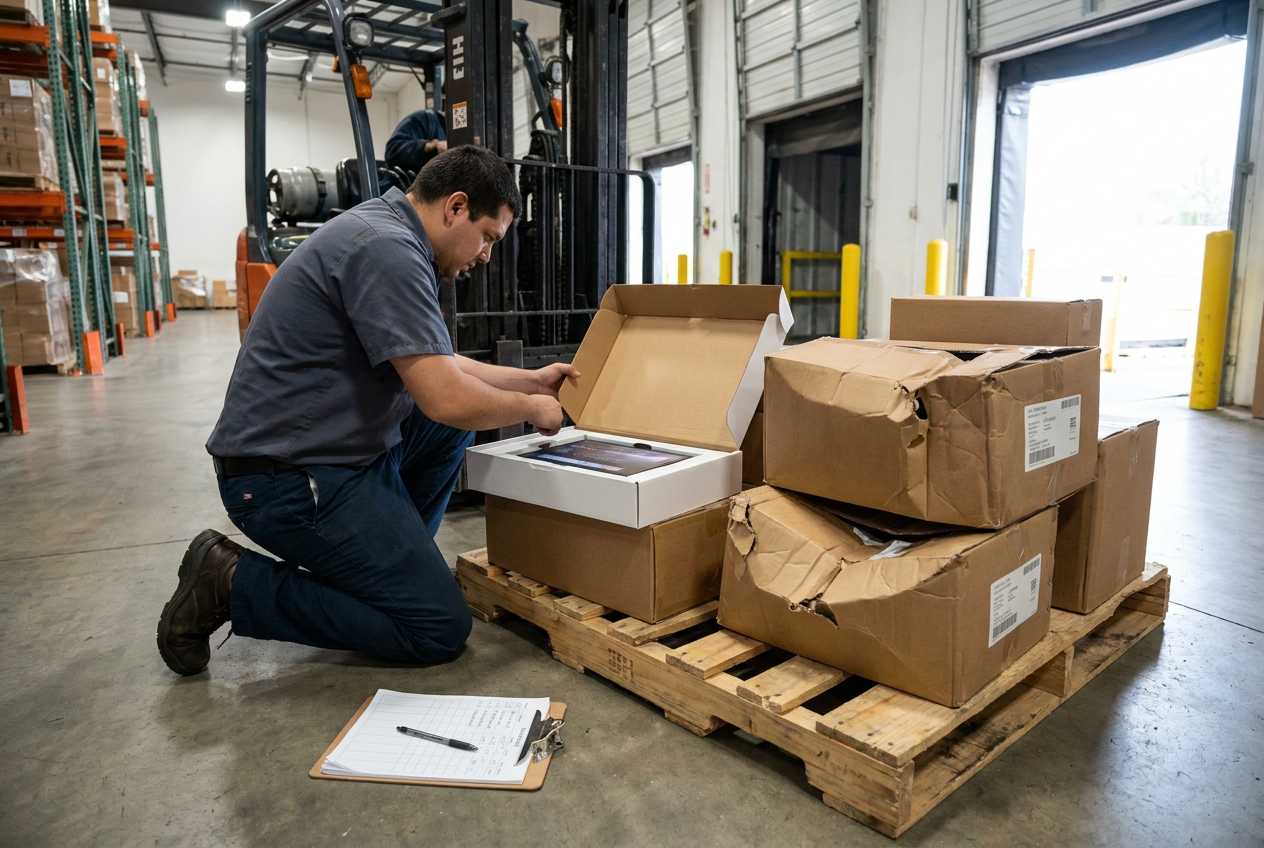
Look for crushed edges, punctures, staining, abnormal odors, loose contents, disturbed seals, and mismatched labels. Note whether damage appears confined to a shipping carton or extends to the retail package.
After safe opening, inspect foam, molded inserts, dividers, and restraints. Crushed cushioning, an unsecured heavy item, or missing protection increases concern, but still requires direct product assessment. Do not aggressively shake a carton to investigate a suspected breakage.
Check the merchandise and required components
Inspect housings, screens, connectors, seams, fasteners, and contact surfaces. Compare included components with the manufacturer's documentation for that exact model. Record cosmetic findings separately from operational findings.
For powered products, follow manufacturer instructions and use qualified personnel when appropriate. Do not energize wet equipment, exposed wiring, leaking batteries, or visibly unsafe items. Isolate suspicious merchandise and consult appropriate handling guidance; do not attempt improvised repairs merely to complete intake.
Check applicable recalls and restrictions before resale. An as-is purchase does not remove the reseller's responsibility to avoid selling recalled, unsafe, or prohibited merchandise.
Price the workload, not the appearance of the carton
At PalletCove, freight is included in the listed price. Free shipping is the only delivery option on every order to all 48 contiguous states. Sales tax on qualifying orders is covered by PalletCove.
The listed purchase price is still only one input in your internal processing budget. Account for:
- Receiving, counting, sorting, and inventory entry.
- Safe testing, cleaning, and condition documentation.
- Replacement packaging and justified accessory sourcing.
- Storage space and time before an item can be listed.
- Marketplace expenses, customer service, and outbound fulfillment.
- Appropriate recycling or disposal of unsuitable merchandise.
For example, a hypothetical $3,000 lot with $450 in inspection labor and $150 in packaging has a $3,600 processing cost before storage, selling expenses, or outbound fulfillment. That calculation says nothing about potential earnings or how many units will be saleable.
Allocate costs after verifying usable inventory; dividing by every manifested unit can understate the cost of items actually prepared for sale. Review the pallet buying guide alongside your own labor capacity and sales-channel requirements.
Product names also do not establish condition. When reviewing a Bulk Hamilton Beach Truckload or a Shoes Truckload, use the specific listing and available lot documentation rather than assuming every unit has the same packaging or defects.
Ordering, payment, and free shipping from Dallas
Before ordering, confirm the lot identifier, purchase unit, quantities, condition language, available documentation, and receiving requirements. Clarify unresolved questions in writing. Keep the listing, manifest version, and order confirmation together.
PalletCove accepts credit/debit card, ACH bank transfer, and domestic bank wire. Handling takes 1–3 business days after payment clears; transit is typically 3–7 business days from Dallas. Handling and transit are separate stages, and typical transit is not a guaranteed arrival date.
Free shipping is the only delivery option, with freight included in every listed order price across the 48 contiguous states. This applies to buyers seeking liquidation pallets in Texas and liquidation pallets in Florida, as well as the other contiguous states. Review the shipping policy for applicable delivery details.
Pallet shipments may move through LTL networks, while truckload shipments can involve a full trailer. Confirm the actual shipment configuration, receiving access, unloading arrangements, and on-site capacity before ordering. Do not assume a photograph establishes shipment dimensions or handling needs.
Have your business information and any requested resale certificate documentation ready. Confirm whether your order qualifies for PalletCove's sales-tax coverage rather than assuming qualification from the merchandise category.
Delivery-day inspection, returns, and claims
Delivery inspection creates a record of arrival condition. It does not prove internal functionality, but it helps distinguish visible transit issues from condition discovered later.
- Inspect before moving inventory when safe. Photograph the load, wrapping, straps, labels, and visible carton damage.
- Check handling-unit counts. Compare delivered pallets or cartons with shipping paperwork; this is different from verifying every manifested item.
- Record specific exceptions. Note observable shortages, torn wrap, punctures, crushing, or moisture on delivery paperwork before signing where possible. Avoid unsupported conclusions about the cause.
- Preserve records and packaging. Keep the delivery receipt, order number, labels, photographs, and relevant protective materials.
- Inspect promptly after receipt. Connect concealed damage or quantity discrepancies to individual items and their packaging.
- Report concerns promptly. Provide a factual timeline and supporting evidence through the applicable process.
All merchandise is sold as-is for resale. Do not assume ordinary retail returns apply, or that a nonworking item automatically qualifies for a refund. Read the refund and claims policy before purchasing for applicable eligibility, procedures, and deadlines.
A delivery exception is evidence, not automatic claim approval. Likewise, keeping packaging does not guarantee a remedy. Ask how to handle serious delivery concerns rather than assuming refusal is required or permitted.
Common mistakes that distort buying decisions
- Treating “box damage” as “tested working.” Keep packaging, completeness, cosmetic condition, and function in separate records.
- Assuming sealed means unused. Tape alone cannot authenticate a product's history or contents.
- Applying one inspected sample to the entire load. Sampling can guide workload estimates, but it does not establish every unit's condition.
- Ignoring channel rules. A functional item with damaged packaging may not meet a marketplace's requirements for a particular condition label.
- Replacing packaging without preserving evidence. Document intake first, then package appropriately for storage or resale.
- Relisting seller terminology without verification. Describe what you observed, what you tested, what is missing, and what remains unknown.
A practical inventory record includes the source lot, item identifier, packaging observations, accessories, test scope, results, photographs, and final disposition. This prevents a broad load-level description from becoming an unsupported item-level claim.
Frequently asked questions
Does box damage mean the product is broken?
No. Packaging may absorb an impact without visible product damage, but the opposite is also possible. Inspect the merchandise and perform appropriate checks before describing its condition.
Can an undamaged box contain a defective item?
Yes. Internal defects, missing accessories, prior use, and concealed damage may not affect the exterior packaging. A clean carton is not a functional test.
Does a manifested pallet contain only working products?
No. A manifest primarily describes the listed inventory, and its fields vary. Working condition requires relevant evidence beyond the presence of an item on the list.
Is box-damaged inventory suitable for every reseller?
Not necessarily. Suitability depends on inspection skills, storage, safe handling, documentation, and the rules of the intended resale channel. Compare those requirements with the specific lot rather than relying on a broad condition label.
Are nonworking liquidation items automatically returnable?
No. PalletCove merchandise is sold as-is for resale, and any request must be assessed under the applicable policy. Preserve evidence and report concerns promptly without assuming a refund or replacement is available.
Talk to PalletCove Liquidation
Discuss condition descriptions, manifests, shipment configuration, and receiving needs before committing to a lot. PalletCove Liquidation LLC is an independent reseller and is not affiliated with, endorsed by, or sponsored by any retailer named.
- Business: PalletCove Liquidation LLC
- Address: 4820 Cove Industrial Blvd, Dallas, TX 75236
- Phone: (713) 819-3904
- Email: sales@palletcoveliquidation.com
- Hours: Mon–Fri 8:00 AM – 6:00 PM CT, Sat 9:00 AM – 2:00 PM CT, Sun closed
To clarify a listing, contact our order desk, or compare lot-specific descriptions in our current inventory.