
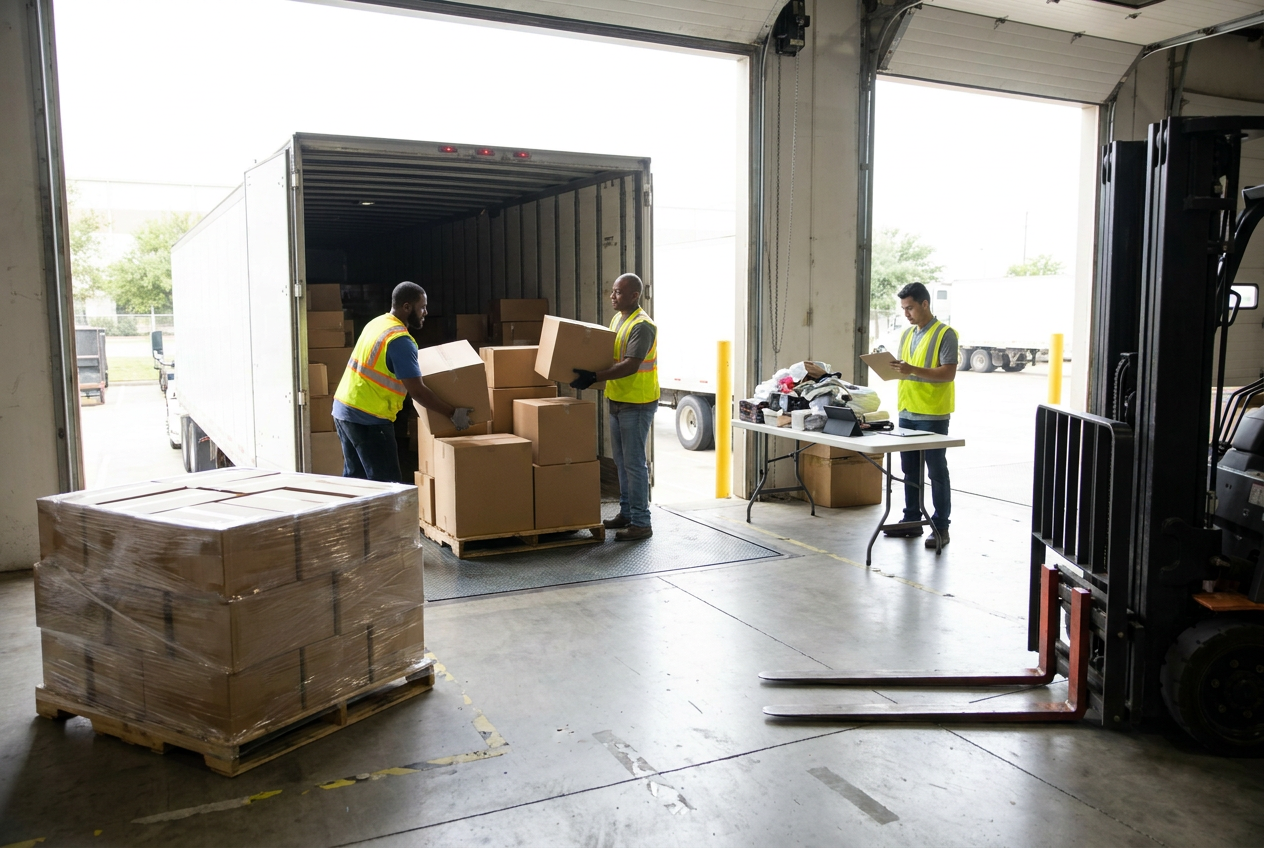
Floor loaded liquidation truckloads arrive with cartons or other shipping units stacked directly on the trailer floor rather than secured to pallets. That changes the receiving job: instead of moving complete palletized units, your crew must remove, count and organize individual cartons before most warehouse handling equipment becomes useful.
For an independent reseller, the central question is not simply whether a full trailer fits at the building. It is whether the site, staffing and receiving process can handle loose freight safely within the agreed unloading window. Carton size, weight, stability and labeling all affect that answer.
PalletCove Liquidation supplies manifested and category-level liquidation pallets and truckloads. This guide explains what to confirm before ordering, how to prepare for arrival and how to document merchandise without confusing shipping damage with the disclosed condition of as-is inventory.
What floor-loaded freight means for your operation
A floor-loaded truckload is a loading configuration, not a condition grade. Loose cartons may contain overstock, customer returns, shelf pulls or salvage. Likewise, a liquidation pallet can contain any of those merchandise types; the pallet only describes how the goods are consolidated.
| Load format | Unloading approach | Receiving implications |
|---|---|---|
| --- | --- | --- |
| Floor-loaded cartons | Remove cartons individually, often with a conveyor or carts | Count cartons and build handling units during unloading |
| Palletized truckload | Move secured pallets with suitable equipment | Verify pallet count, then reconcile cartons and units |
| Mixed-format trailer | Separate palletized freight from loose cartons | Plan both handling methods and separate count records |
| Palletized LTL shipment | Receive pallets on a less-than-truckload route | Confirm individual shipment identification and pallet condition |
LTL describes a transportation arrangement, not a merchandise grade. A full trailer describes the shipment scale; it does not establish an exact carton count, unit count or loading method. Never assume a product called a truckload is floor loaded without written confirmation.
Use the liquidation buying overview to distinguish inventory terminology, and the truckload buying guide to structure pre-order questions. If your operation cannot support loose-carton receiving, compare the handling requirements of liquidation pallets before committing.
Key takeaway: A forklift does not replace a loose-carton unloading crew. Plan the movement of each carton from trailer to receiving area before placing the order.
Condition grades and manifests: what they can establish
Condition descriptions help you evaluate merchandise, but they do not tell you how easy a trailer will be to unload. Heavy tools, small apparel cartons and irregular household goods create different workloads even when they share a condition label.
Common descriptions include:
- Overstock: excess inventory that may still have packaging or storage wear; do not assume every unit is untouched.
- Shelf pulls: merchandise removed from sales floors, potentially with labels, handling wear or incomplete packaging.
- Customer returns: previously purchased and returned goods that may be used, incomplete, damaged or untested.
- Salvage: goods that may require repair, parts recovery or disposal rather than ordinary resale.
Grade names are not universally standardized. Ask what the specific listing means by its condition grade, what testing occurred, and whether missing accessories or mixed conditions are expected. All PalletCove merchandise is sold as-is for resale.
A manifest may identify SKUs, descriptions, quantities and condition information. It may not identify every outer carton or explain which cartons contain multiple products. Confirm whether quantities refer to pieces, sets, cases or shipping cartons, and whether the document is item-level or only a category summary.
The blind versus manifested pallets guide explains what buyers can verify. For floor-loaded receiving, also ask whether carton identifiers can be matched to manifest lines. Without that connection, initial carton counting and final item reconciliation must remain separate tasks.
Estimate labor and reserve receiving space
There is no reliable universal crew size or unloading time for floor loaded liquidation truckloads. The same carton count can mean very different work when boxes vary in weight, dimensions, packaging strength and stack height.
Before scheduling staff, request the available carton count, shipment weight, packaging description and loading photographs. Treat estimates as estimates, and identify what information remains unknown.
Build a plan around four functions:
- Trailer unloading: remove accessible cartons without undermining unstable stacks.
- Transfer: move cartons to the receiving area using a suitable conveyor or carts.
- Count and triage: record cartons and separate visible exceptions.
- Staging: build stable pallets or place cartons in assigned storage lanes.
These are functions, not a fixed four-person recommendation. A heavier or more irregular load may need additional handlers, mechanical assistance and relief coverage. Use site-specific safe-lifting procedures rather than asking workers to keep pace with an unrealistic target.
If you have measured comparable unloading jobs, divide the expected carton count by your observed whole-crew throughput, then allow additional time for setup, breaks and exceptions. Do not treat an optimistic carton-per-hour assumption as a delivery commitment.
Reserve space for unprocessed cartons, counted inventory, damaged packaging and completed pallets. Keep emergency exits and pedestrian routes clear. Receiving capacity includes floor space after unloading—not just room inside the dock door.
Equipment and dock requirements
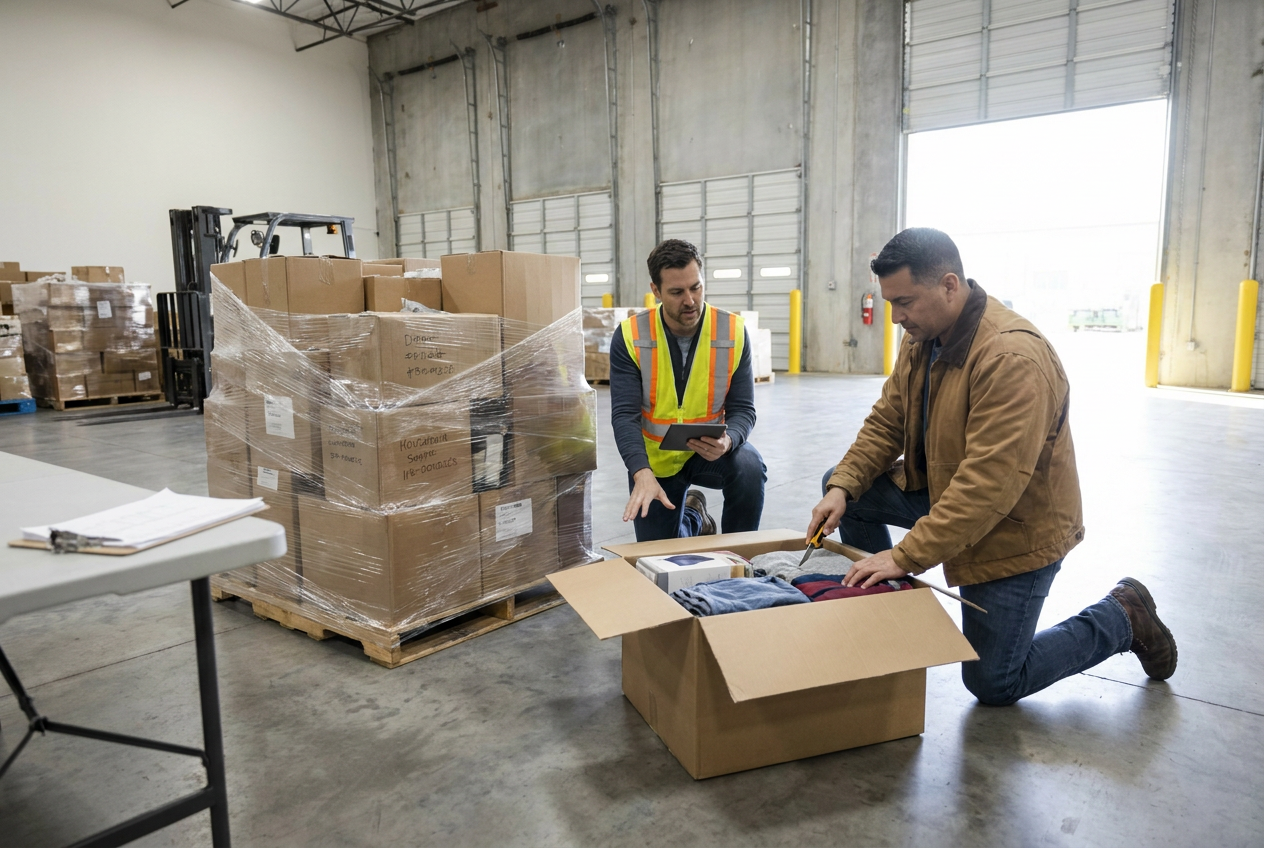
A suitable dock can simplify loose-carton transfer, but dock access alone does not make a site ready. Confirm trailer access, maneuvering clearance, door alignment, receiving-area capacity and the carrier's appointment requirements before dispatch.
Typical equipment to evaluate includes:
- A rated dock leveler or dock plate appropriate to the height difference and intended traffic.
- Trailer restraints or wheel chocks used under the facility's safe-docking procedure.
- A gravity, powered or telescopic conveyor suitable for the cartons being handled.
- Carts, empty pallets and pallet jacks for movement after cartons leave the trailer.
- A forklift for completed pallets, operated only by appropriately trained personnel.
- Lighting, gloves, suitable footwear, labeling supplies and a camera or scanner.
Confirm equipment ratings and inspect the trailer floor and transfer surfaces before entry. Forklift entry requires additional checks, including floor capacity and trailer support; do not assume it is necessary or appropriate for a loose-carton load.
A pallet jack cannot collect boxes directly from the trailer floor. A conveyor reduces carrying distance but does not eliminate lifting, counting or safe stack removal. Avoid climbing on freight or pulling supporting cartons from beneath a stack.
If you lack a dock, ask whether a safe, carrier-compatible receiving arrangement can be confirmed before purchase. Do not assume the driver will hand-unload cartons or supply your unloading equipment.
Ordering, pricing and delivery appointments
Start with the listed merchandise, then verify its physical loading format. The truckload inventory category and general merchandise category help identify relevant offers, but category membership does not establish carton count, condition or unloading requirements.
Similarly, listings such as the Amazon General Merchandise Truckload and Amazon High Piece Truckload should be reviewed individually. A high piece count is not necessarily a high carton count. Confirm current availability, documentation and loading format rather than inferring them from a product name.
PalletCove is an independent reseller and is not affiliated with, endorsed by or sponsored by any retailer named.
Understand the listed price
Free shipping is the only delivery option on every order to all 48 contiguous states. Freight is included in the listed price. Your own receiving labor, warehouse equipment, storage, testing and disposal needs remain separate operational considerations when assessing a purchase.
PalletCove covers sales tax on qualifying orders. Ask what qualifies and what business documentation is needed; have your resale certificate available where applicable. Do not assume every purchase qualifies automatically.
Payment methods are credit/debit card, ACH bank transfer and domestic bank wire. Budget around payment clearance, not merely the date you initiate payment. No manifest, condition description or advertised merchandise mix guarantees resale value or profit.
Confirm the timeline and appointment
Handling takes 1–3 business days after payment clears. Transit is typically 3–7 business days from Dallas. These are separate stages, and typical transit is not a guaranteed appointment date; review the shipping policy before ordering.
Before dispatch, confirm:
- Delivery address, receiving contact and working phone number.
- Trailer access, dock compatibility and operating hours.
- Loading format, available carton information and unloading responsibility.
- Appointment procedure and expected unloading window.
- Any receiving restrictions that could prevent safe completion.
The same free-shipping coverage applies whether you are researching liquidation pallets in Texas or liquidation pallets in Florida. Local receiving conditions still need individual confirmation.
Delivery-day inspection and carton-level receiving
Prepare your receiving log before the truck arrives. Useful fields include shipment reference, carton identifier, observed exterior condition, receiving location and any related photo number. Track carton totals separately from unit totals.
Follow a consistent sequence:
- Match the shipment. Compare delivery paperwork and shipment identifiers with your order. Record seal information if a seal is present and relevant to the shipment.
- Check safety. Follow the site's restraint procedure and assess visible hazards. Shifted freight can press against doors, so do not open them casually or stand in a potential fall path.
- Document the first view. Once access is safe, photograph the loading arrangement and visible crushing, moisture or collapsed stacks before moving affected freight.
- Count during removal. Use one controlled tally or clearly assigned counting lanes to avoid duplicates.
- Separate exceptions. Place questionable cartons in a marked area without blocking the unloading flow.
- Record delivery observations. Note visible damage or count discrepancies on the delivery record where possible. If contents remain unchecked, describe that limitation accurately.
- Reconcile contents. After unloading, open cartons in a controlled work area and compare units with the available manifest.
A carton count proves neither item completeness nor operating condition. One carton may contain multiple units, while a single product may ship in several cartons. Record missing components, substitutions and testing results separately from exterior packaging damage.
Do not rush powered-product testing at the dock. Isolate leaking containers, exposed sharp items or visibly damaged batteries and use appropriate handling procedures. Stop unloading when a condition presents an immediate safety hazard.

Returns, claims and mistakes to avoid
As-is merchandise should not be treated like ordinary retail inventory with an assumed return entitlement. Review the refund and claims policy before payment for applicable eligibility, reporting requirements, deadlines and any exclusions. Do not assume a replacement, refund or credit is available.
Distinguish among transportation damage, a documented quantity discrepancy and merchandise condition consistent with the listing. Photos and a signed delivery record can support a report, but neither establishes automatic claim approval.
If you identify an issue, promptly preserve the order reference, manifest version, delivery record, counts and clear photographs. Retain relevant packaging and affected merchandise while requesting instructions, unless safety requires otherwise. Do not send merchandise back without confirming the applicable process.
Common preventable mistakes include treating pieces as cartons, scheduling only a forklift operator, mixing uncounted inventory into stock, and signing paperwork that implies a verification you did not perform. Another is opening every carton at the trailer door: detailed inspection can obstruct unloading and compromise the count. Separate safe removal from item-level assessment.
Frequently asked questions
Can a forklift unload a floor-loaded truckload?
Not by itself when the freight consists of loose cartons. A forklift becomes useful after cartons are safely consolidated onto suitable pallets; carton handling still needs its own labor and equipment plan.
How many workers should I schedule?
Base staffing on carton weight, dimensions, count, transfer distance and the agreed unloading window. Use measured performance from comparable loads when available, and allow for breaks, irregular freight and exception handling.
Does a manifest show how many cartons will arrive?
Not necessarily: many manifests describe merchandise units rather than shipping cartons. Ask whether carton counts and carton-to-item references are available, then keep receiving counts separate from item reconciliation.
Is shipping included for floor-loaded orders?
Yes. Free shipping is the only delivery option on every PalletCove order to all 48 contiguous states, with freight included in the listed price. Confirm your receiving arrangements before dispatch.
Can customer returns be assumed to work?
No. Customer returns may be used, incomplete, damaged or untested, and all merchandise is sold as-is for resale. Evaluate the listing's disclosures and plan inspection before offering individual items to customers.
Talk to PalletCove Liquidation
Before ordering a full trailer, confirm the loading format, available manifest detail and your receiving plan. Review current inventory and contact our order desk with questions about a specific listing.
PalletCove Liquidation LLC
4820 Cove Industrial Blvd, Dallas, TX 75236
Phone: (713) 819-3904
Email: sales@palletcoveliquidation.com
Hours: Mon–Fri 8:00 AM – 6:00 PM CT, Sat 9:00 AM – 2:00 PM CT, Sun closed