
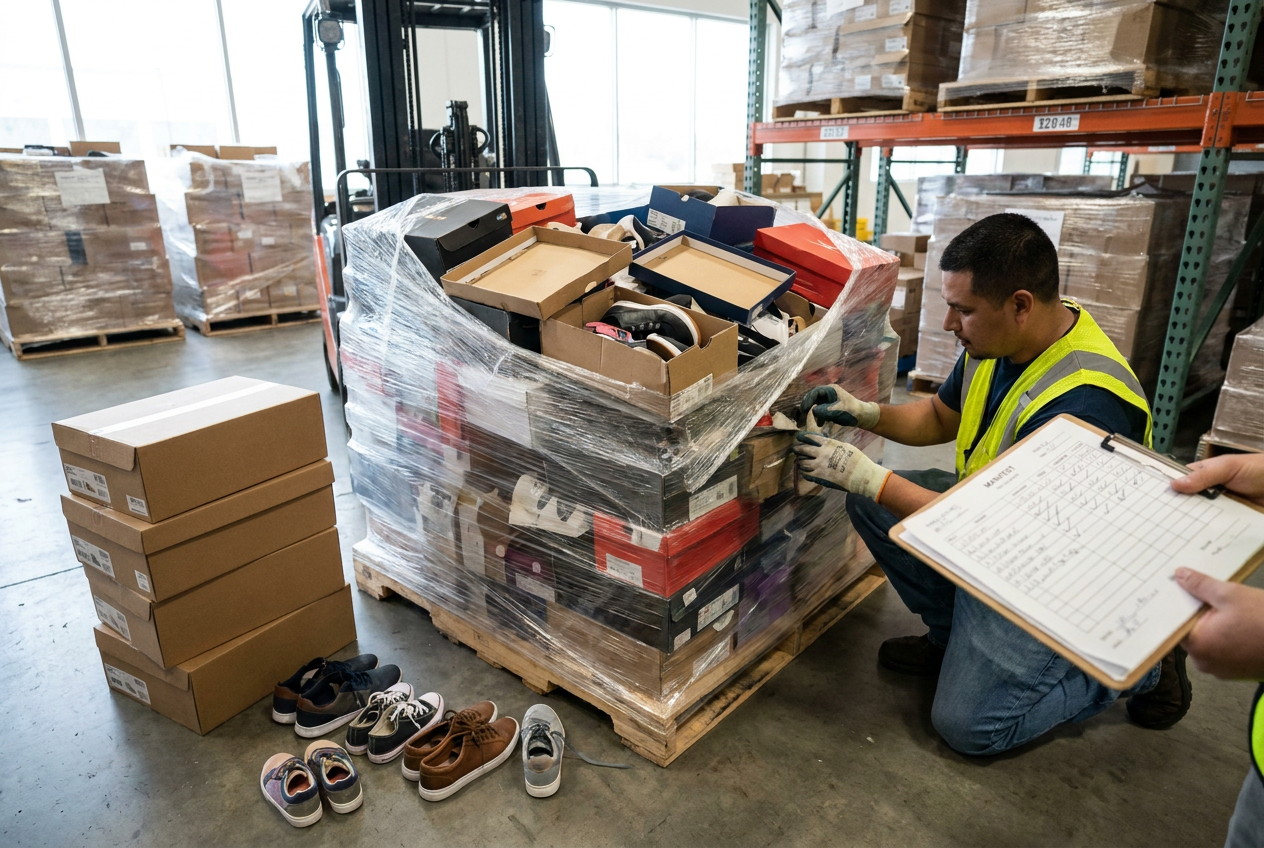
Footwear liquidation pallets need more scrutiny than a total shoe count. A load can contain recognizable styles yet fit your customers poorly because the sizes are concentrated, the pairs are incomplete, or the packaging requires extra work before listing.
For an independent reseller, the useful question is not simply “How many shoes are included?” It is “How many verified pairs match the sizes, styles, conditions, and presentation my customers buy?” That distinction affects buying decisions, sorting time, storage, and the accuracy of your listings.
PalletCove Liquidation supplies manifested and category-level liquidation pallets and full truckloads from Dallas, Texas. This guide explains how to evaluate footwear inventory without treating an assortment description, condition grade, or retail reference price as a guarantee.
Understand footwear load types before comparing offers
A footwear liquidation pallet is a bulk shipment of shoes entering secondary resale channels. Depending on the listing, it may contain overstock, shelf pulls, customer returns, salvage, or a combination. A truckload increases the scale, but not necessarily the consistency, of that inventory.
Common buying formats include:
- Manifested loads: An itemized inventory file is available. Detail varies, so confirm whether it identifies size, style, quantity, and condition.
- Category-level loads: The assortment is described broadly as footwear rather than fully itemized by shoe and size.
- Mixed general merchandise: Footwear may be one component, not the primary category.
- Full trailer loads: Larger shipments that require more receiving space, sorting capacity, and working capital.
Start with the liquidation pallets inventory hub and the guide to types of liquidation pallets to distinguish formats. The general merchandise category and truckload category are separate browsing routes; neither category name alone establishes a footwear assortment.
The Shoes Truckload listing is a footwear-specific starting point. An individual product page such as AJ1 Lightning Hook Low footwear is a different reference point: do not assume a product shown separately is included in a bulk load. Verify the actual listing and available load documentation.
Read condition grades as descriptions, not guarantees
Condition terminology is not universal across liquidation suppliers. Ask what the condition grade means for the specific load and whether it describes the shoes, the packaging, or both.
| Inventory description | What it generally indicates | Footwear checks that still matter |
|---|---|---|
| --- | --- | --- |
| Overstock | Inventory not sold through its original channel | Size concentration, age, storage effects, packaging |
| Shelf pulls | Items removed from selling displays or shelves | Try-on marks, stickers, display fading, missing boxes |
| Customer returns | Merchandise returned by customers | Wear, odor, wrong-item returns, pair matching |
| Mixed condition | More than one condition type | Whether any item-level condition detail exists |
| Salvage | Inventory needing substantial work or suitable only for limited uses | Structural damage, contamination, missing mates |
An unworn shoe can have a damaged box. A clean box can contain worn shoes. Keep merchandise condition and packaging condition separate in your inspection records.
Inspect soles, uppers, linings, closures, insoles, and seams. Look for outsole separation, brittle materials, deteriorating foam, mold, or significant odor. Cleaning does not resolve structural failure, and appearance alone does not establish usability. All PalletCove merchandise is sold as-is for resale; no condition outcome should be assumed beyond the information provided for the order.
Audit the manifest and define the counting unit
The most important manifest question is what “quantity” counts. A unit might mean one pair, one individual shoe, or one boxed item. A carton count and pallet count describe handling units, not necessarily the number of complete pairs.
Before buying, request clarification on:
- Counting basis: Are quantities pairs, individual shoes, cartons, or another unit?
- Product identifiers: Are SKU, UPC, model, color, and size included?
- Sizing system: Are sizes US, UK, or EU, and are they adult, youth, toddler, or infant?
- Width: Are narrow, standard, wide, or other width designations recorded?
- Condition detail: Is condition assigned per line or only to the load overall?
- Document scope: Is the file specific to this load, and are photos actual-load images or representative examples?
A manifest is a planning tool, not proof that every box contains the item on its label. Ask what has actually been counted or checked and what remains unverified.
Retain the listing and manifest supplied for your order. For identifier handling, the guide to UPC versus SKU matching for liquidation items explains why a warehouse identifier should not automatically be treated as a retail listing match.
Map sizes and styles to your actual customers
Size distribution matters more than a broad statement such as “assorted sizes.” An assortment can span many sizes while most pairs sit in only one or two of them. Separate men's, women's, and children's sizing before making comparisons; the same number does not represent the same fit across those groups.
Build a simple size matrix using your own sales history:
| Group | Record from the load | Compare with your business |
|---|---|---|
| --- | --- | --- |
| Adult footwear | Labeled size, system, width | Sizes customers actually purchase |
| Children's footwear | Age range and size system | Local demand and growth-related buying patterns |
| Athletic styles | Model, intended use, size count | Demand for specific activities and models |
| Boots and sandals | Style, size, season | Climate and timing of your selling season |
| Repeated styles | Pairs per style-color-size combination | Ability to sell duplicates without crowding inventory |
Do not apply one universal size-conversion chart across all brands. Preserve the original label information and use model-specific sizing information where available.
Style concentration cuts both ways. Repeated models can simplify photography and listing, but repeated slow-moving sizes can tie up storage. A diverse assortment spreads exposure across styles while increasing identification work.
Buyers exploring liquidation pallets in Texas and liquidation pallets in Florida should still assess their own customers rather than assume statewide demand. Climate, selling channel, price sensitivity, and customer demographics matter more than the destination alone.

Verify matched pairs and packaging separately
Two shoes are not necessarily a sellable matched pair. Check that there is one left and one right shoe with matching model, colorway, labeled size, and width. Compare wear and fading as well: a display shoe may look different from its boxed mate.
Set aside single shoes, mismatched sizes, and uncertain matches. Use identifiers and physical details to reconcile them, rather than forcing visually similar shoes into pairs. Do not list unresolved pairs as complete matching footwear.
The useful buying denominator is verified complete pairs that fit your selling channel—not the headline count of shoes, boxes, or manifest units.
Record packaging in separate categories:
- Original box with matching product information.
- Original box with cosmetic damage or missing lid.
- Replacement or unbranded box.
- Loose footwear without a box.
- Box whose label does not match its contents.
Original packaging can matter to collectors, gift buyers, and customers expecting presentation-ready merchandise. Loose footwear may suit another channel, provided its condition is accurately disclosed. Check laces, removable insoles, and any model-specific accessories; missing components require disclosure and may limit usability.
Do not describe replacement packaging as original. Remove or obscure old customer information on returned packaging before resale, without removing identifiers needed for traceability.
Evaluate pricing and place a documented order
Read the price together with the selling unit: one pallet, a defined lot, or a full truckload. A low apparent cost per manifest unit is not comparable to cost per verified pair if those units are counted differently.
For internal planning, divide the listed order price by the number of verified pairs suitable for your channel. Before inspection, use explicitly labeled scenarios rather than assuming all recorded units will qualify. Also budget your own sorting labor, cleaning supplies, replacement packaging, storage, selling-platform costs, and customer-return handling.
PalletCove provides free shipping as the only delivery option on every order to all 48 contiguous states. Freight is included in the listed price. Sales tax on qualifying orders is covered by PalletCove; confirm whether your order qualifies and what documentation is needed. Keep your resale certificate available where applicable rather than assuming every order has identical documentation requirements.
Follow this ordering sequence:
- Identify the specific load and confirm availability.
- Review its manifest or category description, quantities, condition information, and photos.
- Resolve questions about size distribution, pairs, packaging, and receiving requirements.
- Review the applicable terms and retain written order details.
- Pay by credit/debit card, ACH bank transfer, or domestic bank wire.
The guide to buying liquidation pallets provides a broader purchasing framework. Do not scale into a truckload until you can receive, inspect, store, and list the additional volume.
Plan shipping and delivery-day inspection
Handling takes 1–3 business days after payment clears. Transit is typically 3–7 business days from Dallas. These are separate stages; do not treat transit time as the entire payment-to-arrival period or promise customers a fixed arrival date based on typical timing.
Pallet shipments may move by LTL, meaning less-than-truckload, while larger orders may use a full trailer. Confirm the shipment arrangement and the receiving site's access, unloading equipment, staffing, and available space before dispatch. Review the free-shipping policy for applicable delivery details. Free shipping is the only delivery option; do not plan on customer pickup.
At delivery:
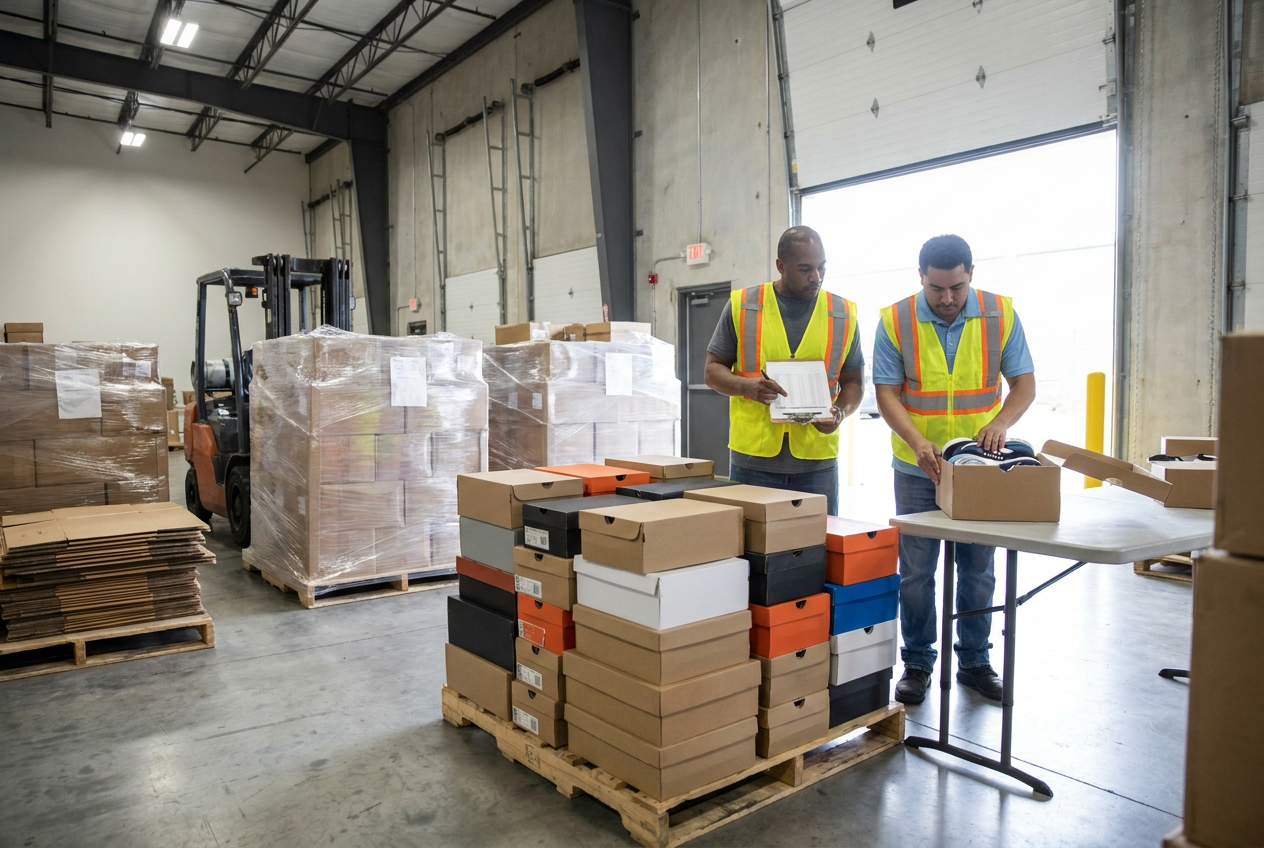
- Compare the shipment identification and visible pallet or carton count with the delivery documents.
- Photograph the load before removing wrap, including labels and visible damage.
- Record visible crushing, punctures, wet packaging, or count discrepancies on the delivery paperwork where applicable.
- Follow the applicable receiving instructions and retain delivery documents.
- During unpacking, photograph affected contents and keep their packaging while any issue is reviewed.
A delivery receipt does not replace an item-by-item intake audit. Keep questionable stock separate so damage documentation and pair counts remain traceable.
Handle claims carefully and avoid predictable mistakes
As-is resale inventory should not be treated like a conventional retail purchase with an assumed return window. Read the returns and claims policy before payment, including any applicable reporting deadlines, documentation requirements, exclusions, or authorization procedures. Do not assume a refund, replacement, or credit will be available.
If something appears inconsistent with the order, report the specific issue promptly with the order number, relevant manifest lines, counts, photos, and delivery records. Distinguish transit damage from merchandise condition and from a claimed quantity discrepancy. Do not send goods back without instructions.
Common avoidable mistakes include buying by retail reference totals, counting boxes as verified pairs, combining incompatible sizing systems, and overlooking repeated styles. Other costly errors are listing before inspection, describing all returns as unworn, and failing to reserve time for reconciliation.
PalletCove is an independent reseller and is not affiliated with, endorsed by, or sponsored by any retailer named. Retailer references do not establish guaranteed authenticity documentation, marketplace selling eligibility, or permission to make affiliation claims; verify your channel's requirements independently.
Frequently asked questions
Are footwear liquidation pallets counted in pairs?
Not necessarily. Confirm whether the listing and manifest count individual shoes, pairs, boxes, or another unit, then verify contents during intake.
Can I choose the sizes in a footwear load?
Do not assume size selection is available. Ask whether the specific load has a size-level manifest and whether any selection is offered before ordering.
Does a damaged box mean the shoes are damaged?
No, packaging and merchandise condition are separate. Inspect both shoes independently and disclose box damage or replacement packaging in your resale listing.
Is free shipping available outside Texas?
Yes. Free shipping is the only delivery option on every order to all 48 contiguous states, with freight included in the listed price. Handling is 1–3 business days after payment clears, followed by typically 3–7 business days in transit from Dallas.
Can customer-return footwear be resold as new?
A customer-return designation alone does not establish the condition required for a new listing. Inspect each pair, follow your selling platform's definitions, and disclose wear, missing components, and packaging issues accurately.
Talk to PalletCove Liquidation
Before choosing a load, explain your customers' sizes, preferred styles, selling channel, and receiving capacity. Ask what documentation is available for the specific inventory rather than relying on a general category description.
PalletCove Liquidation LLC
4820 Cove Industrial Blvd, Dallas, TX 75236
Phone: (713) 819-3904
Email: sales@palletcoveliquidation.com
Hours: Mon–Fri 8:00 AM – 6:00 PM CT, Sat 9:00 AM – 2:00 PM CT, Sun closed
To discuss load details, contact our order desk, or review current inventory for available purchasing options.