
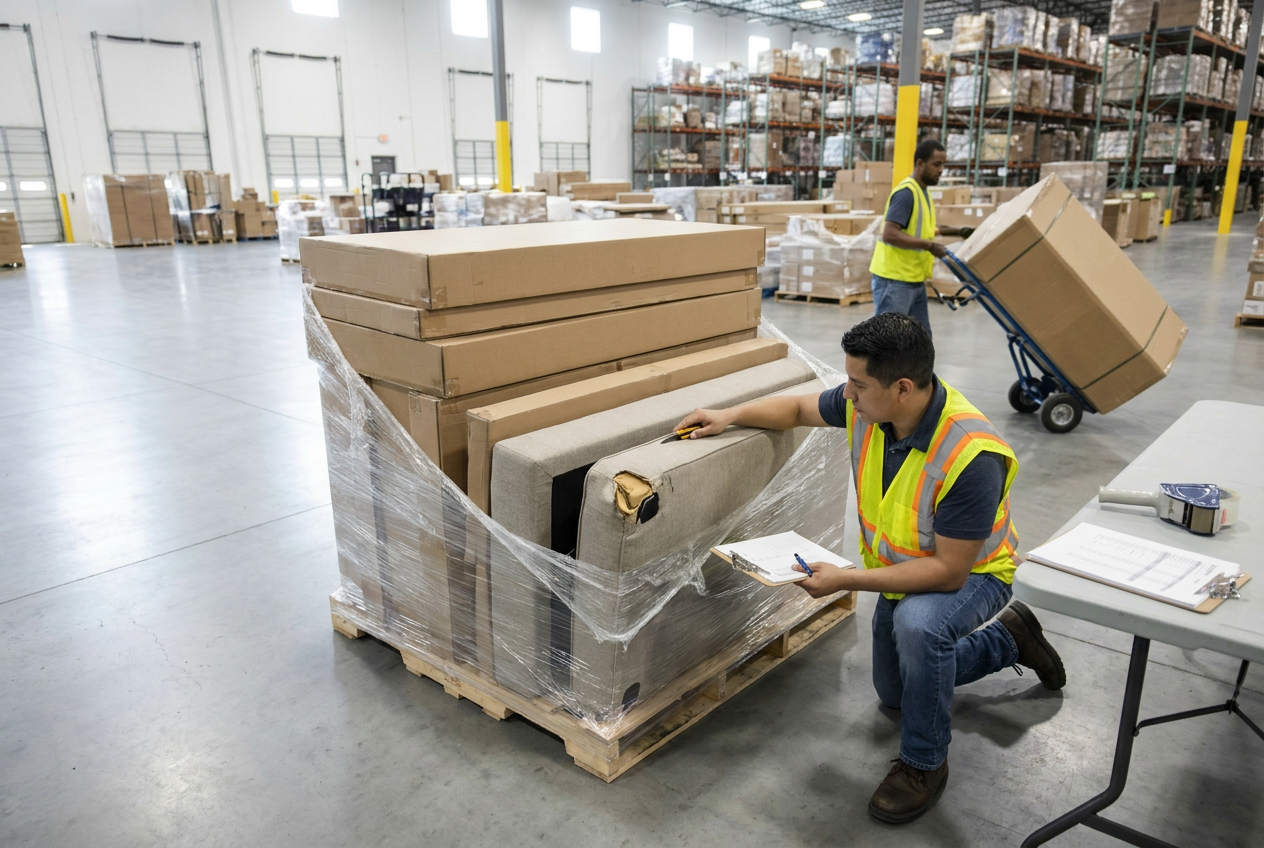
Furniture liquidation pallets can contain inventory that looks manageable on a manifest but becomes difficult once cartons are opened. A missing bed rail, cracked tabletop or sofa with persistent odor can change the handling plan for an entire purchase. Bulky goods also consume storage space while you identify parts, assemble products and arrange customer handoffs.
For an independent reseller, the central question is not simply how many pieces a load contains. It is how many complete, safely saleable items your operation can inspect, prepare, store and deliver without creating a backlog. This guide examines those tradeoffs and explains how ordering and delivery work at PalletCove Liquidation.
Understand furniture load types and condition language
A furniture liquidation pallet is a shipping unit containing furniture-related merchandise offered for resale. A pallet may hold several small items, one bulky item or cartons belonging to multiple sets. A truckload occupies a larger shipping allocation, potentially a full trailer; neither term establishes how many complete furniture units are included.
Start with the liquidation pallets hub and the guide to liquidation pallet types to distinguish packaging format from inventory composition. A manifested load provides item-level information to the extent stated in its listing. A category-level load identifies a merchandise category without necessarily providing a detailed itemized inventory.
Condition descriptions also need careful interpretation:
| Description | What it generally signals | Furniture-specific question |
|---|---|---|
| --- | --- | --- |
| Overstock | Excess inventory rather than a customer return stream | Has storage or handling damaged cartons or surfaces? |
| Shelf pulls | Merchandise removed from selling stock or displays | Are display hardware, tags or accessories missing? |
| Customer returns | Merchandise previously returned by customers | Was it assembled, used, damaged or repacked incompletely? |
| Salvage | Inventory requiring substantial evaluation, repair or parts recovery | Is there a safe, practical use for the components? |
| Condition grade | A seller-defined classification | What inspection and completeness checks support that grade? |
These are general industry descriptions, not guarantees about a particular load. Do not assume that an A, B or other condition grade has a universal meaning. All PalletCove merchandise is sold as-is for resale.
Read the manifest as a parts-and-space document
A furniture manifest should help you understand what is being counted. A quantity of six could mean six complete chairs, six cartons or six components, depending on the listing. Ask before treating a row count as a finished-product count.
For each major item, look for:
- Model number, SKU or UPC that distinguishes similar versions.
- Quantity and whether the count refers to units, cartons or sets.
- Carton sequence, such as “1 of 3,” for multi-box products.
- Packed and assembled dimensions, where available.
- Stated condition, inspection scope and known exceptions.
- Included cushions, legs, rails, slats, hardware and instructions.
- Photos tied to the offered inventory rather than only reference images.
The pallet purchasing guide provides a broader buying framework. For furniture, add a carton-matching worksheet: record identifiers, expected companion boxes and unresolved questions before ordering.
Browse general merchandise inventory and truckload inventory without assuming either category contains furniture in every offering. Likewise, the HD GM Truckloads Pallets listing and WM GM Truckloads Pallets listing are starting points for reviewing their stated contents, not evidence that a specific furniture model is available. The current listing and load-specific documentation should drive the decision.
PalletCove is an independent reseller and is not affiliated with, endorsed by or sponsored by any retailer named.
Check flat-pack completeness before planning assembly
Flat-pack furniture saves space while boxed, but completeness can be difficult to establish without opening cartons. A sealed-looking box is not proof of original contents, particularly in customer returns.
Separate completeness checks from assembly. First match cartons to models and compare panels, hardware and fittings with the manufacturer's parts list when available. Then inspect the components before spending time building an item.
- Match all cartons belonging to the same unit and finish.
- Check panel edges, drilled holes and attachment points for damage.
- Count model-specific brackets, cams, bolts and structural connectors.
- Confirm that instructions and required safety components are present.
- Record missing parts and determine whether appropriate replacements are obtainable.
- Assemble only when the parts and condition justify the labor.
A generic screw assortment cannot resolve every hardware shortage. Fastener length, thread, strength and attachment geometry matter. Improvised substitutions at load-bearing joints can make furniture unsafe.
Pay particular attention to stripped particleboard holes, swollen fiberboard, cracked rails and damaged cam-lock pockets. Disassembly and reassembly can weaken already compromised joints. Keep incomplete sets clearly labeled so components do not migrate between similar models.

Evaluate upholstery beyond visible surface damage
Upholstered furniture requires a different inspection process from boxed tables or shelving. Fabric appearance alone does not establish the condition of the frame, cushions or internal supports.
Inspect exposed surfaces, seams, cushion undersides, legs and accessible frame areas. Look for tears, abrasion, discoloration, water marks, loose attachments and uneven support. Check odors before applying fragrances or cleaning products that could obscure the underlying issue.
Distinguish a removable surface mark from evidence of moisture, mold or pests. Suspect items should be isolated from clean inventory pending appropriate assessment. Do not assume routine cleaning makes every upholstered item suitable for resale; check applicable state and local requirements for used upholstered goods, sanitation and labeling.
Recliners and sleeper sofas add mechanical inspection work. Evaluate accessible mechanisms cautiously, following manufacturer instructions where available and keeping hands away from pinch points. Electrical features need an appropriate safety check rather than a quick demonstration alone.
Before listing any furniture, check applicable recall information using the model identifiers you can establish. Do not offer recalled or unsafe products for sale. Missing labels and uncertain model identity can complicate that review and should influence your buying decision.
Price the workload, not just the pallet
The listed PalletCove price includes freight. Free shipping is the only delivery option on every order to all 48 contiguous states. That simplifies the supplier-to-buyer shipping calculation, but it does not eliminate your own preparation, storage or downstream delivery work.
Build an internal worksheet with separate entries for:
- Listed inventory purchase price.
- Receiving, sorting and carton-matching labor.
- Assembly, inspection and approved replacement parts.
- Cleaning materials and packaging for customer handoff.
- Storage space occupied during evaluation and marketing.
- Your local delivery labor, vehicle use and equipment.
- Disposal or recycling of unusable material.
Track both labor hours and calendar time. A chair may take little hands-on work but occupy a staging area for days while you source a missing component. Conversely, a complete cabinet can require substantial assembly time immediately.
For an internal cost allocation, divide total purchase and preparation spending by the number of units actually cleared for sale—not the manifest's carton count. That calculation describes your costs; it does not establish market value or guarantee a margin.
Furniture liquidation pallets should be evaluated by complete, safely saleable units and handling capacity—not carton counts alone.
A sensible first purchase fits your inspection and storage capacity even if several units remain unresolved. Avoid building a budget that assumes every item is complete, immediately saleable or repairable.
Order with receiving requirements already settled
Before committing, confirm the offered load, available manifest, condition description, carton counts and known inspection limitations. Save the listing and relevant order communications so you have a record of what was represented.
Payment methods are credit/debit card, ACH bank transfer and domestic bank wire. Handling time is 1–3 business days after payment clears; transit is typically 3–7 business days from Dallas. These are separate stages, so plan receiving availability around both rather than treating transit time as the entire order timeline.
Sales tax on qualifying orders is covered by PalletCove. Ask which documentation applies to your order and whether a resale certificate is required for your circumstances; keep appropriate business and resale records.
Free shipping is the only delivery option, with freight included in every listed order price throughout the 48 contiguous states. Review the shipping policy and confirm receiving arrangements before payment. Do not assume shipping includes indoor placement, assembly or removal of packaging.
An LTL shipment generally shares trailer capacity with other freight, while a full trailer requires planning for the larger receiving volume. Confirm the shipment format, unloading arrangements, vehicle access and available staging space rather than guessing from the product name.
Whether you are reviewing liquidation pallets in Texas or liquidation pallets in Florida, the same free-shipping coverage applies. Destination access and your ability to receive bulky goods still deserve advance attention.
Document delivery and understand claims limits
Prepare a clear receiving area, a camera and a copy of the order documents. Inspect safely before breaking down the load, and avoid moving unstable freight without suitable equipment.
On delivery day:
- Compare identifiable pallet and carton counts with the shipping paperwork.
- Photograph the load, labels and visible wrapping condition.
- Document crushed corners, punctures, moisture or displaced cartons.
- Note observable discrepancies on delivery paperwork when possible and retain a copy.
- Preserve relevant packaging and identifiers while checking the contents.
- Contact PalletCove promptly with the order number, specific issue and supporting evidence.
Distinguish shipping damage from pre-existing merchandise condition and a missing carton from an incomplete product inside a carton. These issues can require different evidence. Do not guess at the cause when reporting what you found.
As-is inventory is not the same as ordinary retail merchandise with an assumed return privilege. Read the refund policy before purchasing to understand applicable eligibility, procedures and deadlines. Reporting an issue does not itself guarantee a return, replacement, credit or refund.
The guide to documenting liquidation manifest discrepancies can help organize the record. Keep carton labels, item identifiers and photographs connected to the same claim rather than submitting an unexplained image collection.
Plan storage and your own local customer deliveries
PalletCove's included shipping concerns the order sent to you. Your later deliveries to resale customers are a separate operational responsibility and should be planned before you buy bulky inventory.
Measure storage aisles, doors and work areas. Leave room to inspect and assemble furniture without blocking exits or trapping finished pieces behind unresolved cartons. Protect upholstery from floor contact and dirty handling surfaces, and follow safe stacking practices rather than using fragile cartons as structural supports.
For customer deliveries, establish:
- A defined service area and appointment process.
- Vehicle capacity and safe load-securing methods.
- Enough trained help for the item's size and weight.
- Doorway, stair, elevator and turning-clearance checks.
- A written scope for placement and any assembly you offer.
- Condition photos and a documented customer handoff.
Common mistakes include assembling everything immediately, mixing hardware between models, advertising before checking completeness and measuring only the furniture—not the route into the customer's home. Another is buying a full truckload when the operation lacks space to separate incoming, incomplete and ready-to-sell inventory.

Frequently asked questions
Are furniture liquidation pallets always manifested?
No. PalletCove sells manifested and category-level inventory, so review the documentation attached to the specific offer. A manifest also needs interpretation: listed quantities may not represent complete assembled units.
Does a condition grade guarantee all hardware is included?
No. A condition grade only conveys the scope defined for that listing and does not automatically establish completeness. Ask whether cartons were opened, parts counted or products assembled.
How does shipping work for furniture orders?
Free shipping is the only delivery option on every order to all 48 contiguous states, and freight is included in the listed price. Handling takes 1–3 business days after payment clears, followed by transit typically taking 3–7 business days from Dallas. Confirm receiving arrangements before ordering.
Can I return furniture that needs more repair than expected?
All merchandise is sold as-is for resale, so do not assume unexpected repair work creates return eligibility. Review the applicable refund policy before purchasing and document any specific discrepancy promptly. Any request is subject to the applicable terms.
Should I assemble furniture before advertising it?
Assembly can reveal missing parts and structural problems, but it also uses labor and storage space. Decide item by item, and describe accurately whether the product is assembled, inspected, incomplete or still boxed. Never represent an unchecked item as verified complete or safe.
Talk to PalletCove Liquidation
Discuss load documentation, condition descriptions and receiving requirements before committing to furniture inventory. Share your storage limits, assembly capacity and intended resale channel so the conversation addresses your actual operation.
PalletCove Liquidation LLC
4820 Cove Industrial Blvd, Dallas, TX 75236
Phone: (713) 819-3904
Email: sales@palletcoveliquidation.com
Hours: Mon–Fri 8:00 AM – 6:00 PM CT, Sat 9:00 AM – 2:00 PM CT, Sun closed
For order-specific questions, contact our order desk. Review current inventory for available listings and their stated contents.