
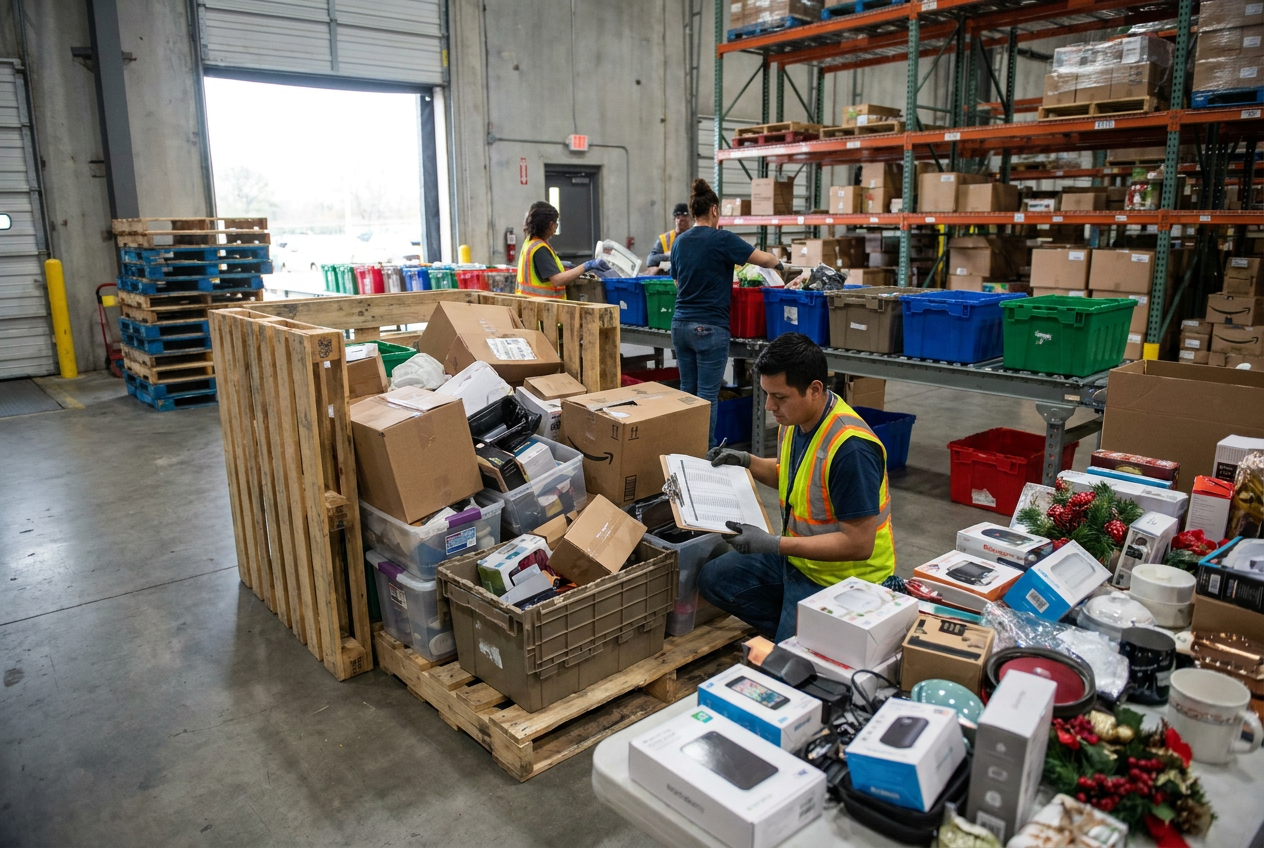
General merchandise liquidation pallets can contain several product categories in one load, giving independent resellers a broader assortment than a single-category purchase. That variety also creates work: identifying unfamiliar products, checking completeness, separating conditions and finding suitable storage for items with different handling needs.
A headline item count does not tell you whether that work fits your operation. A load with many repeated SKUs creates a different challenge from one with hundreds of unique products. Seasonal timing, bulky packaging and testing requirements can matter more than the number of pieces advertised.
PalletCove Liquidation supplies manifested and category-level liquidation pallets and full truckloads from Dallas, Texas. This guide explains how to assess the mix before ordering, build a receiving plan and distinguish documented load information from assumptions.
Understand the load type and condition language
General merchandise describes a mixed assortment rather than a standardized inventory specification. Depending on the listing, a liquidation pallet might combine household goods, small appliances, accessories, toys, textiles or other categories. The actual listing and available manifest—not the category name—should guide your decision.
Start with the liquidation pallets hub to understand the inventory format, then use the guide to pallet types to distinguish assortment structures.
- Manifested loads: Have an inventory document, with detail varying by load. A manifest is not automatically an item-by-item condition inspection.
- Category-level loads: Are described principally by category or assortment. Do not assume exact SKUs or quantities beyond what the listing states.
- Single-category pallets: Concentrate on one merchandise family, which may simplify workflow but increase dependence on one market.
- Mixed truckloads: Increase receiving volume and may contain different pallet compositions. Ask whether documentation covers the whole load or individual pallets.
Condition grade needs separate attention. Overstock generally describes excess inventory; shelf pulls describe merchandise removed from selling shelves. Neither term alone establishes packaging quality or completeness. Customer returns may have been opened, used, damaged or returned for reasons that are not documented. Salvage can require repair, parts recovery or disposal and should not be treated as ready-to-list stock.
Grading systems differ between suppliers and loads. Ask what a grade means for the specific purchase, whether testing occurred and what evidence supports any condition statement. All PalletCove merchandise is sold as-is for resale; no general condition label guarantees an individual item's condition.
Read the manifest for concentration, not just quantity
A useful manifest review starts with the general merchandise category, but moves quickly to load-specific details. Request the available manifest and its preparation date, and establish whether it represents the offered load or is only illustrative.
Look for SKU or UPC identifiers, descriptions, quantities, models, sizes, condition notes and packaging information. Blank fields are unknowns, not evidence of completeness. Also clarify whether “quantity” counts individual units, multipacks, cases or sets.
| Measure | How to check it | Why it matters |
|---|---|---|
| --- | --- | --- |
| Unique SKU count | Group matching identifiers and model variations | Indicates listing and identification workload |
| Largest SKU share | Divide the largest SKU quantity by total units | Shows dependence on one product |
| Top-five SKU share | Add the five largest SKU quantities, then divide by total units | Reveals concentration hidden by category variety |
| Category balance | Group units by merchandise family | Helps match stock to selling channels |
| Missing identifiers | Count lines without usable product identification | Flags research work and uncertainty |
| Bulky-item share | Review dimensions and packaging where available | Helps estimate storage and handling needs |
For illustration, a hypothetical 600-unit load containing 240 identical organizers has 40% of its units in one SKU. It may be easy to create that listing, but demand must support repeated sales. A different 600-unit load with 450 distinct SKUs could require far more research and photography. Neither structure is inherently better.
Compare the Amazon General Merchandise Truckload listing with the Amazon High Piece Truckload listing using their current descriptions and available documentation. A product name alone does not establish assortment, condition or suitability. PalletCove is an independent reseller and is not affiliated with, endorsed by or sponsored by any retailer named.
The useful count is not simply how many items arrive, but how many your operation can identify, process, store and responsibly offer for resale.

Measure seasonal exposure against your processing calendar
Seasonal exposure includes more than holiday decorations. Outdoor goods, school supplies, cold-weather accessories and occasion-specific products can have concentrated selling windows. Model changes, dated packaging and expiring consumables create additional timing constraints.
Separate the assortment into year-round products, season-dependent products and items needing further identification. Then work backward from the relevant selling window:
- Allow for payment clearance, handling and transit.
- Reserve receiving and reconciliation time.
- Estimate testing, cleaning, photography and listing time.
- Consider whether unsold inventory can remain stored until another selling window.
Do not assume arrival during a season means the inventory will be ready to sell during that season. A processing backlog can make otherwise timely goods late.
Review current comparable listings and actual sold-item evidence where available, using matching model, condition and completeness. Asking prices alone are weak evidence of demand. If seasonal goods lack dates or clear descriptions, ask for clarification rather than assigning them a favorable selling window.
Budget sorting labor and storage together
Sorting labor depends on product diversity, not merely load size. Ten identical sealed packages may follow one workflow; ten different returned electrical products may each need separate identification, completeness checks and safe evaluation.
A practical labor estimate separates tasks:
- Receiving, photographing and counting pallets or cartons.
- Identifying products and reconciling manifest lines.
- Checking packaging, accessories and visible condition.
- Testing only where appropriate equipment and competence are available.
- Cleaning, photographing, labeling and creating listings.
- Segregating unsuitable items for lawful recycling or disposal.
Use your own timed batches to estimate hours. For example, 300 items at an assumed six minutes each require 30 hours for that task alone; receiving, difficult exceptions and listing work may be additional. This is planning arithmetic, not a processing benchmark.
Storage capacity must include more than incoming pallet footprints. Reserve space for unpacked goods, inspection benches, packaging materials, listing-ready inventory and unresolved discrepancies. Do not stack fragile cartons simply because vertical space exists. Check rack capacity and use suitable material-handling equipment.
Keep textiles clean and dry, isolate leaking or damaged goods, and handle batteries or chemicals according to applicable safety requirements. Before offering products for resale, check relevant recalls, labeling obligations, expiration dates and marketplace restrictions.
The truckloads category is useful when evaluating a larger purchase, while the truckload buying guide provides a framework for scaling receiving capacity. A full trailer is appropriate only when the unloading, labor and storage plan supports the volume.

Evaluate the listed price against the work required
PalletCove's listed price includes freight. Free shipping is the only delivery option on every order to all 48 contiguous states. There is no separate freight amount to add when comparing PalletCove listings.
Your internal acquisition decision should still account for operational costs: labor, cleaning supplies, replacement packaging, storage, selling-platform costs and appropriate disposal. These are business expenses, not evidence that any particular load will generate a profit.
Calculate listed price divided by stated unit count only after confirming what a unit means. That average can help compare similarly documented loads, but it does not establish the value or usability of individual items. An assortment containing incomplete goods cannot be evaluated as though every piece is ready to sell.
Build a conservative worksheet with documented quantities, unknown-condition items, estimated processing hours and available storage. Avoid treating an advertised retail total as collectible revenue. PalletCove does not promise profit, resale value or percentages of retail.
PalletCove covers sales tax on qualifying orders. Review the sales tax policy for applicable requirements; do not assume every purchase qualifies. Have your resale certificate available if needed for your business's purchasing documentation.
Order with a clear shipping and receiving plan
Before payment, confirm the exact listing, load format, available inventory documentation and stated condition grade. Save the product description and communications so your receiving team has the same reference information used for the purchase.
PalletCove accepts credit/debit card, ACH bank transfer and domestic bank wire. Handling takes 1–3 business days after payment clears; transit is typically 3–7 business days from Dallas. These are separate stages, and the transit range is typical rather than a guaranteed arrival date.
Palletized shipments may move by LTL, or less-than-truckload transportation, while larger orders may occupy a full trailer. Confirm the shipment format, pallet dimensions where available, delivery contact and the unloading arrangements your location can safely support. Do not assume the driver will move merchandise inside or provide your site's handling equipment.
The same included-freight rule applies to liquidation pallets in Texas and liquidation pallets in Florida, as it does throughout the 48 contiguous states. Consult the shipping policy before ordering and ensure someone authorized to inspect and receive the shipment will be present.
Inspect on delivery and document issues promptly
Delivery-day inspection should distinguish external shipping observations from the detailed merchandise assessment that follows unloading. Prepare a camera, the order record and available manifest before the shipment arrives.
- Compare the shipment identifiers and visible pallet count with the delivery paperwork.
- Photograph the load before disturbing wrapping, including all accessible sides and labels.
- Note visible damage, shifted cartons or count discrepancies accurately on the delivery receipt before signing, where applicable.
- Retain relevant wrapping, labels and packaging while documenting an issue.
- Reconcile contents against the available manifest and create an itemized discrepancy record.
- Report concerns promptly through the process and deadlines in the applicable policy.
If cartons are opaque or contents are not yet counted, avoid claiming a complete item-level inspection. Record what you actually observed. Separate potential transport damage, quantity discrepancies and product-condition findings rather than combining everything into one unsupported complaint.
All merchandise is sold as-is for resale. That does not establish a right to return a load or receive compensation for any particular issue. Read the refund and claims policy before purchase for eligibility, exclusions, evidence requirements and deadlines, and obtain any required authorization before returning goods.
For a more structured record, follow the guide to documenting liquidation manifest discrepancies. Supporting evidence helps explain a concern; it does not guarantee a claim outcome.
Frequently asked questions
Are general merchandise liquidation pallets suitable for beginners?
They can suit resellers who can handle several categories, but variety increases research and sorting work. Start with a load whose documented volume, condition and storage requirements fit your actual capacity rather than choosing the largest item count.
Does a manifest mean every item is tested and complete?
No. A manifest is an inventory document, and its fields may not include testing or completeness information. Ask which statements are supported by item-level inspection and treat missing information as unknown.
Is a high-piece load better than a lower-count load?
Not automatically. High quantities can include duplicate SKUs, small components or products requiring substantial work. Compare concentration, unit definitions, seasonal timing and processing requirements before using count as a deciding factor.
How much does shipping cost, and how long does delivery take?
Free shipping is the only delivery option on every PalletCove order to all 48 contiguous states, with freight included in the listed price. Handling is 1–3 business days after payment clears, followed by typical transit of 3–7 business days from Dallas.
What mistakes most often undermine a load assessment?
Common mistakes include treating retail totals as expected revenue, overlooking duplicate SKUs and assuming a condition grade guarantees usability. Others include buying seasonal goods too late, underestimating sorting hours and filling storage space needed for inspection and outbound orders.
Talk to PalletCove Liquidation
Bring your category preferences, receiving setup, available storage and processing capacity to the conversation. To clarify an assortment before ordering, contact our order desk, or review current inventory for available listings and load-specific details.
PalletCove Liquidation LLC
4820 Cove Industrial Blvd, Dallas, TX 75236
Phone: (713) 819-3904
Email: sales@palletcoveliquidation.com
Hours: Mon–Fri 8:00 AM – 6:00 PM CT, Sat 9:00 AM – 2:00 PM CT, Sun closed.