

Handbag liquidation lots need a different buying process from generic apparel loads. A bag can look clean in an exterior photograph while hiding a separating lining, sticky interior coating, broken zipper or missing shoulder strap. Those details affect whether it can be listed promptly, needs repair or should be withheld from sale.
For an independent reseller, the useful question is not simply how many handbags are included. It is how much of the assortment can be accurately identified, inspected, prepared and matched to your sales channel. Material, functional hardware, style duplication and packaging deserve as much attention as the lot price.
PalletCove Liquidation supplies manifested and category-level liquidation pallets and full truckloads from Dallas, Texas. This checklist explains what to verify before buying, how to organize receiving and where uncertainty should change your purchasing decision. All merchandise is sold as-is for resale; neither a manifest nor a condition label guarantees individual-item condition.
1. Define the lot before comparing offers
A handbag liquidation lot is a bulk assortment offered through the secondary market rather than as individually selected retail purchases. It may contain handbags alone or a broader accessory mix, depending on the listing. Confirm whether wallets, wristlets, cosmetic cases and detachable accessories count toward the advertised unit total.
Common purchasing formats include:
- Manifested lot: An assortment accompanied by an inventory record. The detail may range from broad descriptions to item identifiers and quantities.
- Category-level lot: Merchandise described primarily by category, with less item-level visibility. Do not assume that every unit is the same type of bag.
- Liquidation pallet: A palletized shipment whose unit count, carton count and dimensions depend on the specific load.
- Truckload: A larger shipment that may fill a full trailer. Truckload is a shipping scale, not a condition grade or assurance of uniform contents.
Use the liquidation pallets hub to understand the broader inventory format, then compare the definitions in the types of liquidation pallets guide. The buying liquidation truckloads guide is useful when storage, receiving space and sorting labor become load-level decisions.
Do not infer handbag availability from an adjacent department. Review the general merchandise category and new arrivals category against each listing’s actual description. The Macy’s Textile Truckload listing and Shoes Truckload listing are adjacent-category references, not evidence that either includes handbags.
PalletCove is an independent reseller and is not affiliated with, endorsed by or sponsored by any retailer named.
2. Read condition grades and manifests together
Condition terminology is not universally standardized. Ask what the seller means by each condition grade and whether it applies to the whole load or only describes its general source.
| Description | What it generally indicates | Handbag-specific checks |
|---|---|---|
| --- | --- | --- |
| Overstock | Excess inventory that did not sell through its original channel | Storage creases, coating deterioration, missing packaging and repeated styles |
| Shelf pulls | Merchandise removed from displays or selling floors | Handle wear, scuffs, fading, tag residue and missing straps |
| Customer returns | Merchandise returned after purchase for varying reasons | Odor, interior stains, closure failures and incomplete accessories |
| Mixed condition | Multiple condition types within one assortment | Whether the mix is documented and whether any units were individually inspected |
| Salvage | Merchandise designated for substantial repair, parts recovery or other limited use | Structural damage, delamination, broken hardware and contamination |
These descriptions help frame inspection; they are not promises about any particular unit. A retail tag does not establish that a bag is unused, and original packaging does not establish functionality.
What to request in a manifest
Look for item descriptions, quantities, identifiers where available, material information, stated condition and notes about missing components. Ask whether photographs show the actual lot or representative merchandise, and whether listed quantities are exact or estimated.
Reconcile accessory sets carefully. A handbag with a removable pouch might be recorded as one set or multiple pieces. A manifest’s retail reference is not a verified resale price. The blind versus manifested pallets guide explains why an inventory list improves visibility without eliminating uncertainty.
3. Inspect material, closures and interior wear
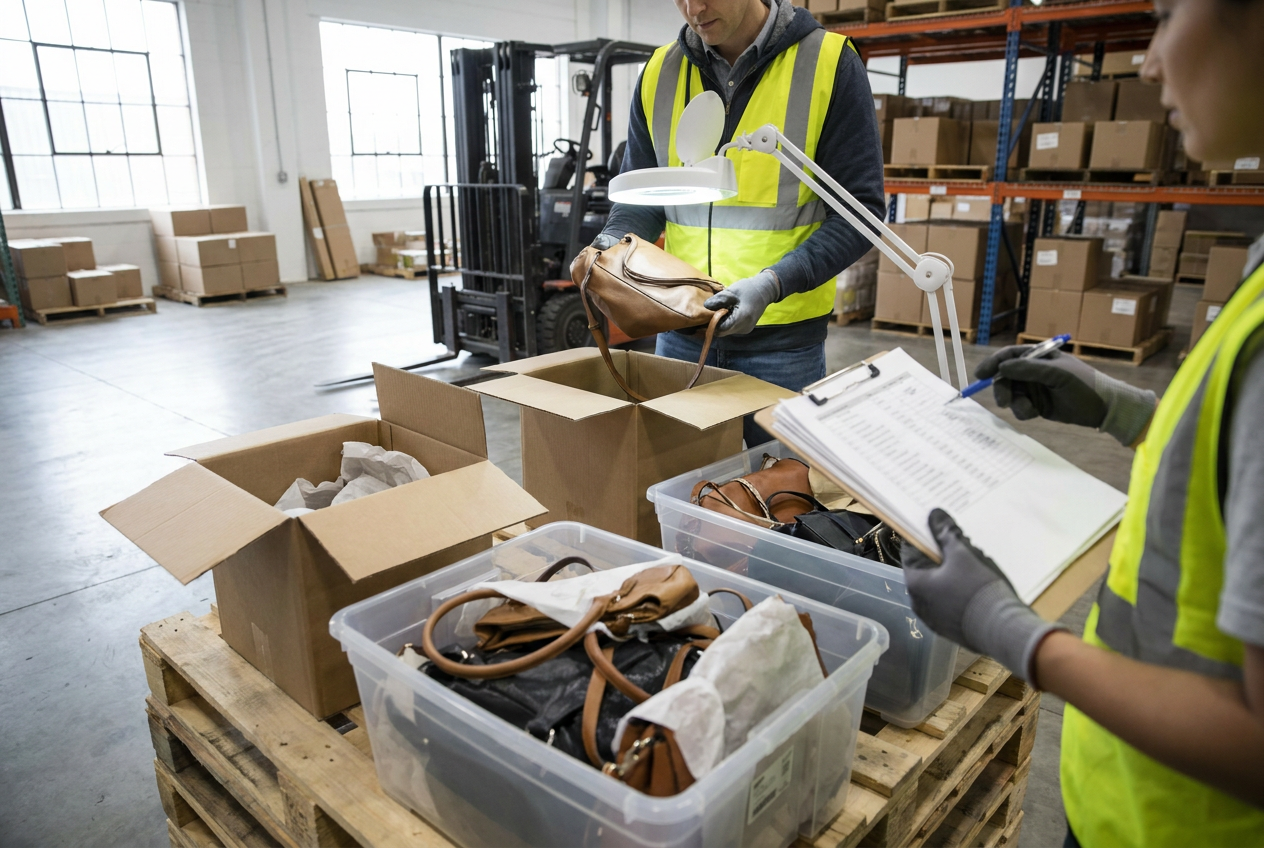
A usable inspection process follows the same sequence for every bag. Request close-up photographs of high-risk areas before purchase when available, then repeat the checks during receiving. Do not generalize from a few attractive top-layer units to an entire pallet.
Material and structure
Read composition labels rather than identifying leather by appearance alone. Leather, coated fabric, polyurethane, PVC, nylon and canvas have different cleaning requirements and failure modes.
- Check synthetic coatings for peeling, tackiness, bubbling and cracking at folds.
- Inspect leather for drying, deep scratches, staining and split edges.
- Look for discoloration, abrasion and seam separation on fabric bags.
- Examine piping, corners, base panels and edge paint, where friction concentrates.
- Check strap anchors and handle attachments for torn stitching or stretched material.
Do not assume cleaning will fix a defect. Surface dirt may be removable; a failing coating or weakened strap attachment is a different problem. Test any suitable cleaning method in an inconspicuous area and avoid treating unknown materials aggressively.
Closures and hardware
Run each zipper through its full travel without forcing it. Check for missing teeth, separated tracks and sliders that move without closing the zipper. Test snaps, magnetic closures, turn locks and buckles for alignment and secure attachment.
Count removable straps, adjustment pieces and other included components. A missing crossbody strap changes the item description even if the short handles remain usable. Inspect metal for sharp edges, corrosion and plating loss, and separate cosmetic wear from functional failure.
Lining, pockets and odor
Open every compartment. Inspect pocket bottoms, lining seams and zipper ends for tears, ink marks, residue and trapped debris. Check whether internal coatings or adhesive areas feel sticky.
Persistent smoke, fragrance or musty odor may require additional handling and may not be removable. Isolate visibly moldy or otherwise suspect merchandise rather than storing it with clean inventory. Use care around unknown contents, and never present a surface wipe as proof of sanitation.
A handbag lot should be evaluated as a collection of functional accessories—not just a count of attractive exterior shells.
4. Measure style duplication and packaging quality
Duplication can simplify photography and listing work, but it can also concentrate inventory in a narrow style. Count exact duplicates separately from similar silhouettes. A tote, satchel and crossbody bag serve different needs even when their colors match.
Build a style matrix using silhouette, dimensions, color, material, strap configuration and closure type. Then identify how many units share the same combination. Compare that concentration with your own sales history rather than assuming a large quantity means broad demand.
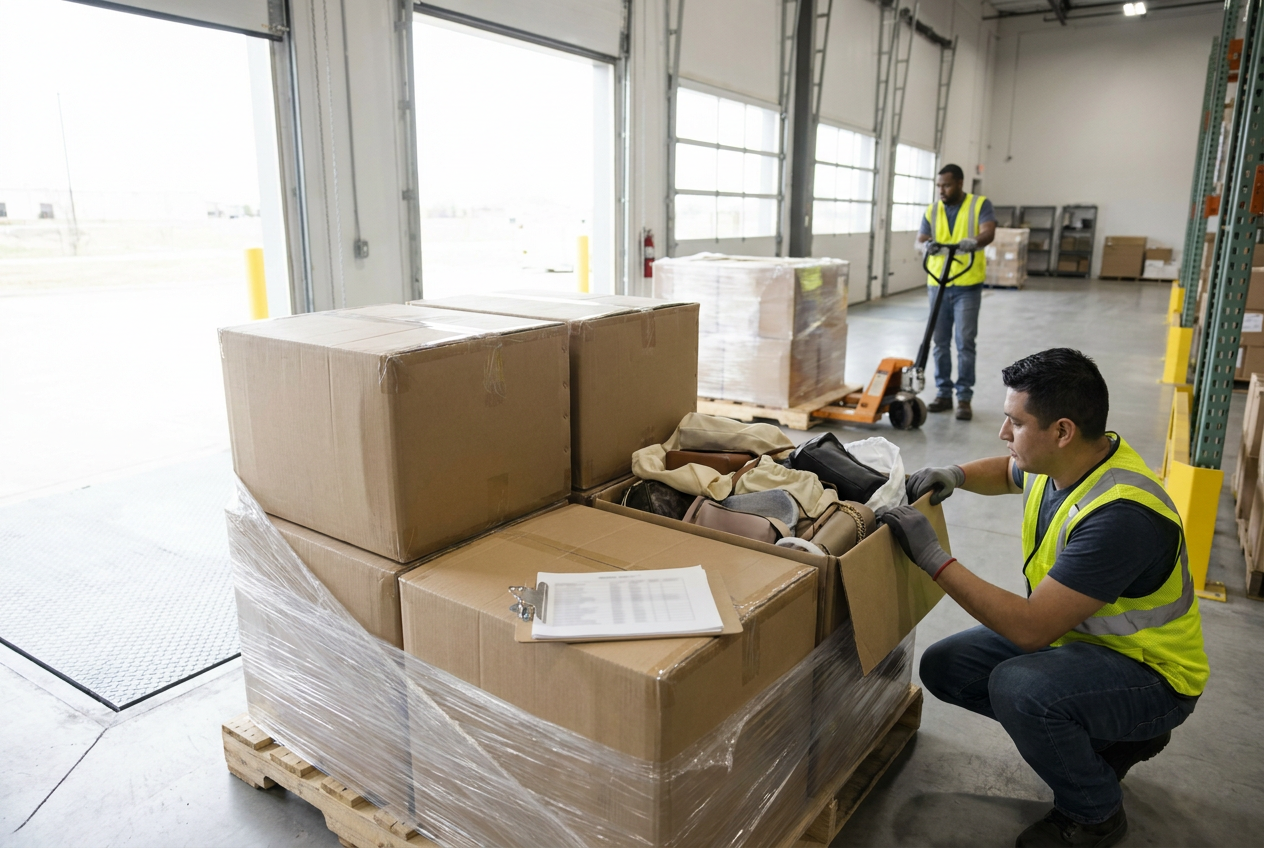
Packaging deserves its own assessment:
- Protective wrapping can reduce surface contact, but it does not verify product condition.
- Missing stuffing can leave structured bags creased or flattened.
- Loose hardware can scratch neighboring bags during handling.
- Mixed straps and pouches create matching work and possible incomplete sets.
- Missing dust bags or boxes should be disclosed rather than assumed replaceable with original materials.
Also check your marketplace’s brand and authenticity requirements. Tags, logos and retailer-origin descriptions do not independently authenticate a handbag. Do not list an item as authentic without adequate support, and hold questionable items out of sale while you investigate.
5. Compare prices using a realistic workload budget
The listed PalletCove price includes freight. Free shipping is the only delivery option on every order to all 48 contiguous states. Sales tax on qualifying orders is covered by PalletCove.
Start with a basic comparison: listed lot price ÷ stated unit count = acquisition cost per stated unit. This is a comparison tool, not a prediction of saleable inventory or profit. If the count is estimated or includes small accessories, that limitation belongs beside the calculation.
For an internal purchasing ceiling, also budget for:
- Inspection, cleaning, photography and listing labor.
- Suitable replacement components and repair work you can actually perform.
- Storage, protective packaging and inventory tracking.
- Marketplace charges and your own outbound customer-order expenses.
- Units that cannot be responsibly listed and require another disposition.
Use several scenarios for usable quantity rather than assuming every bag will pass inspection. Divide your total planned acquisition and preparation budget by each scenario’s usable-unit count to see how sensitive your cost floor is. Those scenarios are planning assumptions, not promised outcomes.
A larger load only makes operational sense when you can receive, sort and store it. Unprocessed inventory ties up space and cash regardless of its apparent unit price.
6. Confirm the order, payment and free shipping details
Before payment, save the listing, manifest, photographs and written answers associated with the specific lot. Confirm the ordering unit and any minimum quantity instead of assuming that one advertised price covers one pallet.
- Verify lot contents, stated count, condition description and included accessories.
- Confirm the listed price, which includes freight, and whether the order qualifies for PalletCove’s sales-tax coverage.
- Provide accurate billing, delivery and contact information, plus a resale certificate when applicable and requested.
- Check shipment dimensions, receiving requirements and your ability to unload safely.
- Pay by credit/debit card, ACH bank transfer or domestic bank wire.
Handling takes 1–3 business days after payment clears. Transit is typically 3–7 business days from Dallas. Handling and transit are separate periods; these ranges are not a guaranteed arrival date.
Palletized shipments may travel by LTL, or less-than-truckload freight, while larger orders may use a full trailer. Confirm the arrangement for your order and communicate site constraints before dispatch. Review the shipping policy for the applicable delivery terms.
Buyers comparing liquidation pallets in Texas with liquidation pallets in Florida receive the same free-shipping policy: it is the only delivery option, and freight is included in the listed price. The policy covers all 48 contiguous states, not Alaska or Hawaii.
7. Inspect delivery and document any claim promptly
Prepare a receiving area, camera, count sheet and labeled bins before the shipment arrives. Keep transport damage records separate from individual merchandise-condition records so the issue can be understood clearly.
At delivery:
- Match the shipment identification and available pallet or carton counts to the paperwork.
- Photograph the load before removing wrap, including visible crushing, tears, moisture or shifted cartons.
- Record observable shortages or damage on delivery paperwork when possible, using specific descriptions.
- Retain packaging and shipping documents while any issue is being reviewed.
- Count and inspect contents promptly, preserving the connection between each discrepancy and its carton or pallet.
Do not describe a load as fully inspected if only its exterior was checked. During sorting, record material defects, missing straps, closure failures and lining issues by unit or inventory identifier.
All merchandise is sold as-is for resale. Do not assume ordinary retail returns, automatic replacements or reimbursement are available. Read the refund policy before ordering and follow its applicable reporting requirements. For a potential shortage, misdescription or transit issue, contact PalletCove promptly with the order number, photographs, counts and a concise explanation; eligibility and resolution depend on the applicable terms.
Common mistakes include discarding packaging before documenting damage, treating every returned bag as defective, treating every tagged bag as unused, and delaying inspection until a customer complains.
Frequently asked questions
Are handbag liquidation lots always manifested?
No. A lot may be manifested or described at category level, depending on the listing. Ask what item-level information is available and do not substitute representative photographs for a confirmed inventory record.
Does a condition grade mean every handbag is ready to sell?
No. Condition labels describe the assortment under the seller’s definitions, and individual units may differ. Inspect materials, closures, lining and accessories before creating accurate resale listings.
Can I select only leather bags or avoid duplicate styles?
Do not assume customization is available. Ask whether the specific offered lot meets your requirements and whether its composition is documented. If material or duplication information is unavailable, treat that as unresolved purchasing risk.
What payment methods and shipping terms apply?
PalletCove accepts credit/debit card, ACH bank transfer and domestic bank wire. Free shipping is the only delivery option on every order to all 48 contiguous states, with freight included in the listed price. Handling is 1–3 business days after payment clears, followed by typically 3–7 business days in transit from Dallas.
Can damaged or incomplete handbags be returned?
All merchandise is sold as-is for resale, so a damaged or incomplete unit does not automatically qualify for a return. Review the refund policy and report a potential claim promptly with supporting records. Do not assume a particular remedy before the issue is reviewed.
Talk to PalletCove Liquidation
Bring your preferred bag types, acceptable repair workload, storage capacity and manifest questions when you contact our order desk. Review current inventory for listing-specific details rather than assuming a handbag assortment is available.
- Business: PalletCove Liquidation LLC
- Address: 4820 Cove Industrial Blvd, Dallas, TX 75236
- Phone: (713) 819-3904
- Email: sales@palletcoveliquidation.com
- Hours: Mon–Fri 8:00 AM – 6:00 PM CT, Sat 9:00 AM – 2:00 PM CT, Sun closed