
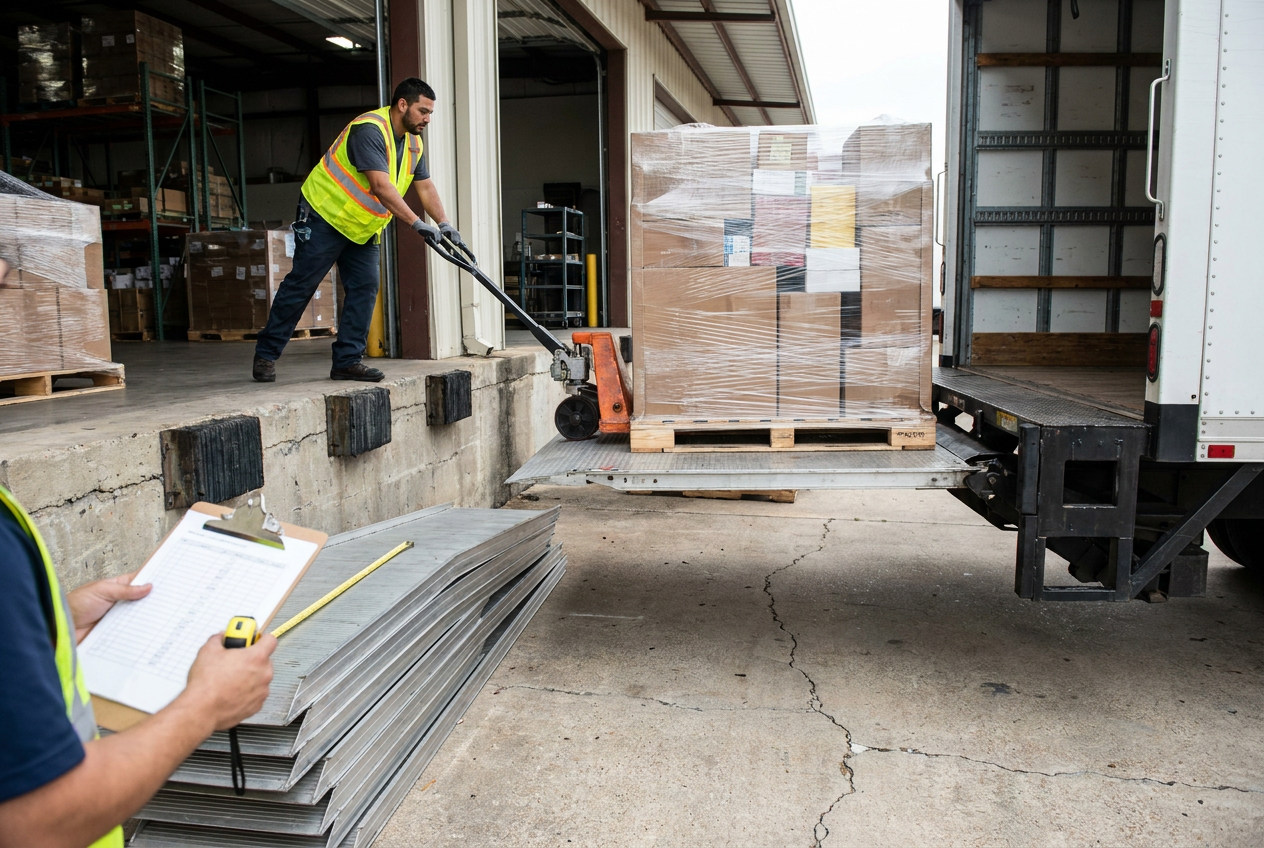
A liquidation pallet can reach your address and still be impossible to unload safely. A truck without the right equipment, a pallet larger than the available platform, or a gravel receiving area can prevent an otherwise straightforward delivery. Understanding liftgate delivery requirements before ordering helps match the shipment to your actual receiving setup.
PalletCove Liquidation supplies manifested and category-level liquidation pallets and full truckloads to independent resellers from Dallas, Texas. Free shipping is the only delivery option on every order to all 48 contiguous states, with freight included in the listed price. That shipping commitment does not eliminate the need to confirm safe unloading arrangements.
This guide explains when to request liftgate service, what measurements matter, and how to connect your inventory purchase with a practical delivery plan.
What liftgate service does—and does not do
A liftgate is a powered platform attached to a freight vehicle that raises or lowers freight between the truck floor and ground level. It bridges the height difference when a receiving location lacks a suitable loading dock or forklift.
A liftgate is not a crane, loading ramp, or substitute for a safe receiving area. It does not automatically include movement into a building, placement in a garage, unpacking, or removal of packaging. Confirm the agreed delivery point and handling scope before dispatch rather than assuming inside placement.
For buyers browsing liquidation pallets, the key distinction is between lowering the pallet and moving it afterward. A pallet jack needs a usable pallet, sufficient clearance, and a firm, smooth route. The driver controls operation of the truck’s liftgate; keep people clear unless the driver directs otherwise.
The essential liftgate delivery requirements are a compatible load, adequate platform capacity and dimensions, and a safe place to lower and move the pallet.
When pallets and truckloads need a liftgate
The receiving equipment—not simply whether an address is residential or commercial—determines the unloading plan. A commercial storefront without a dock may need a liftgate, while a properly equipped warehouse may not.
| Receiving setup | Likely unloading approach | What to verify before dispatch |
|---|---|---|
| --- | --- | --- |
| Compatible loading dock | Dock unloading | Trailer height, dock access, equipment and staffing |
| No dock, suitable forklift available | Forklift unloading | Capacity at the actual load center, fork reach and trained operator |
| No dock or forklift | Liftgate may be needed | Individual pallet weight, platform fit and ground conditions |
| Gravel, sloped or soft receiving area | Resolve the unloading location first | A firm, level delivery point and onward movement plan |
| Full trailer with many pallets | Planned dock or forklift operation | Trailer access, unloading sequence and equipment availability |
LTL versus a full trailer
LTL means less-than-truckload: your shipment shares trailer space with other freight. A small pallet order may move through an LTL network, but not every vehicle has a liftgate suitable for every pallet.
A full trailer is a different receiving project. Do not assume a truckload arrives on a liftgate-equipped vehicle or that unloading many pallets one at a time is practical. Arrange the unloading method in advance, including any delivery-site constraints and carrier requirements.
The guide to buying liquidation pallets supports smaller-order planning, while the guide to buying liquidation truckloads helps frame larger purchasing decisions. Neither order size alone nor a product photograph establishes the correct unloading method.
Platform capacity, dimensions and load stability
A liftgate’s rated capacity is only one part of suitability. A pallet must also fit the usable platform and remain stable during transfer and lowering. Equipment ratings and operating instructions govern; there is no universal pallet weight limit that works for every liftgate.
Use gross weight, not merchandise weight alone
Request the loaded pallet’s gross shipping weight, including the pallet, cartons, wrapping and other packaging. The carrier must also account for handling equipment and any other weight supported by the platform under its operating procedure.
For illustration, 1,800 pounds of merchandise on an 80-pound pallet weighs at least 1,880 pounds before additional packaging or handling equipment. Comparing only the merchandise weight with the liftgate rating understates the load. This example is not a PalletCove shipment specification or an equipment recommendation.
Measure the entire load
Provide the maximum loaded length, width and height, including carton overhang. A nominal 48-by-40-inch pallet footprint does not guarantee compatibility with a particular liftgate. Usable platform space, pallet-jack positioning, edge protection and the transfer path also matter.
Check these details:
- Gross weight of each pallet, not just total shipment weight.
- Maximum dimensions, including irregular protrusions.
- Fork-entry direction and pallet-jack compatibility.
- Pallet condition, including broken boards or blocked openings.
- Load balance, secure wrapping and unusually high centers of gravity.
- Space needed to transfer the pallet from truck floor to platform.
A load under the weight rating may still be unsuitable because it is oversized, unstable or incompatible with the platform. Never improvise with unsupported overhang or split freight on the truck without an approved plan.
Unloading surfaces and vehicle access
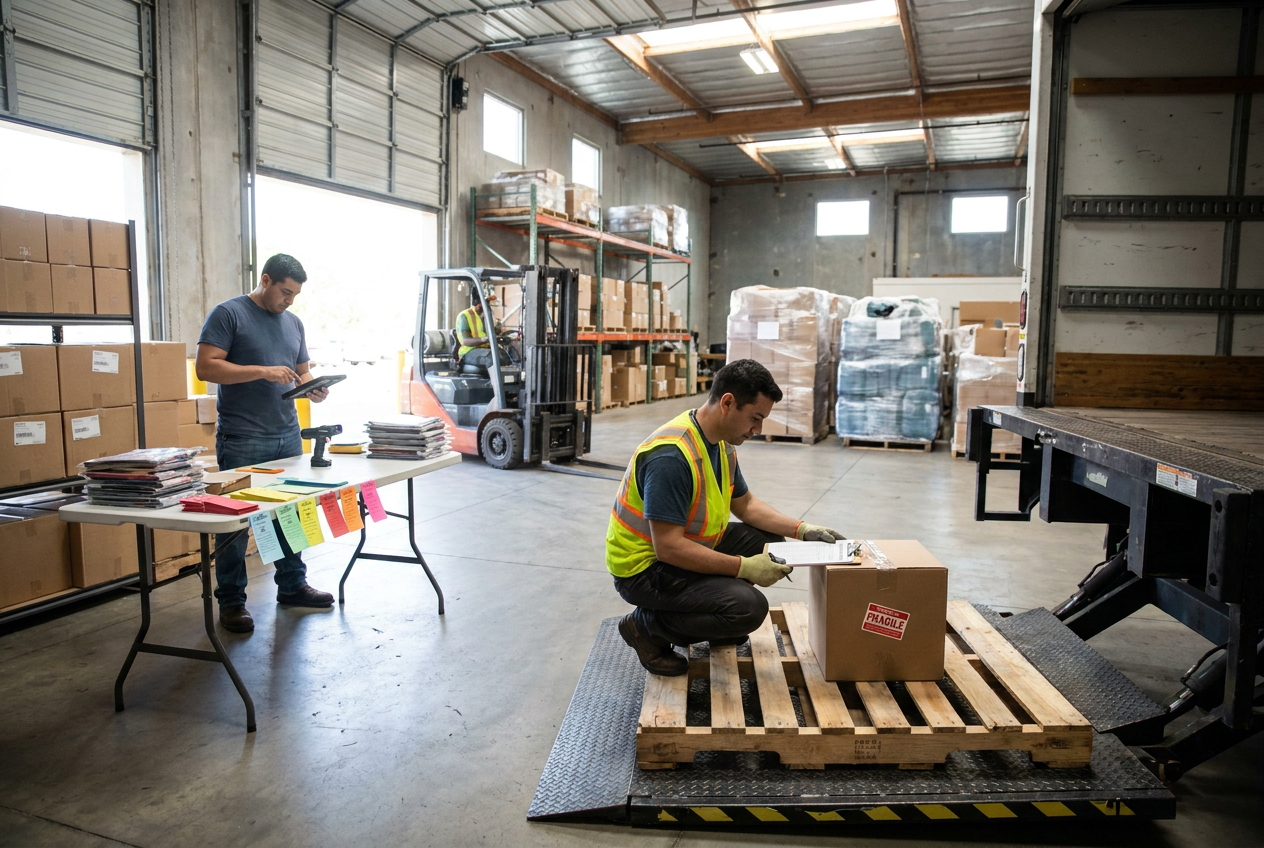
A suitable unloading surface is firm, level and capable of supporting the load and handling equipment. Smooth concrete is generally easier for pallet-jack wheels than gravel, grass, dirt or broken pavement. Asphalt can also create problems when softened, damaged or uneven.
A pallet jack cannot reliably carry a heavy load through loose stone or over ordinary curbs. Slopes increase the risk of uncontrolled movement. If the truck can lower a pallet safely but there is no usable path beyond that point, your receiving plan is incomplete.
Survey the whole route
Before booking, inspect the route from the street to the proposed stopping point and from the pallet’s landing area to storage. Report narrow entrances, low branches, overhead wires, gates, tight turns, posted restrictions and any inability to accommodate a large truck.
Do not assume the truck can enter a driveway or reverse wherever requested. The carrier must determine safe access. Clear parked vehicles, arrange gate access and have an authorized receiver available throughout the delivery window.
Provide photographs and measurements when access is uncertain. A sidewalk, neighboring property or public street is not automatically an acceptable substitute unloading area; permission, traffic conditions and local restrictions matter.
Match the liquidation load to your receiving capability
The merchandise category affects handling. Dense hardware can create heavy pallets, while textiles and mixed household goods may occupy substantial space without comparable weight. Tall or irregular cartons may complicate platform fit even when the pallet’s base is standard-sized.
Compare general merchandise liquidation inventory with liquidation truckload inventory using actual shipment details. Listings such as the Bulk Hamilton Beach Truckload and Macy’s Textile Truckload are useful starting points for asking about pallet counts, dimensions and unloading arrangements—not evidence of a particular shipment weight or liftgate configuration.
PalletCove is an independent reseller and is not affiliated with, endorsed by or sponsored by any retailer named.
Read manifests and condition grades separately
A manifest describes inventory information supplied for a load, potentially including item descriptions, quantities or identifiers. It is not automatically a packing diagram, certified weight record or guarantee that every item is complete and working. Confirm what information is available and what the listing represents.
A category-level load identifies a merchandise grouping but may not provide item-by-item detail. Ask which details are known rather than treating a broad category description as a detailed manifest.
Common condition terms need context:
- Customer returns: Previously returned merchandise that may have use, defects, missing parts or packaging damage.
- Overstock: Excess inventory; the label alone does not establish packaging condition or individual functionality.
- Shelf pulls: Merchandise removed from sales floors, potentially with handling wear, stickers or display-related changes.
- Salvage: Merchandise that may require repair, parts recovery or other evaluation before any resale decision.
Condition grade definitions vary, so use the specific listing’s description. All merchandise is sold as-is for resale. An inventory condition grade does not establish pallet integrity or transport suitability.
Ordering, payment and free shipping preparation
Build your receiving plan before completing the purchase. A low piece count does not necessarily mean a light pallet, and a high piece count does not establish the number of pallets.
- Review the listing, available manifest, condition description and quantity basis.
- Request pallet count, individual gross weights and maximum loaded dimensions.
- Disclose whether you have a dock, forklift or neither, and identify any liftgate need.
- Provide the delivery address, receiving contact, business hours and access restrictions.
- Confirm the unloading arrangement and delivery point before dispatch.
- Pay using credit/debit card, ACH bank transfer or domestic bank wire.
Free shipping is the only delivery option on every order across all 48 contiguous states. Freight is included in the listed price. Compare merchandise offerings on their stated lot, pallet or truckload basis, and do not infer guaranteed resale value or earnings from inventory descriptions.
Handling takes 1–3 business days after payment clears. Transit is typically 3–7 business days from Dallas; these are separate stages, not a guaranteed arrival date. Coordinate receiving availability using shipment updates and any carrier appointment instructions. Review the shipping policy before ordering.
The same receiving checks apply to liquidation pallets in Texas and liquidation pallets in Florida. Distance does not determine whether your location needs a liftgate.
PalletCove covers sales tax on qualifying orders. Ask what documentation applies, including whether a resale certificate is needed for your circumstances. Keep the agreed inventory description and receiving details together; the guide to liquidation purchase order terms explains why written expectations matter.
Delivery-day inspection, claims and common mistakes
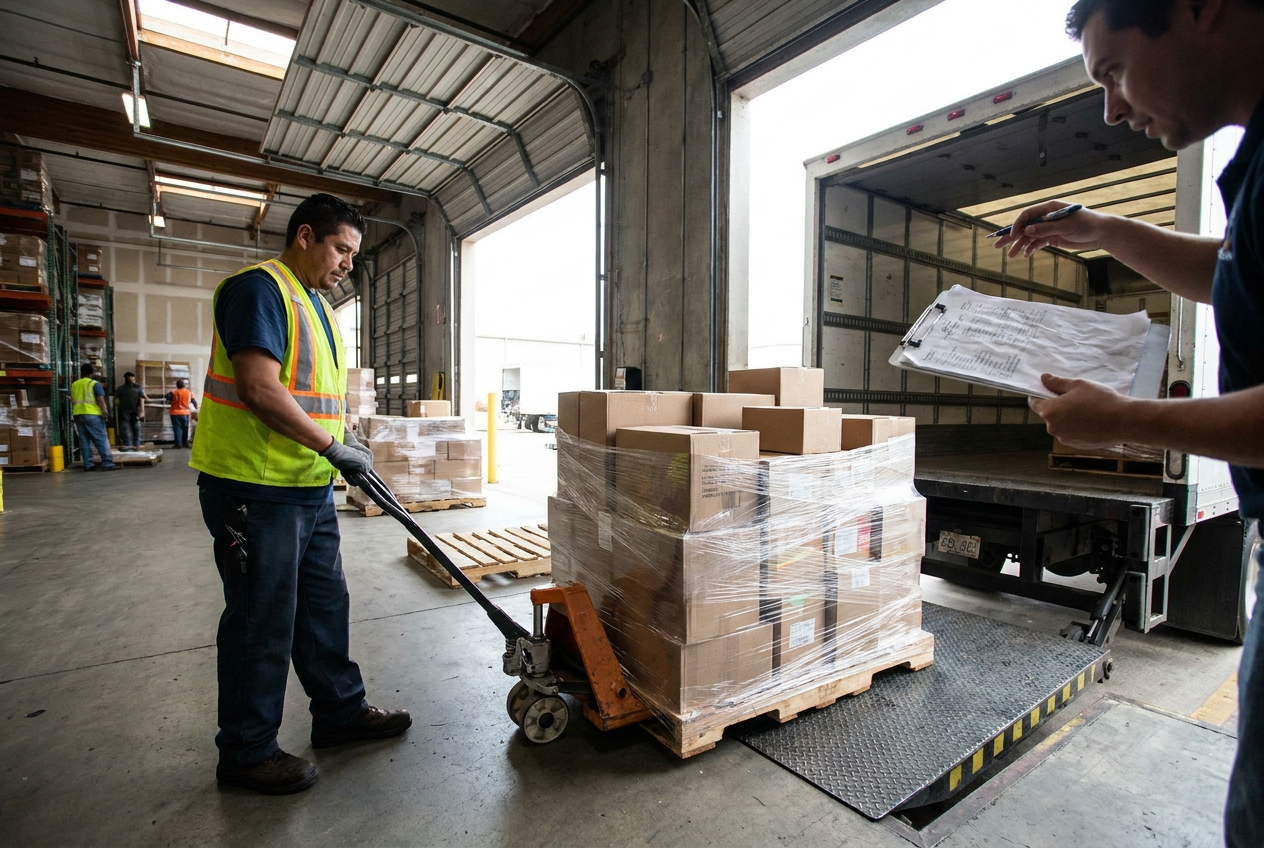
Have your order documents, camera and receiving staff ready before the vehicle arrives. Inspect from a safe position; never stand under a raised platform or attempt to catch a shifting load.
Before signing the delivery receipt:
- Compare the pallet count with the shipping paperwork.
- Look for crushed cartons, punctures, leaning stacks, torn wrap and damaged pallet boards.
- Photograph the load as presented and record identifiable shipment details.
- Describe visible damage or shortages specifically on the receipt, and request acknowledgment from the driver.
- Retain your copy of the paperwork and report concerns promptly.
A signature is not a substitute for inspection, and a general notation does not guarantee a claim outcome. If unloading appears unsafe, stop and contact the order desk and carrier rather than improvising.
Separate transit issues from as-is merchandise condition
Transport damage, a missing pallet and a nonworking returned item are different issues. Preserve packaging, photographs, labels and the manifest so the concern can be evaluated accurately. Do not discard evidence while awaiting instructions.
All merchandise is sold as-is for resale; do not assume a retail-style return right or guaranteed condition. Review the refund policy for applicable return and claim terms, and request guidance promptly. Documentation supports review but does not promise a refund, replacement or claim approval.
Common mistakes include describing an address as “commercial” without disclosing the absence of a dock, reporting only total shipment weight, overlooking carton overhang, and expecting a pallet jack to cross gravel. Another is planning to hand-unload cartons without advance agreement: time, stability and carrier procedures can make that unsuitable.
Frequently asked questions
Do all liquidation pallets require liftgate delivery?
No. A compatible loading dock or properly selected forklift may provide an alternative unloading method. If neither is available, disclose that before dispatch so liftgate suitability can be checked.
What is the maximum pallet weight for a liftgate?
There is no single maximum that applies to every truck. The assigned equipment’s rating, usable platform dimensions, loading instructions and total supported weight determine suitability.
Can a liftgate delivery be made to a residential address?
It may be feasible if truck access, platform fit and a safe unloading surface are confirmed. Residential delivery does not automatically include garage placement or movement inside the home.
Does free shipping mean liftgate arrangements are automatic?
No. Free shipping is the only delivery option on every order, and freight is included in the listed price. You still need to disclose your receiving setup and confirm the appropriate unloading arrangement.
Can I receive a full truckload without a loading dock?
Possibly, with a suitable forklift and a confirmed unloading plan. Do not assume a full trailer includes liftgate capability; discuss equipment, site access and unloading requirements before dispatch.
Talk to PalletCove Liquidation
Before ordering, share your receiving equipment, unloading surface, access restrictions and available pallet measurements. The goal is to identify a workable delivery arrangement before freight is dispatched.
PalletCove Liquidation LLC
4820 Cove Industrial Blvd, Dallas, TX 75236
Phone: (713) 819-3904
Email: sales@palletcoveliquidation.com
Hours: Mon–Fri 8:00 AM – 6:00 PM CT, Sat 9:00 AM – 2:00 PM CT, Sun closed
To discuss liftgate delivery requirements, contact our order desk, or review current inventory for your next resale purchase.