

A first liquidation order can become difficult even when the buyer understands the price and receives the merchandise described. The problem is often a mismatch: more sorting than available evenings can handle, unfamiliar products that require research, or inventory that does not suit the buyer’s sales channel.
A liquidation pallet is a palletized lot of merchandise sold in bulk through a secondary-market supplier. Buying one means accepting an inventory-processing project, not simply receiving ready-to-publish listings. The most avoidable liquidation pallet buying mistakes happen when buyers evaluate the merchandise without evaluating that project.
For the full purchasing sequence, use our guide to buying liquidation pallets. This article focuses on the decisions that make a first order harder than necessary: workload, product familiarity, channel fit and the operational commitments hidden behind a tempting quantity.
1. Treating unit count as usable selling inventory
A pallet listing is the seller’s description of a specific lot or offering, including whatever quantity, condition, assortment and ordering details are supplied. Unit count means the number of merchandise units represented in that offering; it does not automatically mean the number of complete, independently sellable products.
Category mix is the assortment of product categories within a lot. A broad category mix can multiply workflows because apparel, small appliances and bulky home goods require different identification, preparation and selling methods.
Before comparing two offers, translate their quantities into tasks:
- How many units need individual identification and photography?
- Which items require checking for included parts or accessories?
- Can duplicate items share a listing, subject to matching condition?
- Which products require additional safety, eligibility or shipping research?
- Where will incomplete or unresolved merchandise wait?
A manifest is an inventory document that may identify products, quantities and other details. Its scope varies. Confirm whether it describes the offered lot, whether quantities are exact or estimated, and what it does not establish. A manifest is not proof of functionality, completeness or future resale results.
For document and description checks, consult liquidation pallet listing red flags. The operational question remains yours: can you turn the stated assortment into accurately described inventory?
The right first order is one you can process, understand and sell through your actual channels—not simply the largest quantity you can afford.
2. Buying a workload that does not fit your week
Receiving a pallet is one event. Processing it is a sequence of jobs: unloading, sorting, identifying, inspecting, preparing, photographing, listing, storing and fulfilling orders. Inspection means examining merchandise and documenting its observed condition; it does not necessarily include functional testing.
Estimate labor with a sample workflow rather than optimism. As a hypothetical planning exercise, 100 units averaging 12 minutes of preparation each represent 20 hours before customer messages and fulfillment. Those figures are not a prediction for any PalletCove lot; substitute your own assumptions and include difficult items.
| Decision area | First-order mistake | Better constraint |
|---|---|---|
| --- | --- | --- |
| Labor | Counting only photography time | Include research, sorting and packing |
| Storage | Reserving room for the wrapped pallet only | Reserve separate incoming, ready and unresolved zones |
| Selling | Assuming everything can use one channel | Assign a realistic channel to each product group |
| Cash | Spending the entire available balance | Keep capacity for supplies and ongoing operations |
| Reordering | Buying again before processing the first lot | Review actual labor and sales progress first |
Load size matters here. An individual pallet may move by LTL, meaning less-than-truckload freight shared with other shipments. A truckload is a larger bulk purchase, commonly involving a full trailer; verify the offered quantity and configuration rather than assuming a standard count.
The pallet and load types guide explains the broader distinctions. For a first order, increasing volume makes sense only when receiving space, labor and selling capacity increase with it.
3. Choosing unfamiliar products because the category sounds attractive
Product familiarity reduces uncertainty. A reseller who already understands sizing, materials and garment descriptions has a different starting point from someone who routinely identifies tool models and missing components. Neither category is inherently the correct first purchase for everyone.
Browse general merchandise liquidation inventory with attention to assortment breadth. A varied lot may require several kinds of expertise. Likewise, Home Depot liquidation inventory should be evaluated by its actual product descriptions and conditions, not by assumptions attached to a retailer name.
PalletCove is an independent reseller and is not affiliated with, endorsed by or sponsored by any retailer named.
Ask yourself whether you can explain a product accurately without lengthy research. Can you identify its model, intended use, compatibility and completeness? Do you understand the relevant marketplace restrictions? If not, assign research time before treating it as easy inventory.
Condition language is not a shortcut
A condition grade is a seller’s classification of merchandise condition. Grading systems are not universal, so the listing’s definition matters more than the grade label alone.
- Overstock describes excess inventory, not an automatic promise of new condition.
- Shelf pulls are goods removed from retail shelves and may have handling or packaging issues.
- Customer returns may have varied reasons for return and varied completeness or functionality.
- Used merchandise requires condition-specific descriptions.
- Salvage can involve repair, parts recovery or other limited uses, depending on the listing.
- As-is language requires careful reading of the stated condition and applicable terms; it does not establish that every product has the same return eligibility.
Do not substitute a preferred condition for the actual listed condition. If successful resale depends on an unconfirmed assumption, resolve it before ordering.
4. Assuming your sales channel can absorb the assortment
Sales-channel fit means more than having a marketplace account. It includes product eligibility, audience, shipping practicality, required disclosures and how customers expect to inspect or receive merchandise.
An online marketplace can suit identifiable products with manageable packaging, but unfamiliar models and missing accessories can slow listing creation. Local pickup can suit bulky goods, yet requires space, appointment management and enough local demand. Flea-market or booth selling can accommodate assorted inventory, but display space and transport capacity remain constraints.
Use the Amazon High Piece Truckload listing as a reminder to investigate processing volume rather than treating “high piece” as an automatic advantage. Review the actual listing for quantities and conditions. Similarly, the Macy’s Textile Truckload listing prompts different questions about identification, dimensions, storage and presentation; its name alone does not verify the assortment or condition.
For each major product group, write down:
- The intended selling channel and any eligibility requirements.
- The information needed for an accurate listing.
- The packaging or local-handoff method.
- A fallback plan if the first channel is unsuitable.
If your fallback is simply “sell it somewhere,” the channel plan is unfinished. Avoid placing an order whose workable outlet depends on opening an unfamiliar sales operation after delivery.
5. Confusing an included shipping price with a complete operating budget
PalletCove’s listed price includes freight. Free shipping is the only delivery option, on every order, to all 48 contiguous states. There is no separate paid-delivery alternative to compare.
That simplifies the purchase comparison, but merchandise still creates operating costs. Depending on your products and selling method, allow for storage, packaging, cleaning supplies, marketplace fees, outbound customer shipping and labor. A price-per-unit calculation is only an allocation of purchase cost across the stated count—not a prediction of the cost per sellable item.
Keep the detailed calculations in your first-order liquidation pallet budget. For this decision, ask whether you can fund the work after paying for the inventory, including time spent on products that do not become immediate listings.
Before confirming an order, review the payment policy. Payment methods are those shown at checkout: card via a secure payment link, ACH, bank wire and the listed payment apps. Valid resale certificates are reviewed and applied where the buyer’s state allows.
Record the selected offering, stated condition, quantity basis and unresolved questions before paying. Do not rely on remembering a conversation when the shipment arrives.

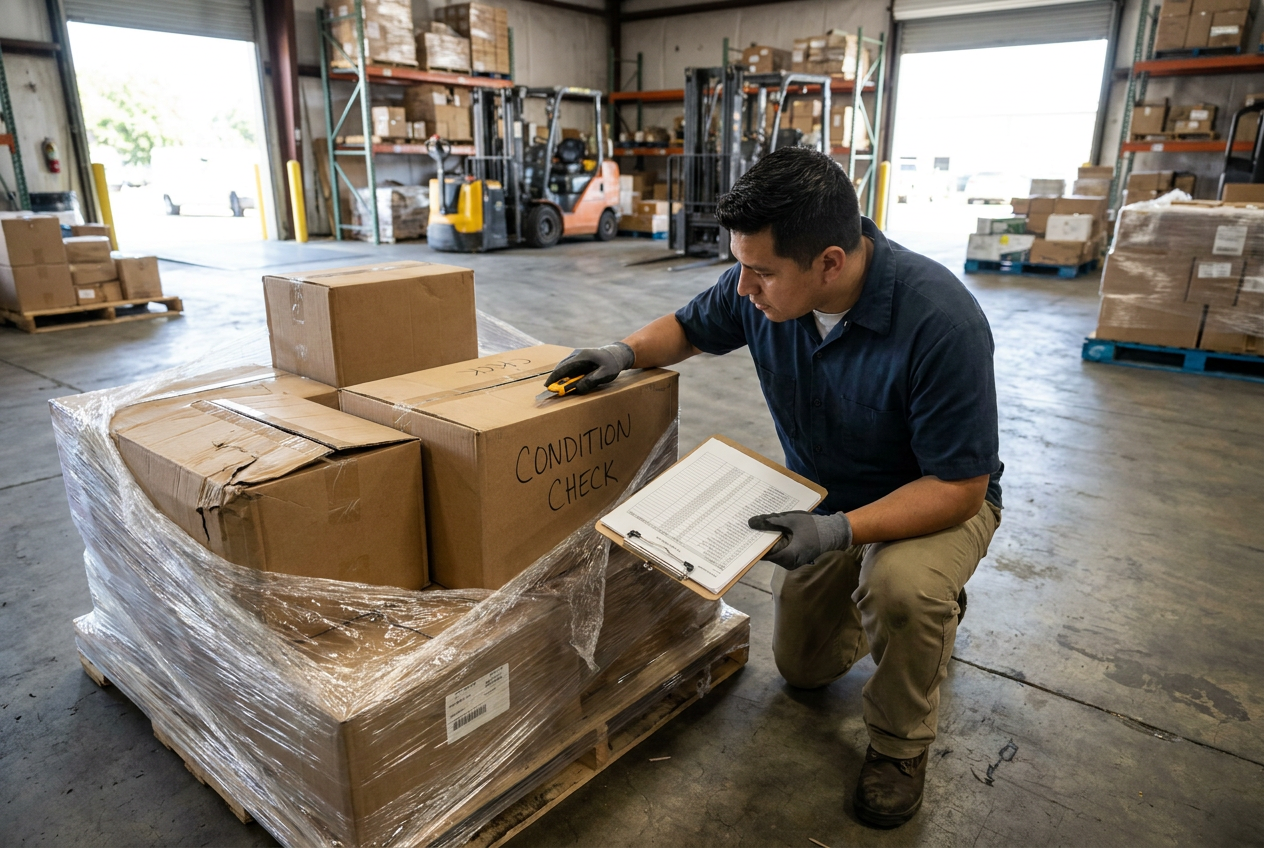
6. Planning for arrival without planning for inspection
Handling takes 1–3 business days after payment clears. Transit is typically 3–7 business days from Dallas, for an estimated total of 4–10 business days. The processing cutoff is 2:00 PM Central Time, America/Chicago, Monday–Friday; after-cutoff confirmations begin the next business day. Weekends and applicable holidays do not count.
Whether comparing liquidation pallets in Texas or liquidation pallets in Florida, build a receiving plan rather than assuming the estimated window is a guaranteed appointment. Confirm receiving access and unloading arrangements before ordering. The liquidation pallets hub provides the broader location starting point.
On delivery day, separate shipment documentation from product processing:
- Photograph the load’s exterior and any visible damage before disturbing it, when safe.
- Record visible discrepancies on delivery paperwork where applicable and retain copies.
- Preserve packaging and labels relevant to an issue.
- Compare received merchandise with the listing and any applicable manifest.
- Separate unresolved items from ready-to-list inventory.
Request delivery-issue reporting within 48 hours so evidence remains clear. That reporting request does not shorten eligible new-product returns.
Under the United States Refund & Returns Policy, products explicitly listed as NEW ONLY qualify for defective and non-defective returns and exchanges within 30 calendar days of delivery. Returns are by mail; the customer is responsible for the return label and shipping, and the restocking fee is 15% of the product price. Refund processing takes 10 calendar days after authorized return receipt and inspection, or approval where no physical return is required.
Mixed and used loads have separate claims terms, not routine change-of-mind returns. Do not assume that unfamiliar merchandise, slow sales or an underestimated workload creates return eligibility.
Frequently asked questions
What is the biggest first-order liquidation pallet buying mistake?
Buying more processing work than you can complete is a major avoidable error. Estimate labor, storage and listing requirements before deciding whether the quantity fits your operation.
Is a single-category pallet always easier than mixed merchandise?
Not always: a familiar category can simplify identification, but technical products may still require substantial evaluation. Compare the actual category mix and condition with your skills rather than assuming a narrower label means less work.
Does a manifest mean every item is ready to resell?
No. A manifest may document identity and quantity without establishing completeness, functionality or selling eligibility. Read its stated scope and the pallet listing together.
Should a first-time buyer start with a truckload?
Only if receiving capacity, labor, storage and sales channels already support that volume. A larger purchase does not solve uncertainty about how to process unfamiliar products; it can multiply it.
What should I measure before ordering again?
Track processing hours, unresolved units, storage occupied and actual sales by product group. Use those observations to adjust the next order instead of treating delivery alone as evidence that the first purchase worked.
Talk to PalletCove Liquidation
Before committing, describe your available processing time, familiar product categories and intended sales channels. Use the liquidation pallet buying guide for the broader process, then choose an order whose workload you can realistically handle.
PalletCove Liquidation LLC is located at 4820 Cove Industrial Blvd, Dallas, TX 75236. To clarify listing details, contact our order desk, then compare current inventory against your operating plan.
- Phone: (713) 819-3904
- Email: sales@palletcoveliquidation.com
- Hours: Mon–Fri 8:00 AM – 6:00 PM CT, Sat 9:00 AM – 2:00 PM CT, Sun closed