

Liquidation sample orders are small, deliberate purchases used to evaluate merchandise and a reseller’s ability to process it. A useful trial answers practical questions: Does the category fit your sales channel? How much testing does it require? Can your team identify, store, and list the inventory efficiently?
A trial cannot establish what every future liquidation pallet or truckload will contain. Liquidation inventory changes with supply, product mix, season, and the reasons merchandise entered the secondary market. One successful pallet is evidence about that purchase—not a guarantee about the next full trailer.
For PalletCove Liquidation, treat a sample order as a purchasing strategy rather than an assumed special program. Confirm the available lot size and listing details before ordering; do not assume individual samples, split pallets, or representative trial packs are available.
What liquidation sample orders can actually reveal
A trial purchase should test both the inventory description and your operating process. It can reveal packaging quality, actual assortment, accessory completeness, inspection workload, and how easily your team can prepare items for resale.
It cannot reliably predict future brand mix, exact condition distribution, selling prices, or customer demand across an entire truckload. Even pallets from the same broad category may differ substantially.
Start with the available liquidation pallets, then use the guide to buying liquidation pallets to frame questions about the specific lot. The goal is a repeatable evaluation—not finding one attractive item that makes the purchase feel successful.
A trial pallet tests a specific lot and your workflow; repeat purchases under comparable specifications provide better evidence of consistency.
Choose a trial that matches the intended load
A sample is useful only when it resembles the inventory you eventually intend to buy. Testing textiles does little to establish whether your business can diagnose returned power tools. Likewise, one bulk product does not reproduce the sorting demands of mixed general merchandise.
Understand the load and condition vocabulary
| Inventory description | What it generally means | What the trial should check |
|---|---|---|
| --- | --- | --- |
| Overstock | Excess inventory that was not sold through its original channel | Packaging, age, assortment, and market relevance |
| Shelf pulls | Merchandise removed from a sales floor | Display wear, labels, completeness, and packaging changes |
| Customer returns | Goods returned after purchase for varying reasons | Functionality, missing parts, use, and return-related defects |
| Salvage | Inventory intended primarily for repair, parts, or recovery | Repair feasibility, usable components, and disposal requirements |
| Mixed-condition lot | Merchandise spanning more than one condition category | Whether your workflow can separate and handle the actual mix |
These are general descriptions, not standardized guarantees. A condition grade applies according to the specific listing’s definition. “Untested” does not mean working, and “overstock” does not establish that every package is pristine.
Browse general merchandise liquidation inventory and available liquidation truckloads separately. Pallet describes a handling unit; truckload describes shipment scale. Neither establishes merchandise quality.
For example, the Amazon General Merchandise Truckload listing and Macy’s Textile Truckload listing involve different evaluation needs. Review their current descriptions rather than assuming either offers a smaller trial version. PalletCove is an independent reseller and is not affiliated with, endorsed by, or sponsored by any retailer named.
Write the trial brief before ordering
- Select the category and intended resale channel.
- Specify the condition descriptions you can realistically process.
- Set a purchase ceiling and a separate processing budget.
- Define available storage, testing equipment, and staff hours.
- Choose a review date and objective stop-or-repeat criteria.
Useful criteria include processing the entire pallet within your available labor hours or identifying every item requiring further testing. Avoid defining success solely by a hoped-for sales total.
Read the manifest as evidence, not a promise
A manifest is an inventory document associated with a lot. Depending on the listing, it may include descriptions, quantities, model numbers, identifiers, condition notes, or reference prices. Some lots may not have an itemized manifest; ask before purchasing.
Save the listing, photographs, condition description, and any manifest supplied for the exact order. Establish whether photographs show the actual lot or illustrate a merchandise type, and ask whether quantities are exact or approximate.
Check these points before payment:
- Does each line describe an individual unit, case, bundle, or multipack?
- Are model numbers, sizes, and variants identified?
- Are testing status and missing accessories disclosed?
- Does the condition grade apply to individual items or the overall lot?
- Are reference prices historical retail figures rather than current selling evidence?
- What written terms address count or description discrepancies?
A manifest does not replace physical inspection. Reference retail amounts do not establish resale value, and a listed model does not prove that every component is present. For unmanifested merchandise, recognize that composition uncertainty is part of the buying decision.

Budget, order, and pay for a controlled trial
At PalletCove, freight is included in the listed price. Free shipping is the only delivery option on every order to all 48 contiguous states. Sales tax on qualifying orders is covered by PalletCove; confirm qualification and any documentation needed for your purchase.
Your operating budget still needs to account for work after receipt: sorting, testing, cleaning, replacement components, storage, selling-platform costs, outbound packaging, and responsible disposal. These are your business expenses, not additional PalletCove delivery charges.
Record the listed purchase price separately from those operating expenses. Dividing the purchase price by the received unit count gives an average acquisition cost, but it can obscure differences between complete products, repair candidates, and unsellable items. Track those groups separately. The liquidation pallet buying-limit guide offers a framework for setting a disciplined ceiling.
Before placing the order, confirm:
- The exact listing, lot size, condition description, and manifest availability.
- The delivery address, receiving contact, and unloading arrangements.
- Applicable sales-tax qualification and whether a resale certificate is needed.
- The written policies governing the purchase.
Accepted payment methods are credit/debit card, ACH bank transfer, and domestic bank wire. Handling begins after payment clears, not necessarily when payment is initiated. Keep the order confirmation and payment record with your trial documents.
Plan free shipping and receiving capacity
Handling takes 1–3 business days after payment clears. Transit is typically 3–7 business days from Dallas. These are separate stages, and typical transit timing is not a guaranteed arrival date. Review the shipping policy before scheduling staff or customer commitments.
A smaller pallet shipment may travel as LTL, or less-than-truckload freight, while a truckload generally uses a full trailer. Confirm how the specific order will move and what receiving arrangements are needed. Free shipping does not mean every location has suitable space or equipment for unloading.
Whether you are researching liquidation pallets in Texas or liquidation pallets in Florida, the same free-shipping policy applies. Coverage extends to all 48 contiguous states.
Prepare a clear receiving area, safe unloading arrangements, an inspection station, and storage locations before arrival. Verify vehicle access and who will accept the shipment. Resolve receiving questions before ordering rather than assuming a trial pallet can be handled like a small parcel.
Inspect delivery and document the whole pallet
Delivery-day documentation helps distinguish visible transport issues from merchandise condition discovered during sorting. Start with the shipment as received before removing wrapping or moving contents unnecessarily.
- Match shipment identification to your order records.
- Count pallets or handling units and compare them with delivery documents.
- Photograph all accessible sides, labels, wrapping, and visible damage.
- Record visible shortages or damage accurately on delivery paperwork where applicable.
- Save the paperwork and follow the written reporting process promptly.
- Unwrap safely, assign item identifiers, and reconcile contents against the manifest if supplied.
Do not record “all items tested” when you have only checked exterior packaging. Delivery acknowledgment and a complete merchandise evaluation are different tasks.
For a manageable trial, inspect every unit rather than selecting only appealing boxes. Classify items as ready for further resale preparation, needing testing, incomplete, repair candidates, or unsuitable for resale. Keep untested inventory distinct from items that have passed your checks.
Use category-appropriate safety practices. Isolate leaking, swollen, or visibly damaged batteries, and do not energize unsafe electrical goods. Check applicable recalls and resale restrictions before listing products; an as-is purchase does not remove a reseller’s obligations to buyers.
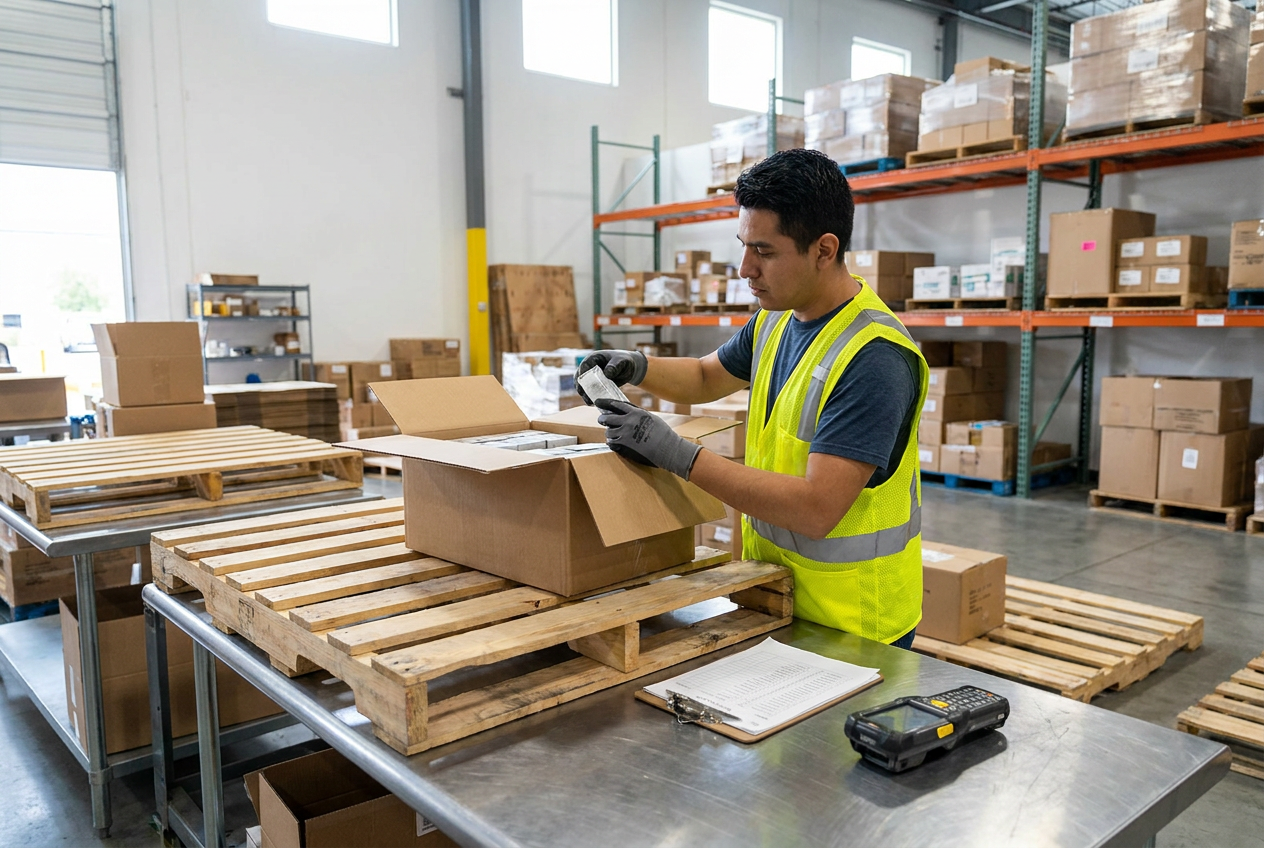
Measure consistency before scaling to a truckload
Build a scorecard using the same definitions on every trial. Record the order date, listing description, category, condition grade, received quantity, and whether the lot was manifested.
Track operational results alongside inventory findings:
- Count discrepancies against the supplied manifest.
- Units missing essential parts or requiring repair.
- Units tested, untested, and unsuitable for resale.
- Labor time spent receiving, sorting, testing, and listing.
- Storage space occupied and time held.
- Actual sales, selling expenses, and remaining unsold stock.
Always include the denominator when reporting a rate. Ten incomplete units mean different things in a 20-unit pallet and a 200-unit pallet. Keep unknown outcomes visible instead of treating untested items as functional.
Compare repeat orders with similar category, lot format, condition language, and testing status. If specifications change, record the change rather than attributing every difference to supplier inconsistency. Several comparable trials provide more information than one, but no fixed number guarantees that a future truckload will match.
Use equal observation windows for sales comparisons. A pallet held for three months cannot fairly be compared with one listed last week. Separate actual sales from asking prices and unsold inventory.
Before scaling, use the truckload purchasing guide to review receiving and processing capacity. Truckload handling is not simply pallet handling multiplied: congestion, staffing limits, and storage bottlenecks can change the workload. Repeat at a manageable scale if the first trial leaves important questions unanswered.
Handle claims correctly and avoid misleading conclusions
All PalletCove merchandise is sold as-is for resale. Do not interpret a trial purchase as an approval period, guaranteed-condition order, or automatic right to return unwanted merchandise.
Review the refund policy before payment for any applicable eligibility, reporting deadlines, evidence requirements, and authorization procedures. This article does not create return or claim rights beyond the written terms. A documented discrepancy and dissatisfaction with an assortment are different issues.
If a concern arises, preserve the order number, listing records, manifest, delivery documents, packaging photographs, and item-level evidence. Report the specific facts promptly through the stated process. Do not ship merchandise back without any authorization required by the policy or assume documentation guarantees a remedy.
Common evaluation mistakes include:
- Inspecting only the most valuable-looking items.
- Comparing lots with different condition definitions.
- Treating manifest reference prices as expected proceeds.
- Ignoring labor, incomplete items, or unsold stock.
- Assuming a deliberately selected pallet is a random sample.
- Ordering a full trailer before confirming receiving and storage capacity.
Frequently asked questions
Does PalletCove offer a dedicated sample-order program?
Do not assume a dedicated program or individual product samples are available. Ask whether the current inventory includes a smaller purchasable lot that fits your trial objectives.
Can one liquidation pallet predict a future truckload?
No. It provides evidence about that lot and your processing workflow, while future merchandise mix and condition may differ. Comparable repeat purchases can improve your understanding without guaranteeing future results.
Is shipping free on a trial order?
Yes. Free shipping is the only delivery option on every PalletCove order to all 48 contiguous states, and freight is included in the listed price. Confirm receiving arrangements for the specific shipment before ordering.
How long does a trial purchase take to arrive?
Handling takes 1–3 business days after payment clears, followed by transit that is typically 3–7 business days from Dallas. Allow for both stages when planning receiving staff and inspection time.
Can I return a trial pallet if it does not suit my business?
Do not assume a return is available because the purchase was intended as a trial. All merchandise is sold as-is for resale, and the written refund policy governs any applicable return or claim process.
Talk to PalletCove Liquidation
Discuss your intended category, receiving setup, and trial objectives before selecting a lot. Ask what current listing details and manifest information are available, then choose a purchase your business can fully inspect and document.
PalletCove Liquidation LLC
4820 Cove Industrial Blvd, Dallas, TX 75236
Phone: (713) 819-3904
Email: sales@palletcoveliquidation.com
Hours: Mon–Fri 8:00 AM – 6:00 PM CT, Sat 9:00 AM – 2:00 PM CT, Sun closed
To discuss a manageable trial purchase, contact our order desk or review current inventory.