

Liquidation supplier payment scams redirect a reseller’s money away from the business they intended to pay. The inventory may be real, the invoice may look familiar, and the message may arrive inside an existing email conversation. The fraud can be as small as a substituted account number on an otherwise accurate document.
For independent resellers, the safest approach is to verify two things separately: what you are buying and where your payment is going. A credible manifest does not authenticate bank instructions, and a successful payment does not prove that a liquidation pallet exists.
This guide explains how to check supplier identity, evaluate an order, and independently confirm a last-minute bank account change. It also covers PalletCove’s ordering and delivery terms so you can recognize instructions that conflict with them.
How liquidation supplier payment scams work
Supplier impersonation happens when someone presents themselves as a legitimate seller without authorization. Business email compromise is a related attack in which a criminal spoofs or gains access to business communications to redirect payments. Neither requires an obviously suspicious website.
Common approaches include copied listings, look-alike domains, fabricated invoices, and messages claiming that the accounting department has changed banks. A criminal may know your order number, purchase amount, or employee’s name from compromised correspondence.
| Warning sign | Why it matters | What to do before paying |
|---|---|---|
| --- | --- | --- |
| New bank details shortly before payment | The destination may have been substituted | Stop and verify through an independently sourced number |
| Sender address differs by one character | A look-alike domain can imitate a supplier | Inspect the complete sender and reply-to addresses |
| Beneficiary name does not match the seller | Funds may go to an unrelated recipient | Require an explanation and independently verify it |
| Pressure to bypass normal checkout | Urgency discourages verification | Keep the order on hold until checks are complete |
| Payment requested through an unsupported method | The request conflicts with published terms | Reject the instruction and contact the supplier |
| Refusal to identify the specific load | A listing may be copied or nonexistent | Request written order details before proceeding |
A padlock in a browser only indicates an encrypted connection; it does not establish that the seller is genuine. Similarly, a logo, business registration, or warehouse photograph is useful context but not proof that the person sending payment instructions controls that business.
Verify the load before verifying the payment
Start with the liquidation pallets inventory hub and compare the proposed order against its actual listing. Our guide to buying liquidation pallets and guide to buying liquidation truckloads provide background for evaluating the buying format.
Load types and manifests
A liquidation pallet is a bulk inventory unit; a truckload is a larger purchase commonly moved in a full trailer. A manifested load provides an itemized inventory reference. A category-level load describes the merchandise category without necessarily providing an item-by-item inventory.
Ask whether a manifest applies to the exact offered load, when it was prepared, and what its fields mean. SKU, description, quantity, and condition information can help reconcile an order, but a spreadsheet is not evidence that someone is authorized to collect payment.
Compare general merchandise liquidation lots with liquidation truckload listings to understand the advertised scope. For specific examples, review the current descriptions of the Amazon General Merchandise Truckload and Macy’s Textile Truckload, rather than assuming their contents from their names.
PalletCove is an independent reseller and is not affiliated with, endorsed by, or sponsored by any retailer named.
Condition grades need written definitions
Condition terminology is not universally standardized. Ask what the stated condition grade means for that particular offer:
- Customer returns: previously purchased merchandise returned by customers; functionality and completeness can vary.
- Overstock: excess inventory; the label alone does not establish packaging or functionality.
- Shelf pulls: merchandise removed from a selling floor, potentially with handling or packaging wear.
- Salvage: inventory that may require repair, parts recovery, or disposal rather than ordinary resale.
All PalletCove merchandise is sold as-is for resale. Do not interpret a grade, photograph, or manifest as a guaranteed condition or resale outcome. For another packaging distinction, the case pack liquidation guide explains a format buyers should distinguish from mixed lots.
Reconcile the price and accepted payment method
Before authorizing payment, obtain a written order record identifying the seller, product or load reference, quantity or scope, stated condition, manifest status, and total. Resolve discrepancies between the listing, invoice, and payment screen first.
At PalletCove, free shipping is the only delivery option on every order to all 48 contiguous states. Freight is included in the listed price. Sales tax on qualifying orders is covered by PalletCove. Ask whether your order qualifies and what documentation is needed; do not assume that every transaction has the same tax treatment.
A resale certificate documents qualifying resale activity under applicable state rules. It does not authenticate the supplier or the bank account. Provide requested business documentation through a verified channel, not an unexpected message attachment portal.
PalletCove accepts only:
- Credit/debit card.
- ACH bank transfer.
- Domestic bank wire.
Check the PalletCove payment policy before choosing a method. Requests for any other method are inconsistent with these terms. Card dispute rights vary by transaction and account; ACH and wire recovery can be difficult. No payment method removes the need to verify the seller and recipient.
Budget separately for your own unloading readiness, sorting, testing, storage, repairs, and disposal. Those operating costs affect a reseller’s purchase decision but do not change PalletCove’s included-shipping pricing.
Use an independent payment-verification workflow

Independent verification means using a contact route not supplied by the suspicious message. Calling the number in a questionable invoice simply gives an impersonator another opportunity to confirm their own instructions.
- Navigate to the supplier’s known website yourself. Avoid sponsored search results or message links when establishing the correct domain.
- Compare the legal business name, address, phone number, and email domain across reliable records. A registry entry supports identity checks but does not validate bank details.
- Obtain the order record through the verified sales channel. Check the load identifier, amount, and buyer information.
- Call a previously verified number or one independently obtained from the genuine website. Ask to confirm the order and payment method.
- For ACH or wire payments, verify the beneficiary name, bank name, routing number, account number, and required reference through an approved secure process.
- Compare the confirmed details with the destination in your payment system. Do not rely only on a saved payee label.
- Record who verified the instructions, when, and through which independently sourced contact route. Have another authorized person review high-value payments where practical.
An email display name is not the sender’s full address. Expand it and check the reply-to field. Even an exact domain match is insufficient by itself because a legitimate mailbox can be compromised.
Do not send account credentials, one-time security codes, or card details in ordinary email. A payment receipt should also be checked before forwarding so it does not expose unnecessary banking information.
Treat every last-minute bank change as a new verification event
A message saying “use our new account for this invoice” should pause payment, even if earlier transactions went smoothly. Fraudsters sometimes wait until an order is nearly complete, when staff are least inclined to revisit instructions.
Verify the payment destination through a trusted, independently sourced channel—not through the message requesting the change.
Call your established supplier contact using a number already on file and previously verified. Ask whether a change was authorized, when it became effective, and which orders it applies to. Confirm the complete destination details through a secure process rather than asking only whether the final four digits look correct.
Request a corrected written invoice through the established channel, then reconcile it with the independently confirmed information. Written confirmation alone is insufficient if it comes from the same potentially compromised mailbox.
Stop if the contact cannot explain a beneficiary-name mismatch, refuses a callback, or insists verification will cost you the load. An explanation involving a processor or related entity still requires independent confirmation. A small test payment proves that an account can receive money, not that it belongs to the intended supplier.
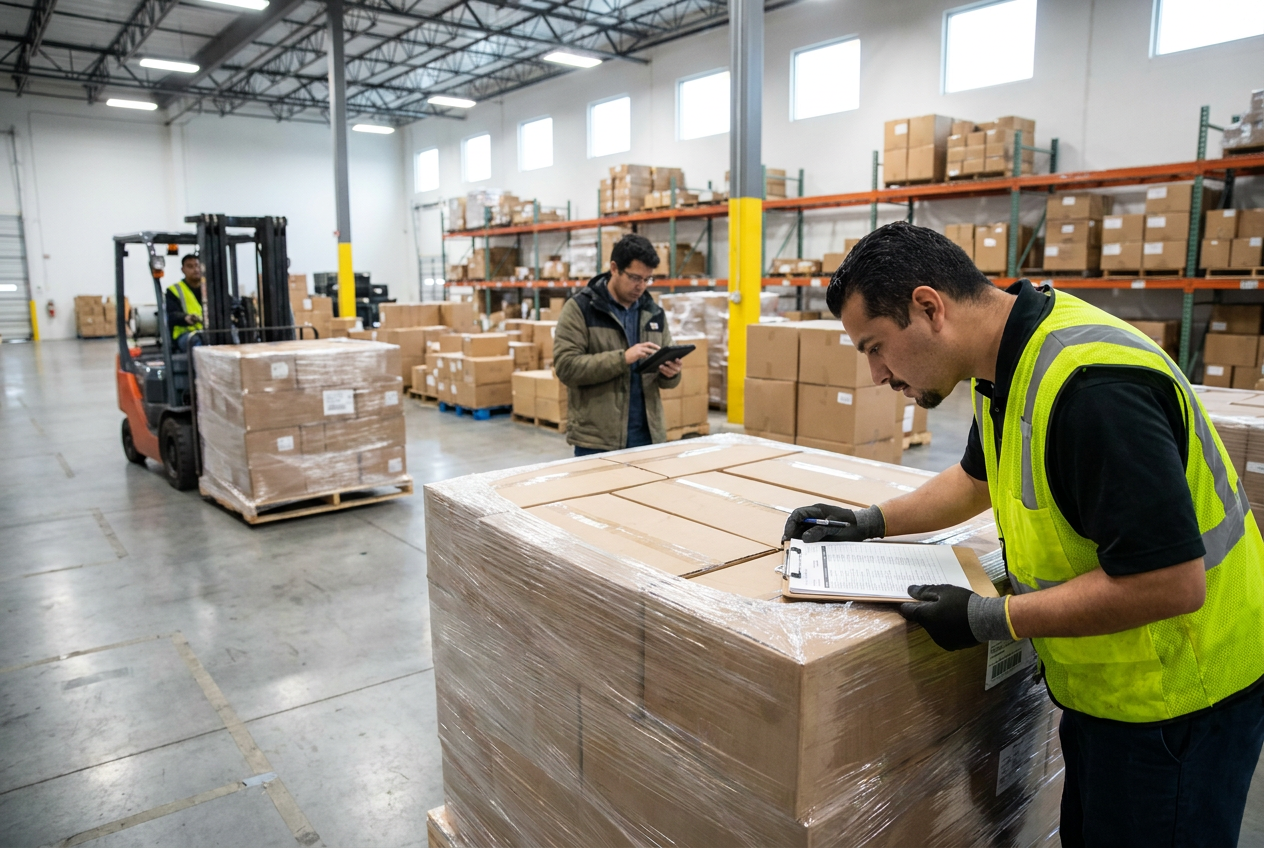
Confirm shipping expectations and inspect delivery
PalletCove ships from Dallas. Handling takes 1–3 business days after payment clears; transit is typically 3–7 business days from Dallas. These are separate stages, and submitting a transfer does not necessarily mean it has cleared.
The same free-shipping terms apply to liquidation pallets in Texas and liquidation pallets in Florida, as well as the other contiguous states. Review the shipping policy and confirm receiving details before ordering.
Ask whether the shipment will move by LTL, meaning less-than-truckload, or as a full trailer. Confirm site access, unloading capability, receiving hours, and appointment requirements. Do not assume that your location can accept every load configuration.
On delivery day:
- Match the shipment reference and pallet or handling-unit count against available paperwork.
- Photograph the load before unloading where safe and permitted.
- Record visible damage, disturbed wrapping, or missing handling units on the delivery receipt before signing where possible.
- Retain the bill of lading, delivery receipt, labels, and relevant packaging.
- Compare received merchandise with the applicable manifest or category-level description and document discrepancies promptly.
Signing for handling units is not the same as testing every item. Visible transit damage, inventory discrepancies, and ordinary as-is merchandise issues should be documented separately.
What to do after a suspicious payment or shipment problem
If you suspect money went to the wrong recipient, contact your bank or card issuer immediately using its official number. Explain that the payment may involve supplier impersonation and ask what recall, fraud-reporting, or dispute options apply. Recovery is not guaranteed, and delay can reduce available options.
Notify the genuine supplier through a verified channel. Preserve original emails, headers, invoices, account instructions, screenshots, transaction references, and a timeline. In the United States, suspected internet-enabled fraud can also be reported to the FBI’s Internet Crime Complaint Center and appropriate law enforcement.
For merchandise concerns, read the refund and claims policy before ordering and follow its current requirements. Do not assume an automatic return right, a particular claim deadline, or a guaranteed remedy. As-is terms make understanding the written claim process especially important.
Common mistakes include trusting a familiar email thread, paying before resolving invoice differences, treating a manifest as an authenticity certificate, and waiting to preserve evidence. Another is confusing a disappointing assortment with payment fraud: the relevant evidence and response differ.
Frequently asked questions
Is paying by domestic wire automatically a scam?
No. Domestic bank wire is one of PalletCove’s accepted payment methods, alongside credit/debit card and ACH bank transfer. Verify the recipient independently because recovering a misdirected wire can be difficult.
Can a scammer reply inside a real supplier email thread?
Yes. A compromised mailbox can let an attacker use real order details and familiar conversation history. Verify sensitive payment instructions outside that thread using a trusted phone number.
What if the bank account name differs from the invoice seller?
Pause payment and request an explanation. Independently confirm both the relationship and the destination through the genuine supplier; an explanation in the same email is not enough.
Does a manifest guarantee the merchandise will work?
No. A manifest is an inventory reference, not a functionality guarantee or proof of payment authority. PalletCove merchandise is sold as-is for resale, so review the specific condition description and applicable terms.
When should I expect a PalletCove order to ship?
Handling takes 1–3 business days after payment clears, followed by typical transit of 3–7 business days from Dallas. Free shipping is the only delivery option on every order to all 48 contiguous states, with freight included in the listed price.
Talk to PalletCove Liquidation
Before paying, resolve questions about the load, invoice, or payment destination with PalletCove Liquidation LLC. If instructions change unexpectedly, pause and independently verify them.
- Address: 4820 Cove Industrial Blvd, Dallas, TX 75236.
- Phone: (713) 819-3904.
- Email: sales@palletcoveliquidation.com.
- Hours: Mon–Fri 8:00 AM – 6:00 PM CT, Sat 9:00 AM – 2:00 PM CT, Sun closed.
To review an order before authorizing payment, contact our order desk. When you are ready to compare available lots, browse current inventory.