
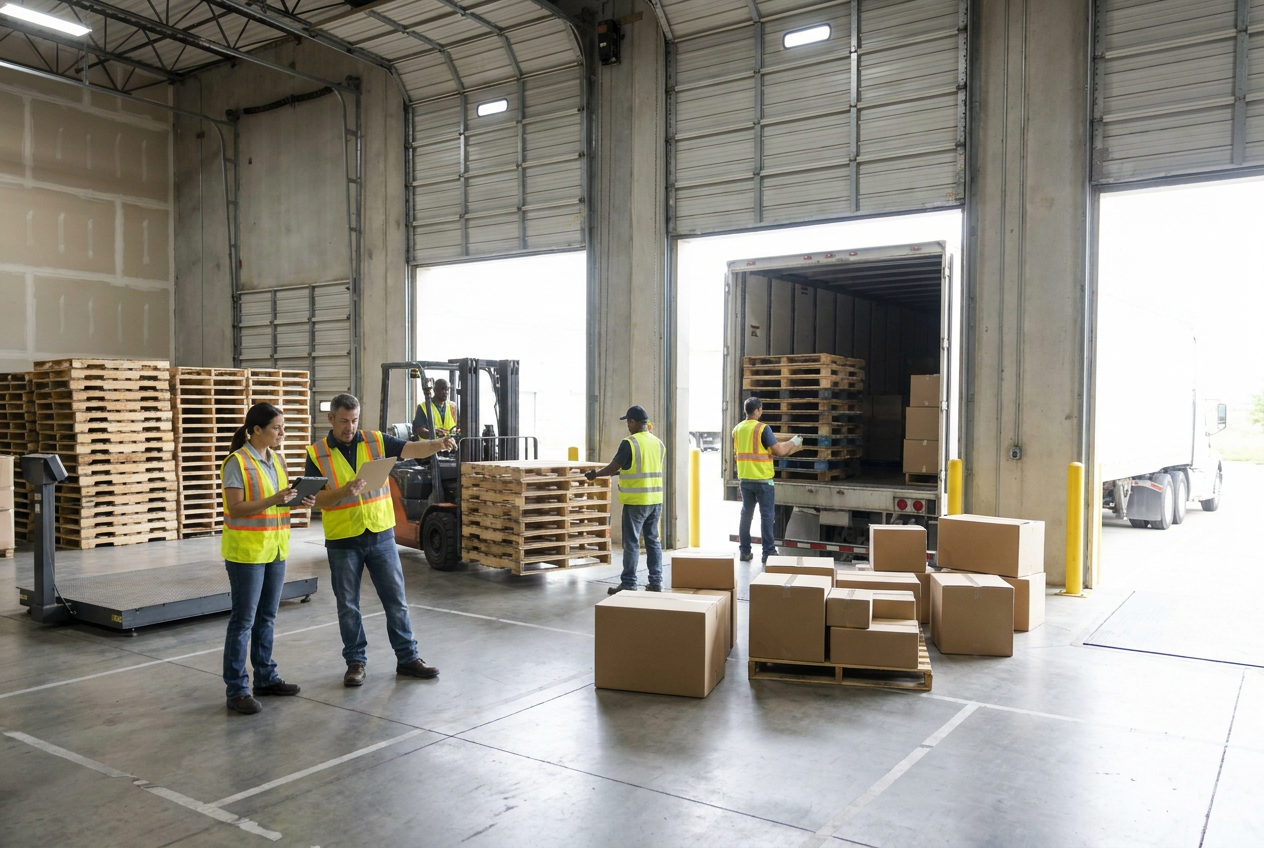
A standard 53-foot dry van commonly accommodates 26 standard 48-by-40-inch pallets in a single layer using a straightforward loading pattern. That is a useful starting point for estimating liquidation truckload pallet count—not a guarantee that every truckload contains 26 pallets.
Actual counts depend on pallet dimensions, merchandise overhang, loaded height, total weight, stacking restrictions and whether the goods arrive palletised or floor-loaded. A trailer can reach its usable capacity before every floor position is occupied, and a floor-loaded truckload may contain no shipping pallets at all.
For independent resellers, the important question is not simply how many pallets fit. It is whether the specific load fits your unloading equipment, receiving area, processing capacity and budget. Here is how to evaluate those requirements before ordering from PalletCove Liquidation.
Standard trailer capacity and pallet-count basics
A liquidation pallet is a shipping platform holding merchandise offered for resale. A truckload describes a bulk shipment or sales lot; it does not, by itself, establish an exact pallet count, unit count or merchandise condition.
A pallet position is a floor location occupied by one pallet. It differs from a physical pallet count when goods are stacked two pallets high. It also differs from a pallet equivalent, which may be an estimate of merchandise volume rather than an actual shipping platform.
| Trailer or loading arrangement | Practical starting point | What to verify |
|---|---|---|
| --- | --- | --- |
| 53-foot dry van, standard straight loading | Commonly 26 standard pallets, single layer | Interior clearance, overhang and weight |
| 48-foot dry van, standard straight loading | Commonly 24 standard pallets, single layer | Actual equipment and load dimensions |
| Turned or mixed-orientation pattern | May differ from standard straight loading | Pallet width, loading clearance and securement |
| Double-stacked pallets | More pallets than floor positions may be possible | Stackability, height, strength and weight |
| Floor-loaded cartons | No fixed physical pallet count | Carton count, volume and unloading method |
The familiar 26-pallet arrangement uses two 48-by-40-inch pallets across the trailer, with the 48-inch dimension running along its length. Thirteen rows occupy 624 inches, or 52 feet. Real loading still requires suitable interior dimensions and clearance; nominal trailer length alone does not approve a loading plan.
Start with the liquidation pallets inventory hub to distinguish individual pallet offers from truckload listings. For broader terminology, the liquidation overview guide explains how bulk resale lots differ from ordinary retail purchases.
Treat 26 pallets as a planning reference for a standard 53-foot trailer, not as a promised liquidation truckload pallet count.
Why weight and dimensions change the count
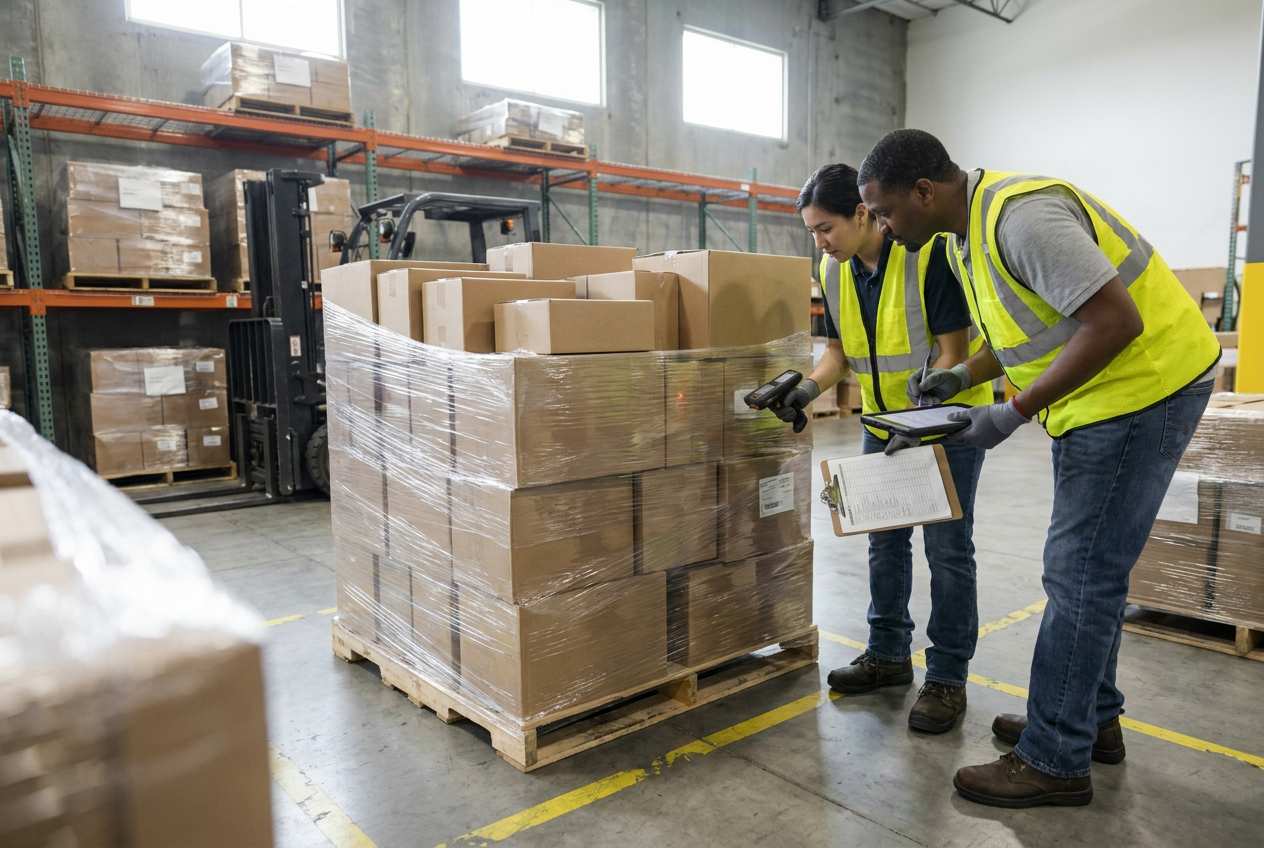
Trailer space is only one constraint. The carrier must also account for vehicle weight, axle loading and safe weight distribution.
On many Interstate routes, the standard federal gross vehicle weight limit is 80,000 pounds, subject to axle, bridge-formula and route requirements. That figure includes the tractor, trailer, fuel, equipment and cargo—not just merchandise. Dry-van cargo capacity is often roughly 42,000–45,000 pounds, but the carrier must confirm the specific equipment's available payload.
Consider a hypothetical 26-pallet load averaging 1,800 pounds per pallet, including the pallet and packaging. Its cargo weight would be 46,800 pounds. It could exceed available payload despite fitting the trailer floor. These figures illustrate the calculation, not a PalletCove listing specification.
Other constraints include:
- Oversized footprints: Furniture, appliances and projecting cartons can occupy more than one standard position.
- Loaded height: Include the wooden pallet, packaging and any protruding merchandise.
- Door clearance: A load that fits inside must still pass through the trailer opening.
- Fragility: Crushable cartons and unstable returns may not support another pallet.
- Weight distribution: Heavy pallets cannot simply be placed wherever floor space remains.
Never assume a forklift can safely move a pallet based only on its rated capacity. Load centre, attachment use and lift height also affect safe handling.
Palletised, floor-loaded, LTL and full-trailer loads
Palletised merchandise arrives grouped on platforms that suitable forklifts or pallet jacks can move. It is generally easier to count at delivery, although cartons hidden inside a wrapped pallet still require later verification.
Floor-loaded merchandise is placed directly on the trailer floor, commonly as individual cartons or loose items. It can use space differently because pallets do not occupy the floor or add height, but unloading may require substantially more manual handling, conveyors and sorting space.
If you receive floor-loaded goods, ask for the carton or piece count, estimated cargo weight and unloading requirements. Do not convert cartons into a precise pallet count without knowing their dimensions, weights and permitted stacking height.
LTL means less-than-truckload transportation: shipments share trailer capacity with other freight. Full truckload generally refers to freight moving with a dedicated trailer, but a commercial listing labelled “truckload” still needs its own quantity and configuration details. Neither term guarantees a completely filled trailer.
Compare the truckload merchandise category with general merchandise liquidation lots, then use the buying liquidation truckloads guide to frame questions about the particular offer.
Condition grades and manifests: what the count cannot tell you
Twenty-six pallets of textiles and twenty-six pallets of mixed hardware can differ dramatically in weight, unit count and processing time. Condition adds another layer of variation.
Common descriptions include:
- Overstock: Excess inventory that was not sold through its original channel; storage or packaging issues may still exist.
- Shelf pulls: Merchandise removed from selling floors, potentially with labels, handling wear or damaged packaging.
- Customer returns: Previously purchased goods returned for varied reasons; completeness and functionality can vary.
- Salvage: Merchandise that may require repair, parts recovery or disposal rather than normal resale.
Condition grades are not universally standardised. A tier number or grade label must be interpreted using the specific listing's definition, not assumptions borrowed from another supplier. All PalletCove merchandise is sold as-is for resale.
A manifest is an inventory document, not automatically a testing report. Depending on the lot, it may identify descriptions, quantities, identifiers and condition information. Ask whether quantities refer to individual units, cartons, bundles or sets, and whether the document covers the exact lot offered.
Use the guide to reading a liquidation manifest to check totals and ambiguous entries. For category-level lots without itemised detail, establish what information is available before payment.
For example, review the specific terms of the Amazon General Merchandise Truckload and Macy’s Textile Truckload rather than assuming equal pallet counts mean equivalent contents. Product names alone do not establish configuration or condition. PalletCove is an independent reseller and is not affiliated with, endorsed by or sponsored by any retailer named.
Pricing structure and ordering checks
First establish what the listed price purchases: one pallet, a multi-pallet lot or an entire truckload. Dividing the price by a presumed 26 pallets can distort your comparison when the actual load uses oversized pallets or ships floor-loaded.
Free shipping is the only delivery option on every order to all 48 contiguous states. Freight is included in the listed price. For your internal budget, separately estimate your own receiving labour, storage, testing, repacking and disposal needs.
Price per pallet is a handling-oriented comparison, not a measure of resale value. Price per listed unit can also mislead when quantities include sets, incomplete goods or salvage.
Before placing an order:
- Confirm the exact listing and whether it is manifested or category-level.
- Verify physical pallet count, dimensions, loaded heights and available weight information.
- Establish whether unloading is palletised, floor-loaded or mixed.
- Review condition descriptions, exclusions and applicable policies.
- Confirm the delivery address, access and receiving equipment.
- Pay using credit/debit card, ACH bank transfer or domestic bank wire.
PalletCove covers sales tax on qualifying orders. Ask whether your order qualifies and whether a resale certificate or other business documentation is needed; a certificate does not establish universal eligibility by itself.
Free shipping and delivery timing from Dallas
Handling takes 1–3 business days after payment clears. Transit is typically 3–7 business days from Dallas. These are separate stages: do not schedule receiving staff as though transit begins immediately when payment is submitted.
Free shipping is the only delivery option, with freight included in the listed price for every order throughout the 48 contiguous states. Review the shipping policy and delivery requirements before ordering, particularly when your location lacks a dock or has restricted truck access.
Whether you are sourcing liquidation pallets in Texas or liquidation pallets in Florida, confirm the actual receiving arrangement rather than assuming standard equipment will suit your property.
Provide an accurate business address, receiving contact and operating hours. Flag gates, narrow turns, overhead obstructions, parking restrictions and any lack of dock access in advance. Confirm scheduling and unloading arrangements before dispatch; free shipping does not determine what equipment your site can safely use.
Plan receiving space before the trailer arrives
A standard 48-by-40-inch pallet occupies approximately 13.33 square feet. Twenty-six such pallets therefore cover about 347 square feet of bare footprint. That excludes aisles, inspection stations, overhang, emergency access and equipment turning space.
Do not treat 347 square feet as a workable warehouse requirement. Sketch a receiving layout using actual loaded dimensions and the aisle clearances required by your equipment and site. Keep exits and fire-protection access unobstructed.
Create separate zones for:
- Newly unloaded merchandise awaiting count verification.
- Inspection, sorting and testing where appropriate.
- Sale-ready storage and order picking.
- Damaged, incomplete or questionable goods awaiting review.
- Empty pallets, packaging and disposal materials.
For floor-loaded deliveries, stage empty pallets, suitable handling equipment and enough labour to clear cartons safely. Establish a count method before unloading starts, such as tallying cartons by trailer section while assigning receiving identifiers.
Ask who is responsible for unloading and what unloading window applies. Never assume the driver will move merchandise into storage. Use trained operators, appropriate dock equipment and a safe trailer-restraint procedure; do not enter a trailer that has not been secured for unloading.
Delivery inspection, claims and mistakes to avoid
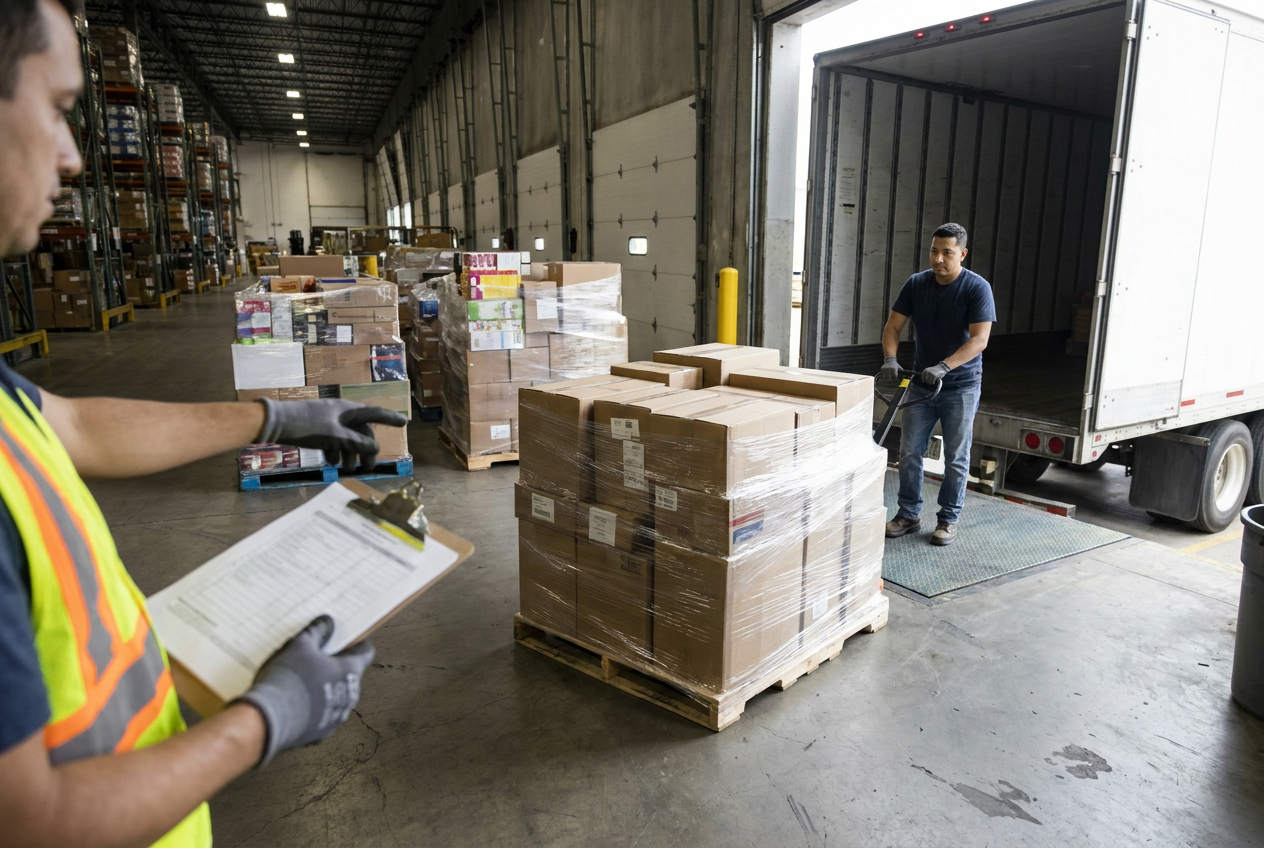
Delivery-day inspection separates shipment problems from the merchandise variability disclosed in an as-is lot. Before signing the delivery receipt, inspect accessible freight and record what you can actually verify.
- Match the shipment identifiers to your order and transportation paperwork.
- Count physical pallets, or cartons where practical for floor-loaded freight.
- Photograph visible shifting, broken wrap, crushed cartons or other damage.
- Note specific shortages or visible damage on the delivery receipt.
- Retain paperwork, photographs, packaging and affected merchandise while seeking instructions.
If wrapped contents cannot be checked at the dock, do not describe them as fully verified. Ask how to document inspection limitations. Avoid opening or entering an unstable load until it is safe.
All merchandise is sold as-is for resale. Do not assume ordinary retail returns, exchanges or condition guarantees apply. Review the refund policy and claim requirements for eligibility, evidence and any reporting deadlines, then contact PalletCove promptly about discrepancies. A report does not itself guarantee a refund or other remedy.
Common mistakes include treating every truckload as 26 pallets, assuming returned items were tested, confusing manifest units with cartons, and budgeting floor-loaded unloading like palletised unloading. Another is ordering more inventory than your team can process: receiving capacity and processing capacity are different constraints.
Frequently asked questions
Does every liquidation truckload contain 26 pallets?
No. Twenty-six standard 48-by-40-inch pallets is a common single-layer reference for a 53-foot dry van. Actual counts depend on dimensions, weight, loading pattern and the specific lot.
Can a truckload contain more than 26 pallets?
Yes, some configurations allow more physical pallets through different loading patterns or safe stacking. That requires suitable dimensions, stable freight, sufficient clearance and compliance with weight limits; it should never be assumed from trailer length alone.
How many pallets are in a floor-loaded truckload?
A floor-loaded shipment may arrive with no pallets. Its eventual pallet count depends on how you sort and stack the goods after unloading, so request carton counts, dimensions and weight information instead.
How much space should I reserve for a truckload?
Twenty-six standard pallets occupy about 347 square feet before aisles or work areas. Your receiving plan must add equipment clearance, inspection space and safe access, using the actual load dimensions rather than a universal multiplier.
How long does PalletCove truckload delivery take?
Handling takes 1–3 business days after payment clears, followed by typical transit of 3–7 business days from Dallas. Free shipping is the only delivery option on every order to all 48 contiguous states, and freight is included in the listed price.
Talk to PalletCove Liquidation
Before ordering, share your receiving setup and the listing you are considering. Ask for the available pallet count, load dimensions, weight information, manifest details and unloading requirements so you can plan around the actual shipment.
PalletCove Liquidation LLC
4820 Cove Industrial Blvd, Dallas, TX 75236
Phone: (713) 819-3904
Email: sales@palletcoveliquidation.com
Hours: Mon–Fri 8:00 AM – 6:00 PM CT, Sat 9:00 AM – 2:00 PM CT, Sun closed
For help evaluating a load, contact our order desk or browse current inventory.