
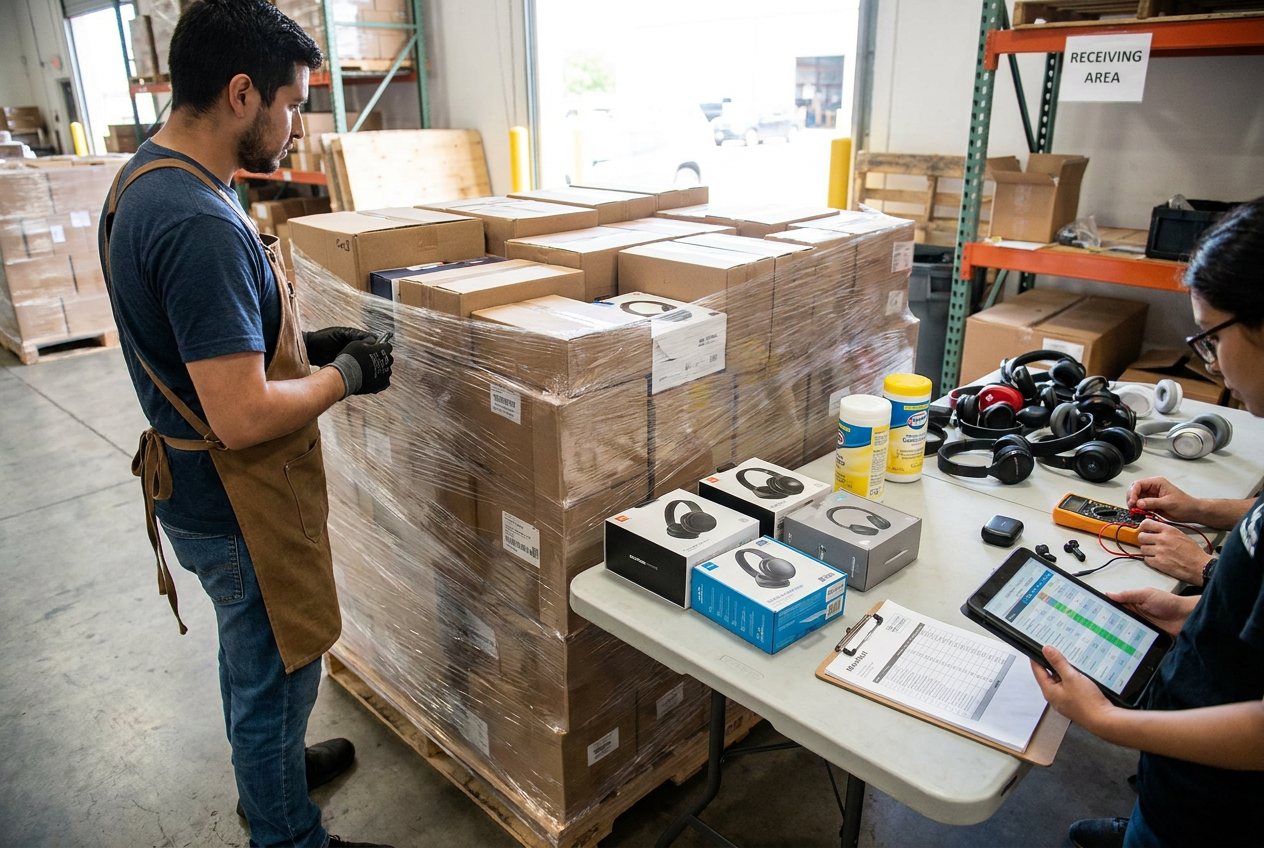
Buying open box headphones wholesale requires more than checking whether a charging light turns on. A headset may pair successfully but lose its connection during calls, while wireless earbuds may contain mismatched components or batteries that discharge at different rates.
For independent resellers, the goal is to establish what a lot contains, what testing it needs and what can be accurately described to the next buyer. Packaging appearance alone cannot establish functionality, hygiene or compatibility.
PalletCove Liquidation supplies category-level liquidation pallets and full truckloads from Dallas, Texas. All merchandise is sold as-is for resale. This guide explains how to evaluate headphone inventory without treating an open box label as a performance guarantee.
1. Understand open box conditions and load types
Open box generally means packaging has been opened; it does not necessarily mean unused, complete, tested or refurbished. Condition grade definitions vary between sellers, so use the specific listing and written disclosures rather than assuming a universal grading standard.
| Description | What it generally describes | What to verify |
|---|---|---|
| --- | --- | --- |
| Open box | Opened packaging, potentially handled merchandise | Use, completeness and documented testing |
| Customer returns | Merchandise returned by a previous buyer | Return reasons, wear and functional defects |
| Overstock | Excess inventory not necessarily previously sold | Storage age, seals and battery condition |
| Shelf pulls | Merchandise removed from retail display or shelves | Demo use, packaging damage and missing accessories |
| Salvage | Inventory intended for repair, parts or recovery | Safety, repair practicality and usable components |
A liquidation pallet concentrates inventory into a receiving unit that may be manageable for a smaller operation. A truckload typically requires full trailer receiving capacity and substantially more sorting space. Neither format implies a particular headphone condition.
Start with the liquidation pallets hub, then compare types of liquidation pallets and the receiving considerations in buying liquidation truckloads. A headphone-focused lot and a mixed-electronics load create different workloads, even when their purchase prices are similar.
2. Read the manifest before estimating usable inventory
A manifest is an inventory description, not automatically a functional test report. Ask whether quantities represent complete headphone sets, individual earbuds, charging cases or assorted accessories. A high piece count can be misleading when components are counted separately.
Request or verify:
- Exact model numbers, generations and manufacturer part numbers.
- Quantities by model and stated condition grade.
- Whether testing was performed, what it covered and when.
- Included cases, ear tips, cables, adapters and wireless dongles.
- Whether photographs show the actual lot or representative inventory.
- How shortages, substitutions and manifest discrepancies are addressed.
For true wireless earbuds, identify the left earbud, right earbud and charging case separately. Visually similar generations may not pair or charge together. Retail packaging can also contain a different model from the one printed on the box.
Browse general merchandise inventory and truckload inventory to understand available load formats. Listings such as the Amazon General Merchandise Truckload and Amazon High Piece Truckload are broader load options, not evidence that headphones are included; confirm the current contents before purchasing.
PalletCove is an independent reseller and is not affiliated with, endorsed by or sponsored by any retailer named.
3. Use a repeatable pairing and audio test
Set up a testing station with known-good audio sources, suitable cables and a model-by-model checklist. Assign each unit an inventory ID so a passing result cannot accidentally be applied to a different headset.

Follow this sequence:
- Inspect for damage before applying power, especially swelling, exposed wiring or damaged charging ports.
- Follow the manufacturer's reset procedure and remove previous pairings where possible.
- Pair with a known-good phone or computer and verify that the expected model appears.
- Play left/right channel identification audio at a moderate volume; check for missing channels, distortion and imbalance.
- Test microphone recording and a call, because media playback alone does not establish microphone performance.
- Check buttons, touch controls, volume changes and automatic pause where supported.
- Test active noise cancellation and transparency modes separately, if fitted.
- Disconnect, restart and reconnect; then walk a consistent indoor route to check for obvious dropouts.
Use a second device to investigate failures rather than immediately blaming the headphones. Computer audio settings can select a lower-quality hands-free profile during microphone use; that behavior is not necessarily a hardware defect.
A pairing pass is one test result—not proof of battery health, complete compatibility or resale readiness.
Record what passed, what failed and what remains untested. Avoid calling a unit “fully tested” when the actual procedure covered only power and Bluetooth discovery.
4. Check batteries beyond the charging indicator
Rechargeable headphones can accept a charge yet provide little usable runtime. Battery percentage displays are estimates, and a brief charging test cannot establish remaining capacity.
For safe-looking units, use manufacturer-compatible charging equipment and note the starting charge, charging behavior and any abnormal warmth. Do not charge swollen, leaking, unusually hot or physically damaged battery products. Isolate them from sale and seek appropriate battery-handling and recycling guidance; do not place them in ordinary trash.
A practical runtime screen should use consistent volume, audio content and feature settings. Record the test duration and ending charge, and watch for unexpected shutdowns. Short screening tests can identify obvious problems, but claims about full runtime require a sufficiently long, controlled test.
For true wireless sets:
- Track left and right earbud discharge separately.
- Confirm both earbuds seat correctly and charge in the case.
- Inspect charging contacts for corrosion or contamination.
- Verify the case accepts power and transfers charge to both earbuds.
- Recheck after an idle period for abnormal self-discharge.
Overstock is not exempt from battery risk: batteries age during storage. Do not present the manufacturer's original runtime specification as a measured result for a particular open box unit.
5. Treat ear-contact hygiene as a separate workflow
Functional headphones may still be unsuitable for immediate resale. Ear tips, cushions, headbands and microphone windscreens can retain skin oils, earwax, odors and other contamination.
Separate incoming inventory from cleaned inventory. Inspect before cleaning, and follow manufacturer guidance for the specific materials. Avoid spraying liquid into drivers, microphones, seams or charging ports; strong solvents can damage coatings and adhesives.
Replace disposable or unsuitable ear-contact components with correctly fitting replacements where practical. Foam tips and deteriorating cushions may not be suitable for reuse. If replacements are third-party parts, disclose that fact rather than implying they are original accessories.

Allow cleaned components to dry fully before charging, testing or packing. Record replaced parts and residual wear. “Cleaned” is a narrower statement than “disinfected” or “sterilized”; use only claims supported by the actual procedure and applicable product instructions.
Check applicable marketplace rules for used personal-audio products. A platform may restrict condition descriptions or require disclosures beyond your normal listing template.
6. Verify model and device compatibility
Bluetooth connectivity does not mean every feature works on every device. Basic stereo playback, call handling, app support, codecs, multipoint connectivity and spatial-audio features can have different requirements.
Build a compatibility record for each model covering:
- Phones and computers: Operating systems tested, required apps and feature limitations.
- Gaming systems: Whether a proprietary dongle, console-specific version or wired connection is required.
- Wired connections: Connector type and whether the source supports the required audio format or adapter.
- Charging: Required cable, connector and supported charging method.
- Replacement components: Exact compatible earbud generation, case model, cushions and cables.
A USB-C connector alone does not establish audio compatibility. Likewise, a headset designed for one console ecosystem may lack equivalent wireless functionality on another. Check the manufacturer's model-specific documentation instead of relying on the product family's name.
Some models may retain account associations or device-finding features. Follow supported removal procedures and do not attempt to bypass ownership protections. Keep unresolved units out of ready-for-sale stock and disclose unresolved limitations if they are sold for parts where permitted.
7. Price the workload, not just the piece count
PalletCove's listed price includes freight. Free shipping is the only delivery option on every order to all 48 contiguous states, so do not add inbound freight a second time when evaluating the purchase.
Your internal processing budget should still include testing labor, replacement ear-contact parts, compatible accessories, cleaning materials, packaging, selling-platform costs and responsible disposal. These are operating costs, not predictions of resale value.
A useful planning calculation is:
Acquisition and preparation cost per ready unit = (lot purchase price + preparation costs) ÷ actual ready-for-sale units.
Before inspection, the denominator is uncertain. Model several possible usable-unit counts rather than treating every manifest line as a complete, working set. Maintain a separate record for repairable items, parts-only inventory and unusable goods.
The guide to calculating a liquidation pallet buying limit provides additional budgeting context. Common mistakes include valuing incomplete earbuds as complete sets, overlooking replacement-case compatibility and buying more inventory than the testing team can process promptly. No lot offers guaranteed profit or a guaranteed condition outcome.
8. Order, receive and document the load
Before payment, confirm the exact lot, quantity basis, condition disclosures and receiving requirements. Keep the listing, manifest and written clarifications with the order record. Ask about any resale certificate documentation needed for your purchase; sales tax on qualifying orders is covered by PalletCove.
Accepted payment methods are credit/debit card, ACH bank transfer and domestic bank wire. Handling takes 1–3 business days after payment clears, and transit is typically 3–7 business days from Dallas. These are separate stages, not a guaranteed delivery date.
Review the shipping policy and confirm your receiving arrangements. Palletized shipments may travel by LTL, while larger orders may require a full trailer; clarify the arrangement for the specific order and ensure suitable unloading capacity. Free shipping is the only delivery option across the 48 contiguous states, with freight included in the listed price.
Buyers researching liquidation pallets in Texas or liquidation pallets in Florida receive the same stated free-shipping coverage.
Delivery-day inspection and claims
Before breaking down the shipment, photograph all sides, labels, wrapping and visible damage. Compare the received pallet or carton count with the delivery paperwork, note visible exceptions before signing where possible, and retain packaging while discrepancies are investigated.
Reconcile contents against the manifest during sorting. Keep transportation damage, quantity discrepancies and functional defects in separate records, with inventory IDs and photographs connecting each issue to the order.
All merchandise is sold as-is for resale. Review the refund and claims policy before ordering for applicable eligibility, reporting requirements and deadlines; do not assume routine consumer returns or a working-unit guarantee. Report concerns promptly with the order number, delivery records, photos and itemized findings. Documentation supports review but does not guarantee an adjustment.
Frequently asked questions
Are open box headphones guaranteed to work?
No. Open box describes packaging status, not a universal testing standard. PalletCove merchandise is sold as-is for resale, so evaluate the listing's specific disclosures and plan your own inspection.
Can I sell earbuds with a replacement charging case?
First verify that the exact case model supports both earbuds and that pairing and charging work correctly. Disclose the replacement, whether it is original or third-party, and any limitations. A case that physically fits is not necessarily compatible.
How long should a battery test last?
Match the test length to the claim you intend to make. A short screen can reveal immediate shutdowns, but it cannot verify full runtime. Record volume, enabled features and duration so your results have context.
Is a smaller pallet better than a truckload for a first purchase?
A smaller lot may be easier to receive, test and document with limited staff. It does not necessarily have better condition or lower per-unit processing costs. Choose a quantity that fits your available space and realistic testing capacity.
What should a resale listing disclose?
Identify the exact model, tested functions, cosmetic wear, included accessories and replaced ear-contact parts. State battery observations accurately and distinguish untested features from known defects. Do not imply a manufacturer warranty unless you have verified that coverage applies.
Talk to PalletCove Liquidation
Discuss your preferred headphone models, acceptable condition grades and receiving capacity before selecting inventory. Ask what lot-specific documentation is available and leave room in your workflow for pairing, battery, hygiene and compatibility checks.
PalletCove Liquidation LLC is located at 4820 Cove Industrial Blvd, Dallas, TX 75236.
- Phone: (713) 819-3904
- Email: sales@palletcoveliquidation.com
- Hours: Mon–Fri 8:00 AM – 6:00 PM CT, Sat 9:00 AM – 2:00 PM CT, Sun closed
To discuss a lot, contact our order desk or browse current inventory.