
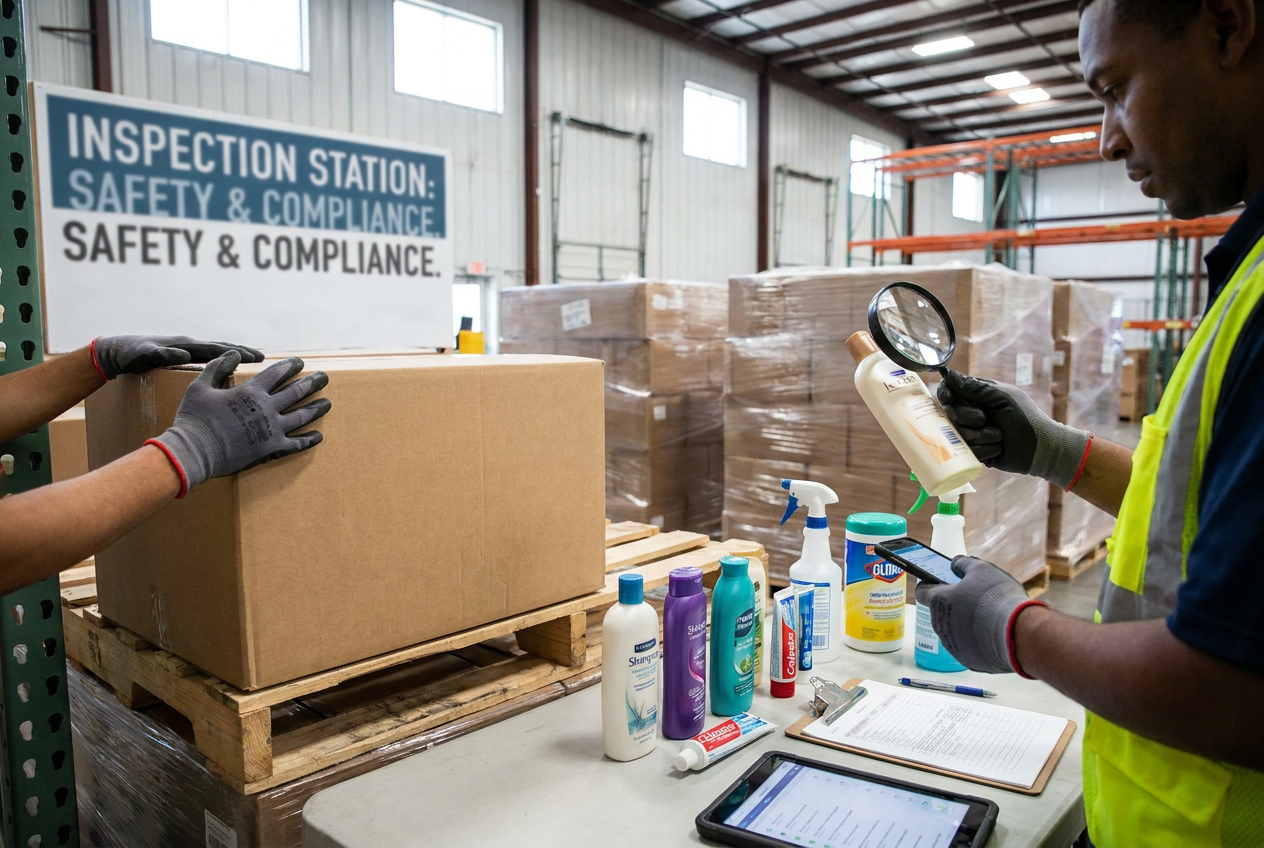
Personal care liquidation pallets require more than a count of bottles and boxes. A sealed shampoo bottle, an opened cosmetic jar, and an expired sunscreen may arrive in the same broad merchandise category, but they require different resale decisions. The first job is identifying what each product is and whether its identity, packaging, and history support resale.
PalletCove Liquidation supplies manifested and category-level liquidation pallets and full truckloads to independent resellers from Dallas, Texas. All merchandise is sold as-is for resale. A category description, manifest, or condition grade helps you evaluate a purchase; none replaces an item-level safety inspection.
This guide explains how to separate cosmetics and toiletries from household chemicals, review a load before ordering, and build a receiving process that keeps questionable products out of saleable inventory.
What belongs in a personal care liquidation pallet?
Personal care is a merchandising label, not a single regulatory classification. These pallets may include cosmetics, grooming supplies, toiletries, or products regulated as drugs. Classification depends partly on intended use and labeling claims, not just the aisle where a product was displayed.
| Product group | Typical examples | Main inspection concern |
|---|---|---|
| --- | --- | --- |
| Cosmetics and ordinary toiletries | Lipstick, lotion, nonmedicated shampoo, body wash | Tampering, contamination, packaging integrity, identity |
| OTC drugs or cosmetic-drug combinations | Sunscreen, acne treatments, antiperspirants, some dandruff shampoos | Drug Facts labeling, expiration, storage, recalls |
| Hygiene accessories | Toothbrushes, razors, applicators | Unused condition, protective packaging, complete components |
| Household cleaning products | Bleach, surface cleaners, laundry detergent | Chemical leaks, warnings, incompatible storage |
| Disinfectant products | Certain surface sprays and wipes | EPA-regulated claims, label directions, container integrity |
Household cleaners are not toiletries. Do not merchandise a surface disinfectant as a skin product, even if its packaging resembles personal wipes. Hand sanitizers are generally regulated as OTC drugs in the United States; surface disinfectants commonly fall under EPA pesticide rules.
The broader liquidation pallets inventory hub is a starting point for comparing formats. For personal care, ask specifically whether household chemicals are mixed into the offered lot.
Load types and condition grades: know what you are buying
A manifested load provides an itemized description of expected contents, with detail varying by listing. A category-level lot describes the merchandise grouping without necessarily identifying every unit. Neither format establishes that every product is sealed, current-dated, or suitable for resale.
Common condition descriptions include:
- Overstock: excess inventory, which still needs checks for age, storage damage, and recalls.
- Shelf pulls: merchandise removed from selling shelves, potentially carrying stickers, faded packaging, or short remaining shelf life.
- Customer returns: goods returned after purchase, with uncertain opening, use, or storage history.
- Salvage: heavily compromised merchandise that may be unsuitable for consumer resale and require disposal.
Condition grades are not universal standards. Ask what the seller's grade means for the specific lot, whether conditions are mixed, and whether any inspection was a sample or an item-by-item review. “Uninspected” does not mean unused.
Review the guide to liquidation pallet types alongside the listing. Compare general merchandise lots with truckload inventory, but do not assume either category guarantees personal care contents.
A liquidation pallet may move by LTL, meaning less-than-truckload freight shared with other shipments. A truckload involves a full trailer shipment; confirm the stated pallet count, dimensions, and receiving requirements rather than assuming a standard configuration.
Read the manifest and calculate the real buying cost
Request the current manifest, when available, and confirm whether it describes the exact offered load or is illustrative. Useful fields include product name, brand, UPC, size, quantity, condition, lot number, and expiration date where applicable. Missing fields are unanswered questions, not evidence that products are acceptable.
Reconcile case quantities with individual units. Twelve cases of six bottles differ substantially from twelve bottles, and a multipack UPC may not identify an individual retail unit. Shade, fragrance, formulation, and package size also matter when matching inventory to listings.
For mixed-load comparisons, review the Amazon General Merchandise Truckload listing and WM GM Truckloads Pallets listing. These are broader merchandise options, not evidence of a dedicated personal care assortment. Confirm actual contents and availability before buying. PalletCove is an independent reseller and is not affiliated with, endorsed by, or sponsored by any retailer named.
PalletCove's listed price includes freight. Free shipping is the only delivery option on every order to all 48 contiguous states. Sales tax on qualifying orders is covered by PalletCove; confirm qualification and documentation before payment.
Your operating budget should also account for inspection labor, segregation space, packaging, selling-platform expenses, and lawful disposal. After inspection, dividing acquisition and processing costs by the units actually released for sale gives a more useful cost measure than dividing by every manifested unit. It does not predict profit or resale value.
The liquidation pallet buying guide provides broader purchasing context. Record important representations in writing using the checklist in liquidation purchase order terms.
Safety checks: seals, date codes, leaks, and recalls

A condition grade describes inventory; it does not establish that an individual personal care product is safe to resell.
Check original packaging and signs of use
Inspect shrink bands, foil liners, induction seals, caps, pumps, and carton closures where the manufacturer normally uses them. Not every legitimate product has every seal type. Compare uncertain packaging with reliable manufacturer information rather than assuming an absent shrink band proves tampering.
Look for broken seals, residue around openings, fingerprints in creams, used applicators, displaced liners, and mismatched closures. An intact outer carton does not prove the inner container is untouched. Do not open a sound factory seal merely to inspect the contents.
Do not reseal used goods, refill containers, or present opened products as new. Cleaning the exterior cannot establish that the contents are uncontaminated.
Separate expiration dates from batch codes
A lot or batch code identifies a production batch; it may not be a readable expiration date. Ask the manufacturer to interpret unclear codes. Unofficial batch-code lookup tools should not be your only basis for releasing stock.
Most ordinary cosmetics are not required by federal law to carry expiration dates, although manufacturers may provide them. OTC drugs generally carry expiration dates and require different handling. A period-after-opening symbol, such as an open jar marked “12M,” describes use after opening, not an unopened expiration date.
Hold products with unreadable required dates, altered labels, or uncertain opening history. Exclude expired OTC drugs from resale. For dated cosmetics, follow manufacturer guidance and applicable rules, and do not override an expiration date based on appearance.
Inspect leaks and possible storage damage
Quarantine leaking, swollen, corroded, cracked, or distorted containers. Unexpected separation, discoloration, or residue can justify further review, but visual inspection cannot establish microbiological safety. Do not test questionable cosmetics on skin or deliberately sniff unknown chemicals.
Ask about storage conditions, especially for temperature-sensitive formulas and aerosols. A clean label does not prove acceptable storage. If a cleaner has leaked onto personal care goods, isolate the affected area and evaluate exposure rather than simply wiping packages dry.
Verify recalls and product identity
Check FDA recall and enforcement information for cosmetics and drugs, CPSC recalls for relevant accessories, and EPA information for relevant disinfectant products. Manufacturer notices can help confirm affected lot codes and remedy instructions.
Match brand, exact product, package size, lot, and date range. A UPC alone may not establish whether a batch is affected. Keep recalled goods out of saleable inventory and follow the applicable recall instructions. Quarantine products with suspect authenticity, missing identity information, or inadequate required labeling until resolved.
Ordering, payment, and free shipping from Dallas
Before ordering, confirm the listing, quantity basis, condition description, manifest status, known date limitations, and whether household chemicals are present. Ask what is unknown as well as what has been checked.
PalletCove accepts credit/debit card, ACH bank transfer, and domestic bank wire. Handling takes 1–3 business days after payment clears. Transit from Dallas is typically 3–7 business days; these are typical transit times, not a guaranteed arrival date.
Free shipping is the only delivery option, applies to every order, and covers all 48 contiguous states. Freight is included in the listed price. Buyers comparing liquidation pallets in Texas and liquidation pallets in Florida receive the same free-shipping coverage.
Review the shipping policy and confirm your receiving address, contact information, appointment requirements, and unloading capability before ordering. If a resale certificate is relevant to your purchase, provide valid documentation as requested; do not assume business registration alone substitutes for one.
Delivery-day inspection and controlled receiving
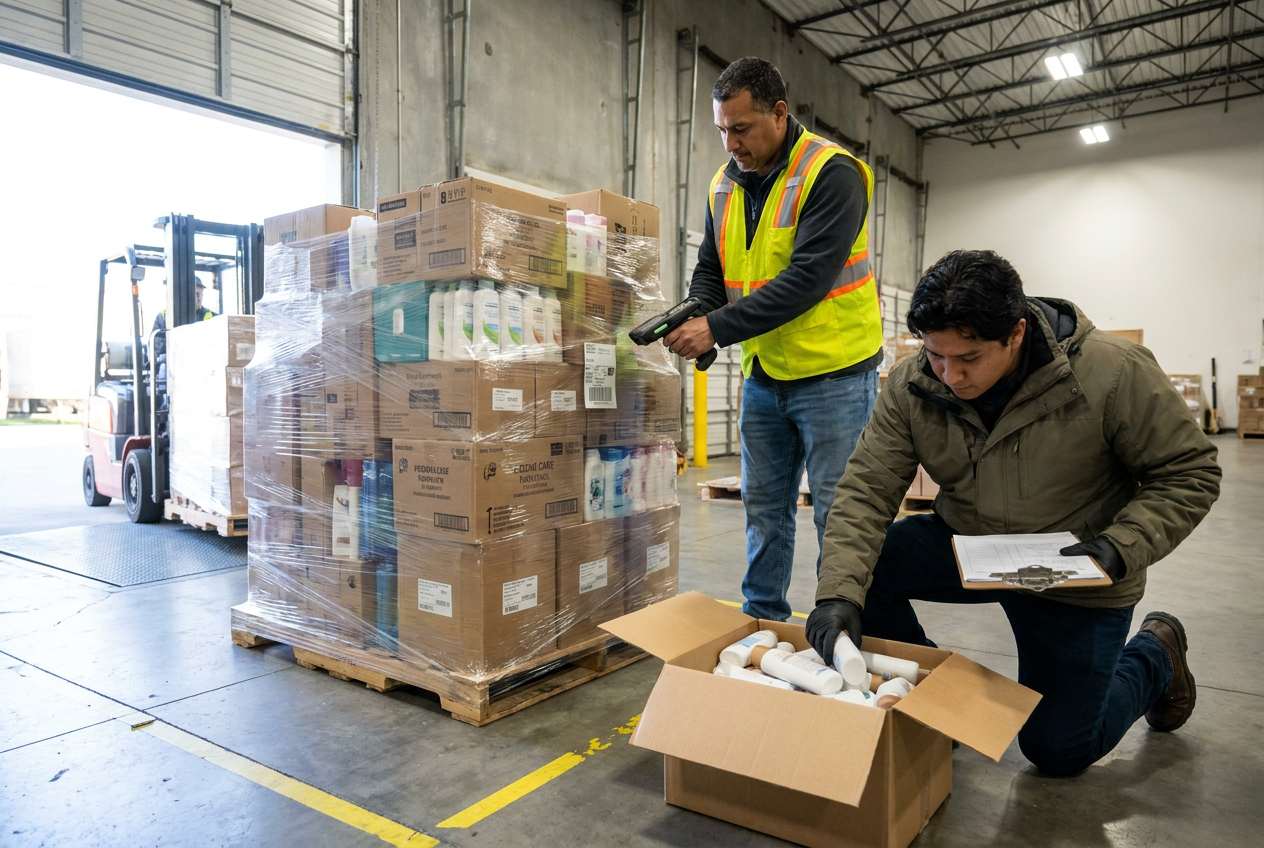
Prepare designated areas for uninspected, held, released, and rejected inventory. Keep personal care goods away from leaking cleaners and follow labeled storage instructions.
- Photograph the shipment before removing wrap, including pallet labels, visible damage, and wet cartons.
- Compare the delivered pallet or handling-unit count with the shipping documents.
- Note visible shortages or damage accurately on the delivery receipt when possible, and retain a copy.
- Unwrap safely and isolate suspect containers without opening or mixing chemicals.
- Reconcile units against the manifest, recording substitutions, missing goods, and unreadable codes.
- Complete item-level screening before releasing products for sale.
A count check is not a condition check. Outer-wrap inspection cannot detect every broken inner seal, and sampling cannot establish that every returned unit is unused. Prioritize returned cosmetics, eye and lip products, OTC drugs, and chemical-adjacent goods for careful review.
Retain photos, labels, packaging, and lot information needed for investigation. If there is an active spill or exposure concern, prioritize safety and appropriate emergency guidance over documentation.
Resale decisions, returns, and claims
Release an item only after its identity, packaging, applicable dates, recall status, and labeling have been satisfactorily checked. Confirm that your intended marketplace permits its sale; platform rules may be stricter than general resale requirements.
Keep these goods out of resale inventory:
- Opened or used cosmetics, contaminated toiletries, and used hygiene accessories.
- Recalled products and expired OTC drugs.
- Leaking containers or goods affected by unresolved chemical exposure.
- Items with unresolved authenticity concerns or missing required warnings and directions.
- Products whose safety-relevant condition cannot be established.
Use first-expire, first-out rotation for dated stock and retain lot-level records where practical. Never obscure expiration dates, lot codes, warnings, or required labels with price stickers. Avoid decanting or rebuilding compromised packages as a workaround.
All PalletCove merchandise is sold as-is for resale. Review the refund and claims policy before purchasing to understand applicable eligibility, deadlines, and procedures. Do not assume that disappointment with an assortment creates a return right or that documenting damage guarantees reimbursement.
For a concern, retain the order number, listing, manifest, delivery receipt, photos, and affected quantities. Report it promptly under the applicable policy and request instructions before returning or disposing of disputed goods, unless immediate safety needs require action. Follow local waste requirements for chemicals, aerosols, and other restricted materials.
Common mistakes that increase avoidable risk
- Treating “overstock” as proof of freshness. Age, recalls, and storage still matter.
- Counting every unit as saleable before inspection. Hold and reject quantities affect planning.
- Listing a whole pallet immediately. Unverified products can reach buyers before screening is complete.
- Confusing household wipes with body wipes. Intended use and label directions control.
- Treating a batch code as an expiration date. Verify ambiguous coding with the manufacturer.
- Assuming as-is means anything can be resold. Resellers still need to comply with applicable laws and marketplace requirements.
Start with a volume your team can inspect, store, and document. More units are not useful if questionable stock becomes mixed with released merchandise.
Frequently asked questions
Are personal care liquidation pallets always factory sealed?
No. Seal status depends on the specific assortment and condition, especially when customer returns are included. Verify expected packaging and inspect each unit before resale.
Can I resell cosmetics without expiration dates?
The absence of an expiration date does not automatically make an ordinary cosmetic unsuitable; most are not federally required to carry one. You still need to evaluate condition, manufacturer guidance, labeling, recalls, and applicable selling rules.
Does a manifest guarantee resale-ready products?
No. A manifest describes expected inventory at the level of detail provided. It does not establish that every seal is intact or every unit is safe, current-dated, or accepted by your marketplace.
How does PalletCove deliver these orders?
Free shipping is the only delivery option on every order to all 48 contiguous states, with freight included in the listed price. Handling takes 1–3 business days after payment clears, followed by typical transit of 3–7 business days from Dallas.
What should I do with recalled or leaking items?
Isolate them and keep them out of saleable inventory. Follow recall instructions or appropriate chemical-handling and disposal guidance, and preserve safe-to-collect documentation for any applicable claim.
Talk to PalletCove Liquidation
Discuss assortment details, manifest availability, condition descriptions, and receiving requirements before placing an order. You can contact our order desk or review current inventory.
- Business: PalletCove Liquidation LLC
- Address: 4820 Cove Industrial Blvd, Dallas, TX 75236
- Phone: (713) 819-3904
- Email: sales@palletcoveliquidation.com
- Hours: Mon–Fri 8:00 AM – 6:00 PM CT, Sat 9:00 AM – 2:00 PM CT, Sun closed