

Receiving a liquidation truckload starts before the trailer reaches your property. You need a confirmed receiving location, an unloading plan, people who know their roles and the order records needed to check what arrives. Without that preparation, even an otherwise straightforward delivery can become difficult to document and process.
This checklist is for independent resellers buying manifested or category-level loads from PalletCove Liquidation. It separates transportation checks from merchandise evaluation, explains what to record on delivery paperwork and outlines how to report discrepancies without assuming that every imperfect item is a shipping problem.
All merchandise is sold as-is for resale. A delivery inspection documents what arrived and its visible shipping condition; it does not establish that every item works or qualifies for a return.
1. Understand the load before delivery day
A liquidation pallet is merchandise consolidated on a pallet for bulk resale. A truckload is a larger purchase shipped as a load, but the term alone does not establish pallet count, trailer dimensions, item quantity or unloading method. Confirm those details for your actual order. The guide to buying liquidation truckloads and types of liquidation pallets provide useful purchasing context.
Load types and manifests
- Manifested load: Supplied with an inventory document that may list descriptions, identifiers, quantities and other fields. Check what the particular manifest includes and whether quantities are estimates or stated counts.
- Category-level load: Described primarily by merchandise category. Do not assume a SKU-level manifest exists unless the listing says so.
- Palletized load: Merchandise rests on pallets, generally requiring suitable mechanical handling equipment.
- Floor-loaded trailer: Cartons or goods are loaded directly into the trailer. Ask whether this applies; it changes staffing, equipment and unloading time.
LTL means less-than-truckload freight, where a shipment shares trailer space with other freight. A full trailer carries a larger load, but neither shipping description guarantees a fixed number of pallets. Your order and shipping documents govern what you should expect.
Condition grades are not transportation condition
| Term | General meaning | Receiving implication |
|---|---|---|
| --- | --- | --- |
| Customer returns | Merchandise returned by customers for varied reasons | Expect to evaluate function, completeness and packaging individually |
| Overstock | Excess inventory not sold through its original channel | Do not assume undamaged packaging or verified operation |
| Shelf pulls | Merchandise removed from sales floors or shelves | Look for labels, handling wear and missing packaging |
| Salvage | Merchandise designated for repair, parts recovery or other limited use | Plan separate assessment and appropriate disposal where needed |
Condition grade definitions vary between suppliers and listings. Read the actual description rather than treating a grade name as a universal standard. A damaged retail box may be part of the listed merchandise condition; fresh crushing across an entire wrapped pallet needs separate documentation.
Browse liquidation pallets, truckload inventory and general merchandise loads to compare formats. Product pages such as the Amazon General Merchandise Truckload and Macy’s Textile Truckload are places to check current descriptions, not evidence that every load has identical contents. PalletCove is an independent reseller and is not affiliated with, endorsed by or sponsored by any retailer named.
2. Confirm the order, price and shipping timeline
Before payment, save the listing, condition description, manifest if provided, order confirmation and any written clarifications. Ask about unclear quantities, packing format or receiving requirements before committing.
PalletCove accepts credit/debit card, ACH bank transfer and domestic bank wire. Handling time is 1–3 business days after payment clears. Transit from Dallas is typically 3–7 business days; those are separate stages, not a guaranteed delivery appointment.
Free shipping is the only delivery option on every order to all 48 contiguous states. Freight is included in the listed price. PalletCove covers sales tax on qualifying orders; confirm qualification and any documentation needed, including a resale certificate if applicable, before payment. Budget separately for your own unloading labor, storage, testing and waste handling.
The same shipping coverage applies whether you are sourcing liquidation pallets in Texas or liquidation pallets in Florida. Review the shipping policy and confirm receiving arrangements for your address rather than assuming free shipping specifies the equipment or labor supplied at delivery.
3. Set the appointment and prepare the receiving area
When scheduling information becomes available, verify the date, delivery window, carrier contact and shipment reference. Confirm whether the time is an appointment or an estimate, and make sure someone can answer the receiving phone throughout the window.
Use this pre-arrival checklist:
- Confirm the exact street address, suite, gate instructions and receiving contact.
- Tell the order desk about narrow access, low clearances, steep approaches or restricted receiving hours.
- Confirm trailer access, dock compatibility and the agreed unloading method.
- Ask who supplies unloading equipment and labor; do not assume the driver will unload.
- Verify pallet dimensions and weights when available so equipment can be selected appropriately.
- Schedule trained operators and enough help for the confirmed load format.
- Clear travel lanes and reserve staging space without blocking exits or fire equipment.
- Prepare a charged camera or phone, receiving worksheet, markers and document copies.
- Create a separate area for damaged, wet or questionable merchandise.
A pallet jack moves compatible pallets on suitable surfaces; it does not lower freight from trailer height to the ground. Any dock plate, ramp or forklift must be appropriate for the actual task and rated load. If your site cannot safely receive the shipment, resolve the plan before dispatch rather than improvising at arrival.
4. Check the shipment when the driver arrives
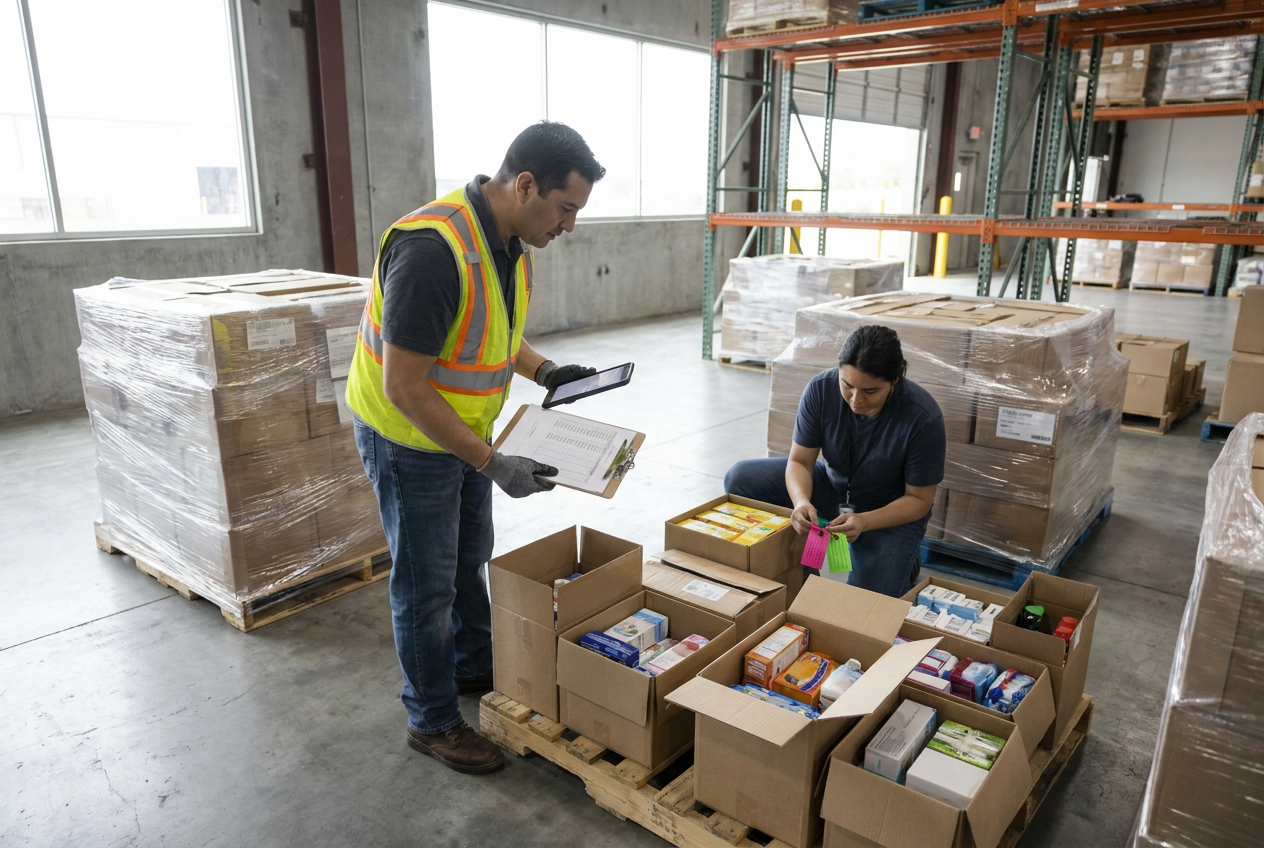
Designate one person to coordinate with the driver and maintain the receiving record. Keep other staff focused on safe unloading and counting.
- Match the shipment. Compare the destination, order reference and available shipment identifiers with your records.
- Check the documents. Review the bill of lading, delivery receipt and any listed pallet or handling-unit count.
- Record identifiers. Note the arrival time, carrier, trailer number and shipment reference as available.
- Check the seal if applicable. Record the seal number and visible condition before authorized opening. A seal discrepancy should be reported, not treated as proof of missing goods.
- Inspect from a safe position. Look for leaning stacks, fallen cartons, water intrusion or loads pressing against the doors. Trailer doors can release shifted freight when opened.
- Photograph the initial condition. Capture an overview before moving freight when it is safe and permitted.
If freight appears unstable, stop and agree on a safe approach with the driver and receiving supervisor. Do not climb into an unsafe load or enter a trailer before proper vehicle and dock safety procedures are in place.
5. Count, inspect and document the bill of lading
The bill of lading, or BOL, identifies the shipment and transportation details. The delivery receipt or electronic proof of delivery records receipt and may provide space for exceptions. Carriers may present these separately or in a combined workflow; record observations on the actual delivery record before signing.
Inspect as each handling unit comes off
Count pallets or other handling units against the shipping document. A pallet count is not an item count: receiving all listed pallets does not establish that every manifest line is present.
Look at all accessible sides for broken boards, punctures, crushed cartons, torn wrap, water staining, exposed goods and visible shortages. Give each questionable pallet a temporary receiving ID and photograph:
- The full pallet and its shipping label.
- The affected side and surrounding packaging.
- Close-ups showing the damage clearly.
- Its position in the load, if still visible safely.
Keep observations objective. “Wet cartons on lower two layers of pallet P4” is more useful than “entire load ruined.” Do not open suspicious leaking packages or handle damaged batteries without suitable safety procedures.
Write specific delivery exceptions
For an illustrative shortage, a note might read: “Shipping document lists 24 pallets; 23 pallets received after recount.” For visible damage: “Pallet P7 received with torn wrap and crushed cartons on right side; photographs taken.” Use only counts and observations you have actually verified.
Ask the driver to acknowledge the notation where the delivery process allows. If acknowledgement is declined, record that fact without confrontation and notify PalletCove promptly. Obtain a legible copy or photograph of the completed receipt, including any electronic exceptions.
The key delivery-day task is to record observable counts and damage before signing—not to diagnose every item or assume a delivery note guarantees a claim outcome.
Do not sign a clean receipt when you can see an unresolved exception. Conversely, do not declare the entire shipment damaged because you have not yet tested the merchandise. If the electronic form cannot capture your observations, ask how exceptions can be attached and send a contemporaneous written report.

6. Reconcile inventory and report issues promptly
After unloading, separate intake counting from detailed testing. Preserve pallet IDs as you sort, and reconcile a manifested shipment line by line. Record missing units, extra units, unreadable identifiers and substitutions separately rather than netting them into one total. The guide to reading a liquidation manifest explains how to structure that comparison.
For a category-level load, compare against the stated category, quantity basis and other documented commitments. Do not invent a SKU-level expectation where none was provided.
Distinguish among transportation damage, a potential order discrepancy and the as-is merchandise condition. A nonworking customer return is not automatically evidence of carrier damage or an eligible return.
Report discovered issues promptly and follow the applicable deadlines and procedures in the refund policy and your order terms. Do not assume a universal reporting window, automatic refund or replacement entitlement.
Include the following in one organized report:
- Order number, delivery date and shipment reference.
- Expected versus received handling-unit counts.
- BOL and completed delivery receipt copies.
- Photographs linked to pallet IDs and affected items.
- The relevant listing or manifest lines.
- A factual description of what was discovered and when.
Retain relevant packaging and affected merchandise when safe, pending instructions. Ask before returning, repairing or disposing of disputed goods. If the problem is concealed damage found later, document the opening sequence and report it even though it was not visible at delivery; eligibility remains subject to the applicable terms and evidence.
7. Avoid common receiving mistakes
- Treating transit estimates as appointments: Keep staff informed using confirmed scheduling details.
- Assuming unloading help is included: Verify responsibilities and equipment before the truck arrives.
- Guessing the pallet count: Recount discrepancies before recording a shortage.
- Signing first and checking later: Inspect accessible shipping condition before acknowledging delivery.
- Taking only close-up photos: Include labels and wide views so images identify the affected freight.
- Discarding packaging immediately: Preserve evidence relevant to reported damage when safe.
- Confusing as-is stock with verified working inventory: Test and grade individual merchandise before making resale claims.
- Refusing a shipment without guidance: For a serious mismatch or unsafe condition, stop and contact PalletCove and the carrier for instructions rather than assuming refusal resolves the issue.
Frequently asked questions
How long does receiving a liquidation truckload take?
Unloading time depends on load format, pallet count, equipment, staffing and site layout. Confirm these details before scheduling, and reserve additional time afterward for inventory reconciliation and testing.
Is shipping free for every PalletCove order?
Yes. Free shipping is the only delivery option on every order to all 48 contiguous states, with freight included in the listed price. Confirm the receiving setup and unloading responsibilities before dispatch.
Do I need a forklift to receive a truckload?
You need equipment suitable for the confirmed load and delivery location; a forklift is not a universal requirement for every arrangement. A dock-equipped facility may use a different safe unloading setup, while floor-loaded freight requires a distinct handling plan.
Should I open every carton before signing?
A delivery inspection generally focuses on shipment identity, handling-unit counts and accessible shipping condition. Detailed item counting and functional testing usually happen afterward, so document visible exceptions and reconcile inventory promptly.
Can I return damaged or nonworking merchandise?
All merchandise is sold as-is for resale, so damaged or nonworking items do not automatically qualify for a return. Report transportation damage or order discrepancies with supporting evidence and follow the applicable policy; no particular resolution is guaranteed.
Talk to PalletCove Liquidation
Before ordering, confirm your load format, receiving address and unloading plan with PalletCove Liquidation LLC. Use contact our order desk for order questions and browse current inventory for available listings.
- Address: 4820 Cove Industrial Blvd, Dallas, TX 75236
- Phone: (713) 819-3904
- Email: sales@palletcoveliquidation.com
- Hours: Mon–Fri 8:00 AM – 6:00 PM CT, Sat 9:00 AM – 2:00 PM CT, Sun closed