

Buying liquidation inventory involves two separate decisions: whether the merchandise fits your resale business and how the purchase should be documented for sales tax. A resale certificate can support tax-exempt invoicing where state rules allow, but it is not a universal exemption from every business purchase or future tax obligation.
For a resale certificate liquidation purchase, the practical goal is straightforward: establish who is buying, confirm that the merchandise is intended for resale, and get the correct documentation attached to the order. PalletCove covers sales tax on qualifying orders. That coverage is distinct from a legal resale exemption, so buyers should confirm the applicable treatment before payment.
This guide explains those distinctions and connects them to the everyday work of buying a liquidation pallet or truckload: checking the manifest, understanding condition grades, arranging receiving, and keeping useful records. It is general business information, not individualized tax advice.
What a resale certificate does—and does not do
A resale certificate is documentation a purchaser gives a seller to support buying qualifying merchandise without sales tax at that transaction stage because the merchandise is intended for resale. The permitted form, required information, and acceptance rules vary by state.
A sales tax permit or seller’s permit is different. It generally registers a business with a tax authority; a resale certificate documents the claimed exemption on a purchase. An EIN alone is not a resale certificate, and forming an LLC does not automatically make purchases exempt.
For Texas transactions, the Texas Comptroller’s rules and applicable resale certificate requirements matter. Interstate purchases can involve destination-state requirements and rules for accepting out-of-state documentation. Buying from a Dallas supplier does not make Texas documentation sufficient everywhere.
Typical distinctions include:
- Inventory bought to sell to customers may qualify for resale treatment.
- Equipment, shelving, or tools retained for your own operations generally are not inventory purchases for resale.
- Supplies and packaging require separate review under applicable state rules.
- Inventory withdrawn for personal or business use may create a use-tax obligation.
Your later retail sales are separate transactions. You may need to collect and remit tax unless an exemption or marketplace collection rule applies.
How PalletCove handles sales tax on qualifying orders
PalletCove covers sales tax on qualifying orders. This does not mean every order is legally tax-exempt, and it does not replace documentation needed to substantiate an exemption.
A qualifying resale transaction may receive tax-exempt invoicing where allowed and supported by acceptable documentation. Separately, PalletCove’s coverage of sales tax on qualifying orders concerns who bears that tax cost. Do not treat these as interchangeable accounting descriptions.
Before paying, review the sales tax policy for qualifying orders and ask the order desk to confirm:
- Whether the specific order qualifies for PalletCove’s sales-tax coverage.
- Whether resale-exempt treatment is available for the transaction.
- What documentation is needed before invoicing.
- How the invoice will identify the applicable tax treatment.
If the invoice does not match your understanding, request clarification rather than changing the document yourself. Do not assume a later certificate submission automatically produces a correction or refund; the available process depends on applicable law and the circumstances.
A resale certificate supports an exemption where allowed; PalletCove covering sales tax on a qualifying order is a separate matter. Confirm both the documentation and invoice treatment before payment.
Prepare your resale documentation before ordering
Provide a complete, accurate certificate using the form accepted for the transaction. Ask whether a state-specific form or an accepted multistate form is appropriate; no single certificate should be assumed valid nationwide.
Common information requested includes:
- Legal business name, business address, and relevant registration or permit number.
- The seller’s name and any other seller details required by the form.
- A description of your business and the merchandise being purchased for resale.
- The exemption basis, purchaser signature, and date.
- Whether the certificate applies to one purchase or qualifying recurring purchases, if permitted.
Use consistent business details across the certificate, order, and supporting records. Disclose differences such as a registered legal name and a trading name rather than assuming the seller will reconcile them.
Keep the submitted certificate, order confirmation, final invoice, payment record, and correspondence together. Check state retention requirements and update documentation when your business details or registration status change. A certificate accepted previously should not be treated as permanently valid for every future transaction.
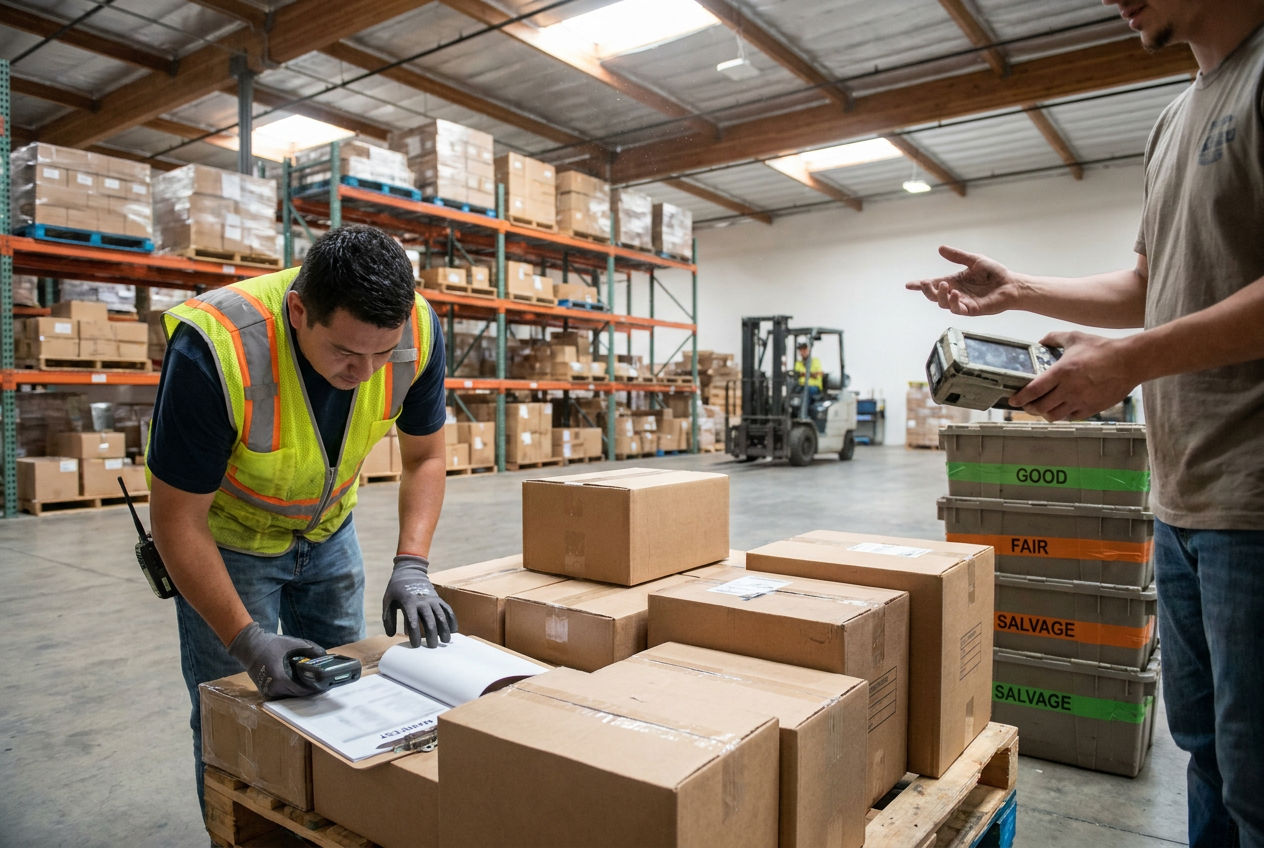
Match the load type and condition to your operation
Tax paperwork does not establish the quality, contents, or suitability of a load. All PalletCove merchandise is sold as-is for resale. Review the specific listing rather than treating a category name or condition label as a guarantee.
Start with the liquidation pallets inventory hub, then use the guide to liquidation pallet types to distinguish load formats. A manifested load includes an inventory document; a category-level load is described primarily by merchandise category and may offer less item-level visibility.
| Term | General meaning | Buyer check |
|---|---|---|
| --- | --- | --- |
| Liquidation pallet | Merchandise grouped on a pallet for bulk sale | Listing-specific quantity, category, and condition disclosures |
| Truckload or full trailer | A larger bulk shipment using a trailer | Actual load configuration, receiving space, and unloading readiness |
| Customer returns | Goods previously returned by customers | Testing status, completeness, wear, and disclosed defects |
| Overstock | Excess inventory removed from normal stock | Packaging, age, model mix, and storage-related issues |
| Shelf pulls | Merchandise removed from a sales floor or shelf | Labels, handling wear, and packaging condition |
| Salvage | Inventory described for repair, parts, recovery, or similar uses | Whether your business can safely process the disclosed material |
Condition grades are not standardized across liquidation sellers. A label such as “Tier 2” needs its listing-specific definition; it should not be translated into an assumed working-item percentage.
Compare general merchandise liquidation inventory with the truckload inventory category to narrow the format. Product pages such as the Amazon General Merchandise Truckload and Macy’s Textile Truckload provide specific starting points, but current descriptions and availability must guide the purchase.
PalletCove is an independent reseller and is not affiliated with, endorsed by, or sponsored by any retailer named.
Read the manifest as inventory evidence, not a forecast
A manifest may list product descriptions, identifiers, quantities, and other fields. Its usefulness depends on what those fields mean and whether the document represents the actual offered load. Ask whether it is final, estimated, or representative, and which statements are incorporated into the sale terms.
The line-by-line liquidation manifest guide can help you organize a review. At minimum, check:
- Quantity units: Distinguish individual pieces, multipacks, cases, and sets.
- Product identifiers: Use model numbers or UPCs to distinguish similar items.
- Condition information: Separate item-level disclosures from load-level descriptions.
- Completeness: Look for information about accessories, matching components, and packaging.
- Limitations: Identify untested goods, unknown quantities, or other disclosed uncertainty.
Any retail figures appearing in a manifest are not guaranteed resale values or evidence of profit. Your results depend on actual condition, lawful resale eligibility, demand, selling expenses, and processing work.
For a category-level purchase without an itemized manifest, ask what content information is available and what remains unknown. Do not create an assumed item list from a category title. Also check recalls, applicable product restrictions, and marketplace requirements before offering received merchandise for sale.
Understand pricing, ordering, and payment
PalletCove’s listed price includes freight. Free shipping is the only delivery option, on every order, to all 48 contiguous states. Sales tax on qualifying orders is covered by PalletCove; confirm qualification and invoice treatment rather than assuming that submitting a certificate determines both.
Your own operating costs remain separate from the inventory purchase. Budget for receiving labor, storage, inspection, testing, cleaning, repairs where appropriate, disposal, selling-platform expenses, and customer fulfillment. None of those costs can be reliably inferred from a manifest’s retail column.
A practical ordering sequence is:
- Select the specific listing and confirm its current availability.
- Review the description, condition grade, manifest if provided, and sale terms.
- Confirm your delivery address and ability to receive the stated load.
- Submit any requested resale documentation and clarify tax treatment.
- Review the invoice and pay using an accepted method.
- Save the order records and prepare for receiving.
PalletCove accepts credit/debit card, ACH bank transfer, and domestic bank wire. Handling takes 1–3 business days after payment clears; initiating a transfer is not necessarily the same as cleared payment. Verify payment instructions through a trusted business contact if anything appears inconsistent.
Use the liquidation pallet buying guide for smaller bulk purchases and the truckload purchasing guide when assessing full-load capacity.
Free shipping and delivery-day inspection
Transit is typically 3–7 business days from Dallas, after the 1–3-business-day handling period following cleared payment. These are separate stages, not a guaranteed arrival date. Plan staffing and space around confirmed shipment communications.
The same free-shipping coverage applies to buyers browsing liquidation pallets in Texas and liquidation pallets in Florida, as well as the other contiguous states. Review the shipping and receiving policy before ordering.
A pallet shipment may move by LTL, meaning less-than-truckload transportation, while a truckload may occupy a full trailer. Confirm the shipment format, site access, and unloading arrangements before dispatch. Do not assume a residential address or limited receiving area can accommodate every load.
On delivery day:
- Match the shipment paperwork to your order.
- Count the pallets or handling units you can verify.
- Inspect wrapping, straps, and exposed packaging before unloading when safe.
- Photograph the load and any visible damage or shortage.
- Record specific visible exceptions on the delivery receipt and retain a copy.
- Inspect internal contents promptly and keep relevant packaging and records.
A delivery receipt is not a complete item-level inventory audit. Clear notes and photographs create a useful factual record, but they do not automatically establish a claim’s validity.

Returns, claims, and mistakes to avoid
All merchandise is sold as-is for resale. Do not assume consumer-style returns, guaranteed working condition, or automatic reimbursement for unsellable pieces. Review the refund and claims policy before payment for applicable eligibility, procedures, evidence requirements, and deadlines.
Distinguish transportation damage, a possible shipment discrepancy, and merchandise condition. These are different issues and may require different evidence. If you identify a concern, contact PalletCove promptly with the order number, delivery date, photographs, relevant manifest lines, and a concise description. Follow the applicable instructions before discarding or altering disputed items where safe and practical.
Common avoidable mistakes include:
- Treating a business license or EIN as sufficient resale documentation.
- Assuming every state accepts your home-state certificate.
- Claiming resale treatment for merchandise intended for your own use.
- Confusing PalletCove’s tax coverage with exemption from later retail sales tax.
- Reading a condition grade as a guarantee that every item works.
- Budgeting from retail figures instead of purchase cost and operating requirements.
- Waiting until arrival to assess unloading space or inspect the shipment.
If inventory originally purchased for resale is later retained for business use, ask your tax adviser whether use tax or another reporting adjustment is required.
Frequently asked questions
Does a resale certificate make every liquidation purchase tax-exempt?
No. The transaction must qualify under applicable law, and the seller must have acceptable documentation. A certificate generally does not exempt equipment or merchandise you purchase for your own use.
Does PalletCove cover sales tax without a resale certificate?
PalletCove covers sales tax on qualifying orders, but a certificate and order qualification are separate questions. Confirm your specific order’s eligibility and invoice treatment before payment rather than assuming either requires or eliminates the other.
Can I use an out-of-state resale certificate?
Acceptance depends on the applicable state rules and transaction details. Ask which form and supporting information are required, especially when your business registration and delivery address are in different states.
Is freight included for both pallets and truckloads?
Yes. Free shipping is the only delivery option on every order to all 48 contiguous states, and freight is included in the listed price. Confirm the receiving requirements for your particular load before ordering.
What happens if received merchandise has defects?
All merchandise is sold as-is for resale, so defects do not automatically establish return or reimbursement eligibility. Document the issue promptly and follow the applicable refund and claims policy, distinguishing disclosed condition from a possible shipment discrepancy.
Talk to PalletCove Liquidation
Before committing to a load, confirm its description, documentation requirements, tax treatment, and receiving needs. For order-specific answers, contact our order desk and review current inventory.
- Business: PalletCove Liquidation LLC
- Address: 4820 Cove Industrial Blvd, Dallas, TX 75236
- Phone: (713) 819-3904
- Email: sales@palletcoveliquidation.com
- Hours: Mon–Fri 8:00 AM – 6:00 PM CT, Sat 9:00 AM – 2:00 PM CT, Sun closed