
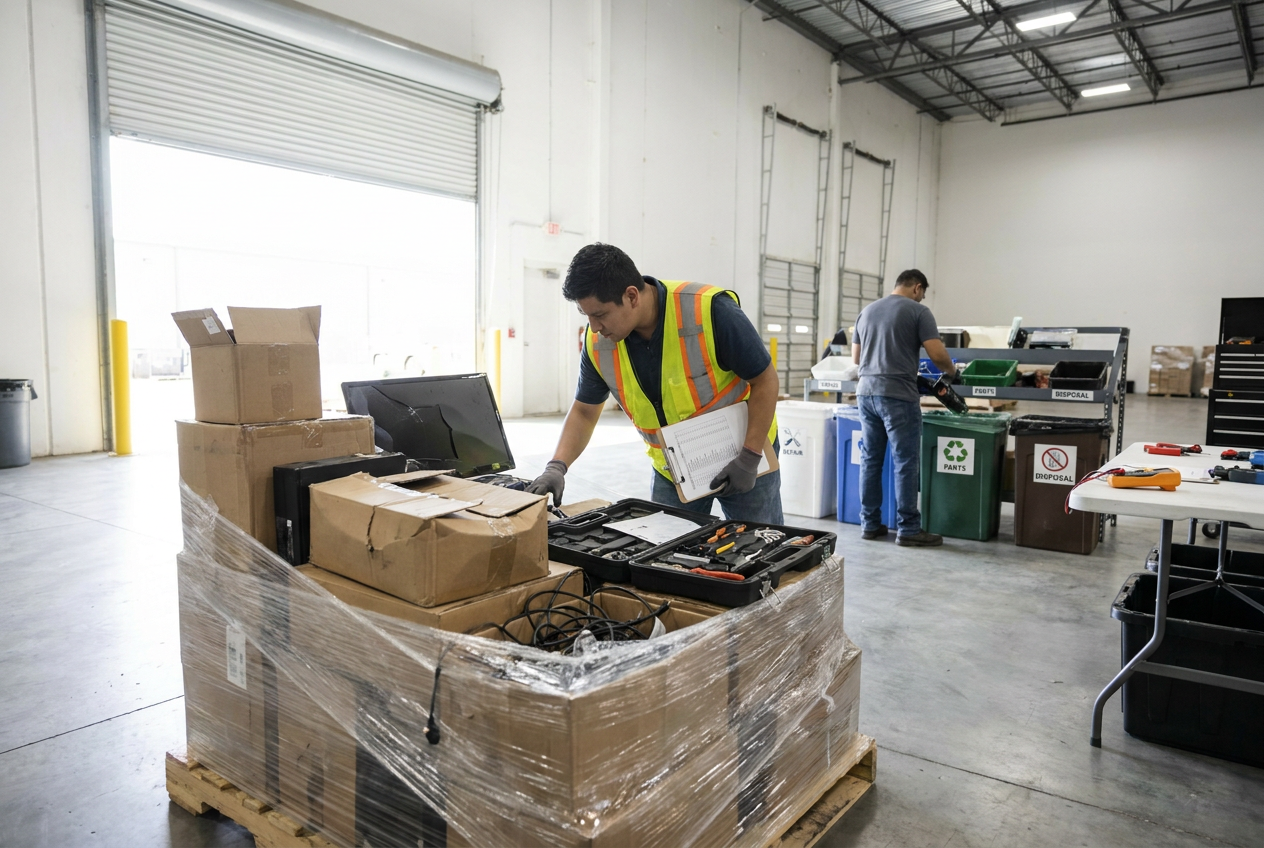
Salvage liquidation pallets are not simply discounted merchandise with damaged boxes. They can contain products that are broken, incomplete, unsafe to use, uneconomical to repair or suitable only for parts recovery. The buying decision depends on what your operation can diagnose, repair, document and responsibly remove—not just what you can list for sale.
For an independent reseller, the distinction matters before money changes hands. A load that fits a repair shop with trained technicians, parts storage and recycling arrangements may overwhelm a seller equipped only to photograph and ship working goods. Even recognizable brands and detailed manifests do not establish that individual items function.
PalletCove Liquidation supplies manifested and category-level liquidation pallets and full truckloads from Dallas, Texas. This guide explains how to evaluate salvage as an operating commitment, including condition language, receiving procedures and the obligations that remain after the usable merchandise has been separated.
What salvage means—and what it does not
In liquidation, salvage generally describes merchandise with substantial defects, missing components or other limitations that may prevent ordinary resale as a functioning product. Some pieces may be repairable; others may provide usable parts or require recycling or disposal. The listing’s specific definition matters because condition grades are not standardized across suppliers.
Inventory source and condition are different things. Customer returns describe how goods reentered the supply chain, not whether they work. Overstock describes excess stock, while shelf pulls generally describe merchandise removed from selling shelves. Either can develop damage during storage or handling.
| Inventory description | What it generally tells you | What still needs verification |
|---|---|---|
| --- | --- | --- |
| Overstock | Excess inventory remained unsold | Completeness, age, storage damage and condition |
| Shelf pulls | Merchandise was removed from retail shelves | Packaging wear, missing pieces and sale restrictions |
| Customer returns | Buyers returned the merchandise | Function, reason for return and accessory completeness |
| Untested | Functional testing is not represented | Whether anything works safely or consistently |
| Salvage | Significant defects or recovery-only uses may exist | Repair feasibility, usable parts and disposal needs |
A condition grade such as “Tier 2,” “Tier 3” or a letter grade has meaning only within the seller’s stated grading system. Do not translate it automatically into a repair rate. Likewise, “untested” does not mean “probably working,” and salvage does not mean every component is unusable.
Use the liquidation inventory overview to distinguish sourcing terms, then compare the liquidation pallets selection against your actual processing capabilities.
Buy salvage for the work your operation can verify and complete, not for the condition you hope to find.
Choose the load format before choosing the merchandise
A single liquidation pallet limits the initial volume but still requires sorting space and a disposal plan. Multiple pallets can improve category consistency, although they also increase the number of unresolved items on your floor. A truckload introduces a receiving and processing commitment that continues well after unloading.
Palletized orders may move by LTL, or less-than-truckload service. A full trailer requires a receiving site that can accommodate the vehicle and unload the shipment safely. Neither format proves that the contents are tested, complete or suitable for salvage recovery.
Manifested loads provide item-level information to the extent stated in the listing. Category-level loads may describe a merchandise mix without identifying every unit. Uncertainty is greater when you cannot estimate model concentration, accessory requirements or disposal streams.
Compare types of liquidation pallets, general merchandise inventory and available truckload inventory by workload rather than packaging alone. Mixed goods require multiple testing methods; repeated models may simplify diagnosis but can also share the same defect.
Read the manifest as a planning document
A manifest is an inventory reference, not a functional test report. Ask which fields are included, whether quantities are exact or estimated, and whether the document represents the specific shipment. A listed retail figure is not evidence of current resale demand or recoverable value.
Before ordering, review:
- Model numbers and identifiers: broad descriptions make parts matching difficult.
- Unit counts: distinguish individual products from sets, cases and accessories.
- Condition notes: look for stated defects, missing components and testing scope.
- Photographs: determine whether they show the actual lot or representative merchandise.
- Age and compatibility: obsolete interfaces, unsupported software and unavailable parts can limit use.
- Restrictions: investigate recalls, data-bearing devices and regulated materials before resale.
A title alone is insufficient. For example, the Home Depot Tier 3 Truckload listing needs its own grading explanation; “Tier 3” is not a universal synonym for salvage. Similarly, evaluate the Bulk Hamilton Beach Truckload listing using its current description rather than assuming appliances are working or repairable. These are listings to investigate, not representations that either is currently a salvage load.
PalletCove is an independent reseller and is not affiliated with, endorsed by or sponsored by any retailer named.
Assess repairability and parts recovery separately
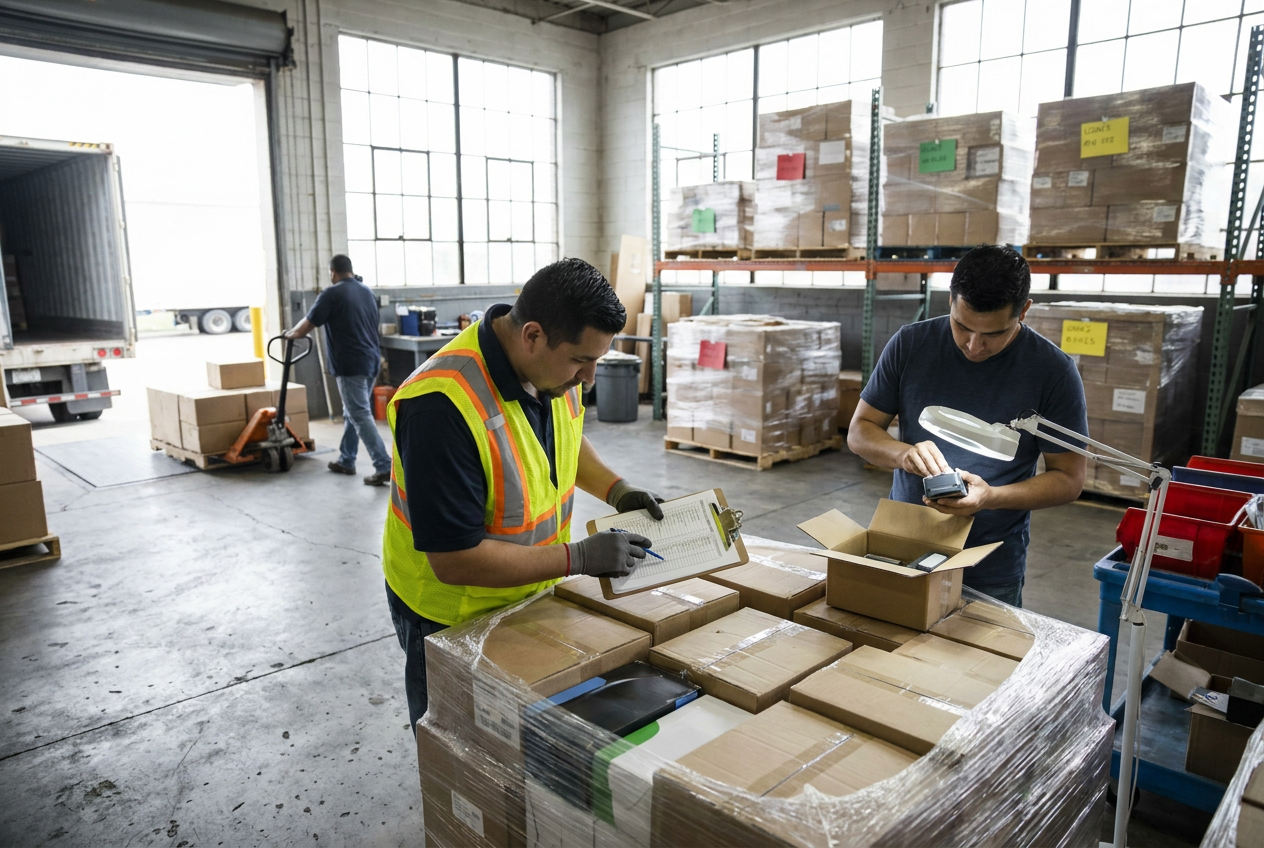
Repairability is a technical question and a capacity question. An item may be fixable but still unsuitable for your operation because diagnosis takes too long, required parts are unavailable or safe verification requires equipment you do not have.
Set a repair limit before work begins
Create a written intake process. Record the model, visible damage, missing components and symptoms before authorizing work. Set limits for diagnostic time, replacement parts and technician time, and require a new decision when an item exceeds those limits.
Do not energize damaged electrical equipment merely to see whether it works. Suspected liquid intrusion, exposed conductors, damaged batteries or compromised safety components call for qualified assessment. A brief power-on test does not establish electrical safety or reliable operation.
For each candidate, ask:
- Is the fault identifiable with available tools and skills?
- Can the correct replacement component be sourced?
- Can the completed repair be tested appropriately?
- Can the resale description accurately disclose condition and work performed?
The guide to electronics liquidation testing costs explains why diagnosis and documentation belong in the buying calculation.
Treat recovered parts as inventory
Parts recovery is not a cost-free fallback. Components need identification, safe removal, inspection, labeling, storage and accurate compatibility information. A motor, board or adapter taken from a failed unit is not automatically a tested working part.
Track donor units and test results, and distinguish verified parts from untested components in listings. Exclude recalled or otherwise unsafe components from resale. For data-bearing equipment, establish a secure sanitization or destruction process before transferring devices or storage media.
Plan disposal before the load arrives
Salvage purchasing leaves the buyer responsible for managing residual material appropriately. Requirements vary by material, business activity and jurisdiction; accepting a shipment does not make every item suitable for ordinary commercial trash.
Separate potentially hazardous or regulated materials from general waste. Batteries, refrigerant-containing equipment, some lamps and certain electronics may require specialized handling. Keep damaged batteries away from routine testing and packing areas, and obtain guidance from qualified handlers rather than improvising storage or transport.
Before buying, confirm:
- Which recycler or waste contractor accepts each anticipated material.
- Whether batteries, fluids or other components must be separated by qualified personnel.
- What documentation and storage practices apply to your location.
- How removal costs and collection schedules affect your processing capacity.
- Who will keep receipts, transfer records and any required handling documentation.
Check recalls before selling complete goods or recovering parts intended for reuse. Do not assume an as-is disclosure makes a recalled product lawful to sell. Food, cosmetics, medical items and products with expiration dates or contamination concerns need category-specific review; some should not enter a resale stream at all.
Calculate operating cost and place a deliberate order
PalletCove’s listed price includes freight. Free shipping is the only delivery option on every order to all 48 contiguous states. Your internal operating budget should therefore focus on the listed purchase price plus your own receiving labor, storage, testing, repair materials, selling expenses and responsible disposal.
A useful planning equation is:
Total processing commitment = listed purchase price + receiving and sorting labor + testing and repair inputs + storage and selling costs + recycling or disposal costs.
This is a cost framework, not a profit prediction. Assign a cost to your own labor and model the possibility that fewer items qualify for resale than expected. Avoid treating original retail totals as recoverable cash or assuming parts will sell quickly.
To order deliberately:
- Select a specific listing and confirm its current availability, load size and condition description.
- Review available manifests and photographs; resolve unclear grading or quantity language before payment.
- Confirm that the receiving address, equipment and staffing match the shipment format.
- Review the sale and claim terms, then complete payment through the order process.
- Retain the listing, order confirmation and any written clarifications for receiving.
Accepted payment methods are credit/debit card, ACH bank transfer and domestic bank wire. Handling begins after payment clears and takes 1–3 business days. PalletCove covers sales tax on qualifying orders; ask what documentation establishes qualification. A resale certificate may be relevant to eligibility, but it does not replace product-safety or waste-management obligations.
Free shipping and delivery-day inspection
Transit is typically 3–7 business days from Dallas, separate from the 1–3 business-day handling period after cleared payment. These are typical timelines, not a guaranteed arrival date. Review the shipping policy and prepare your receiving area before dispatch.
Whether you are researching liquidation pallets in Texas or liquidation pallets in Florida, free shipping is the only delivery option, with freight included in the listed price. The same applies across all 48 contiguous states.
Tell the order desk about site constraints in advance, including dock availability, forklift access, vehicle clearance and receiving hours. Do not assume a residential driveway can accommodate a full trailer or that unloading equipment accompanies every shipment.
At delivery:
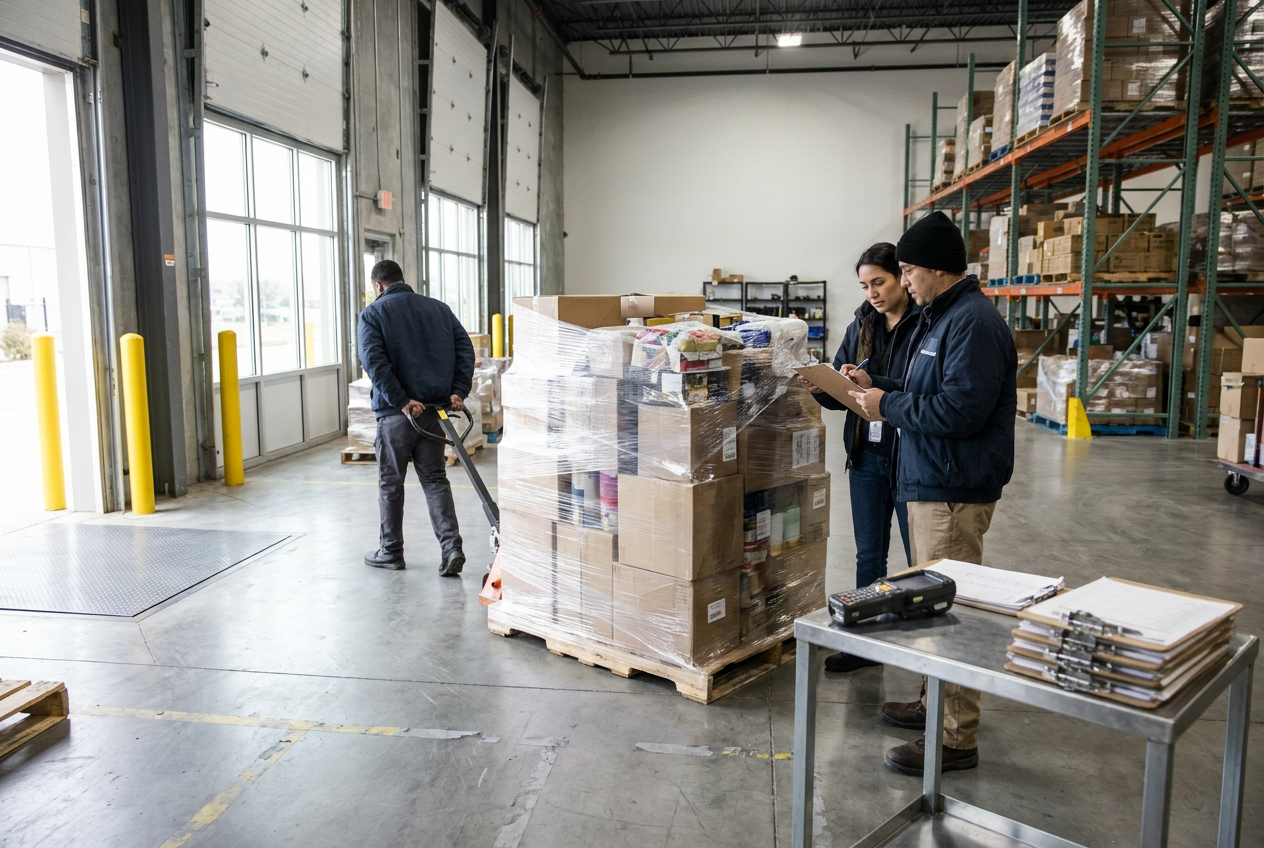
- Photograph the shipment’s exterior, labels, wrapping and visible damage before unloading when safe.
- Count pallets or handling units against the delivery paperwork.
- Record visible shortages or damage accurately on the carrier’s receipt before signing.
- Keep copies of paperwork and identify affected pallets for later inspection.
- Move unstable, leaking or otherwise unsafe merchandise into an appropriate controlled process.
Exterior inspection is not a functional inventory audit. Complete item-level receiving afterward, preserving the connection between each discrepancy and its pallet or manifest entry.
Understand as-is sales, returns and claims
All PalletCove merchandise is sold as-is for resale. Do not assume a retail-style return privilege, guaranteed condition or warranty because an item appears unused. Review the refund and claims policy before ordering to understand applicable procedures, eligibility and deadlines.
Expected salvage defects, shipping damage and a possible order discrepancy are different issues. A broken item may fall within the disclosed condition; a missing handling unit or an apparent mismatch requires separate documentation. Reporting a concern does not guarantee a refund, replacement or other remedy.
Preserve photos, labels, packaging, delivery notes and the original listing. Contact the order desk promptly with the order number, specific issue and supporting records; do not assume undocumented disposal will leave enough evidence for review. For unsafe material, prioritize safe handling and record what happened.
Common mistakes include buying beyond weekly processing capacity, interpreting a manifest as a test report, accumulating unidentified parts and leaving disposal planning until storage is full. Another is repairing first and documenting later, which can obscure whether damage existed at receipt.
Frequently asked questions
Are salvage liquidation pallets the same as customer returns?
No. Customer returns describe the source of goods, while salvage describes a condition or recovery category. Returned merchandise can range from unused to severely damaged, so use the listing’s explicit condition description.
Can I resell salvage merchandise without repairing it?
Some goods or components may be suitable for accurately disclosed parts-only sales. That does not remove recall, safety, data-security or other legal obligations, and unsafe products should not be represented as usable merchandise.
Does a manifest guarantee that the listed items work?
No. A manifest records inventory information within its stated scope, not necessarily test results. Ask what testing occurred and whether any results apply to individual units rather than assuming functionality from a model number.
Should a first-time salvage buyer start with a truckload?
Only if receiving capacity, technical skills, processing space and disposal arrangements already support that volume. A smaller purchase can help measure actual labor and material requirements, although no order size guarantees a favorable outcome.
Is shipping included, and when does an order move?
Yes. Free shipping is the only delivery option on every order to all 48 contiguous states, and freight is included in the listed price. Handling takes 1–3 business days after payment clears; transit is typically 3–7 business days from Dallas.
Talk to PalletCove Liquidation
Before committing to salvage, identify your repair capabilities, weekly processing capacity and routes for unusable material. Then contact our order desk with questions about a specific listing or review current inventory for a load that matches those limits.
PalletCove Liquidation LLC
4820 Cove Industrial Blvd, Dallas, TX 75236
Phone: (713) 819-3904
Email: sales@palletcoveliquidation.com
Hours: Mon–Fri 8:00 AM – 6:00 PM CT, Sat 9:00 AM – 2:00 PM CT, Sun closed.