
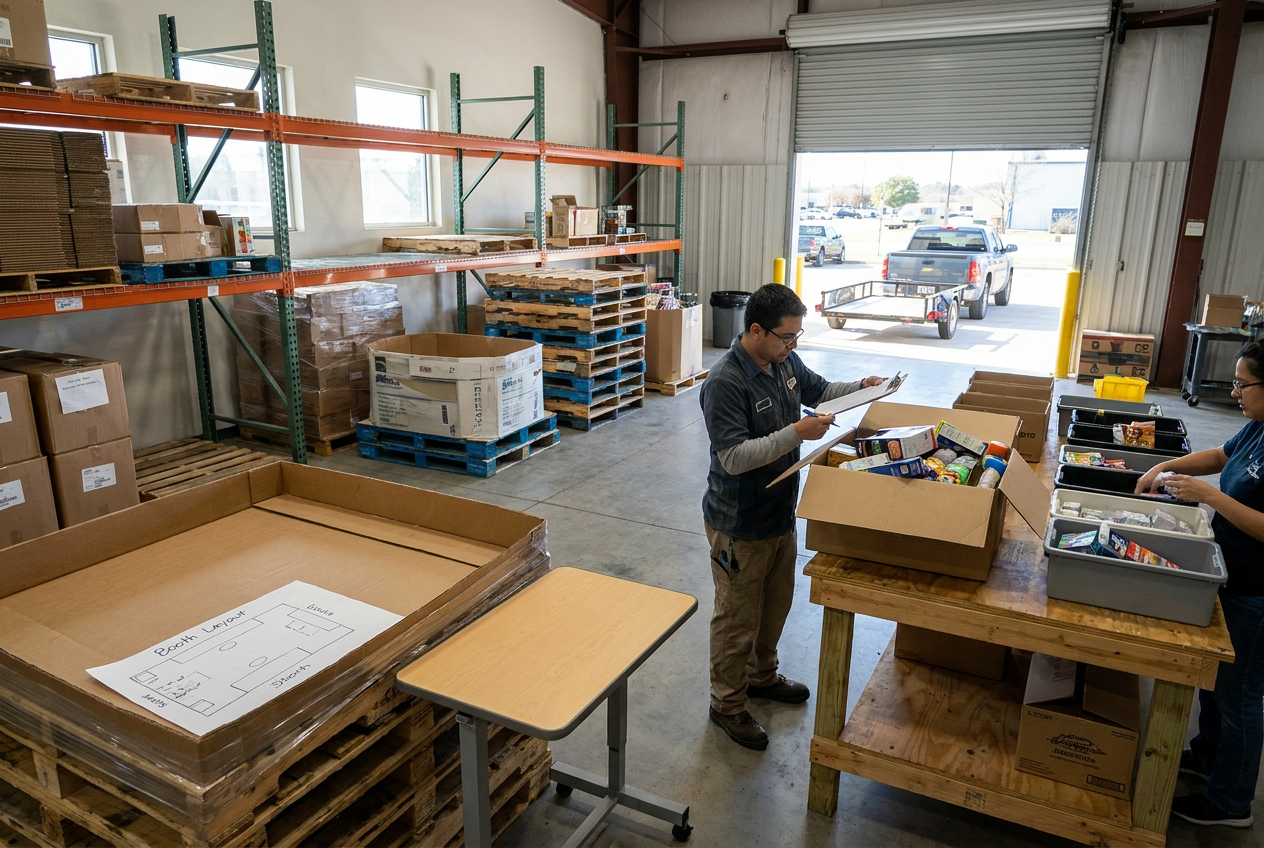
Selling liquidation at flea markets connects bulk inventory with shoppers who want to inspect merchandise, ask questions and take purchases home immediately. That makes booth layout, honest condition labels and manageable stock just as important as the purchase price of a liquidation pallet.
The practical challenge is matching a variable assortment to a specific market. A crowded aisle does not necessarily produce buyers for your category, and a large load can create sorting and storage work before anything reaches a table. Start with your selling space, transport capacity and preparation time, then work backward to the inventory purchase.
Choose a market before choosing your load
Visit potential markets during the hours you would actually sell. Observe what shoppers carry away, not just what vendors display. Compare indoor and outdoor locations, recurring weekly markets and occasional events; weather exposure and repeat customers change what stock makes sense.
Ask management for written answers to these questions:
- What are the booth dimensions, reservation rules and daily or monthly fees?
- Are electricity, tables and covered space included or separately priced?
- Are there deposits, cancellation deadlines or weather-related refund rules?
- When can vendors unload, and must vehicles leave the selling area?
- Which merchandise categories, demonstrations and signs are prohibited?
- Are vendor permits, liability insurance or business registrations required?
- What rules govern tents, ballast, aisles, trash and overnight storage?
Check local licensing and sales-tax obligations with the relevant authorities. A resale certificate may document qualifying inventory purchases, but it is not a substitute for a market permit or every other registration your business needs.
For location-specific sourcing information, explore liquidation pallets in Texas or liquidation pallets in Florida. Your market's audience and rules should still determine the assortment you bring.
Understand load types, condition grades and manifests
Liquidation is merchandise sold through secondary channels rather than its original sales channel. A liquidation pallet groups inventory into a bulk lot; a truckload contains a larger shipment that may be palletized or floor-loaded. A full trailer requires considerably more receiving space and sorting capacity than a single pallet.
Read the liquidation overview and compare types of liquidation pallets before evaluating individual listings. Category-level buying narrows the merchandise family, but it does not establish the condition of every unit.
| Inventory description | What it generally means | Flea market planning implication |
|---|---|---|
| --- | --- | --- |
| Overstock | Excess inventory that did not sell through its original channel | Check age, packaging, completeness and local demand |
| Shelf pulls | Merchandise removed from retail displays or shelves | Expect possible stickers, handling marks or packaging wear |
| Customer returns | Items returned by previous buyers | Budget time for inspection, testing and accessory checks |
| Salvage | Merchandise designated for repair, parts or recovery | Keep separate from ready-to-use stock and disclose limitations |
| Mixed-condition inventory | Multiple conditions within one lot | Sort and label by actual findings before setting prices |
A condition grade is a seller-defined classification, not a universal standard. Ask what the listing's grade means, whether testing occurred and whether the description applies to individual units or the overall load. All PalletCove merchandise is sold as-is for resale; never assume a grade guarantees functionality or completeness.
A manifest is an inventory record that may list descriptions, quantities, models, identifiers and reference values. If one is supplied, establish whether it is final, approximate or illustrative. Check for repeated SKUs, size concentrations, missing identifiers and units that require accessories. Do not treat a manifest's retail reference values as achievable selling prices.
Browse available liquidation pallets with those questions in hand. For an unmanifested lot, acknowledge that the assortment cannot be planned unit by unit and size the purchase accordingly.
Build an assortment that fits face-to-face selling
Useful flea market stock is easy to understand, carry and inspect. Household basics, clearly sized apparel and straightforward accessories can be simpler to present than bulky or technically complex products. That is a handling advantage, not a prediction of sales.
Build your booth around three roles:
- Attention items: a few visible products that clearly communicate your category.
- Core stock: practical items organized into consistent price or product groups.
- Add-ons: small, related products customers can evaluate without a lengthy explanation.
Compare the assortment possibilities in general merchandise liquidation with the scale of liquidation truckloads. Avoid buying a full trailer merely because its total unit count appears attractive. Repeated items need enough local demand, and every unit needs a storage location.
Product pages can help frame specific questions. When reviewing a shoes truckload, ask about size distribution, matching pairs and the stated condition. For 64 oz water bottle bulk inventory, verify quantities, dimensions, lid completeness and any material claims in the listing rather than assuming them.
PalletCove is an independent reseller and is not affiliated with, endorsed by or sponsored by any retailer named in its listings.
Budget booth costs and set workable prices
Separate the inventory purchase from the cost of running a selling day. PalletCove's listed price includes freight, but transporting your sorted inventory from your receiving location to a flea market remains your own operational task.
Include booth rent, vehicle rental if needed, fuel, parking, helpers, bags, labels, batteries, test supplies, storage and your selling-payment processing costs. Consider unsold inventory as well as damaged or incomplete units. The guide to liquidation inventory holding costs explains why stock continues to consume resources between markets.
Use a simple event worksheet:
- Record fixed event costs, including space and transport.
- Allocate acquisition costs across inventory using a consistent method.
- Add preparation costs and transaction costs where applicable.
- Set asking prices from condition, comparable local offers and buyer demand.
- Establish a minimum acceptable price before negotiating.
For illustration only, a $50 booth, $30 vehicle operating cost and $20 in supplies create $100 in event overhead before inventory and labor. If an item leaves $5 after its allocated acquisition and variable selling costs, 20 such sales would cover that $100—not establish overall profit. Actual outcomes depend on your costs, merchandise and sales.
Use visible prices and simple bundle rules. Do not use an inflated reference price to make an item appear discounted, and do not assume every unit in a mixed lot deserves the same cost allocation.
Plan the booth around inspected, explainable stock—not the total number of units on the pallet.
Order with enough preparation time
Before paying, confirm the listing's load type, quantity basis, condition description, manifest availability and included accessories. Save the listing and order records so you can compare the shipment with what was offered.
PalletCove accepts credit/debit card, ACH bank transfer and domestic bank wire. Sales tax on qualifying orders is covered by PalletCove. Ask which documentation applies to your purchase, including a resale certificate where relevant; this does not remove your obligations when selling to flea market shoppers.
Free shipping is the only delivery option on every order to all 48 contiguous states. Freight is included in the listed price. Handling takes 1–3 business days after payment clears, and transit is typically 3–7 business days from Dallas. These are separate stages, and typical transit is not a guaranteed event-date arrival.
Review the shipping policy and confirm receiving requirements before ordering. A pallet may travel by LTL, or less-than-truckload service, while a larger shipment may occupy a full trailer. Confirm the actual shipment configuration, access needs and unloading arrangements with the order desk.
Leave additional time after delivery for counting, testing, cleaning, labeling and packing. Do not schedule your first selling day around the earliest possible arrival.
Inspect deliveries and prepare market transport
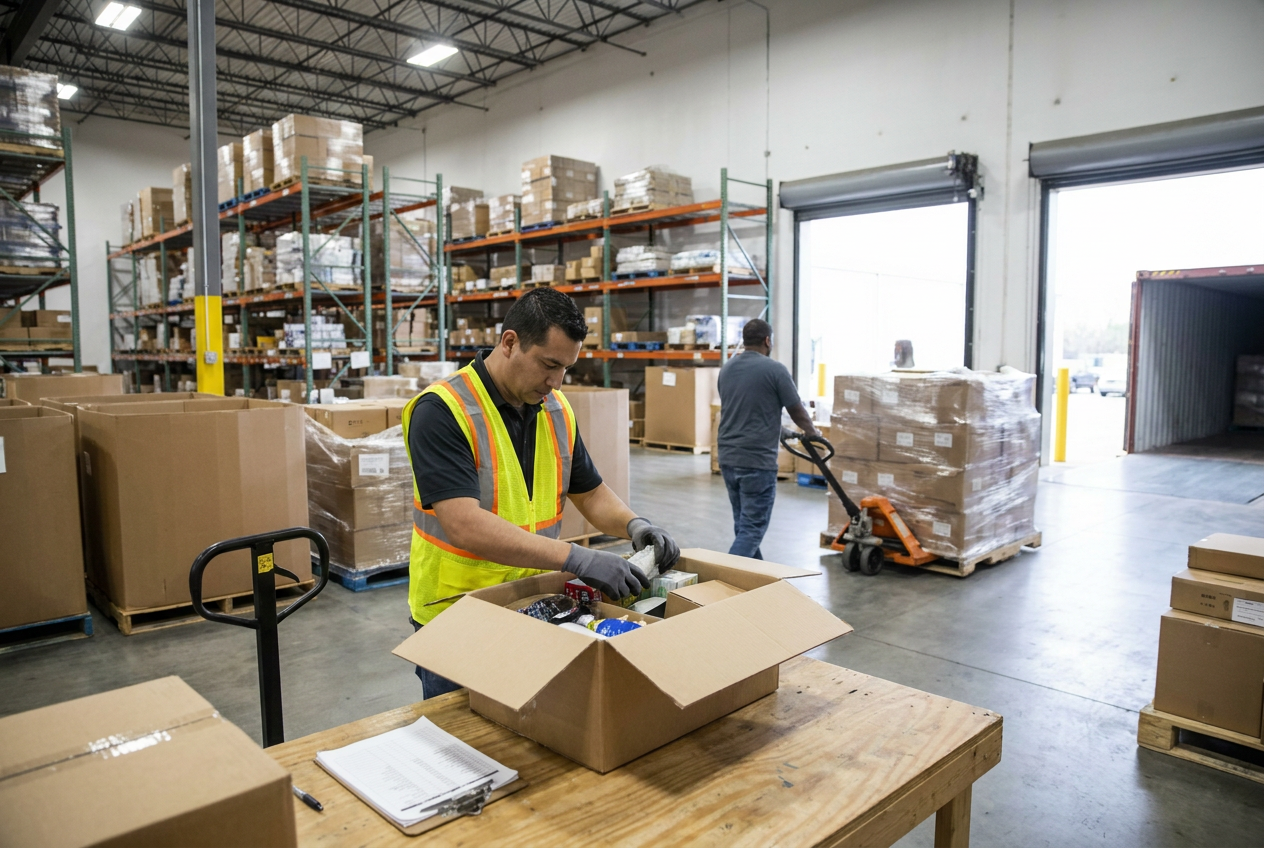
Keep the receiving area clear and arrange suitable equipment and help for the confirmed shipment. Palletized and floor-loaded freight require different unloading plans; neither should be improvised when the vehicle arrives.
On delivery day:
- Check shipment identification against your order.
- Photograph visible packaging, pallet and load condition before unpacking.
- Record visible damage or apparent shortages on delivery paperwork where applicable, accurately describing what you can observe.
- Retain delivery documents and packaging needed to document an issue.
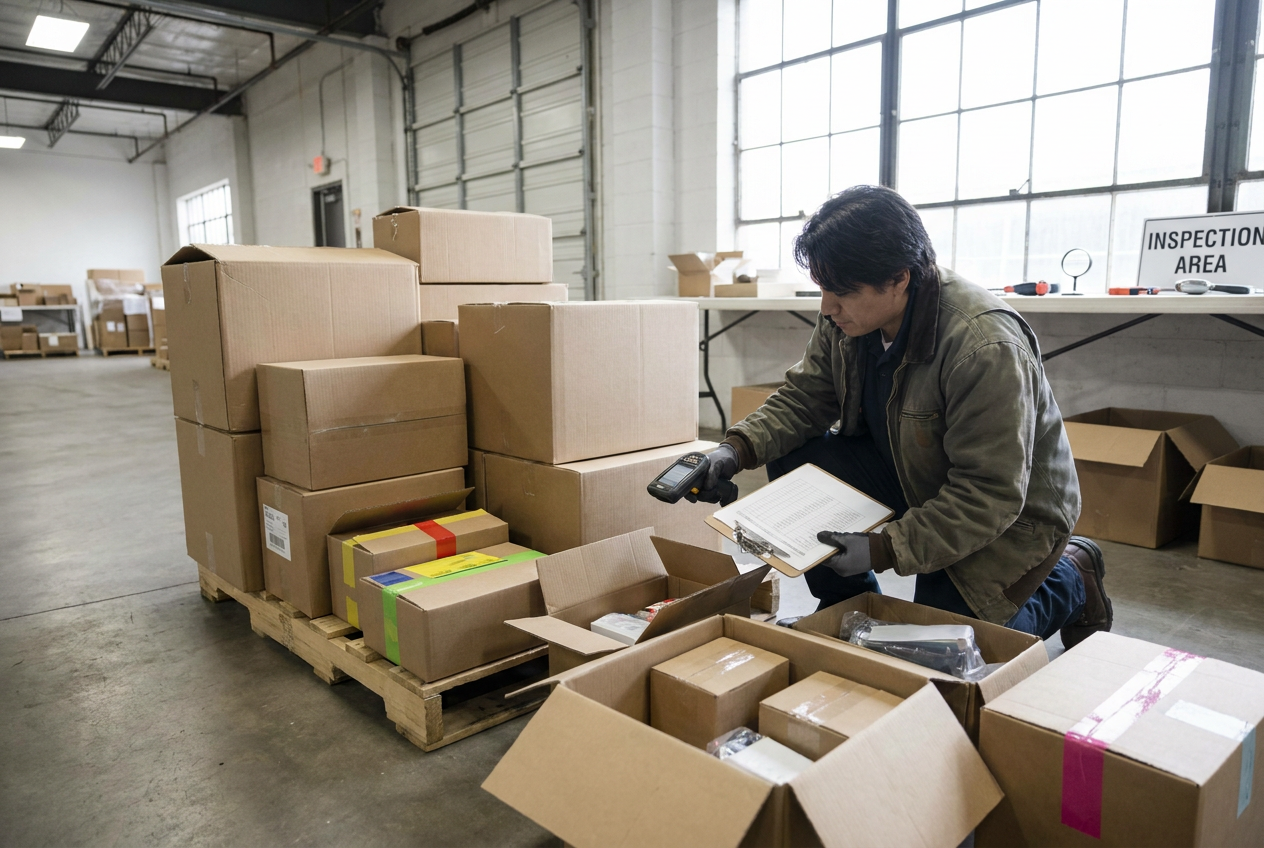
- Count and inspect contents promptly, comparing them with the listing and any supplied manifest.
Separate transit damage, apparent order discrepancies and ordinary as-is merchandise issues in your records. Read the refund and claims policy for applicable eligibility, documentation and deadlines, and report concerns promptly through the order desk. Delivery notes do not themselves guarantee a refund, replacement or claim approval, and as-is inventory should not be treated as automatically returnable because it sells slowly or needs repair.
For the market trip, use labeled totes, dividers and restrained loads. Verify vehicle payload and trailer limits, including shelving, tables and unsold stock. Pack heavy objects low, protect fragile items and load setup equipment where it can be reached first. Keep rain protection available for outdoor events.
Arrange the booth and demonstrate responsibly
Create a visible entrance and a browsing path that stays inside your assigned space. Place stable display tables along the perimeter where practical, keep heavy products low and put small valuable items within sight. Store replenishment stock separately from merchandise available for immediate sale.
Use condition labels that describe actual observations: “packaging opened,” “missing attachment” or “powered on; other functions not tested.” A brief power check is not a complete safety or performance test. Remove recalled, unsafe or prohibited products from sale; consult authoritative recall information before offering relevant merchandise.
Ask market management before using electricity, batteries, sound or water for demonstrations. Use suitable equipment and keep cables out of walkways. Never energize a product with damaged wiring or operate equipment with missing guards.
A useful demonstration follows a short routine:
- Identify the exact item and show included accessories.
- Explain what you inspected and what remains untested.
- Demonstrate only functions you can operate safely.
- State the price and your own lawful customer return terms before purchase.
Provide receipts and clear seller contact information. Your obligations to customers are separate from PalletCove's wholesale as-is terms; do not assume an “as-is” sign overrides applicable consumer law.
Track results and avoid repeat mistakes
After each event, record units sold by category, realized prices, discounts, expenses and questions customers repeatedly asked. Note weather, event hours and booth location so you do not mistake one unusual day for a lasting demand pattern.
Common mistakes include buying beyond storage capacity, overlooking duplicate SKUs, displaying uninspected returns and bringing more stock than shoppers can browse. Other avoidable problems include missing price labels, unsafe stacked displays and spending the entire event unpacking.
Reorder from observed demand rather than foot traffic alone. Keep slow-moving, repairable and unsafe stock in separate groups, and establish a review date for each. An incomplete item should not return to the ready-to-sell table simply because it occupied storage for several weeks.
Frequently asked questions
Is a pallet or a truckload better for a first flea market booth?
A smaller purchase is generally easier to inspect, store and transport while you learn the market. A truckload requires a receiving plan, substantial sorting capacity and outlets for inventory that does not suit one booth.
Can customer returns be sold without testing?
Do not represent an untested customer return as working. Whether it can be offered at all depends on product safety, applicable law and market rules; clear disclosure does not make an unsafe item suitable for sale.
How far ahead should I order liquidation inventory?
Allow for 1–3 business days of handling after payment clears and typically 3–7 business days of transit from Dallas. Add a separate preparation buffer for inspection, testing, labeling and packing before your market date.
Does PalletCove charge separately for shipping?
No. Free shipping is the only delivery option on every order to all 48 contiguous states, and freight is included in the listed price. Your own transport from the receiving location to the flea market is a separate business expense.
Can I return merchandise that does not sell?
All PalletCove merchandise is sold as-is for resale, so do not assume slow-moving stock qualifies for a return. Review the applicable refund policy before ordering and follow its requirements for any potentially eligible issue.
Talk to PalletCove Liquidation
Match your next order to your booth footprint, receiving capacity and inspection schedule. Share your preferred categories and market date when you contact our order desk, then compare the descriptions in our current inventory.
PalletCove Liquidation LLC
4820 Cove Industrial Blvd, Dallas, TX 75236
Phone: (713) 819-3904
Email: sales@palletcoveliquidation.com
Hours: Mon–Fri 8:00 AM – 6:00 PM CT, Sat 9:00 AM – 2:00 PM CT, Sun closed