
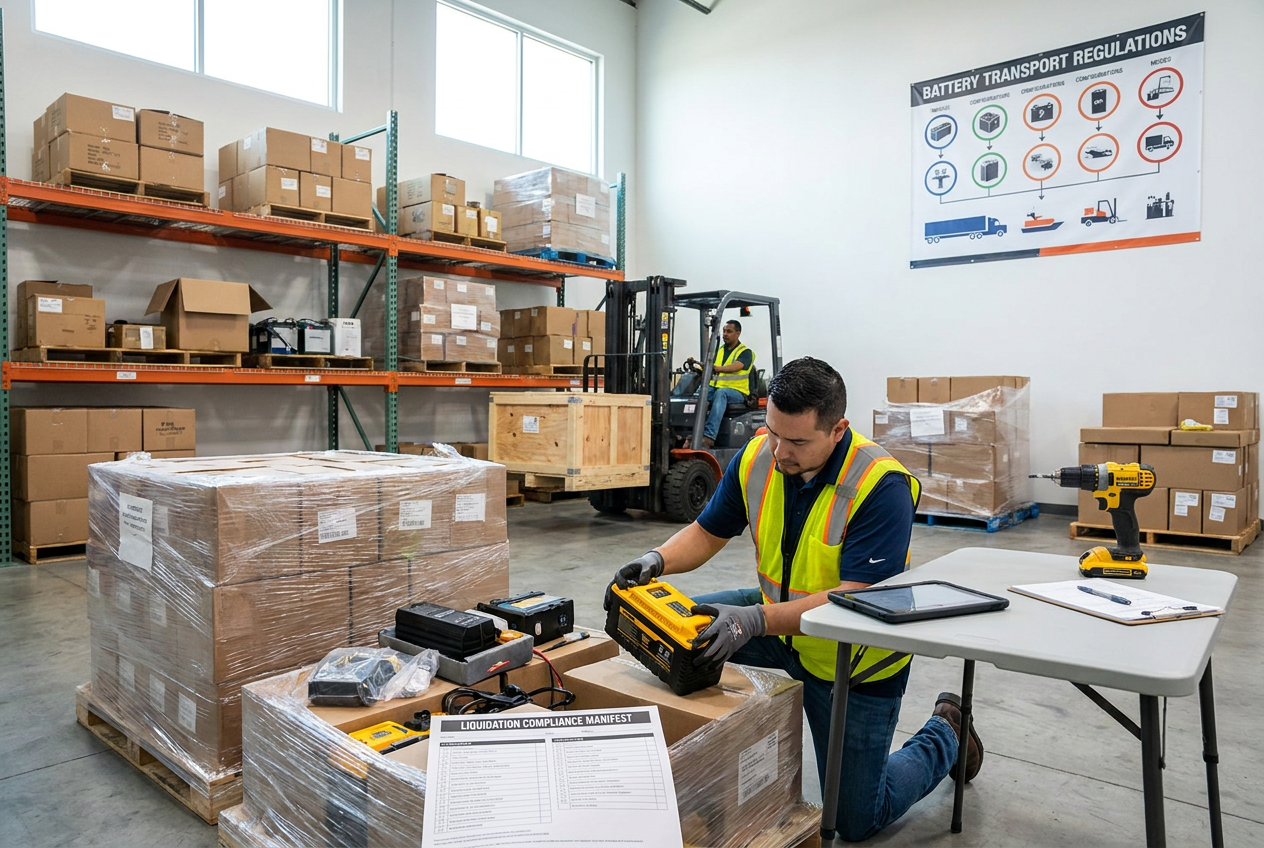
Shipping liquidated lithium batteries requires more than identifying a pallet as electronics or cordless tools. A loose replacement battery, a battery installed in a laptop and a damaged mower battery can have different transportation requirements—even when they arrive in the same liquidation lot.
For independent resellers, the essential questions are what the battery is, how it is packaged, whether it is safe for transportation and which transport mode will carry it. A manifest or condition grade can help identify inventory, but neither establishes hazardous-materials compliance.
PalletCove Liquidation supplies manifested and category-level liquidation pallets and full truckloads from Dallas, Texas. This guide explains the compliance checks to make before ordering and before reshipping inventory. Consult the linked official requirements for the actual shipment; this article is not a substitute for shipment-specific classification or required hazmat training.
1. Classify the battery and its configuration first
Lithium-ion batteries are rechargeable batteries commonly found in laptops, cordless tools and outdoor power equipment. Lithium metal batteries are generally nonrechargeable and appear in products such as certain cameras, sensors and backup devices. Their classification numbers differ.
| Configuration | Lithium-ion designation | Lithium metal designation | Liquidation example |
|---|---|---|---|
| --- | --- | --- | --- |
| Batteries shipped by themselves | UN3480 | UN3090 | Loose replacement packs |
| Batteries packed with equipment | UN3481 | UN3091 | A removed battery packaged with its compatible tool |
| Batteries contained in equipment | UN3481 | UN3091 | A battery installed in a laptop or tool |
Sharing a pallet does not automatically make a loose battery “packed with equipment.” The contents and arrangement of the individual shipping package matter. A removed pack does not remain “contained in equipment” simply because it came from that equipment.
For lithium-ion batteries, record the watt-hour rating. When appropriate, calculate Wh as nominal volts multiplied by amp-hours; divide milliamp-hours by 1,000 first. Lithium metal classification instead depends on lithium content. If markings or reliable specifications are missing, do not guess.
The main U.S. rule is 49 CFR §173.185, lithium cells and batteries. Some smaller batteries qualify for exceptions, but exceptions have conditions: “small” does not mean unregulated.
Key takeaway: Battery chemistry, configuration, condition and transport mode determine shipping eligibility—not the liquidation grade or the value of the merchandise.
2. Separate commercial grades from battery safety
Liquidation terms describe merchandise history or sorting practices. They are not standardized battery safety certifications. Use the liquidation overview and guide to pallet types to understand buying formats, then request the seller’s specific grading definitions.
- Overstock: Excess inventory may be unused, but storage age, recalls and packaging deterioration still matter.
- Shelf pulls: Removed retail stock may have opened packaging, missing protection or display wear.
- Customer returns: Return reasons can include preference, incompatibility, malfunction or damage. The label alone does not identify the cause.
- Salvage: Repair, parts recovery or recycling may be the intended use. Do not assume batteries in salvage lots qualify for routine transportation.
Look for swelling, leakage, crushed cases, punctures, scorched surfaces, exposed conductors or unusual heat. A product that will not power on is not necessarily a damaged battery, but a working product is not proof that its battery is safe.
Section 173.185(f) sets special requirements for damaged, defective or recalled batteries with the potential to produce dangerous heat, fire or short circuits. Such batteries are forbidden aboard aircraft. Ground transportation may be possible under the applicable protective packaging requirements, but severe hazards can require PHMSA approval; “ground only” is not blanket authorization.
Check manufacturer recall information and the CPSC recall database. Not every product recall is battery-related, so identify the reason and affected model or serial range. Do not charge, test or disassemble suspect batteries just to determine whether the merchandise works.
3. Read the manifest at battery level
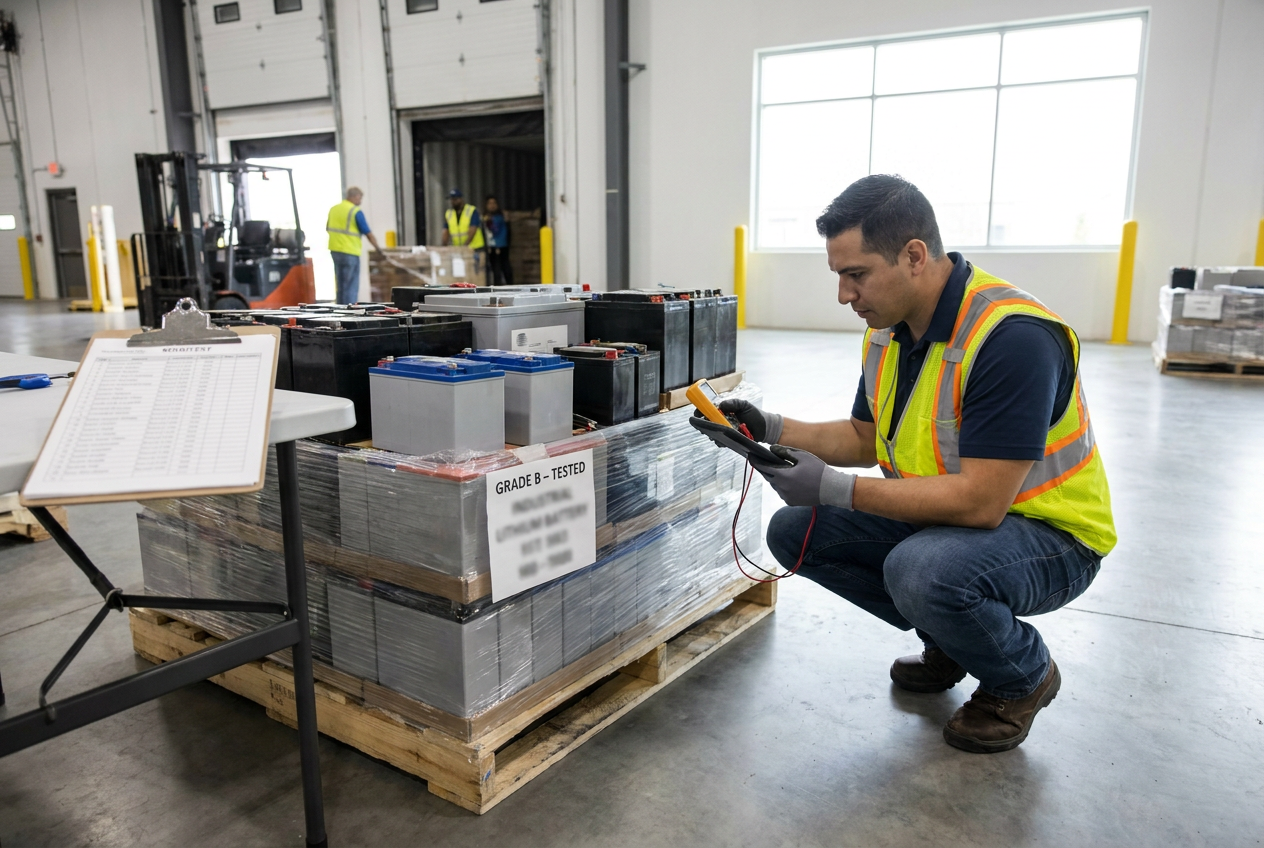
A manifested liquidation pallet provides an itemized inventory reference, while a category-level lot may offer broader descriptions without item-by-item detail. Neither format necessarily identifies battery chemistry, capacity or condition. Explore the liquidation pallets hub with those information limits in mind.
LTL means less-than-truckload service, where a shipment shares trailer capacity. A full truckload generally occupies a full trailer for the booked movement. Neither format exempts lithium batteries from package-level requirements, and neither guarantees identical products or conditions throughout the load.
For potential battery inventory, ask for:
- Product model numbers, quantities and any available serial or lot information.
- Battery chemistry, model, watt-hour rating or lithium content.
- Whether batteries are installed, separately packaged with products or loose.
- Known damage, recall status and inspection or testing scope.
- Original versus replacement batteries and missing terminal protection.
- Available UN 38.3 test-summary information and the intended transport mode.
Most lithium battery designs offered for transport must meet UN Manual of Tests and Criteria subsection 38.3, subject to specific exceptions. Applicable manufacturers and subsequent distributors must make the required test summary available. It is not simply a certificate that must be enclosed in every carton, and an SDS is not a substitute.
Use PHMSA’s lithium battery resources for official guidance. Missing documentation calls for further verification, not an assumption that batteries are compliant.
When browsing general merchandise liquidation or Home Depot liquidation inventory, investigate battery content rather than relying on category names. Likewise, the Amazon General Merchandise Truckload and Home Depot Tool and Hardware Truckload are listings to evaluate—not proof that any particular battery is included or transport-eligible. PalletCove is an independent reseller and is not affiliated with, endorsed by or sponsored by any retailer named.
4. Match packaging and paperwork to the transport mode
Highway freight is not a compliance exemption
Highway shipments can use certain exceptions unavailable by air, but eligibility depends on the exact battery and package. For example, the commonly referenced smaller-battery limits include 20 Wh per lithium-ion cell and 100 Wh per lithium-ion battery. Larger packs require a different assessment; specialized highway or rail provisions are conditional, not a general waiver.
Packaging must prevent short circuits, movement that could cause damage and accidental activation where applicable. Exposed terminals need suitable protection. Equipment must be secured, and required packaging must withstand the conditions prescribed by the applicable rule. Stretch wrap around mixed cartons is not a substitute for compliant inner and outer packaging.
A qualified shipper must determine required lithium battery marks, Class 9 lithium battery labels, UN numbers, shipping papers and emergency-response information. Not every package requires the same combination. If packages form an overpack, required marks and labels must remain visible or be reproduced as applicable.
Air and vessel movements add requirements
Standalone UN3480 and UN3090 batteries are prohibited as cargo on passenger aircraft. Eligible cargo-aircraft shipments face additional restrictions. Standalone lithium-ion air shipments generally have a 30% state-of-charge limit unless an applicable approval allows otherwise; packed-with-equipment shipments also require checking current rules rather than applying an old instruction from memory.
Consult the FAA’s lithium battery shipping guidance and current ICAO requirements before offering anything for air transport. Aircraft operator restrictions can be stricter than baseline regulations. Vessel movements require review of applicable U.S. rules and the IMO’s IMDG Code framework.
Recycling and disposal shipments have separate provisions under §173.185(d). A salvage label does not automatically qualify a resale shipment for those provisions. Carrier acceptance also does not replace legal compliance.
Employees performing regulated hazmat functions may need general awareness, function-specific, safety and security-awareness training under 49 CFR §172.704. Limited exceptions do not eliminate the need to understand the applicable instructions.
5. Order with battery questions resolved in writing
Start with the lot’s listed price, manifest availability, condition description and stated inclusions. Clarify battery quantities, missing chargers and inspection scope before payment. Merchandise is sold as-is for resale; a category description is not a guarantee of functionality, completeness or resale value.
Free shipping is the only delivery option on every PalletCove order to all 48 contiguous states. Freight is included in the listed price. This applies whether you are shopping for liquidation pallets in Texas or liquidation pallets in Florida. Included shipping does not make an otherwise prohibited battery shipment eligible for transportation.
PalletCove accepts credit/debit card, ACH bank transfer and domestic bank wire. Sales tax on qualifying orders is covered by PalletCove. Provide business information and any applicable resale certificate requested for the transaction; do not assume every order qualifies without confirmation.
Handling takes 1–3 business days after payment clears. Transit is typically 3–7 business days from Dallas. Review the shipping policy and confirm delivery-site access, receiving hours and unloading arrangements before ordering.
For budgeting, separate the listed merchandise price from your own downstream inspection, compliant packaging, storage, testing and recycling needs. Document important representations using the liquidation purchase order terms guide. No purchase calculation should assume every returned item is saleable.
6. Inspect delivery safely and document claims
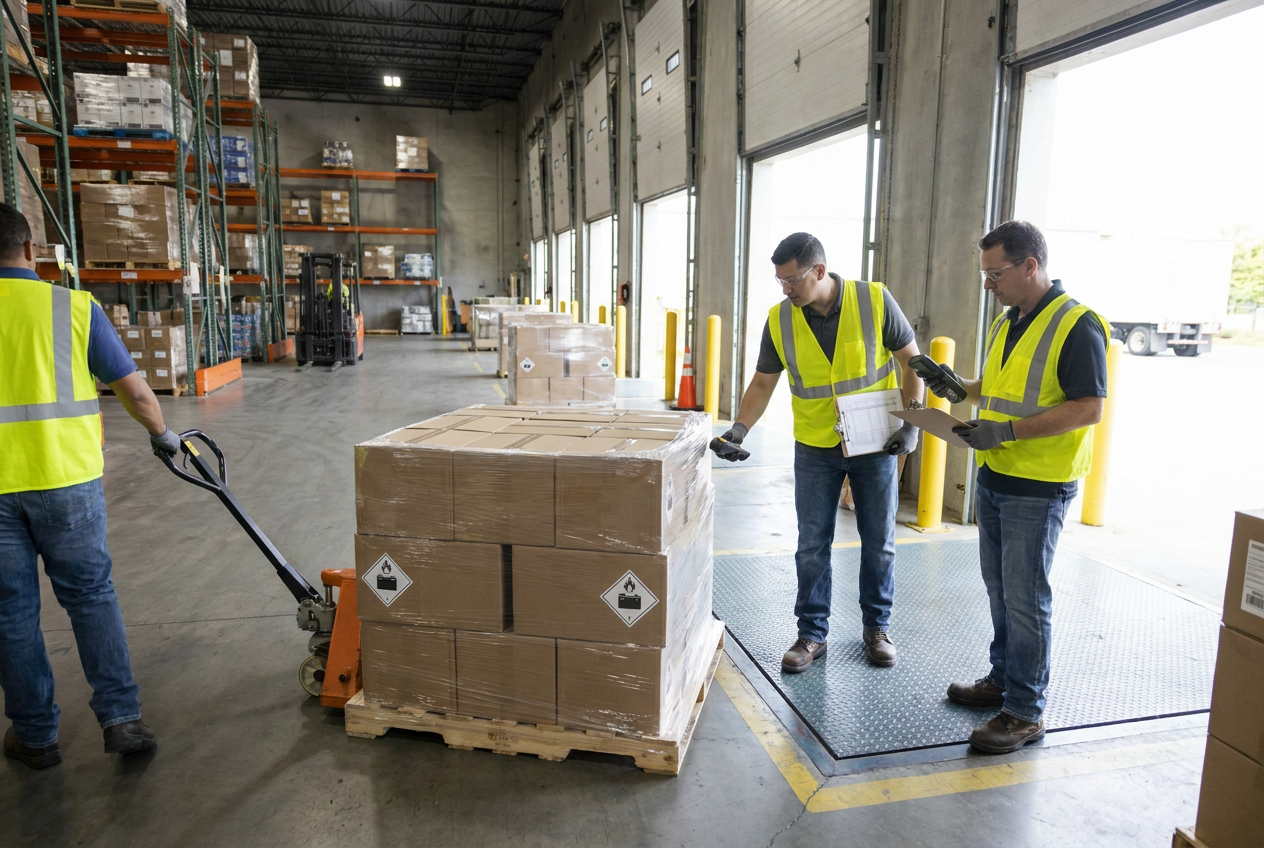
Prepare a clear receiving area and make staff aware that the load may contain batteries. Do not open a smoking or unusually hot carton to obtain a better photograph. Keep people away and call emergency services when there is smoke, fire or an immediate hazard.
For a delivery without an active hazard:
- Compare pallet or carton counts against transportation documents.
- Inspect visible wrap, cartons and pallet structure before signing.
- Photograph the load, identification labels and visible damage where safe.
- Record specific shortages or damage on the delivery receipt; avoid vague notes alone.
- Preserve packaging and reconcile contents against the available manifest.
- Report discrepancies promptly through the process in the refund and claims policy.
As-is merchandise condition and transportation damage are different issues. Documentation supports review but does not guarantee a refund, replacement or return authorization. Check the policy for deadlines and required evidence rather than assuming ordinary retail returns apply.
Never mail a suspect battery back without approved instructions and a lawful shipping method. If batteries require disposal, use a qualified battery recycler and verify transportation requirements; ordinary trash is not an appropriate destination.
7. Avoid mistakes when reshipping inventory
The reseller becomes responsible for the functions it performs when offering a new shipment. Receiving an intact pallet does not prove that your repacked parcel meets the rules.
- Reusing obsolete markings: Reassess the new contents and configuration instead of copying the inbound label.
- Combining loose packs: Prevent terminal contact and assess package quantity limits before consolidating inventory.
- Trusting voltage alone: Battery capacity and chemistry also affect classification.
- Treating all returns as damaged: Investigate actual condition, but do not overlook signs of dangerous defects.
- Changing modes without review: Ground-ready packaging is not automatically air-ready.
- Shipping first and seeking paperwork later: Resolve classification, documentation and carrier acceptance before tender.
Keep an inventory record tying each battery model to its source, available test summary and inspection findings. Separate unverified or suspect units from stock approved for routine fulfillment. Transportation eligibility also does not establish electrical safety or suitability for consumer resale.
Frequently asked questions
Can lithium batteries travel in a liquidation pallet?
Yes, when the batteries and packages meet applicable requirements and the carrier accepts the shipment. Palletization does not override classification, short-circuit protection, marking or documentation rules.
Are customer-return batteries automatically damaged or defective?
No. Customer returns describe merchandise history, not a regulatory determination. Physical damage, safety defects, recall details and other evidence must be evaluated before transportation.
Can a swollen battery ship by ground?
Do not place it in an ordinary parcel or pallet shipment. It needs assessment under the damaged or defective battery provisions, and specialized packaging or approval may be necessary. It cannot travel by air under those provisions.
Does free shipping include every contiguous state?
Yes. PalletCove’s only delivery option is free shipping on every order to all 48 contiguous states, with freight included in the listed price. Handling is 1–3 business days after payment clears, and transit is typically 3–7 business days from Dallas.
Is a manifest enough to reship batteries legally?
No. A manifest generally identifies commercial inventory, not all transportation requirements. Verify battery specifications, configuration, condition, applicable documentation and the rules for your selected mode before reshipping.
Talk to PalletCove Liquidation
Before buying battery-containing inventory, ask what the listing and available manifest establish—and what remains unverified. Review current inventory and contact our order desk to discuss lot descriptions, ordering and receiving arrangements.
PalletCove Liquidation LLC
4820 Cove Industrial Blvd, Dallas, TX 75236
Phone: (713) 819-3904
Email: sales@palletcoveliquidation.com
Hours: Mon–Fri 8:00 AM – 6:00 PM CT, Sat 9:00 AM – 2:00 PM CT, Sun closed.