
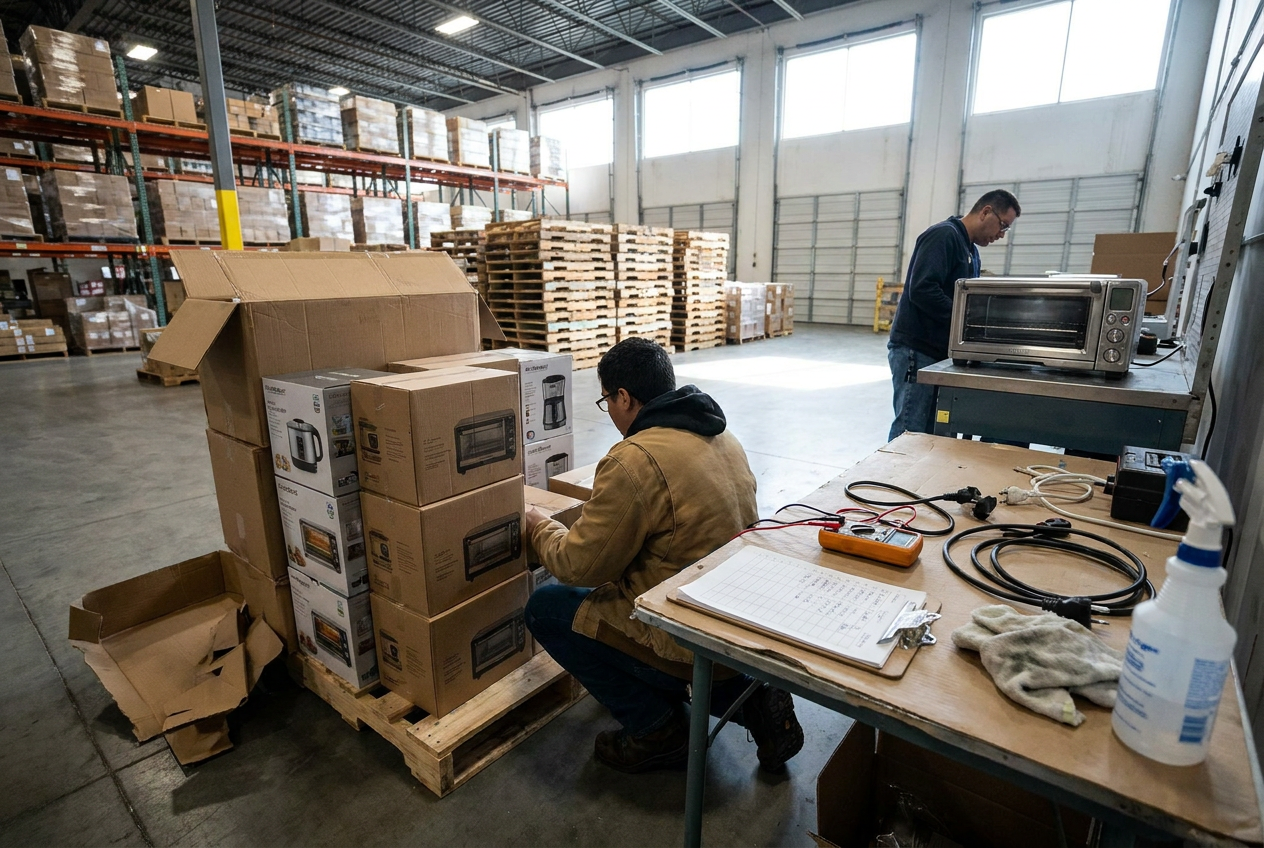
Small appliance liquidation pallets can contain countertop kitchen equipment, floor-care products and other household appliances with very different resale requirements. A boxed blender missing its blade assembly presents a different problem from a complete vacuum with a damaged cord. Counting boxes alone will not tell you how much inspection, cleaning or sourcing work a load needs.
For an independent reseller, the useful questions are specific: What is documented? Which accessories are essential? Does the appliance match the destination’s electrical supply? Can it be cleaned and tested safely? This checklist walks through those decisions before purchase and after delivery.
PalletCove Liquidation is a wholesale liquidation supplier in Dallas, Texas offering manifested and category-level pallets and full truckloads. All merchandise is sold as-is for resale; a listing, condition grade or manifest should never be treated as a guarantee that every appliance is complete or functional.
1. Understand the load type and condition grade
A small appliance liquidation pallet is a bulk lot of kitchen or household appliances sold through a secondary-market channel. Its contents may reflect customer returns, overstock, shelf pulls or salvage rather than a uniform assortment of ready-to-sell products.
The liquidation pallets hub provides a starting point for comparing formats. Use the guide to pallet types to distinguish the selling unit from the information supplied about its contents.
- Manifested loads: Include an inventory document, but the fields and level of detail vary. A manifest is not automatically a unit-level inspection report.
- Category-level loads: Describe the merchandise category without necessarily identifying every model or accessory.
- Mixed general merchandise: May contain appliances alongside unrelated items. Review the general merchandise category without assuming a particular appliance concentration.
- Truckloads: Offer a larger buying unit, not inherently better condition. Compare the truckload category against your receiving, storage and testing capacity.
| Condition description | What it generally indicates | What still needs verification |
|---|---|---|
| --- | --- | --- |
| Overstock | Inventory remaining outside its original sales channel | Storage damage, age, seals and completeness |
| Shelf pulls | Goods removed from selling shelves | Display use, packaging wear and missing parts |
| Customer returns | Merchandise returned by purchasers | Reason for return, use, sanitation and function |
| Salvage | Goods potentially requiring parts recovery or substantial repair | Safety, repair feasibility and disposal needs |
| Mixed condition | More than one condition category | The actual distribution and evidence supporting it |
Condition terminology is not universal. Ask what the grade means for the specific load, who assigned it and whether any testing supports it. “Untested” means the operating condition is unknown, not that the appliance merely needs cleaning.
2. Read the manifest and calculate the real workload
Start with the offered selling unit: one pallet, several pallets or a full trailer. Confirm whether the listed quantity counts individual appliances, cartons, sets or accessory pieces. A replacement filter is not equivalent to a complete vacuum, even if both occupy one manifest line.
Request the current listing and available manifest before payment. Useful fields include manufacturer, model number, UPC, quantity, condition notes and any documented testing. Ask whether photographs show the actual load or illustrate a merchandise category. Where information is unavailable, preserve that uncertainty in your buying decision.
For comparison, inspect the Bulk Hamilton Beach Truckload listing and the Amazon General Merchandise Truckload listing. Product names alone do not establish current contents, appliance quantities, accessory completeness or availability.
PalletCove is an independent reseller and is not affiliated with, endorsed by or sponsored by any retailer named.
Build an internal acquisition-and-processing budget using:
- The listed load price, which includes freight.
- Replacement accessories verified against exact model numbers.
- Cleaning supplies, filters, packaging and labels.
- Inspection, testing and qualified repair labor.
- Storage, selling-platform expenses and responsible disposal.
Dividing the purchase price by the manifest count produces an average acquisition cost, not a reliable cost per sellable appliance. Some pieces may require repair, parts recovery or recycling. Do not base a purchase on suggested retail totals or an assumed sell-through outcome.
3. Check accessories before judging completeness
An appliance can power on yet remain unusable because one essential component is missing. Build a model-specific checklist from the manufacturer’s manual or parts diagram, rather than comparing appliances by appearance.
| Appliance group | Components to check | Common inspection concern |
|---|---|---|
| --- | --- | --- |
| Blenders and food processors | Jar or bowl, lid, blade assembly, seals, pusher | Cracks, damaged locking tabs or incompatible blades |
| Coffee makers and espresso machines | Reservoir, carafe, basket, portafilter, drip tray | Missing seals, scale or mismatched containers |
| Air fryers and toaster ovens | Basket, drawer, racks, trays, handle | Damaged coatings, poor fit or missing cooking supports |
| Mixers | Bowl, beaters, whisk, dough hook | Wrong attachment interface or bent shafts |
| Vacuums | Bin or bag, filters, hose, brush roll, charger if applicable | Debris, damaged latches or incorrect power supply |
| Pressure cookers | Inner pot, lid, sealing ring, valves and shields | Missing or damaged pressure-control components |
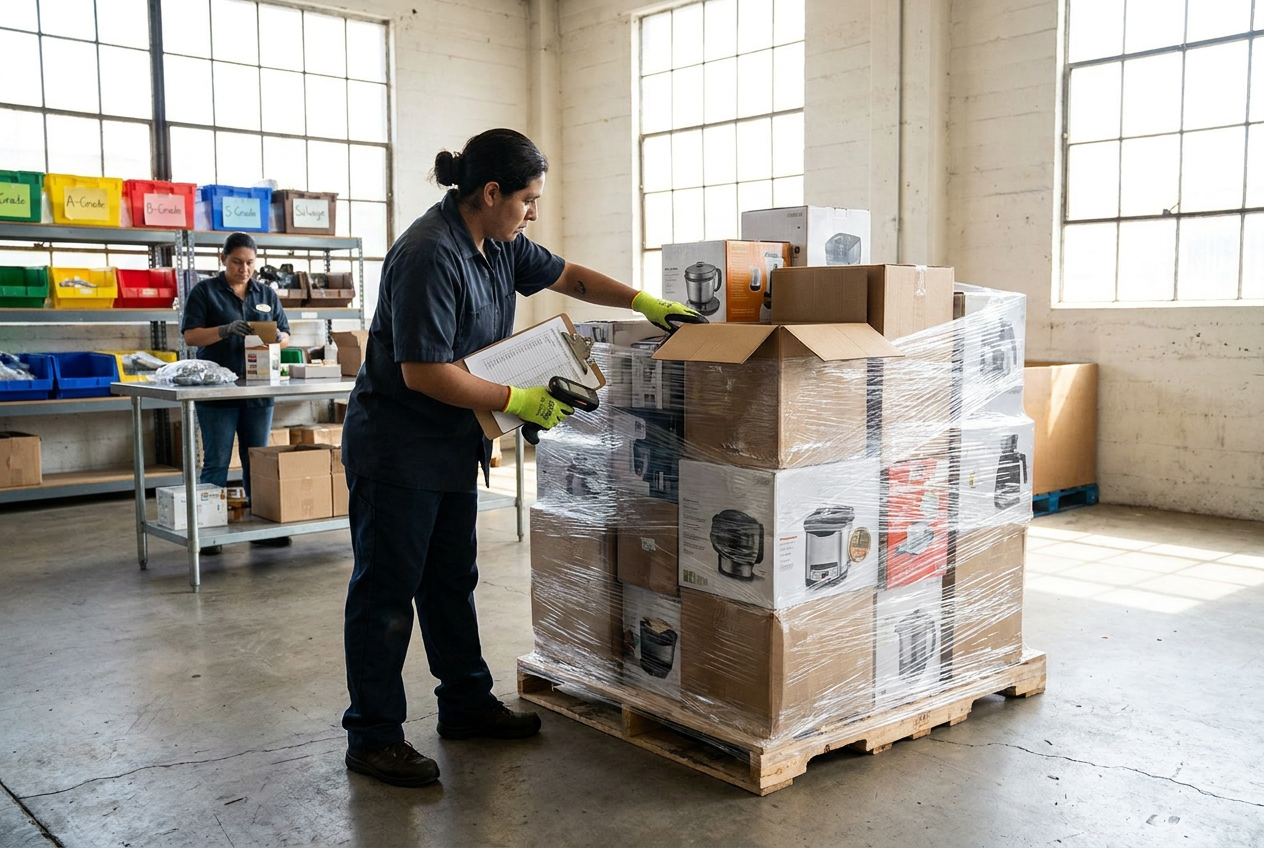
Keep accessories physically associated with their appliance during intake. Record the part number where available, photograph what is included and separate unmatched pieces. Similar-looking lids, chargers and carafes are not necessarily interchangeable.
Check replacement availability before committing to repair. A missing cosmetic trim piece and a missing safety interlock create very different decisions. Never improvise a pressure-control component, bypass an interlock or substitute an unverified food-contact part.
The useful buying unit is not just the appliance: it is the appliance, its required accessories and the documented work needed before resale.
4. Verify voltage compatibility and electrical safety
Read the appliance’s rating plate before connecting it to power. Many household outlets in the United States provide nominal 120-volt, 60-hertz power, but liquidation inventory can include models intended for other electrical systems.
Record voltage, frequency and rated current or wattage. For corded equipment, inspect the plug, cord insulation, strain relief and visible grounding provisions. For rechargeable appliances, match the manufacturer-approved charger specification, including output voltage, current requirements, polarity and connector.
A plug adapter changes physical fit; it does not necessarily convert voltage or frequency. Do not assume that a transformer makes an imported heating appliance appropriate for resale or routine testing. Refer uncertain configurations to a qualified technician.
Before powering anything:
- Isolate units with frayed cords, exposed conductors, melted plastic, corrosion or signs of liquid intrusion.
- Check that removable parts and protective covers are correctly installed.
- Look for model and serial information needed for recall searches.
- Check the U.S. Consumer Product Safety Commission recall database and manufacturer notices.
- Keep recalled appliances out of resale until any legally permitted remedy is completed and documented.
A visual inspection is a screening step, not proof of electrical safety. Do not open energized housings or attempt internal electrical repairs without appropriate qualifications.
5. Separate sanitation from functional testing
Clean according to the manufacturer’s instructions
Treat customer returns as potentially used, even when packaging looks tidy. Inspect food-contact surfaces, reservoirs, seals, hoses, filters and hidden collection areas for residue, mold, pests, odors and deterioration.
Remove loose debris first, then clean removable components using methods approved for that model. Follow any specified sanitizing procedure and product-label directions. Do not assume that every removable part is dishwasher-safe, and never immerse a motor base or electrical housing unless its manufacturer explicitly permits it.
Replace consumables when appropriate, using compatible parts. Units with persistent contamination, inaccessible residue, damaged food-contact coatings or pest evidence should remain out of sellable inventory pending a defensible disposition decision. “Cleaned” should describe actual work, not imply sterility.
Test the intended function, not just the power light
Use a stable, dry work area and suitable electrical protection. Avoid running multiple high-wattage heating appliances on an inadequately rated circuit. Follow the operating manual, observe the appliance throughout testing and stop immediately for smoke, sparks, leakage, abnormal noise or overheating.

A practical test sequence is:
- Assign an inventory ID and record the model, serial number and accessories.
- Complete visual, recall and compatibility checks.
- Clean and dry the appliance as instructed.
- Run an appropriate manufacturer-described operating cycle with required consumables or contents.
- Record controls, heating or motor performance, leaks, odors and shutdown behavior.
- Classify the result as observed working functions, repair review, parts-only or recycling.
Do not operate blenders dry when prohibited, heaters without required water, or vacuums without necessary filtration. Pressure cookers require particular care; uncertainty about locking mechanisms, valves or seals warrants qualified assessment rather than improvised testing.
Preserve test dates, methods and limitations. A successful short cycle does not establish long-term reliability, and “powers on” is not equivalent to refurbished or fully tested.
6. Order with receiving capacity in mind
Before selecting a load, compare your available floor space and weekly processing capacity with the proposed quantity. A full trailer can overwhelm a small operation even when the inventory is desirable. The guide to buying liquidation pallets helps organize the pre-purchase questions.
Confirm the load identity, selling unit, condition description, available documentation and delivery requirements before paying. Payment methods are credit/debit card, ACH bank transfer and domestic bank wire. Handling begins after payment clears and takes 1–3 business days.
Free shipping is the only delivery option on every order to all 48 contiguous states. Freight is included in the listed price. Transit from Dallas is typically 3–7 business days; handling and transit are separate intervals, not a guaranteed arrival date. Review the shipping policy when planning receipt.
Pallet-sized shipments commonly move by LTL, or less-than-truckload service, while larger orders may occupy a full trailer. Confirm the shipment format and the receiving site’s unloading arrangements before ordering. Provide accurate contact details and identify access constraints early.
These shipping terms apply whether you are browsing liquidation pallets in Texas or liquidation pallets in Florida. PalletCove covers sales tax on qualifying orders. Ask what qualifies and provide a valid resale certificate when applicable; do not assume every purchase has identical tax treatment.
7. Inspect delivery and document discrepancies
Prepare a camera, receiving checklist and segregated intake area before arrival. Keep incoming appliances separate from inspected inventory until identification and screening are complete.
- Match the shipment identifiers and pallet count to the available shipping documents.
- Photograph the load before removing wrap, including visible crushing, punctures, leaning or broken restraints.
- Record observable damage or shortages on delivery paperwork where possible, and retain a copy.
- Photograph layers while unpacking and preserve relevant packaging and labels.
- Reconcile units against the manifest using model numbers and inventory IDs.
- Report concerns promptly through the stated process, with order details and supporting evidence.
Review the refund policy before purchase for applicable reporting requirements, deadlines, exclusions and available remedies. As-is merchandise should not be approached like a consumer purchase with an assumed return window. Documentation supports review but does not guarantee a refund, replacement or accepted claim.
The guide to documenting liquidation manifest discrepancies can help separate a shipment-count problem from a model mismatch or condition concern. Describe facts precisely rather than grouping every issue under “damaged.”
Common mistakes include discarding packaging too early, mixing accessories across models, testing visibly unsafe units, treating unopened cartons as verified new goods and advertising undocumented functions. Also avoid letting unprocessed inventory accumulate without a repair, resale or recycling decision.
Frequently asked questions
Are small appliance liquidation pallets ready for immediate resale?
Not necessarily. Completeness, sanitation, electrical compatibility and function must be evaluated at the unit level. All PalletCove merchandise is sold as-is for resale, without a promise of uniform condition.
Does a manifest confirm that accessories are included?
Only if the document explicitly identifies them, and even then the received contents should be reconciled. A model number or product description alone does not establish that every required attachment is present.
Can a 220–240-volt appliance use a standard U.S. outlet?
Do not assume compatibility. Check the rating plate and manufacturer instructions; a physical plug adapter does not resolve voltage or frequency differences. Keep incompatible or uncertain units out of routine testing pending qualified review.
How much is shipping, and how long does delivery take?
Free shipping is the only delivery option for every order to all 48 contiguous states, with freight included in the listed price. Handling takes 1–3 business days after payment clears, and transit is typically 3–7 business days from Dallas.
Can defective or incomplete appliances be returned?
Do not assume an automatic return right for defects or missing accessories in an as-is load. Review the refund policy before purchasing and follow its requirements for reporting any eligible issue. Preserve the listing, manifest, delivery records and photographs for review.
Talk to PalletCove Liquidation
Before purchasing, identify your preferred category, pallet or truckload size, receiving capabilities and inspection capacity. Ask which details are documented for the specific load rather than relying on a category name.
PalletCove Liquidation LLC is located at 4820 Cove Industrial Blvd, Dallas, TX 75236.
- Phone: (713) 819-3904
- Email: sales@palletcoveliquidation.com
- Hours: Mon–Fri 8:00 AM – 6:00 PM CT, Sat 9:00 AM – 2:00 PM CT, Sun closed
To discuss a load’s available documentation and ordering requirements, contact our order desk. Review current inventory before making your final selection.