
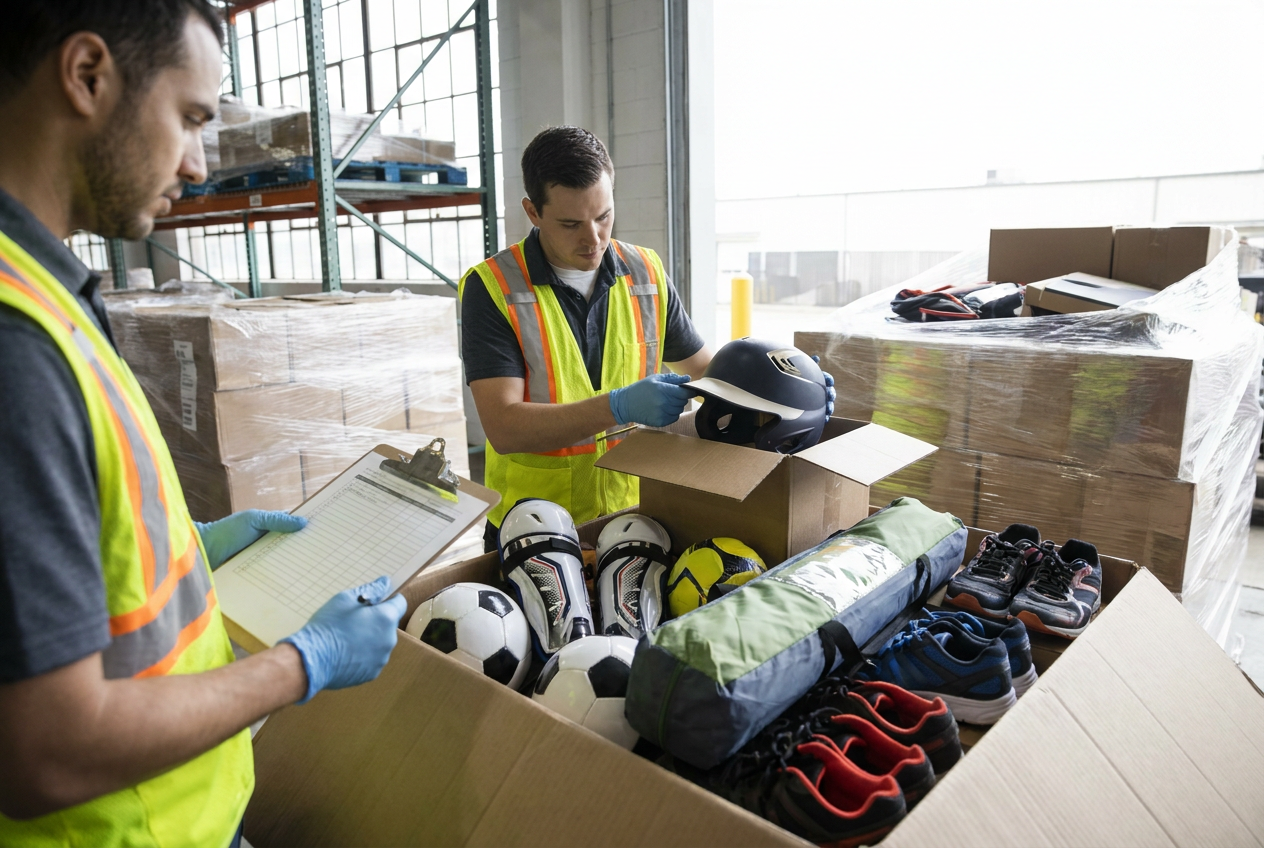
Sporting goods liquidation pallets can combine straightforward resale items with equipment that needs careful identification, assembly or safety review. A carton of water bottles presents different challenges from a mixed assortment of youth helmets, adjustable dumbbells and incomplete badminton sets. The category label alone does not tell a reseller how much usable inventory a load contains.
The practical approach is to assess four dimensions before buying: which sports are represented, how sizes are distributed, whether equipment is complete and which items require additional scrutiny. Then connect those findings to your storage space, testing capability and customer base—not just the advertised piece count.
PalletCove Liquidation supplies manifested and category-level liquidation pallets and full truckloads from Dallas, Texas. All merchandise is sold as-is for resale; condition, contents and available documentation should be evaluated at the individual listing level.
Understand load types and condition descriptions
A liquidation pallet is a shipping unit containing merchandise offered through the secondary wholesale market. A truckload is a larger purchase moving as a full trailer; it does not imply a standard number of pallets or identical contents across loads. Start with the liquidation pallets hub and the guide to types of pallets when comparing formats.
A manifested assortment provides an inventory record, although its detail and verification status vary. A category-level assortment identifies a broad merchandise category without necessarily providing item-level counts, sizes or models. Neither format alone establishes condition.
Common descriptions require interpretation:
- Overstock generally refers to excess inventory, but packaging damage or aging can still matter.
- Shelf pulls have been removed from selling floors and may carry labels, handling wear or display exposure.
- Customer returns may have been opened, used, exchanged, damaged or returned incomplete.
- Salvage describes merchandise that may be suitable only for parts, recovery or disposal, subject to safety and legal restrictions.
A condition grade is the seller's classification, not a universal testing standard. Ask what the grade means for that listing and whether it describes packaging, cosmetic appearance, function or all three. For a broader purchasing framework, review the guide to buying liquidation pallets.
Read the manifest as an assortment map
The manifest should help you understand what the load will require after arrival. Separate confirmed fields from assumptions: a product title might identify a baseball glove without giving handedness, age group or exact size.
Request available information about:
- SKU or UPC, manufacturer model and product description.
- Unit quantity and whether the count means individual pieces, pairs, sets or cartons.
- Apparel and footwear sizes, including youth versus adult classifications.
- Condition notes, testing status and known missing components.
- Duplicate concentrations, assortment substitutions and the date the record was prepared.
- Whether photographs show the actual lot or are representative.
Reconcile the total against the line items. Twelve loose rackets are not twelve complete racket-and-net sets; twenty shoes are not necessarily ten matching pairs. A listed retail figure also does not establish current demand or a resale price.
If information is unavailable, treat the gap as uncertainty rather than filling it with an optimistic assumption. The blind versus manifested pallets guide explains why documentation changes what buyers can verify, not whether every unit works.
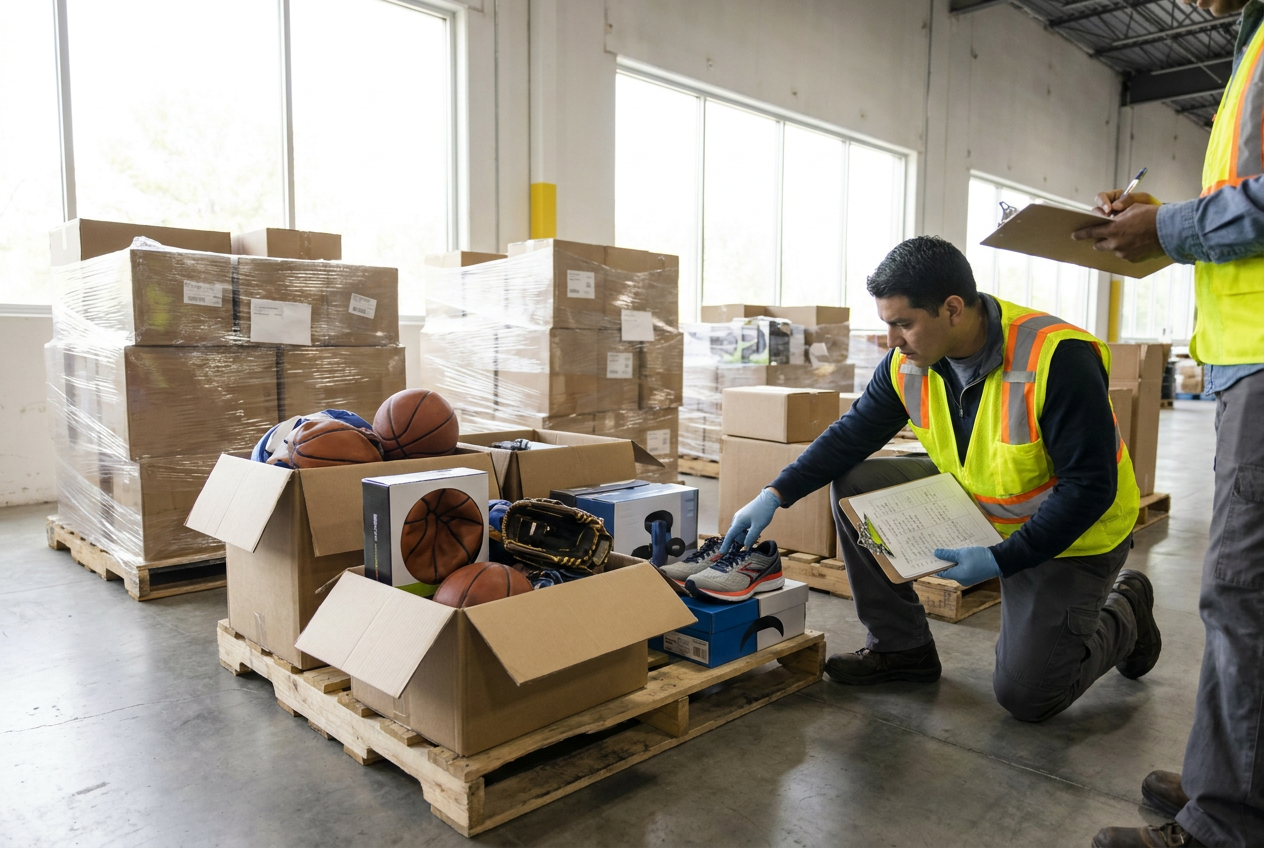
Assess the mix by sport, size and completeness
Sort by the way customers actually shop. A broad outdoor category may contain team sports, home fitness, camping accessories and recreation products with different seasonal demand and inspection needs.
| Assortment group | Size or compatibility checks | Completeness checks | Additional scrutiny |
|---|---|---|---|
| --- | --- | --- | --- |
| Team sports | Youth/adult sizing, glove handedness, bat specifications | Matching protective pieces, set contents | Cracks, altered parts, applicable league rules |
| Racket sports | Grip size, racket length, net dimensions | Poles, bases, connectors, carry bags | Frame damage, damaged strings, unstable supports |
| Fitness equipment | Weight, adjustment range, floor footprint | Collars, pins, cables, fasteners, power supplies | Load-bearing damage, locking mechanisms, electrical faults |
| Apparel and footwear | Labeled size, width, matching pairs | Insoles, laces, removable liners | Sole separation, contamination, deteriorated materials |
| Cycling and skating | Wheel size, frame size, component compatibility | Axles, brakes, guards, hardware | Structural damage, worn braking parts, impact history |
| Outdoor recreation | Capacity, dimensions, model-specific fit | Tent poles, stakes, valves, straps | Leaks, mold, damaged seams, degraded materials |
Count sizes, not just units
Build a size distribution rather than recording only a total apparel count. A large number of one youth size serves a different buyer pool from a balanced adult range. Keep manufacturer sizing distinctions visible; nominal sizes can differ between brands and product lines.
Do the same for equipment specifications. Left-hand-worn gloves, junior rackets and replacement parts for one discontinued model should not be pooled with broadly compatible goods when forecasting workload or demand.
Define what makes a complete selling unit
Use manufacturer parts lists or instructions where available. Separate essential functional components from packaging and convenience accessories, and disclose missing items accurately. Do not substitute generic bolts, chargers or load-bearing parts unless compatibility and suitability can be established.
The general merchandise category and new arrivals category provide browsing starting points, but neither label guarantees sporting goods content. Likewise, the Shoes Truckload listing and 64 Oz Water Bottle Bulk listing are separate product references, not evidence that either product is included in a particular sports load. Verify each listing independently.
Quarantine safety-sensitive equipment first
Some sporting goods protect users from injury; others support body weight, store energy or operate electrically. Visual cleanliness is not enough to establish suitability for reuse.
Assess sporting goods liquidation pallets by complete, identifiable items—not piece count alone—and keep unresolved safety-sensitive goods out of resale inventory.
Helmets, climbing equipment, flotation products and other protective gear require special caution. Missing labels, unknown impact or use history, material degradation and unavailable instructions can prevent a responsible resale decision. Inspecting a helmet's exterior cannot establish that its internal protective structure is intact.
Use a separate review process:
- Identify the exact model, size, serial number and manufacturing information where present.
- Check relevant U.S. Consumer Product Safety Commission recall records and manufacturer safety notices.
- Follow manufacturer inspection, replacement and retirement guidance for that product.
- Quarantine recalled goods and equipment with unresolved structural or protective-function concerns.
- Use the applicable recall remedy, appropriate disposal or another lawful disposition rather than offering an unsafe item for use.
For fitness equipment, check frames, welds, cables, adjustment locks, guards and stability. Powered machines need appropriate electrical and functional assessment by a competent person; a brief power-on test does not verify safe operation under load. Resistance bands and elastic components can degrade even when their packaging looks acceptable.
Do not conduct improvised proof-load tests or claim professional certification from a basic receiving inspection. If your business cannot competently evaluate a product, include outside assessment or exclusion from resale in your plan. An as-is purchase does not remove downstream product-safety obligations.
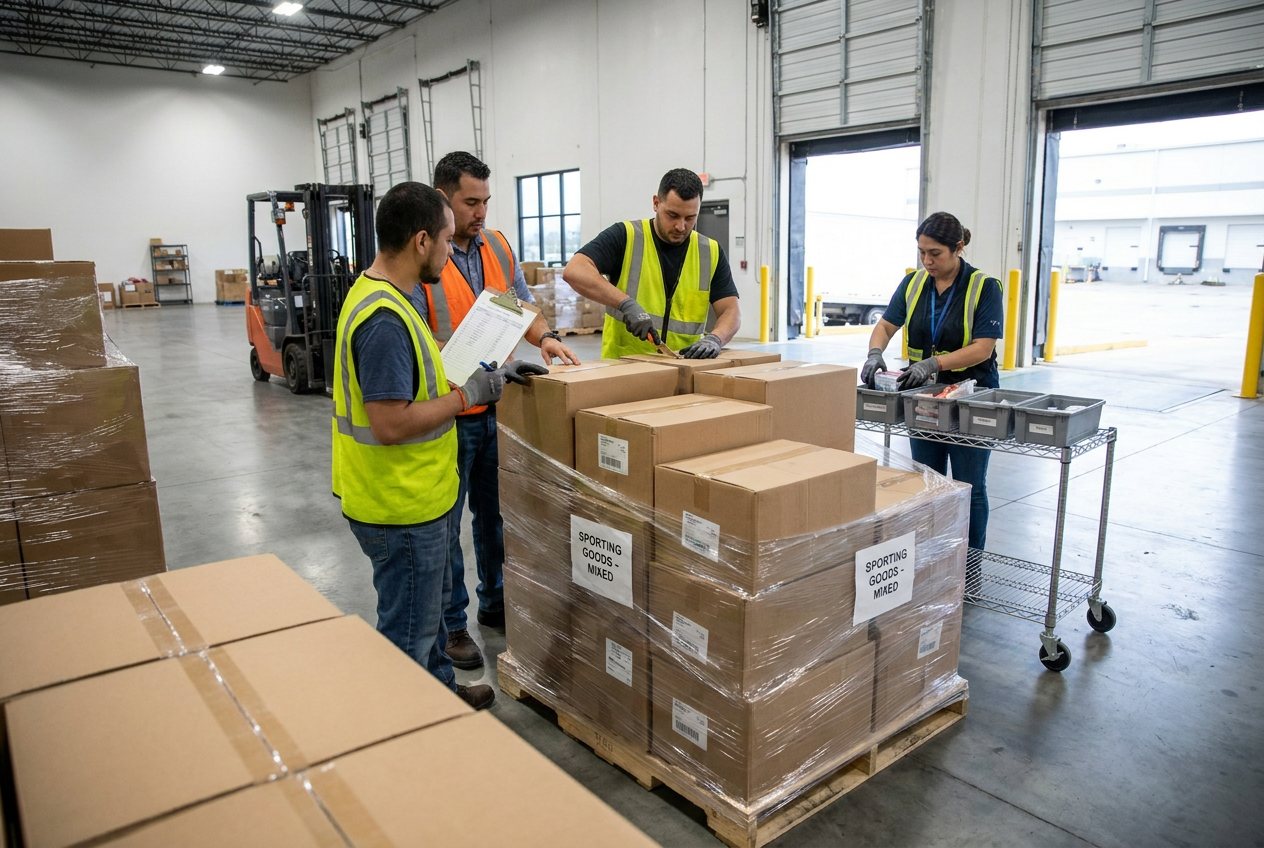
Compare pricing and prepare the order
The listed price includes freight. Free shipping is the only delivery option on every PalletCove order to all 48 contiguous states, so compare listings using that included-delivery price rather than inventing a separate shipping allowance.
Your internal acquisition cost is only part of the decision. Budget for receiving labor, sorting, cleaning, identification, appropriate testing, verified replacement components, storage, selling-channel expenses and disposal. These operating costs can vary considerably between soft goods and large fitness machines.
For planning, divide the purchase price plus your estimated processing costs by the number of units you reasonably expect to make ready for lawful resale. That produces a working cost allocation, not a guaranteed result. Run a second scenario with fewer ready units and more labor to see whether the purchase still fits your resources.
Before ordering:
- Confirm the exact listing, quantity, load format and any minimum order requirement.
- Save the listing, photographs, manifest and condition disclosures available at purchase.
- Resolve questions about sizing, missing components and testing before paying.
- Confirm the receiving address, contact information and unloading arrangements.
- Review the applicable sales terms and retain the order confirmation.
Accepted payment methods are credit/debit card, ACH bank transfer and domestic bank wire. Handling starts after payment clears and takes 1–3 business days. PalletCove covers sales tax on qualifying orders; ask what qualifies and whether a resale certificate or other business documentation is needed for your transaction. Do not assume qualification from reseller status alone.
PalletCove is an independent reseller and is not affiliated with, endorsed by or sponsored by any retailer named in its listings or materials.
Plan free shipping and delivery-day inspection
Transit is typically 3–7 business days from Dallas, after the 1–3-business-day handling period following cleared payment. These are separate stages, and typical transit is not a guaranteed arrival date.
Pallet shipments may move by LTL, meaning less-than-truckload transportation, while a truckload moves as a full trailer. Confirm the shipment configuration, unloading responsibilities and site requirements before ordering. Ensure you have space for the load and appropriate equipment and trained personnel to receive it.
The same free-shipping framework applies to buyers browsing liquidation pallets in Texas or liquidation pallets in Florida. Review the shipping policy for applicable delivery procedures.
On delivery day:
- Compare the shipment identifiers and handling-unit count with the transport paperwork.
- Photograph the load before unwrapping, including visible carton damage, disturbed wrapping or leaning stacks.
- Record visible damage or shortages accurately on delivery paperwork where applicable.
- Preserve packaging, labels and shipment documents while resolving discrepancies.
- Reconcile individual items against the manifest during sorting.
External freight inspection and item-level condition inspection are different tasks. A pallet arriving with intact wrapping does not prove every product inside is functional or complete.
Handle discrepancies and avoid common mistakes
All merchandise is sold as-is for resale. Do not assume that ordinary customer-return wear, incomplete units or unsold inventory qualify for a return. Review the refund and claims policy before purchase to understand any available remedy, reporting deadline and evidence requirements.
If something appears inconsistent with the order, document the order number, affected manifest lines, quantities and photographs. Distinguish a shipping shortage from a missing accessory inside a customer-return carton. Contact the order desk promptly, preserve relevant evidence and follow its instructions; reporting a problem does not guarantee a refund or replacement.
Common buying mistakes include treating every manifest piece as a complete product, assuming sealed packaging proves unused condition and buying more bulky equipment than the receiving area can hold. Another is cleaning or discarding labels before recording model and serial information needed for recall checks.
Finally, avoid assessing the assortment only by its most recognizable items. Duplicates, narrow sizing, seasonal timing and unresolved safety questions can determine the actual processing burden.
Frequently asked questions
Are sporting goods liquidation pallets ready for immediate resale?
Not necessarily. Merchandise is sold as-is for resale, and each item may need identification, condition assessment, completeness checks and accurate disclosure. Safety-sensitive products require additional review before any resale decision.
Does a manifest guarantee every item is complete and working?
No; a manifest is an inventory record, not automatically a functional test report. Check which fields are provided, how quantities are counted and whether testing or completeness is explicitly documented.
Should a reseller choose a pallet or a truckload?
Choose according to receiving capacity, inspection labor, storage and the assortment details available. A full trailer increases the amount of inventory to process and is not inherently a better fit simply because it contains more merchandise.
Can returned helmets or protective equipment be resold?
Do not assume they are suitable for resale based on appearance. Verify identification, recall status and manufacturer guidance, and keep items with unresolved impact history or protective-function concerns out of resale inventory.
What are the shipping and payment options?
Free shipping is the only delivery option on every order to all 48 contiguous states, with freight included in the listed price. Payment is accepted by credit/debit card, ACH bank transfer or domestic bank wire. Handling takes 1–3 business days after payment clears, and transit is typically 3–7 business days from Dallas.
Talk to PalletCove Liquidation
Bring your target sports, size requirements, receiving capacity and inspection limitations to the order discussion. For listing-specific questions, contact our order desk or review current inventory before committing to a load.
- Business: PalletCove Liquidation LLC
- Address: 4820 Cove Industrial Blvd, Dallas, TX 75236
- Phone: (713) 819-3904
- Email: sales@palletcoveliquidation.com
- Hours: Mon–Fri 8:00 AM – 6:00 PM CT, Sat 9:00 AM – 2:00 PM CT, Sun closed