
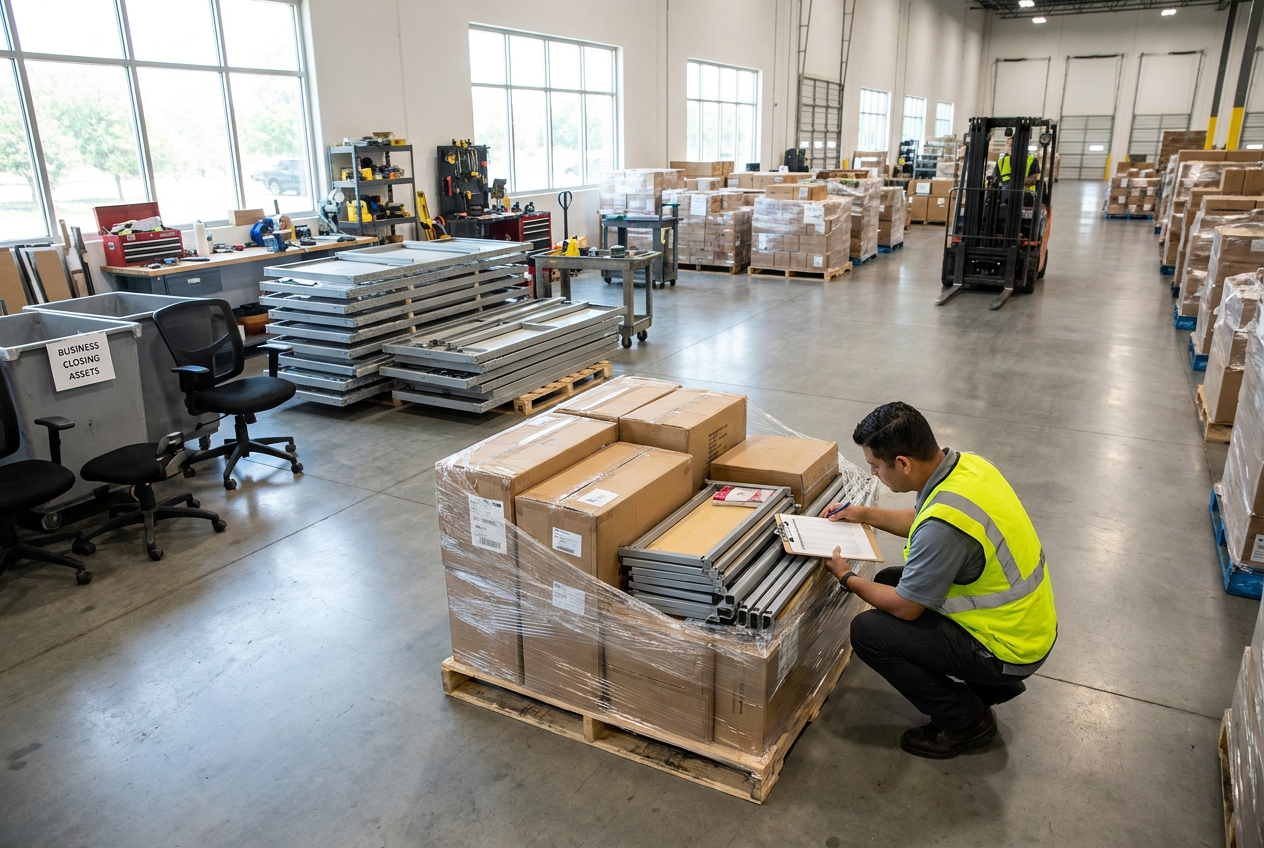
The difference between store liquidation vs retail liquidation is not simply where the merchandise originated. Store liquidation usually describes selling assets from a closing, relocating or restructuring location. Retail liquidation usually describes moving merchandise out of a retailer’s regular sales channels, whether or not any store is closing.
That distinction matters when you are buying for resale. A store-closing lot might contain saleable inventory, display shelving, checkout equipment or a combination. A retail merchandise lot typically contains products such as customer returns, overstock or shelf pulls—not the store’s operating equipment unless explicitly listed.
PalletCove Liquidation supplies category-level liquidation pallets and full truckloads to independent resellers from Dallas, Texas. This guide explains how to identify what you are buying, evaluate uncertainty and prepare for delivery without confusing a merchandise purchase with a business asset sale.
What store liquidation and retail liquidation mean
Store liquidation describes an event: a business sells assets connected with a location or operation. The seller might separate merchandise from fixtures and equipment, or bundle multiple asset types into auction lots. A closing sale does not automatically mean bankruptcy; relocation, retirement and restructuring can also lead to asset disposal.
Retail liquidation describes an inventory disposition process. Merchandise can enter liquidation because it was returned, discontinued, over-ordered, seasonally displaced or removed from shelves. The retailer may continue operating normally.
| Buyer question | Store liquidation | Retail merchandise liquidation |
|---|---|---|
| --- | --- | --- |
| What is being sold? | Inventory, fixtures, equipment or separately defined asset lots | Merchandise removed from regular retail channels |
| Does it imply a closure? | Often associated with a location closing or changing operations | No; routine inventory management can generate liquidation stock |
| Could shelving be included? | Yes, if identified in the lot description | Only if expressly included |
| What needs verification? | Asset ownership, inclusions, functionality and removal obligations | Contents, quantities, condition descriptions and shipping terms |
| What defines the purchase? | The specific asset list and sale agreement | The specific listing, manifest and applicable terms |
The terms can overlap. Unsold inventory from a closing store can become a retail liquidation pallet, while the store’s counters and racks are sold separately. For broader context, review the liquidation buying overview.
Buy the documented contents of the lot, not the story suggested by the word “liquidation.”

Identify the asset type and load format
Before considering price, determine whether the lot contains products you can resell through your existing channels or assets requiring a different business model.
- Resale inventory: Consumer products intended for individual or bundled resale, subject to condition and applicable restrictions.
- Fixtures: Shelving, display racks, counters and other store fittings. Confirm whether mounting hardware and components are included.
- Equipment: Checkout systems, refrigeration, material-handling equipment or other operating assets. Ownership, functionality and any software transfer requirements need separate verification.
In a third-party store asset sale, ask whether removal requires disassembly, qualified trades or permission from the property owner. Do not assume a buyer can remove everything shown in a location photograph. Those questions are different from ordering merchandise through PalletCove’s free-shipping-only delivery model.
A liquidation pallet is a shipping unit, not a standardized piece count or condition promise. A category-level pallet groups merchandise by a category; it does not establish exact models, sizes or quantities. Start with the liquidation pallets hub and compare the general merchandise category with the truckload inventory category.
A truckload describes a larger shipment, often using a full trailer. Verify pallet count, estimated units and whether the shipment is palletized or floor-loaded. Floor-loaded merchandise requires a different unloading plan because individual cartons must be handled rather than simply moving wrapped pallets.
Listings such as the Amazon General Merchandise Truckload and Macy’s Textile Truckload illustrate different inventory focuses. Check each current listing rather than inferring contents or availability from its name. PalletCove is an independent reseller and is not affiliated with, endorsed by or sponsored by any retailer named.
Understand condition grades before comparing lots
Condition terminology is not universal. One supplier’s grade may differ substantially from another’s, and a mixed lot can contain multiple conditions. Ask what the grade means for that specific shipment and whether the description reflects inspection, testing or only the source classification.
| Condition description | What it generally indicates | What still needs verification |
|---|---|---|
| --- | --- | --- |
| Overstock | Excess inventory not sold through the original channel | Packaging, completeness, age and storage effects |
| Shelf pulls | Products removed from sales-floor inventory | Handling marks, labels, fading and missing packaging |
| Customer returns | Products returned after a customer transaction | Functionality, use, missing parts and reason for return |
| Salvage | Goods requiring repair, parts recovery or other disposition | Repair feasibility, safety and lawful disposal options |
“Untested” does not mean working, and “open box” does not establish that every accessory is present. A sealed package alone does not confirm functionality. Treat unsupported assumptions as uncertainty, not as additional value.
All PalletCove merchandise is sold as-is for resale. No condition label should be read as a guarantee of every item’s condition. Budget time for sorting, testing, cleaning and accurate descriptions before listing products for your customers.
Check applicable recalls, expiration dates and marketplace restrictions. Electrical items, batteries, cosmetics and children’s products may require particular care. Do not sell a recalled or unsafe item merely because it arrived in a liquidation lot.
Read the manifest alongside the listing
A manifest is an inventory document that may include item descriptions, identifiers, quantities and reference values. Its usefulness depends on its detail, accuracy and relationship to the actual load. Some lots are unmanifested; others have partial or estimated inventories.
Before buying, ask:
- Does this manifest identify the exact lot being offered?
- Are quantities counted, estimated or subject to stated tolerances?
- Are entries individual units, multipacks, cases or assortment lines?
- Are condition descriptions provided per item or only for the load overall?
- Are photographs of the actual lot or representative inventory?
- Are fixtures, equipment, accessories or display pieces expressly included or excluded?
A UPC or model number helps identify an item but does not prove its condition. Likewise, a manifest’s retail reference value is not an expected selling price, a current market valuation or a profit forecast.
For an unmanifested lot, ask what category and condition information is available. If the unknown mix could exceed your testing capacity or storage space, a more documented purchase may suit your operation better. Preserve the listing, manifest and written answers associated with your order.

Compare pricing without assuming resale value
A store asset sale may price items individually, group them into lots or use auction bidding with a buyer’s premium. Read those sale terms carefully: an apparent merchandise bargain may also create equipment-removal obligations.
For PalletCove orders, freight is included in the listed price. Free shipping is the only delivery option on every order to all 48 contiguous states. PalletCove also covers sales tax on qualifying orders; verify qualification rather than assuming every transaction qualifies.
Your operating budget should still account for work after receipt:
- Sorting, testing and cleaning labor.
- Replacement components and resale packaging.
- Storage space and inventory handling.
- Marketplace charges and your own customer fulfillment.
- Unsellable items, recycling and appropriate disposal.
Dividing the purchase price by a stated unit count produces an average acquisition cost—not a reliable cost per saleable item. Actual saleable quantities are determined after inspection. Use conservative scenarios and a maximum buying budget, as explained in the liquidation pallet buying-limit guide.
Order with a receiving plan and confirmed payment terms
Before placing an order, match the shipment to your sales channels, processing capacity and available cash. A full trailer can overwhelm a reseller who has space to store goods but insufficient labor to unload and inspect them.
Use this order sequence:
- Confirm the specific lot, inventory category, condition description and available manifest.
- Review the listed price, qualifying sales-tax treatment and applicable purchase terms.
- Verify your delivery address, receiving contact and unloading capabilities.
- Resolve material questions in writing before paying.
- Save your order confirmation and shipment documentation.
The guide to buying liquidation pallets provides additional purchase-planning context.
PalletCove accepts credit/debit card, ACH bank transfer and domestic bank wire. Review the payment policy, and verify payment instructions directly through the order desk if anything appears inconsistent. Handling starts after payment clears, not simply when a transfer is initiated.
A resale certificate documents resale-related tax status where applicable; it is not a condition guarantee or a universal exemption. Keep a valid certificate available and confirm what documentation your order requires. PalletCove covers sales tax on qualifying orders.
Free shipping and delivery preparation
PalletCove ships from Dallas with 1–3 business days of handling after payment clears. Transit is typically 3–7 business days from Dallas. These are separate stages, and typical transit is not a guaranteed arrival date.
Free shipping is the only delivery option, and freight is included in the listed price on every order throughout the 48 contiguous states. The same delivery framework applies when reviewing liquidation pallets in Texas or liquidation pallets in Florida. Consult the shipping policy for applicable details.
Smaller pallet shipments may travel by LTL, or less-than-truckload service, sharing trailer capacity with other shipments. A larger load may use a full trailer. Confirm the actual shipping configuration rather than assuming that the word “truckload” establishes the unloading method.
Before dispatch, clarify site access, receiving hours, dock or unloading-equipment availability and any appointment requirements. Reserve adequate space and staff for the shipment. Free shipping does not eliminate the need to confirm that your location can safely receive it.
Inspect delivery and understand returns or claims
Delivery-day inspection should separate visible transportation issues from item-level merchandise condition. Damaged outer wrapping is not the same issue as a nonworking customer return discovered during testing.
At receipt:
- Compare shipment identifiers and pallet or carton counts with the delivery paperwork where feasible.
- Photograph the shipment, labels, wrapping and visible damage before unpacking.
- Record visible shortages or damage accurately on delivery documents before signing, where possible.
- Retain packaging, paperwork and relevant item identifiers.
- Reconcile the manifest and document discrepancies during sorting.
Report concerns promptly with your order number, delivery date, photographs and a factual description. Review the refund and claims policy before ordering and follow its current reporting requirements. Do not assume a particular return window, refund entitlement or claim outcome: as-is merchandise does not carry a general satisfaction or working-condition promise.
Common mistakes include discarding evidence, treating reference retail values as promised resale prices, assuming every manifest line is a single item and expecting fixtures shown in background photos to be included. Avoid repairing, disposing of or sending back disputed goods before obtaining instructions, unless immediate safety requirements dictate otherwise.
Frequently asked questions
Does store liquidation always mean the entire business is closing?
No. A business can liquidate assets from one location while continuing elsewhere, or sell excess assets during relocation or restructuring. Confirm the actual lot contents rather than relying on the reason for the sale.
Do retail liquidation pallets include shelves or checkout equipment?
Not automatically. Retail merchandise lots generally consist of products, while fixtures and equipment must be specifically identified as included. Photographs showing store fittings do not establish ownership or inclusion.
Are customer returns guaranteed to work?
No. Customer returns can include functional items, damaged products, incomplete packages and goods requiring repair. PalletCove merchandise is sold as-is for resale, so plan for inspection and item-level testing.
Is a manifest required for a useful purchase?
Not every liquidation lot has a manifest. An unmanifested purchase requires greater tolerance for uncertainty about the assortment and quantities. Assess the available category, condition and photographic information before committing.
How do PalletCove shipping and payment work?
Free shipping is the only delivery option on every order to all 48 contiguous states, with freight included in the listed price. Payment methods are credit/debit card, ACH bank transfer and domestic bank wire. Handling takes 1–3 business days after payment clears, followed by typical transit of 3–7 business days from Dallas.
Talk to PalletCove Liquidation
Choose a lot based on documented merchandise, manageable uncertainty and a realistic receiving plan. For questions about contents, condition descriptions or delivery preparation, contact our order desk and review current inventory.
- Business: PalletCove Liquidation LLC
- Address: 4820 Cove Industrial Blvd, Dallas, TX 75236
- Phone: (713) 819-3904
- Email: sales@palletcoveliquidation.com
- Hours: Mon–Fri 8:00 AM – 6:00 PM CT, Sat 9:00 AM – 2:00 PM CT, Sun closed