
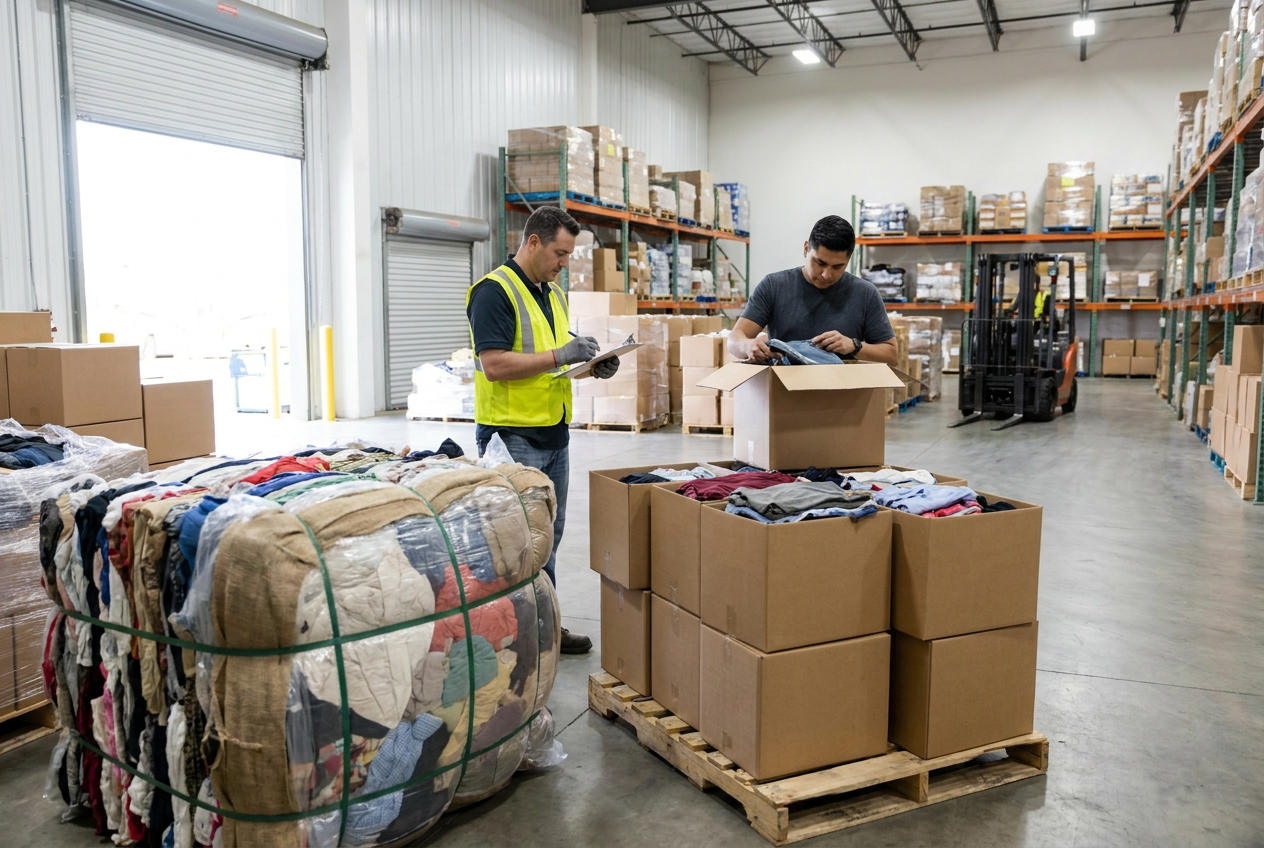
Used clothing bales and retail liquidation apparel can both supply a resale business, but they are not interchangeable inventory sources. A bale describes compressed packaging, while a pallet describes a shipping platform. Neither term, by itself, tells you whether the clothing is wearable, sorted, new, previously worn or suitable for your customers.
The useful comparison of used clothing bales vs pallets is therefore about the supply model behind the packaging. Secondhand textile businesses typically collect and sort previously owned garments; retail liquidation businesses sell inventory leaving retail channels, including overstock, shelf pulls and customer returns. Both models require careful buying and hands-on processing.
PalletCove Liquidation supplies category-level liquidation pallets and full truckloads to independent resellers from Dallas, Texas. This guide explains how to evaluate textile bales against retail apparel lots without assuming that either format guarantees a particular condition or business outcome.
Understand the two supply models
A used clothing bale is a compressed bundle of textiles, usually secured with straps and wrapping. Bales may contain mixed clothing, a single garment category, seasonal selections or material intended for textile recovery rather than wearable resale. They are commonly described and priced by weight, although the seller's actual specification controls.
A retail liquidation pallet is merchandise consolidated on a pallet for handling and transportation. Apparel may arrive in cartons, bags or other packaging. Some sellers also compress retail textiles, and secondhand bales can travel on pallets, so packaging alone cannot establish sourcing.
| Buying factor | Secondhand clothing bales | Retail liquidation apparel pallets |
|---|---|---|
| --- | --- | --- |
| Typical source | Collection programs, thrift operations and textile sorters | Retail inventory exits, returns and excess stock |
| Common quantity basis | Weight per bale or shipment | Lot, pallet, estimated units or truckload |
| Product detail | Often category and grade specifications | May include a manifest or broad category description |
| Main sorting work | Wear, cleanliness, garment type and market fit | Condition, tags, completeness, size and item identity |
| Packaging effect | Compression can obscure individual garments | Cartons or wrap can also prevent full inspection |
| Larger order format | Multiple bales or bulk shipments | Multiple pallets or a full trailer |
Start with the liquidation pallets inventory hub to understand the retail-liquidation format. The broader liquidation sourcing overview explains the channel, while the guide to pallet types helps separate category, source and condition descriptions.
Buy the documented contents and processing workload—not the shape of the package or an assumed condition.
Compare sourcing and condition grades
Secondhand textile grades
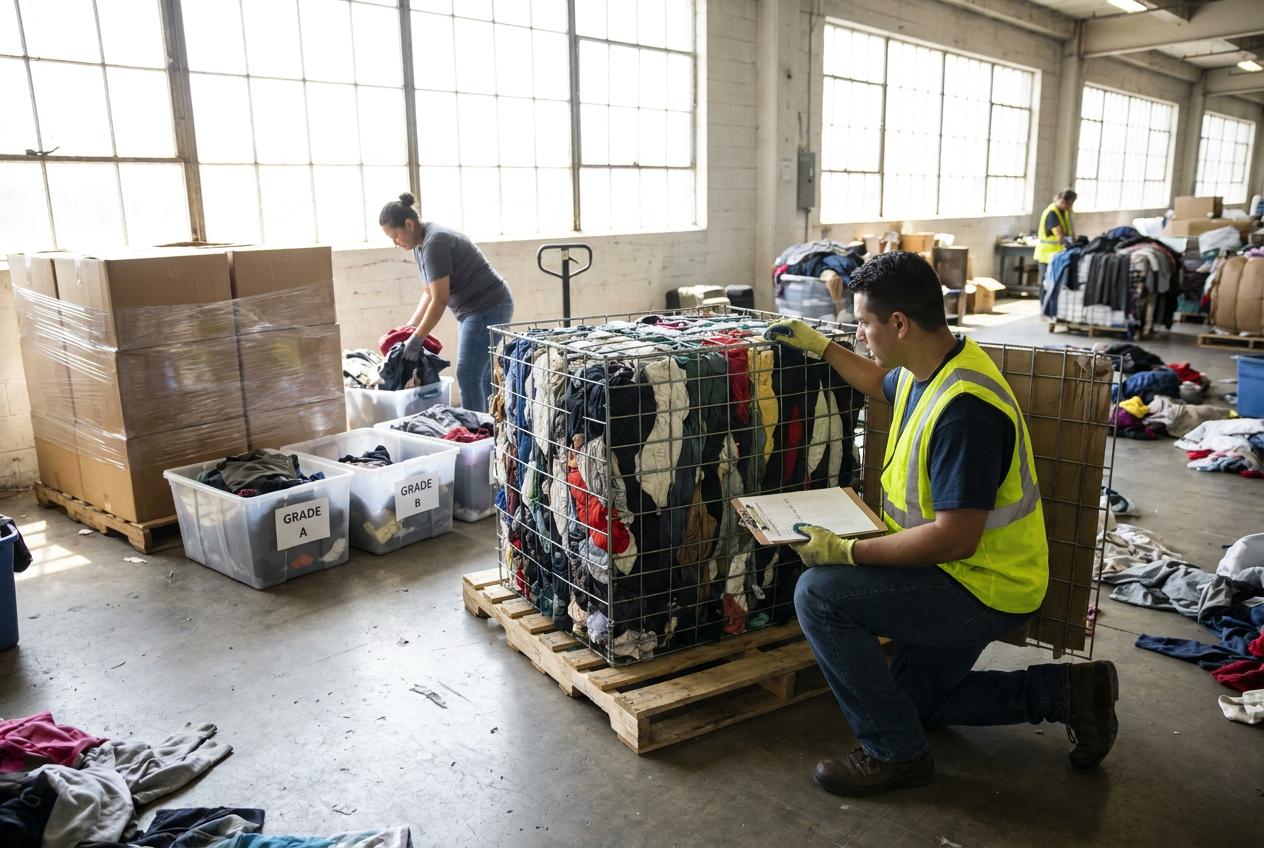
Textile sellers may use labels such as cream, premium, Grade A or Grade B. These are not universal standards. One supplier's Grade A may allow wear that another supplier excludes, and a category-specific bale may still contain varied sizes, fabrics and styles.
Ask for the seller's written definition, including permitted stains, holes, fading, missing closures and nonwearable material. Clarify whether the bale is original collected clothing, sorted wearable clothing or salvage textiles. Also ask whether it has already been selected for higher-demand pieces; an unsearched-lot claim should never substitute for a usable specification.
Retail liquidation conditions
Retail apparel can include several inventory streams:
- Overstock: excess inventory, which may still require checks for storage damage, aging or inaccurate labels.
- Shelf pulls: merchandise removed from displays or selling floors, potentially with handling marks or altered tags.
- Customer returns: items returned after purchase, with variable wear, packaging and completeness.
- Salvage: merchandise that may need repair, parts recovery, textile recycling or disposal rather than ordinary resale.
A condition grade describes the seller's classification; it is not a promise about every garment. New-looking packaging does not prove that an item is unworn, and a retail source name does not establish authenticity or condition for every unit.
Review the Macy's liquidation category for relevant listings and the truckload inventory category for larger formats. PalletCove is an independent reseller and is not affiliated with, endorsed by or sponsored by any retailer named. All merchandise is sold as-is for resale.
Read the manifest and define the load
A manifest is a shipment inventory document. Depending on the seller and lot, it may identify product descriptions, quantities, sizes, styles, UPCs or SKUs. It may also contain reference retail prices, which are not evidence of achievable resale prices.
Not every bale or liquidation lot has an itemized manifest. For a nonmanifested shipment, treat missing information as uncertainty—not as evidence of a favorable assortment. Confirm whether photographs show the actual load or representative inventory.
Before ordering, establish:
- Whether you are buying one bale, one pallet, several pallets or an entire truckload.
- Whether weight is net garment weight or includes wrapping and other packaging.
- Whether a unit means one garment, a multipiece set, a pair or a package.
- Whether quantities are exact, estimated or subject to stated tolerances.
- Whether the assortment includes accessories, footwear or household textiles.
- Whether descriptions apply to every item or characterize a mixed load.
For example, the Macy's Textile Truckload listing should be evaluated using its current description; “textile” alone does not mean apparel-only. Likewise, the Shoes Truckload listing represents a different processing task, including pair matching, size verification and sole inspection.
A full trailer describes transportation scale, not a fixed garment count. Do not extrapolate an entire truckload's contents from one photographed carton or one previous purchase.
Match the sorting workload to your resale operation
The right supply model depends on your sales channel and labor capacity. A business that sells individually photographed garments has different requirements from a bulk secondhand distributor.
| Resale operation | Potentially suitable model | Main question before buying |
|---|---|---|
| --- | --- | --- |
| Thrift or market-stall seller | Sorted wearable bales or suitable apparel pallets | Does the assortment match local sizes, seasons and price expectations? |
| Online individual-item seller | Either model with sufficient product detail | Can staff inspect, measure, photograph and list the volume? |
| Discount apparel store | Retail apparel with documented assortment | Are size runs and repeated styles useful for the store? |
| Bulk secondhand wholesaler | Bales with defined categories and grades | Are weight, grade and destination requirements clear? |
| Textile recovery operator | Appropriately specified salvage textiles | Does the material meet the recovery process requirements? |
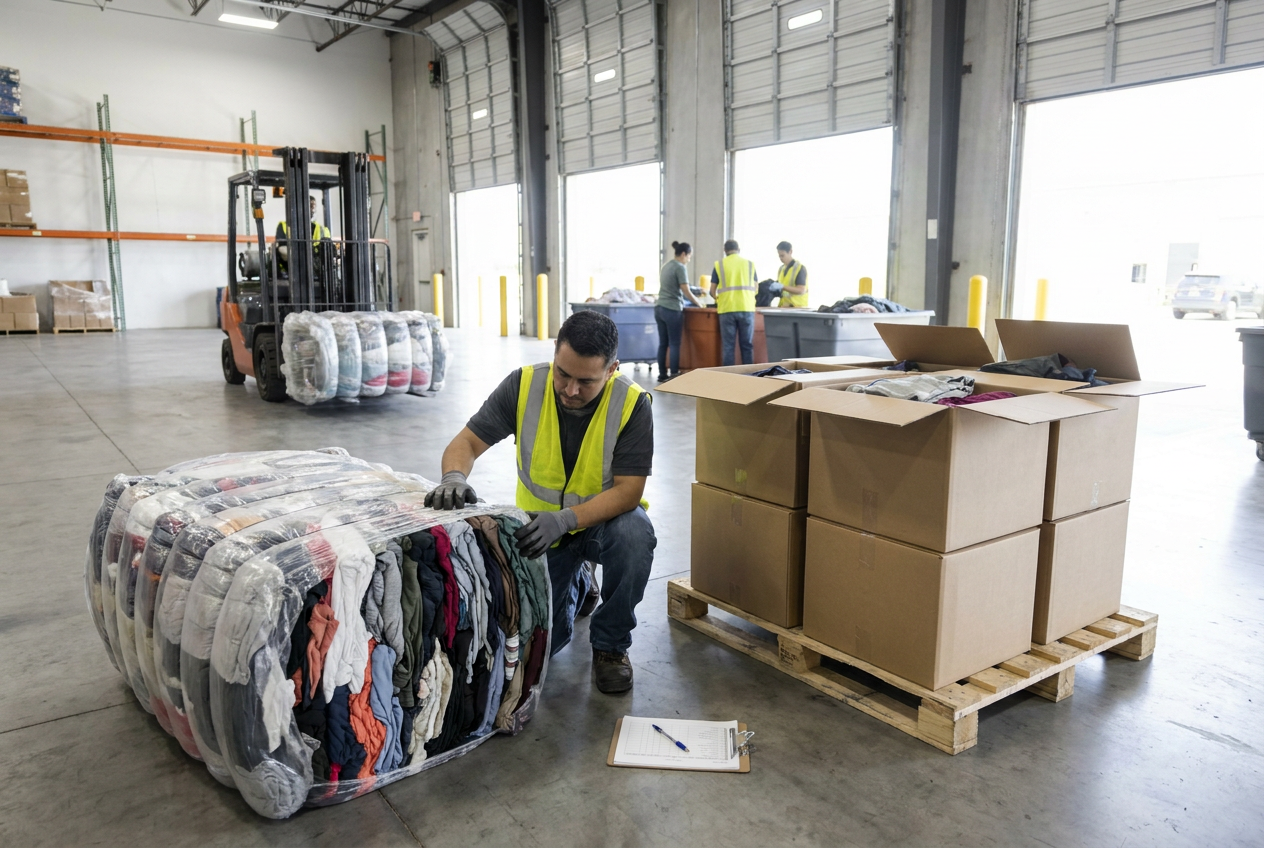
For bales, plan to open the wrapping safely, separate garment categories and inspect for moisture, odor, staining and damage. Use appropriate tools and protective equipment when releasing tensioned straps. Follow garment care labels when cleaning, and isolate questionable material from sale-ready stock.
For retail pallets, check returns carefully for wear, incorrect items, missing components and mismatched sets. Separate sellable inventory from repair candidates and material unsuitable for your channel. Tags and packaging are useful identifiers, not substitutes for inspection.
Both models need clean, dry storage and space for incoming stock, work in progress and finished inventory. International secondhand sellers should independently verify destination-country import, labeling and sanitation requirements; PalletCove's delivery coverage should not be confused with an export service.
Compare pricing using usable inventory and labor
A low price per pound is not directly comparable with a low price per pallet. Garment weights differ, and neither measurement establishes how many items fit your resale channel.
Track acquisition cost separately from processing expenses. At PalletCove, freight is included in the listed price. For internal planning, add your own inspection labor, cleaning, repairs, supplies, storage and disposal expenses as applicable.
Two useful calculations are:
- Acquisition cost per received item = order price ÷ verified items received.
- Processed cost per channel-ready item = total acquisition and processing expenses ÷ items actually prepared for that channel.
For illustration only, a $1,200 lot containing 600 verified garments has an acquisition cost of $2 per received garment. If processing costs another $300 and 400 garments are prepared for your intended channel, the allocated cost is $3.75 per channel-ready garment. This is a planning example, not a PalletCove offer, expected yield or resale-value estimate.
Before inspection, run several scenarios rather than assuming every item will be usable. Allocate costs consistently if you sell remaining material through another channel. The guide to calculating a liquidation buying limit provides a complementary framework for setting an order budget.
Ordering, payment and free shipping
Confirm the listing's load type, condition description, quantity basis and available documentation before payment. Ask about unclear size mixes, seasonal content and receiving requirements rather than filling gaps with assumptions.
PalletCove accepts credit/debit card, ACH bank transfer and domestic bank wire. Handling takes 1–3 business days after payment clears. Transit from Dallas is typically 3–7 business days; handling and transit are separate stages, not a guaranteed arrival date.
Free shipping is the only delivery option on every order to all 48 contiguous states. Freight is included in the listed price. Buyers researching liquidation pallets in Texas and liquidation pallets in Florida receive that same free-shipping policy; Alaska and Hawaii are outside this coverage.
A pallet shipment may travel by LTL, meaning less-than-truckload service, while a larger order may occupy a full trailer. Confirm the actual transportation arrangement and unloading requirements before ordering. Share accurate delivery contact details, receiving hours and site limitations, and review the shipping policy.
PalletCove covers sales tax on qualifying orders. Ask what qualifies and whether your resale certificate or other business documentation is needed; do not assume every purchase automatically qualifies.
Inspect delivery and understand claims
Prepare a receiving area before the shipment arrives. Keep the order confirmation, listing description and available manifest accessible so staff know what to check.
- Compare the delivery documents with the order and count the handling units where possible.
- Photograph the shipment before removing wrapping, including labels, seals and visible damage.
- Note visible damage or handling-unit shortages on the delivery receipt when appropriate, following carrier procedures.
- Inspect contents promptly, recording discrepancies separately from ordinary condition variation.
- Retain packaging and relevant records while seeking instructions about a documented issue.
A signed delivery receipt is not a garment-by-garment inspection. Concealed damage or a contents discrepancy may become apparent only during unpacking, so keep a dated inspection record.
All PalletCove merchandise is sold as-is for resale. Do not assume retail-style returns, exchanges or refunds. Review the refund and claims policy before purchasing, and confirm any applicable reporting requirements and deadlines. Reporting an issue does not itself establish eligibility for a remedy.
Common mistakes include buying on a retailer name alone, treating an estimated manifest as an exact count, confusing salvage with wearable stock and overlooking duplicate styles or uneven sizes. Another is scaling to a truckload before measuring how long your team takes to process one smaller lot. Bales introduce a similar risk when weight is mistaken for a predictable piece count.
Frequently asked questions
Are used clothing bales cheaper than liquidation pallets?
Not necessarily on a comparable basis. Compare documented quantities, category fit and total processing expenses, then calculate costs using verified inventory rather than package size alone.
Is apparel on a liquidation pallet always new?
No. Retail liquidation can include overstock, shelf pulls, customer returns and salvage, and a mixed lot may require several different inspection workflows. The listing's condition description matters more than the pallet format.
Can I choose brands, sizes or seasons?
Only when the seller's specific offer permits that selection. A category-level description does not automatically provide control over brands, size runs or seasonal balance, so confirm the assortment before payment.
Does a clothing bale include a manifest?
Some suppliers provide detailed information, but many bales are sold using weight, category and grade specifications instead of item-level manifests. Ask what documentation exists and whether quantities or grades are estimates.
How does PalletCove deliver apparel orders?
Free shipping is the only delivery option on every order to the 48 contiguous states, with freight included in the listed price. Handling is 1–3 business days after payment clears, followed by transit typically lasting 3–7 business days from Dallas.
Talk to PalletCove Liquidation
Choose the inventory model your team can inspect, store and sell responsibly. For retail liquidation apparel, verify the current listing rather than assuming that a product name establishes garment counts, condition or selection rights.
PalletCove Liquidation LLC is located at 4820 Cove Industrial Blvd, Dallas, TX 75236. Call (713) 819-3904 or email sales@palletcoveliquidation.com. Business hours are Mon–Fri 8:00 AM – 6:00 PM CT, Sat 9:00 AM – 2:00 PM CT, Sun closed.
To clarify a load description or receiving requirements, contact our order desk. Browse current inventory for available listings and their stated purchase terms.