
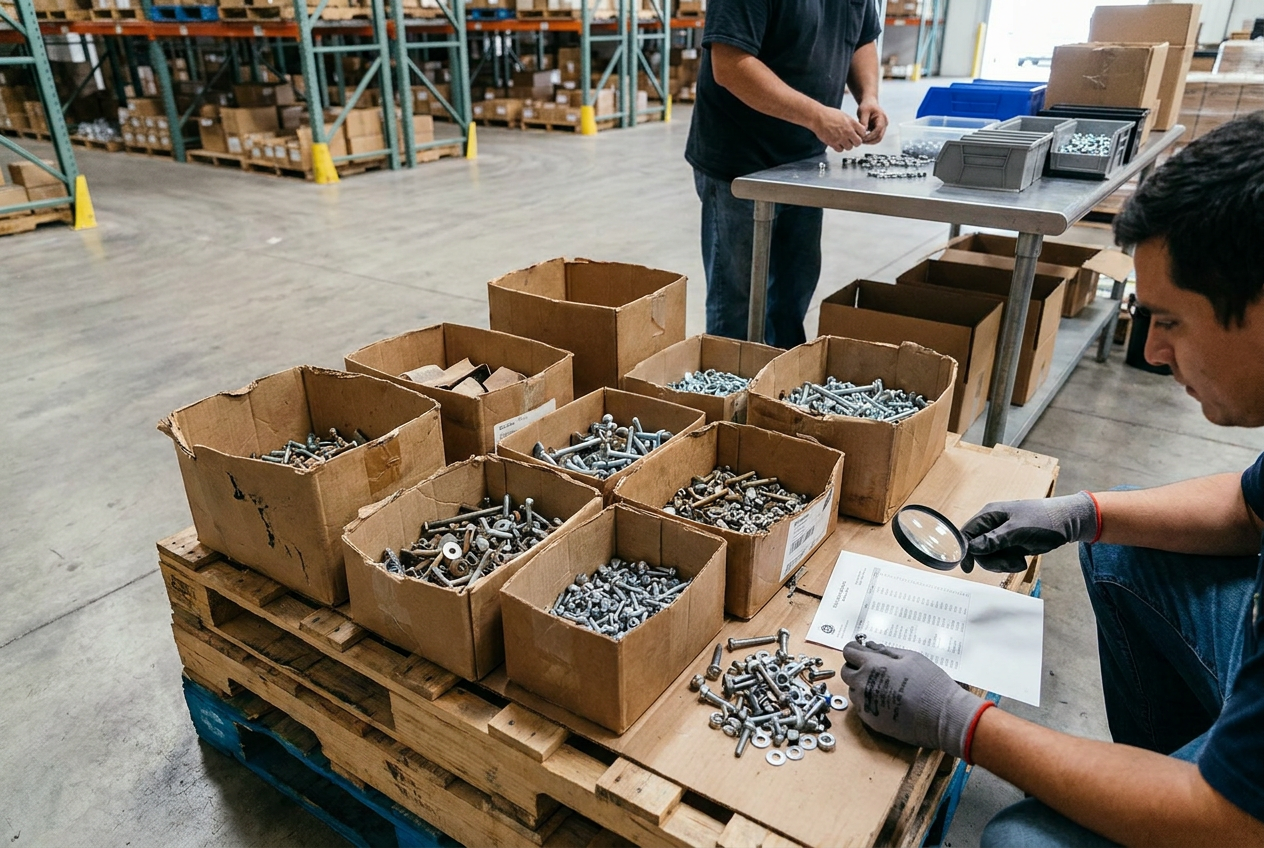
Wholesale hardware lots can contain thousands of small components without providing thousands of individually sellable products. A carton of screws, a mixed bin of washers and an incomplete anchor kit each require different counting, identification and listing decisions. For an independent reseller, the key question is not simply how much hardware is present, but how much can be accurately identified and responsibly offered for resale.
That makes hardware different from power-tool loads. Power tools usually require model identification, functional testing and checks for batteries or accessories. Small hardware requires specification matching, quantity verification and careful separation of visually similar parts. Damaged packaging can erase the information that made an otherwise intact item useful.
PalletCove Liquidation supplies manifested and category-level liquidation pallets and full truckloads from Dallas, Texas. This guide explains how to evaluate the information available before ordering and build a receiving process that accounts for sorting labor, incomplete packages and uncertain specifications.
1. Understand the load type before comparing offers
A wholesale hardware lot is a bulk assortment of products such as screws, bolts, nuts, washers, anchors, brackets, hinges and related installation supplies. Depending on the listing, hardware may share a liquidation pallet with tools or general merchandise.
A manifested lot includes an inventory document, but its detail can vary. A category-level lot describes the merchandise category without necessarily identifying every product or package count. Neither format, by itself, establishes condition or completeness.
Common buying formats include:
- A single pallet for buyers with limited receiving and sorting capacity.
- Multiple pallets that increase volume without filling a full trailer.
- A truckload requiring sufficient unloading capacity, storage and processing staff.
- A mixed tools-and-hardware load containing products with different inspection requirements.
Use the liquidation pallets inventory hub to explore the format, then review the guide to pallet types and truckload buying guide before choosing a scale.
The Home Depot liquidation category and general merchandise category provide comparison starting points, not promises about a particular load. PalletCove is an independent reseller and is not affiliated with, endorsed by or sponsored by any retailer named.
2. Treat fastener specifications as product identity
Two fasteners that look alike can serve different applications. Diameter alone does not establish compatibility, and a matching finish does not prove matching material or strength.
| Attribute | What to check | Why it matters |
|---|---|---|
| --- | --- | --- |
| Diameter and thread | Metric versus inch sizing, pitch or threads per inch | Similar-looking threads may not mate correctly |
| Length | Measurement convention for the head style | Countersunk and non-countersunk fasteners are commonly measured differently |
| Head and drive | Hex, pan, flat, Phillips, slotted or Torx | Changes installation method and tool compatibility |
| Material and finish | Labeled steel type, stainless designation or coating | Appearance alone cannot establish corrosion performance |
| Grade or rating | Manufacturer identification, markings and documentation | Strength and intended use cannot be inferred from size |
| Package quantity | Pieces per pack, packs per case and actual contents | Prevents package counts from becoming inflated piece counts |
| Application | Substrate, matching components and installation instructions | Anchors and specialty hardware depend on the intended assembly |
A thread pitch gauge and calipers help separate parts, but measurements do not establish material grade, load capacity or manufacturer approval. Metric M6 hardware and 1/4-inch hardware should not be combined just because they appear close in size.
For anchors, retain instructions and identify the intended substrate. Drywall, masonry and concrete anchors are not interchangeable. For structural, overhead or other safety-critical applications, do not advertise an unverified rating. Quarantine unidentified parts rather than guessing.
3. Separate condition grade from packaging condition
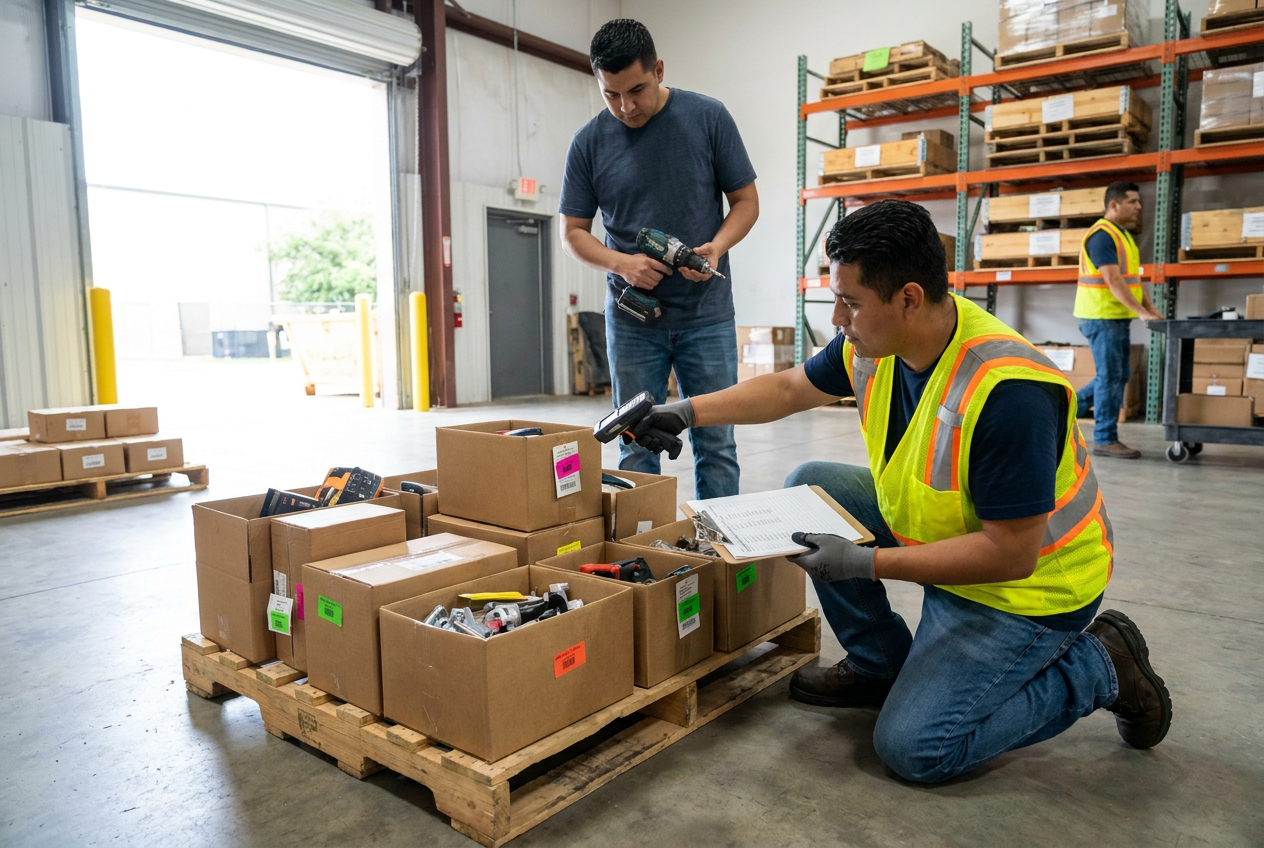
Condition terminology describes a source or expected state, not a universal testing standard. Ask what the condition grade means for the specific listing and whether it applies to the whole lot or a mix of items.
- Overstock: Excess inventory that may have storage wear or aging packaging; the label alone does not verify every unit.
- Shelf pulls: Merchandise removed from selling shelves, potentially with stickers, faded labels or opened packaging.
- Customer returns: Items returned after purchase, with possible use, missing pieces, substituted contents or damage.
- Salvage: Merchandise that may require parts recovery, repair, recycling or disposal rather than ordinary resale.
Packaging deserves its own assessment. A crushed box may contain intact screws, while an undamaged resealed carton may contain an incomplete assortment. Torn bags can allow neighboring sizes to mix. Water-damaged labels may conceal the product number even when the metal looks usable.
Check for corrosion, damaged threads, bent shanks, stripped drives and missing matching components. Surface appearance is not a substitute for performance verification. A returned door-hardware kit may also lack the strike plate, mounting screws or installation template needed to sell it as complete.
All PalletCove merchandise is sold as-is for resale. Do not interpret a condition label or photograph as a guarantee of every item's condition.
4. Read the manifest at package level
Start by identifying what one manifest unit represents: an individual piece, a retail package, an inner carton or a case. “Quantity 24” beside a screw description is ambiguous without the unit of measure.
Reconcile these fields when available:
- Product description and manufacturer part number.
- UPC or other product identifier.
- Package size and quantity per case.
- Manifest quantity and its unit of measure.
- Condition notes and known exceptions.
- Whether counts are verified, estimated or provided from upstream records.
For example, 24 packs originally labeled as containing 50 screws represent 1,200 pieces only if all packs contain their stated quantity. Open packages require verification. Do not multiply a package count into a confirmed loose-piece total without checking that assumption.
Match identifiers to package size as well as product description. The UPC versus SKU matching guide explains why identifier matching matters when selecting resale listings.
Compare the Home Depot Tool and Hardware Truckload and HD GM Truckloads Pallets pages by their current descriptions and available documentation. Product names alone do not establish fastener content, quantities or condition. Request clarification if the manifest and photographs appear inconsistent.
5. Price the workload, not just the piece count
The listed price is the acquisition starting point. At PalletCove, freight is included in that price, and free shipping is the only delivery option on every order to all 48 contiguous states.
For an internal operating budget, add your expected receiving, sorting, repackaging, labeling, storage and disposal costs to the listed price. Then compare that total with the number of verified resale units you expect to prepare—not the headline number of loose components.
A practical planning formula is:
Processing-adjusted cost per prepared unit = (listed price + internal processing and materials costs) ÷ verified prepared units.
This is a cost calculation, not a resale valuation or profit forecast. Before inspection, use clearly labeled scenarios rather than treating estimated sellable counts as facts.
Sorting labor often determines whether a hardware lot fits your operation. Time a representative sample from several cartons, separating identification, counting, condition checking and repackaging. A sample drawn only from the cleanest sealed boxes will understate work elsewhere.
A counting scale can help with uniform parts after tare and average-piece-weight checks. Mixed lengths, different coatings and debris undermine the result. Recheck with manual counts and keep uncertain quantities separate.
The useful unit in a hardware lot is an accurately identified, correctly counted resale package—not simply a piece of metal.

Use separate bins for verified sealed stock, verified loose parts, incomplete kits and unidentified material. Preserve original labels wherever possible and avoid combining uncertain batches under one specification.
6. Confirm ordering, payment and free shipping details
Before paying, confirm the lot identifier, listed price, manifest version, condition description and whether photographs show the actual inventory or are illustrative. Save the listing and written clarifications with your order records.
PalletCove accepts credit/debit card, ACH bank transfer and domestic bank wire. Handling takes 1–3 business days after payment clears; transit is typically 3–7 business days from Dallas. Handling and transit are separate stages, and the typical transit window is not a guaranteed arrival date.
Free shipping is the only delivery option, on every order, throughout the 48 contiguous states. Freight is included in the listed price. Buyers exploring liquidation pallets in Texas or liquidation pallets in Florida receive that same shipping structure.
A pallet shipment may move by LTL, meaning less-than-truckload freight, while a larger order may occupy a full trailer. Confirm the shipping arrangement and communicate your receiving hours, site access, unloading equipment and space constraints before dispatch. Review the shipping policy for applicable delivery details.
Sales tax on qualifying orders is covered by PalletCove. Ask what documentation applies to your order and whether a resale certificate is needed; do not assume every buyer or transaction qualifies without review.
7. Inspect delivery and document any claim
Prepare a clear receiving area and a way to photograph the shipment before unpacking. Dense cartons of fasteners can be difficult to handle safely, so use suitable equipment and avoid overloading shelving.
On delivery day:
- Compare the shipment identification and pallet count with the delivery paperwork.
- Photograph all accessible sides, wrap, labels and visible damage before moving or opening the load.
- Record observable shortages, torn wrap, crushed cartons or other exceptions accurately on delivery paperwork before signing when possible.
- Retain packaging, labels and order records while reviewing a discrepancy.
- Separate transit observations from merchandise-condition findings discovered during sorting.
A signed delivery receipt documents receipt; it does not verify every internal package count. Equally, noting damage does not automatically establish eligibility for a refund or another remedy.
Because merchandise is sold as-is for resale, do not assume ordinary retail return rights apply. Review the refund and claims policy and terms of service before purchase for applicable procedures, deadlines and exclusions. Report concerns promptly with the order number, affected items, photographs and a clear description; any resolution depends on the applicable terms and review.
8. Avoid common hardware-lot buying mistakes
Several errors recur when buyers apply power-tool evaluation habits to small parts:
- Counting pieces instead of packages: A thousand washers do not necessarily become a thousand practical resale listings.
- Treating sealed cartons as verified contents: Packaging helps identification but does not replace inspection where needed.
- Mixing near-matching fasteners: Small differences in pitch or length create compatibility problems.
- Discarding labels too early: Manufacturer numbers and instructions may be difficult to reconstruct.
- Ignoring kit completeness: A missing mounting component can change how an assembly should be described.
- Buying beyond sorting capacity: Unprocessed inventory occupies storage while identification work remains unfinished.
- Advertising unsupported specifications: Do not infer stainless grade, exterior suitability or load ratings from appearance.
Keep a simple exception log recording the carton reference, discrepancy and disposition. It supports accurate listings and prevents uncertain parts from returning to verified inventory.
Frequently asked questions
Are wholesale hardware lots the same as power-tool loads?
No. Hardware lots emphasize small parts, package counts and specification matching, while power-tool loads typically require functional testing and accessory checks. Mixed loads can require both workflows.
Does a manifest guarantee every fastener count?
A manifest provides inventory information, but its unit definitions and verification basis matter. Ask whether quantities represent pieces, packages or cases and check open-package contents before making resale quantity claims.
Can hardware with damaged packaging still be resold?
It may be suitable for resale if identity, condition and quantity can be established and accurately disclosed. Missing instructions or unknown safety-critical specifications can make an item unsuitable for the intended listing despite an intact appearance.
How is shipping handled for a pallet or truckload?
PalletCove offers free shipping as the only delivery option on every order to all 48 contiguous states, with freight included in the listed price. Handling is 1–3 business days after payment clears, followed by typical transit of 3–7 business days from Dallas.
What should I do if the delivered lot has a discrepancy?
Document what you received, preserve packaging and compare the shipment with your order records. Follow the applicable claims procedure promptly; an as-is purchase does not imply an automatic return or refund entitlement.
Talk to PalletCove Liquidation
Discuss the available manifest, load format and receiving requirements before choosing a hardware pallet or truckload. For order-specific questions, contact our order desk, or browse current inventory.
- Business: PalletCove Liquidation LLC
- Address: 4820 Cove Industrial Blvd, Dallas, TX 75236
- Phone: (713) 819-3904
- Email: sales@palletcoveliquidation.com
- Hours: Mon–Fri 8:00 AM – 6:00 PM CT, Sat 9:00 AM – 2:00 PM CT, Sun closed