
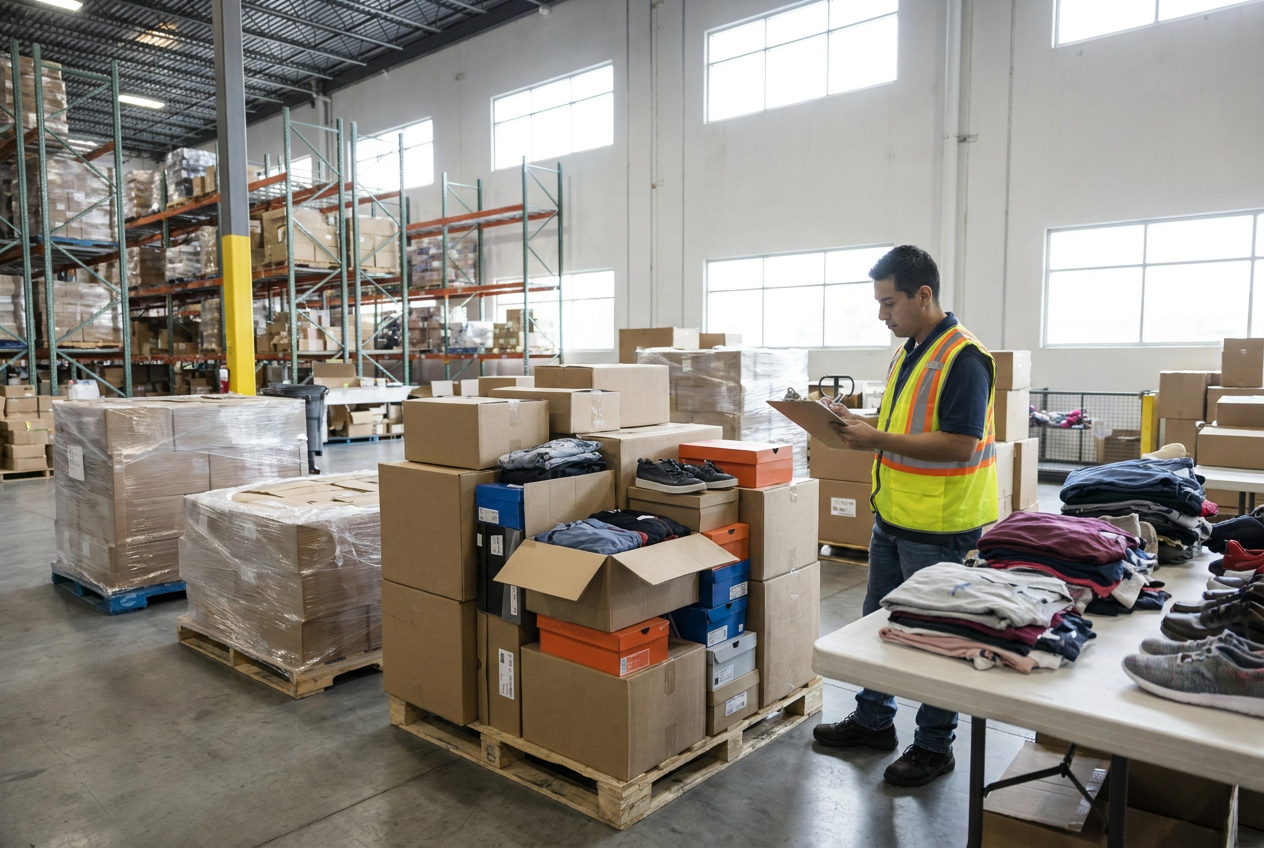
Apparel liquidation pallets can contain clothing, footwear and accessories with very different preparation requirements. A sealed overstock carton, a mixed customer-return box and a pallet of loose shoes may all require different amounts of counting, inspection and listing work. The useful buying question is not simply how many pieces a load contains, but how well its mix fits your resale channel and processing capacity.
PalletCove Liquidation supplies manifested and category-level liquidation pallets and full truckloads to independent resellers. This guide explains how to evaluate clothing and shoe loads, interpret available inventory information, plan a sorting workflow and protect merchandise in storage. Start with the liquidation pallets inventory hub when comparing available formats, then evaluate the individual listing rather than assuming every load follows the same specification.
Understanding apparel and footwear load types
A liquidation pallet is a consolidated wholesale lot sold for resale. A truckload is a larger shipment that may occupy a full trailer; its pallet count, carton count and merchandise mix depend on the specific offering. Neither term establishes condition or guarantees an assortment.
Common descriptions include:
- Apparel-focused loads: Clothing that may span departments, seasons, sizes and garment types.
- Footwear-focused loads: Shoes, boots, sandals or other footwear, potentially boxed, unboxed or mixed.
- Textile loads: A broader description that can include household textiles rather than exclusively wearable apparel.
- Mixed-category loads: Apparel or shoes alongside unrelated merchandise; confirm whether category quantities are documented.
- Manifested loads: Lots accompanied by an inventory file with some item-level detail.
- Category-level loads: Lots described primarily by merchandise category, without necessarily providing a complete itemized inventory.
Use the guide to pallet types to distinguish format from merchandise condition. The Macy’s category listings and general merchandise category provide different browsing routes, but a category name alone does not establish clothing content.
Likewise, evaluate the Macy’s Textile Truckload listing and Shoes Truckload listing against their current descriptions. Do not infer garment counts, footwear brands or size distribution from a product title. PalletCove is an independent reseller and is not affiliated with, endorsed by or sponsored by any retailer named.
Condition grades: what the labels actually tell you
All merchandise is sold as-is for resale. A condition grade is a description to investigate, not a universal standard shared by every supplier or source.
| Description | General meaning | Clothing and footwear checks |
|---|---|---|
| --- | --- | --- |
| Overstock | Excess inventory that did not sell through the original channel | Storage marks, age, seasonality, packaging and tags |
| Shelf pulls | Merchandise removed from a selling floor | Handling wear, markdown labels, fading and missing packaging |
| Customer returns | Merchandise returned after a customer transaction | Wear, stains, odors, altered garments, missing parts and mismatched shoes |
| Salvage | Merchandise described as damaged, incomplete or requiring substantial work | Repair feasibility, safe handling and disposal requirements |
| Mixed condition | More than one condition class in the lot | Whether any breakdown is documented and how exceptions are handled |
An original hangtag does not prove that a garment is unworn. An intact shoe box does not prove that the correct pair is inside. Conversely, missing retail packaging does not by itself describe the physical condition of the merchandise.
Ask what the listing’s grade means, whether inspection occurred and what that inspection covered. For additional context, read customer returns and condition grades explained. Avoid converting a broad label into an assumed sellable count.
Evaluate the load as a processing project: assortment, condition, size distribution and storage needs matter alongside the purchase price.
Reading manifests and evaluating size curves
A manifest may show descriptions, SKUs, UPCs, quantities, sizes, colors, condition notes or reference retail prices. Fields vary, and some files provide only partial information. Ask whether the file describes the specific lot, when it was prepared and how quantity exceptions are addressed under the sale terms.
First establish the counting unit. A “piece” might mean one garment, one set, one pair of shoes or an individual shoe, depending on the source. Verify how multipacks and coordinated sets are counted. For footwear, reconcile claimed pair quantities with physical pairs during intake.
Build a size curve before planning sales
A size curve is the distribution of units across sizes. A large lot may be concentrated in just a few sizes, rather than resembling a balanced retail assortment.
- Separate adult, youth, toddler and infant merchandise.
- Group apparel by garment type and labeled sizing system.
- Keep footwear sizing systems, widths and departments separate.
- Total units in each size, noting unknown or missing labels.
- Compare the distribution with your own sales history and selling channels.
Do not treat women’s, men’s and youth shoe sizes as interchangeable. International size conversions also require care: use the manufacturer’s information when available, and retain the original labeled size in your records.
For clothing, record useful measurements when inconsistent sizing or missing labels would prevent accurate listings. A manifest showing repeated styles in one size represents a different merchandising challenge from a broad assortment with fewer duplicates. Reference retail figures, if present, are not evidence of current resale value.

Pricing, ordering and payment
Compare the listed price with the documented scope of the lot: quantity basis, category mix, available manifest, condition description and packaging. Freight is included in the listed price. Free shipping is the only delivery option on every order to all 48 contiguous states.
For internal planning, divide the listed lot price by the stated unit count to calculate a preliminary acquisition cost per stated unit. After intake, track the actual count and separate items ready for listing from those requiring work or removal from resale inventory. These calculations are bookkeeping tools, not forecasts of resale value or profit.
Your operating budget should also account for your own labor, cleaning supplies, shelving, replacement packaging, selling-platform expenses and storage time. An inexpensive-looking lot can still exceed your capacity to process it responsibly.
Before paying:
- Save the listing, available manifest and written clarifications.
- Confirm the unit definition, merchandise scope and condition wording.
- Verify the delivery address and receiving capability.
- Review the applicable sale, shipping and claims terms.
- Keep any requested business or resale certificate documentation ready.
PalletCove accepts credit/debit card, ACH bank transfer and domestic bank wire. Sales tax on qualifying orders is covered by PalletCove; confirm qualification and documentation requirements rather than assuming every transaction qualifies.
The pallet buying guide can help structure a first-order checklist. Choose a load you can receive, inspect and store without relying on immediate sales to clear floor space.
A practical sorting and tagging workflow
Set up a clean intake area before breaking down the first pallet. Keep unsorted merchandise separate from inspected inventory so that condition notes and counts remain traceable.
Process garments in consistent stages
- Document intake: Assign a lot ID and photograph pallet labels, cartons and the initial assortment.
- Count and separate: Divide clothing, footwear, accessories and non-apparel items into distinct groups.
- Inspect: Check seams, closures, lining, pockets, hems, fabric surfaces and labels.
- Classify work: Separate ready-to-list items, items needing cleaning or minor repairs, and items unsuitable for resale.
- Measure and record: Capture labeled size, relevant measurements, color, style and specific defects.
- Tag and locate: Assign an internal SKU and a shelf or bin location before listing.
For shoes, verify left and right sides, matching style, labeled size and width. Inspect soles, uppers, insoles, closures and signs of separation or material deterioration. Do not combine visually similar shoes into a pair without checking their identifying details.
Keep original care and fiber-content labels intact. Distinguish your inventory tag from an original retail hangtag, and never describe an item as “new with tags” solely because some type of label remains attached. Record missing boxes and replacement packaging accurately.
Follow care instructions when cleaning. Avoid masking odors with fragrance or applying a single treatment across incompatible materials. Isolate suspected mold, pests or contamination rather than moving affected merchandise directly into clean inventory.
Storage requirements for clothing and shoes
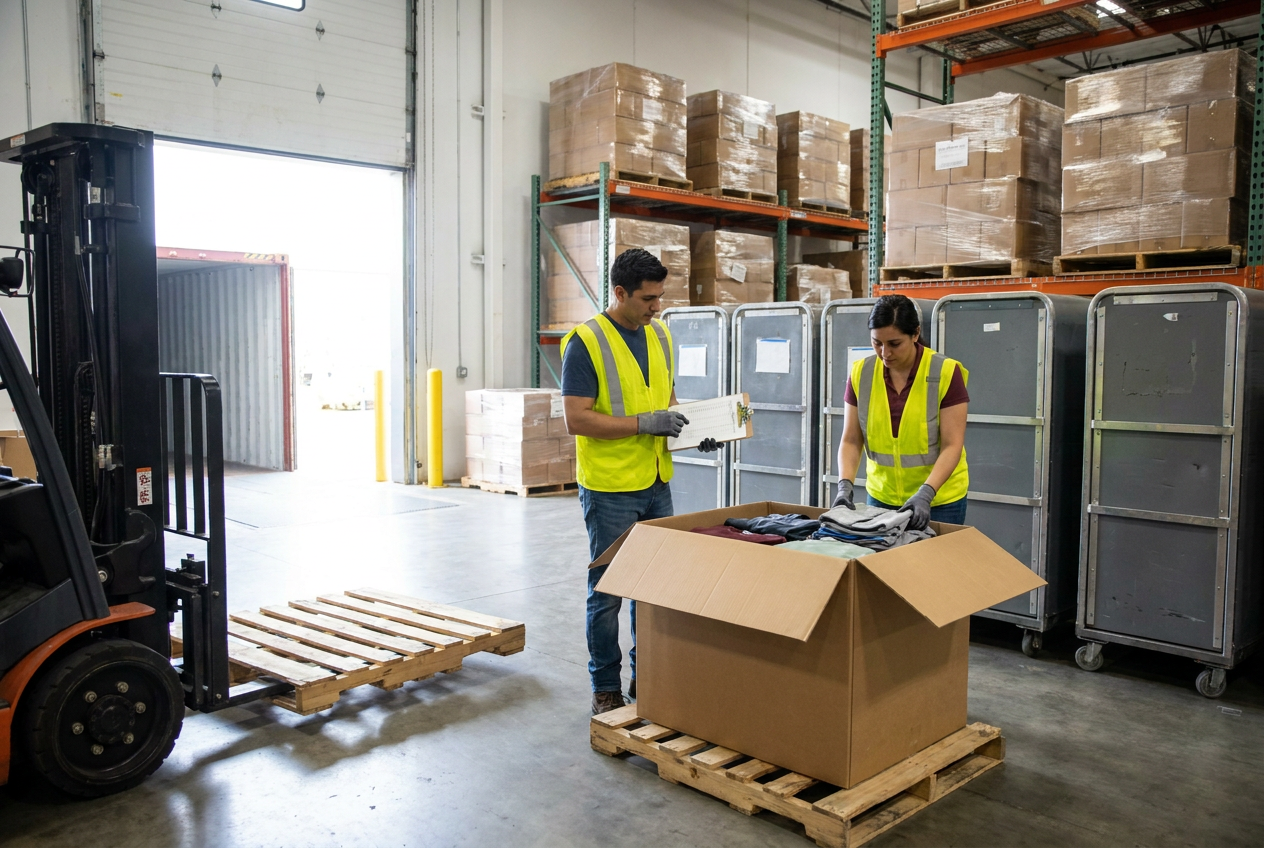
Apparel is vulnerable to moisture, sunlight, dust, pests and odor transfer. Use a clean, dry indoor space with stable conditions, ventilation and regular inspection. Keep merchandise off the floor and away from leaks, exterior moisture and strong-smelling chemicals.
Use labeled shelving or bins with locations tied to your inventory records. Hang garments that crease or deform easily when space permits; fold suitable items without overpacking. Do not seal damp clothing in bags or containers.
For footwear, keep verified pairs together and protect shape without crushing uppers. Store heavy cartons below lighter goods, and do not assume that aging shoe materials remain sound simply because they have been stored in a box.
Allow distinct space for receiving, sorting, photography, packing and exceptions. A full truckload requires capacity for both the incoming shipment and the work in progress. Before ordering, estimate carton volume, usable shelving and how many units your team can fully process each day.
Free shipping and delivery-day inspection
PalletCove ships from Dallas. Handling takes 1–3 business days after payment clears, and transit is typically 3–7 business days from Dallas. These are separate stages, not a guaranteed arrival date.
A pallet shipment may move by LTL, or less-than-truckload freight, while larger orders may use a full trailer. Confirm the shipment format and unloading arrangements before dispatch. Free shipping does not remove the need to verify that the receiving location can accommodate the delivery vehicle and safely handle the shipment.
The same free-shipping-only approach applies to liquidation pallets in Texas and liquidation pallets in Florida, as it does throughout the 48 contiguous states. Review the shipping policy for applicable delivery procedures.
On delivery day:
- Match the shipment identification to your order paperwork.
- Count pallets and accessible cartons against the delivery documents.
- Photograph wrapping, labels and visible damage before breakdown.
- Note visible shortages, crushed cartons, punctures or moisture on the delivery receipt before signing, where applicable.
- Retain packaging and promptly document concealed issues found during unpacking.
A signed receipt is not a substitute for item-level inspection. Schedule that inspection promptly and keep the incoming lot identifiable until reconciliation is complete.
Returns, claims and mistakes to avoid
Because merchandise is sold as-is for resale, do not assume ordinary retail returns, exchanges or condition guarantees apply. Review the refund policy before ordering for any eligibility requirements, exclusions, reporting deadlines and evidence requirements. Ask for clarification before payment if the policy does not answer a concern.
If an issue occurs, assemble the order number, manifest version, shipment labels, delivery receipt, photographs and a count of affected items. Describe the discrepancy precisely rather than submitting only a general statement that the load was disappointing. Preserve relevant merchandise and packaging while seeking instructions; reporting an issue does not guarantee a remedy.
Common mistakes include buying by reference retail totals, assuming balanced sizes, confusing textiles with apparel, overlooking unpaired shoes and treating every returned item as ready to list. Another is scaling to truckloads before establishing reliable counting, tagging and storage procedures. Match the purchase to demonstrated capacity, not just available floor space.
Frequently asked questions
Are apparel liquidation pallets always manifested?
No. PalletCove offers manifested and category-level loads, and the available detail depends on the specific listing. Confirm whether you will receive item-level quantities, sizes and descriptions before ordering.
Will a clothing load contain a complete size range?
Do not assume a complete or balanced size range. Review size-level quantities when available, and treat missing size information as an unresolved assortment question rather than evidence of an even mix.
Are shoes guaranteed to be paired and boxed?
Do not infer pairing or original packaging from the phrase “shoe load.” Check the listing’s counting basis and packaging description, then verify each pair during intake. All merchandise is sold as-is for resale.
How much does shipping cost, and how long does it take?
Free shipping is the only delivery option on every order to all 48 contiguous states, with freight included in the listed price. Handling is 1–3 business days after payment clears; transit is typically 3–7 business days from Dallas.
What payment methods are accepted, and how is sales tax handled?
PalletCove accepts credit/debit card, ACH bank transfer and domestic bank wire. PalletCove covers sales tax on qualifying orders. Confirm eligibility and whether resale certificate documentation is needed for your order.
Talk to PalletCove Liquidation
Bring your preferred categories, size requirements, processing capacity and receiving details when you contact our order desk. Review current inventory for listing-specific quantities, condition descriptions and available manifest information.
- Business: PalletCove Liquidation LLC
- Address: 4820 Cove Industrial Blvd, Dallas, TX 75236
- Phone: (713) 819-3904
- Email: sales@palletcoveliquidation.com
- Hours: Mon–Fri 8:00 AM – 6:00 PM CT, Sat 9:00 AM – 2:00 PM CT, Sun closed