
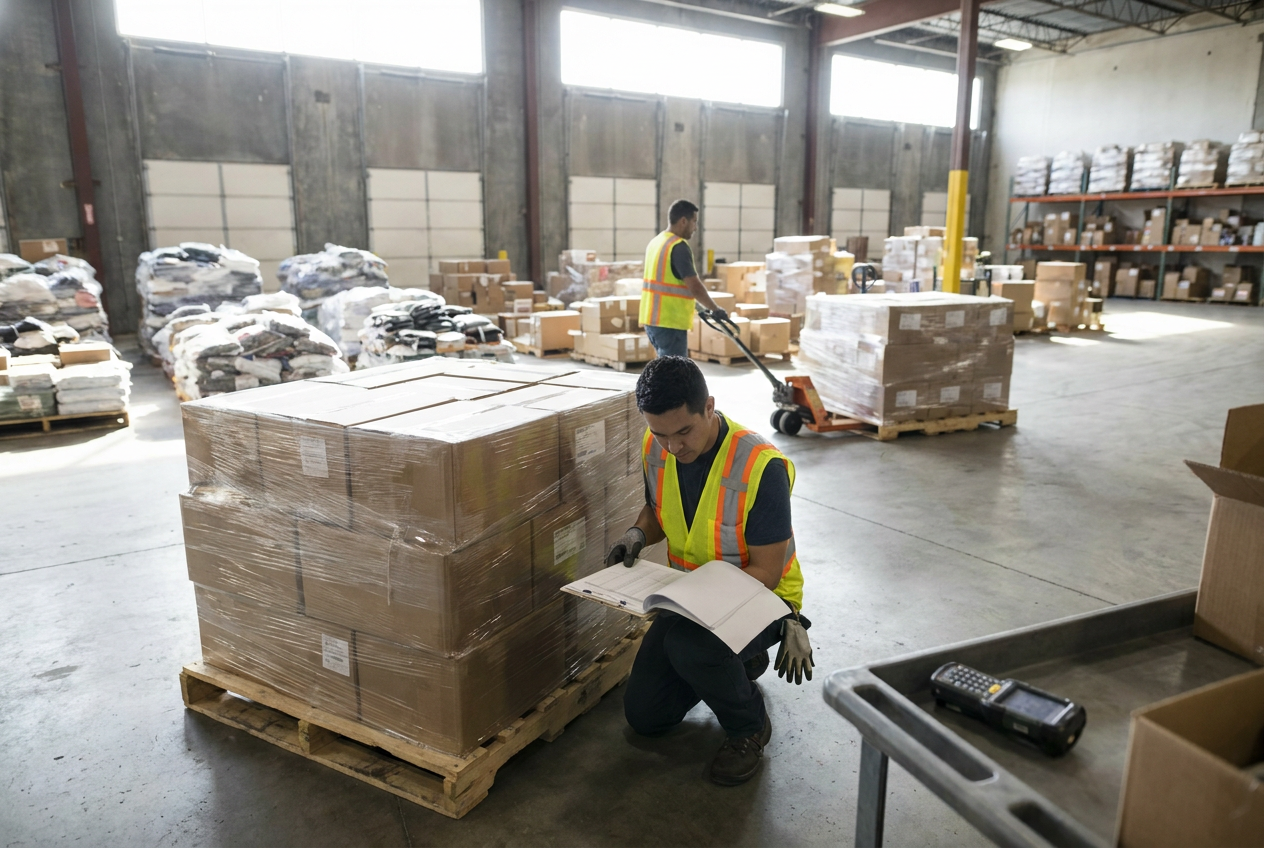
Are liquidation pallets legit? Yes—liquidation is a real inventory channel through which businesses sell customer returns, overstock, shelf pulls and other merchandise in bulk. But a legitimate business model does not make every seller trustworthy or every load suitable for your resale operation.
The useful question is whether you can verify the supplier, understand what is being offered and accept the purchase terms before paying. A real liquidation pallet can still contain incomplete, damaged or unsellable items. Supplier legitimacy and merchandise condition are separate issues.
This guide explains what independent resellers should check, from business registration and manifests to payment, delivery and claims. It also distinguishes general buying precautions from PalletCove Liquidation’s terms so you can make a documented decision rather than rely on promotional language.
What makes a liquidation pallet legitimate?
A legitimate liquidation transaction involves an identifiable seller, an accurately described offering, disclosed terms and fulfillment consistent with the agreement. It does not require every item to be new, functional or individually listed; those expectations depend on the written load description.
Liquidation suppliers may acquire excess or returned merchandise through intermediaries. A retailer name on a listing does not, by itself, establish a direct relationship with that retailer or prove the contents of a particular shipment.
PalletCove is an independent reseller and is not affiliated with, endorsed by or sponsored by any retailer named. All merchandise is sold as-is for resale, without a promise of profit, resale value or guaranteed condition.
Start with the liquidation inventory overview if this channel is new to you, then use the liquidation pallets hub to explore pallet options.
A trustworthy supplier makes the transaction verifiable. That does not make an as-is load predictable or eliminate the reseller’s inventory risk.
Verify the business before evaluating the deal
A polished website is not business verification. Check independent records and compare them with the information on the invoice, policies and payment instructions.
Check registration and identity
For a Texas supplier, search Texas Secretary of State business records and the Texas Comptroller’s taxable entity search, as applicable. Compare the legal entity name and available status information with the seller’s paperwork. Registration establishes an entity record; it is not a government endorsement of inventory quality or fulfillment.
Use this checklist:
- Confirm the legal business name, address, phone number and company-domain email.
- Ask whether the listed address is an office, warehouse or mailing location; do not assume it permits visits.
- Verify that the invoice identifies the seller and specific order.
- Compare the payment beneficiary with the legal seller, and obtain an explanation for discrepancies.
- Independently call a known business number if payment instructions change.
A working phone and consistent records are useful signals, not standalone proof. Reviews can provide context, but screenshots and anonymous praise should not replace transaction documents.
Recognize reasons to pause
Be cautious when a seller refuses written load details, pressures you to pay immediately, uses inconsistent company names or promises guaranteed earnings. Copied warehouse images and vague claims of retailer partnerships also warrant further checking.
Ask whether photos show the actual load or representative inventory. A representative photo may illustrate a category, but it cannot establish the quantities or condition of your order. If material questions remain unanswered, postpone payment.

Understand load types and condition grades
Two descriptions matter: how the load is organized and where the merchandise falls within the seller’s condition definitions. Neither should be inferred from a product title alone.
| Term | What it generally describes | What to verify |
|---|---|---|
| --- | --- | --- |
| Manifested load | Inventory accompanied by an itemized list | Fields included, count basis and stated limitations |
| Category-level load | Inventory described by a merchandise category rather than a complete item list | Category boundaries, exclusions and quantity information |
| Customer returns | Merchandise returned by purchasers | Testing status, missing parts and possible damage |
| Overstock | Excess inventory that was not sold through the original channel | Packaging, age, storage effects and completeness |
| Shelf pulls | Merchandise removed from retail shelves | Labels, packaging wear, display use and damage |
| Salvage | Merchandise intended primarily for repair, parts or material recovery | Restrictions, handling requirements and disposal needs |
Condition grades are not universally standardized. “Grade A,” “Tier 2” or “untested” can mean different things across suppliers. Obtain the seller’s written definition, including whether it applies to individual units or the load overall. Untested does not mean working, and unopened packaging does not establish functionality.
A liquidation pallet is a handling unit of bulk merchandise. A truckload is a larger shipment whose exact scope needs confirmation; do not assume a universal pallet count or unit count. A full trailer may be palletized or floor-loaded, depending on the offering.
The guide to types of liquidation pallets helps separate these formats. Compare general merchandise inventory with liquidation truckloads based on your storage, labor and selling channels—not simply order size.
Ask for written load detail and read the manifest
A manifest is a purchasing reference, not automatically a tested-condition report. Before relying on one, ask when it was prepared, what inventory it describes and whether counts are exact or estimates.
Useful fields can include SKU, UPC, model, description, quantity and condition notes. Not every manifest includes all of them. Missing identifiers make research harder, while repeated rows can obscure how heavily a load depends on one product.
Check the following before ordering:
- Match the manifest or category description to the listing and order identifier.
- Confirm the sales unit: one pallet, multiple pallets, individual bulk units or a truckload.
- Separate item quantities from carton counts and pallet counts.
- Ask whether bundles, sets and accessories count as separate units.
- Identify any substitutions, estimated quantities or other disclosed limitations.
- Save the listing, manifest version and written clarifications with your order records.
If a spreadsheet includes retail reference prices, do not treat them as expected selling prices. Research exact models and completed sales where available, accounting for condition and missing components. A manifest total cannot establish demand or your eventual results.
For category-level inventory, ask what information replaces an itemized manifest. There may be less detail available; your purchase decision should reflect that uncertainty rather than an assumed product mix.
For practice, review the Shoes Truckload listing and Bulk Hamilton Beach Truckload listing for the details you would need before ordering. Product names alone do not establish sizes, models, quantities or functionality. The guide to reading a liquidation pallet manifest explains how to examine the underlying inventory data.
Check pricing, payment and the ordering process
The relevant starting figure is the price for the exact offering—not an advertised per-unit figure whose denominator is unclear. Verify whether the listing covers a pallet, a group of pallets or an entire truckload.
At PalletCove, freight is included in the listed price. Free shipping is the only delivery option on every order to all 48 contiguous states. Sales tax on qualifying orders is covered by PalletCove; ask whether your order qualifies rather than assuming every transaction has the same treatment.
A resale certificate documents a purchaser’s claim that eligible merchandise is being bought for resale under applicable rules. It is not proof that a supplier is trustworthy. Ask what documentation your order requires and provide accurate business information.
Budget beyond the inventory purchase
Even with shipping included, your operation may incur costs for receiving, storage, sorting, testing, cleaning, replacement parts, selling-platform fees, buyer fulfillment and disposal. Budget from your own workflow. Do not assume every manifested unit can be listed or sold.
Use documented payment instructions
PalletCove accepts credit/debit card, ACH bank transfer and domestic bank wire. Before paying, confirm the order total, recipient information and how payment clearance is determined.
Credit-card dispute rights and debit-card protections vary by issuer and circumstances. ACH and domestic wire recovery options are different and can be limited. No payment method substitutes for checking the supplier, and buyer’s remorse about disclosed as-is merchandise is not automatically a valid dispute.
A practical ordering sequence is:
- Select the offering and confirm availability.
- Review written load details and applicable policies.
- Provide accurate billing, delivery and resale documentation where required.
- Confirm the final order summary and approved payment instructions.
- Pay and retain confirmation of payment clearance.
- Prepare the receiving location and preserve shipment communications.
Confirm free shipping terms and receiving requirements
PalletCove ships from Dallas. Handling takes 1–3 business days after payment clears; transit is typically 3–7 business days from Dallas. These are separate stages, and typical transit timing is not a guaranteed delivery date.
Free shipping is the only delivery option, and freight is included in every listed order price for delivery throughout the 48 contiguous states. Review the shipping policy and delivery terms before ordering.
Pallet shipments may travel as LTL, or less-than-truckload freight, while a truckload may occupy a full trailer. Confirm the shipment format and receiving requirements for the specific order instead of assuming standard parcel delivery.
Provide an accurate address, reachable receiving contact and business hours. Explain any site constraints before payment, and confirm vehicle access, appointment arrangements and unloading responsibilities. Free shipping does not tell you what equipment or space your receiving location needs.
Whether you are researching liquidation pallets in Texas or liquidation pallets in Florida, plan around your actual facility and shipment. Do not schedule downstream customer commitments around an estimated arrival alone.
Inspect delivery and understand returns or claims
Delivery inspection protects the factual record. It does not mean the carrier will remain while you open and test every item.
Document the shipment before unpacking
Have a receiving checklist and camera ready. When safe and permitted:
- Compare shipment identifiers with your order and delivery paperwork.
- Count handling units and note apparent discrepancies.
- Photograph all accessible sides, wrapping, labels and visible damage.
- Record punctured cartons, broken pallets, shifted freight or signs of moisture.
- Describe visible exceptions on the delivery receipt before signing, and retain a copy.
A delivery receipt is not a substitute for a detailed inventory check. After unloading, photograph the unpacking process, reconcile contents against the applicable written description and preserve packaging related to an issue.

Separate condition risk from a potential claim
As-is merchandise can include defects consistent with the disclosed load description. Disappointing resale results or an item requiring repair do not, on their own, establish that the seller failed to meet the order terms.
A shipment discrepancy, wrong order or apparent transit damage raises different questions. Review PalletCove’s refund policy and claims terms before payment for applicable eligibility, reporting requirements and deadlines. Do not assume an automatic return, refund, replacement or standard retail return window.
Report an issue promptly with the order number, delivery date, receipt, photos and a specific explanation. Keep relevant goods and packaging available, and obtain written instructions before returning or disposing of disputed merchandise. Ask how an issue should be handled rather than assuming refusal of delivery resolves it.
Common mistakes include discarding evidence, reporting only a general complaint, missing a policy deadline and confusing an inventory manifest with a functionality guarantee.
Frequently asked questions
Are liquidation pallets legit, or are they usually scams?
Liquidation pallets are a legitimate way to buy bulk resale inventory, but individual sellers still require verification. Check the business identity, written offering, payment instructions and policies rather than treating a low price or familiar retailer name as proof.
Does a manifest guarantee everything will work?
No. A manifest identifies inventory to the extent described, but it is not automatically a testing report or condition guarantee. Ask what each condition field means and whether quantities have stated limitations.
Can a legitimate supplier sell unmanifested pallets?
Yes, a supplier can sell category-level inventory without a complete itemized manifest if that limitation is clearly disclosed. The buyer must decide whether the available category, quantity and condition information is sufficient for the risk.
Is PalletCove shipping free on every order?
Yes. Free shipping is the only delivery option on every PalletCove order to all 48 contiguous states, with freight included in the listed price. Handling takes 1–3 business days after payment clears, followed by transit that is typically 3–7 business days from Dallas.
Can I return a pallet if the contents disappoint me?
Do not assume a retail-style return right: PalletCove merchandise is sold as-is for resale. Review the refund policy before ordering, and distinguish disclosed condition risk from a specific shipment or order discrepancy. Any claim must be evaluated under the applicable terms.
Talk to PalletCove Liquidation
Before purchasing, gather the listing, your receiving requirements and any questions about condition, manifests or policy terms. Request written clarification wherever the available information does not support a confident decision.
PalletCove Liquidation LLC
4820 Cove Industrial Blvd, Dallas, TX 75236
Phone: (713) 819-3904
Email: sales@palletcoveliquidation.com
Hours: Mon–Fri 8:00 AM – 6:00 PM CT, Sat 9:00 AM – 2:00 PM CT, Sun closed
To discuss an offering before payment, contact our order desk. When you are ready to compare available loads, review current inventory.