
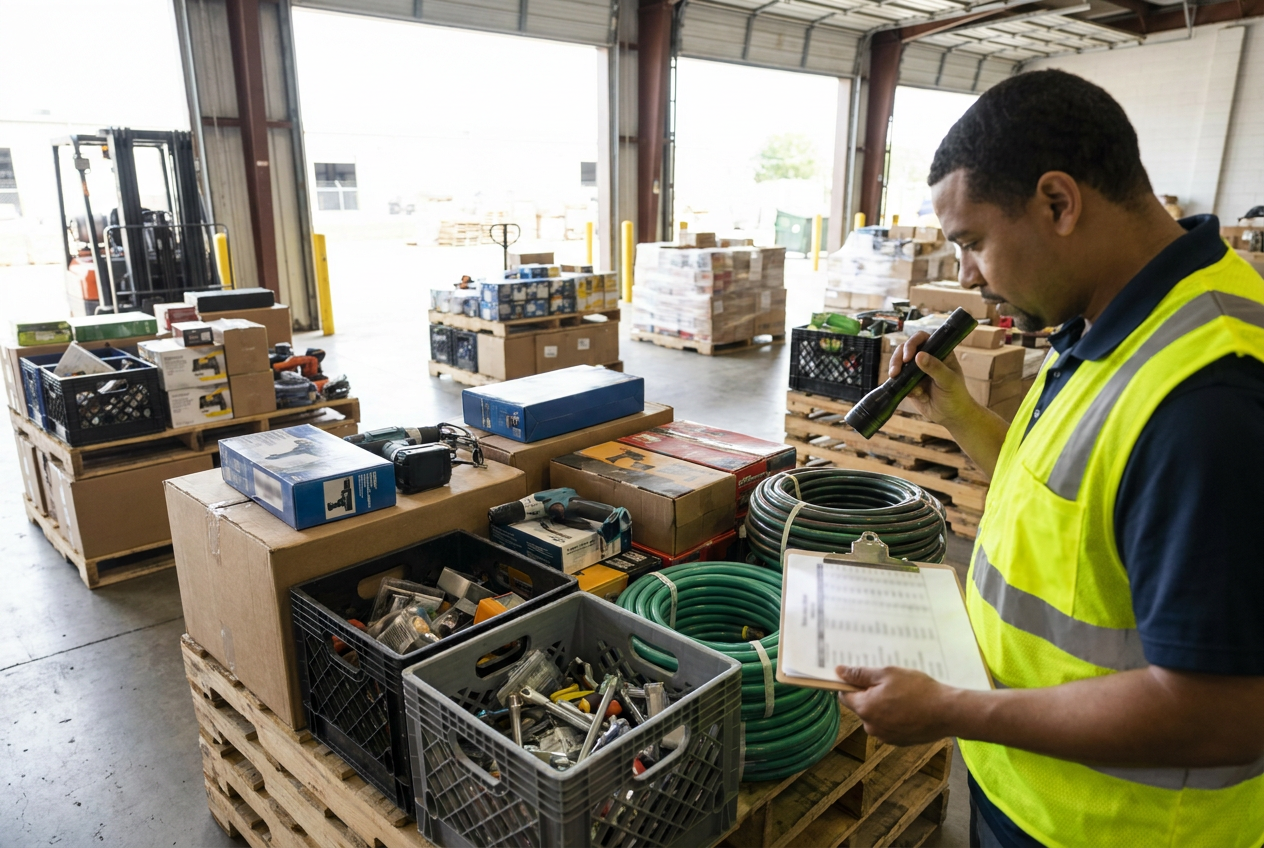
Home Depot liquidation pallets can contain power tools, hand tools, installation hardware, home-improvement supplies and seasonal merchandise. For an independent reseller, the important question is not simply which brands appear in a photograph. It is whether the actual lot fits your testing capabilities, storage space and resale channels.
Tool and hardware inventory requires careful inspection. A drill without its battery, a faucet missing mounting hardware and a seasonal machine with an unknown operating history create different workloads. A useful buying process separates what the listing documents from what remains untested or uncertain.
PalletCove Liquidation sells manifested and category-level liquidation pallets and full truckloads from Dallas, Texas. All merchandise is sold as-is for resale. PalletCove is an independent reseller and is not affiliated with, endorsed by or sponsored by Home Depot or any other retailer named.
What Home Depot liquidation pallets are
A liquidation pallet is a freight-handling unit containing merchandise offered through a secondary resale channel rather than ordinary retail sale. The retailer name identifies the advertised inventory source or assortment; it does not establish manufacturer authorization, warranty coverage or a condition guarantee.
Common buying formats include:
- Manifested pallets: Lots accompanied by an itemized inventory document. Detail can range from descriptions and quantities to model numbers and condition notes.
- Category-level pallets: Assortments described primarily by merchandise category, such as tools or hardware, without a complete item-by-item inventory.
- Mixed general merchandise: Loads combining several home-improvement categories, potentially including bulky or assembly-intensive goods.
- Truckloads: Larger purchases shipped as a full trailer or another specifically described load configuration. Confirm pallet count and dimensions rather than assuming every truckload has the same capacity.
Use the liquidation pallets inventory hub to explore formats. The guide to types of liquidation pallets explains format differences, while the liquidation truckload buying guide helps assess larger receiving and processing requirements.
Tools, hardware and seasonal lots: what to expect
Contents vary by listing. The following examples explain likely inspection demands, not a promise that any particular product will appear in your order.
| Merchandise group | Possible contents | Priority inspection points |
|---|---|---|
| --- | --- | --- |
| Cordless tools | Drills, drivers, saws, sanders | Exact model, battery platform, charger, guards and controls |
| Corded tools | Saws, grinders, shop equipment | Cord insulation, plug, housing, switches and missing safety parts |
| Hand tools and hardware | Wrenches, sockets, fasteners, hinges | Complete sets, corrosion, size markings and package counts |
| Plumbing and electrical | Faucets, valves, fixtures, switches | Connections, mounting parts, ratings and signs of installation |
| Outdoor equipment | Trimmers, blowers, pressure washers | Power source, attachments, leaks and safe testing requirements |
| Seasonal goods | Patio items, fans, heaters, holiday products | Assembly parts, weather damage, electrical condition and timing |
Cordless tools need platform-level checks
Two tools from the same brand may use different battery systems. Record the exact model and required voltage, and establish whether each unit is a bare tool or a kit. A battery pictured on packaging is not evidence that a battery is inside.
Hardware can create substantial counting work
A carton of fasteners may contain many individual pieces but relatively few sellable packages. Opened plumbing kits, mixed sockets and loose brackets require sorting and identification. Confirm whether a listed quantity means individual components, retail packages, sets or cases.
Seasonal inventory needs space and timing
Patio furniture and outdoor equipment can occupy substantial floor space before assembly or testing. Seasonal demand also varies by market, so consider how long you can store the assortment without disrupting your regular operation.
Compare the Home Depot liquidation category with the broader liquidation truckloads category. Read the actual descriptions for the Home Depot Tool and Hardware Truckload and HD general merchandise truckloads and pallets; product names alone do not establish current contents or availability.
Condition grades describe risk, not certainty
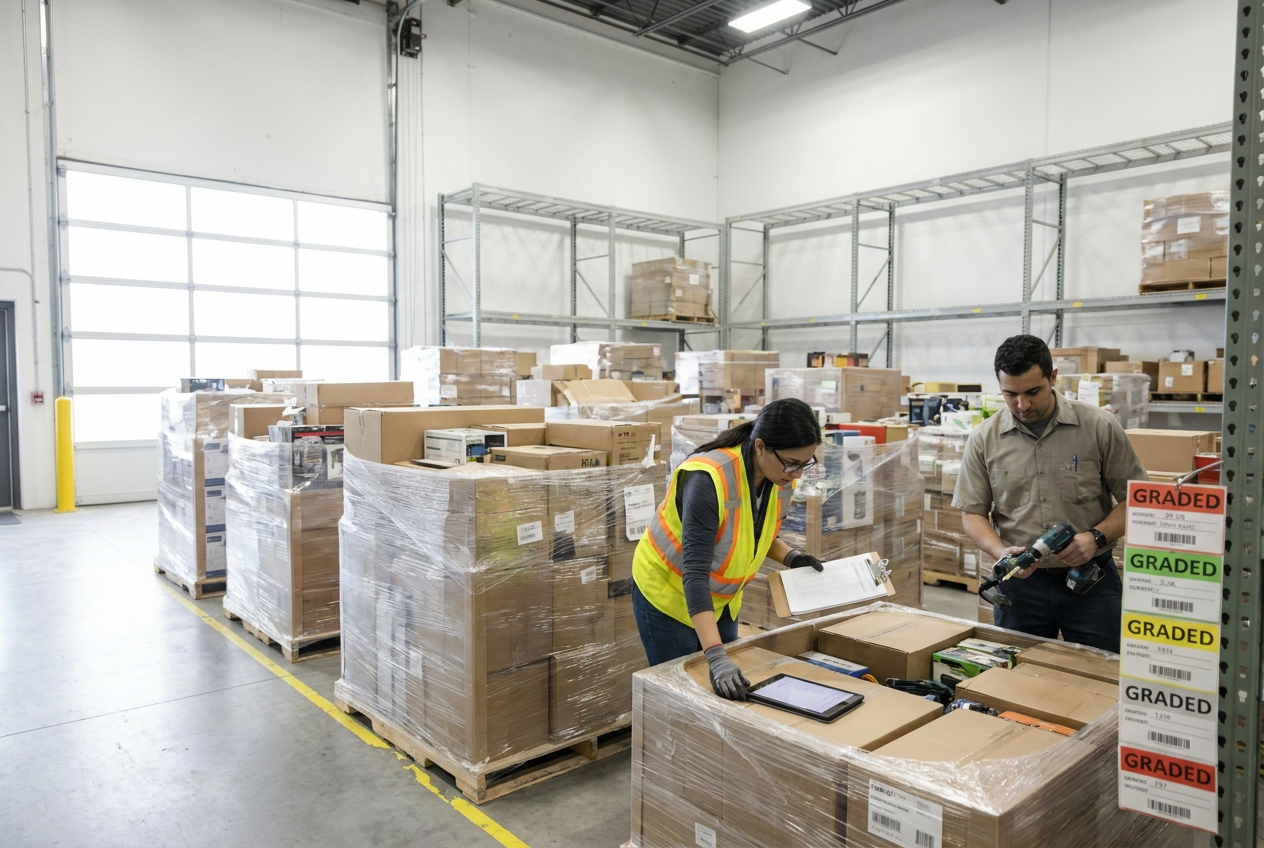
A condition grade is useful only when its definition is clear. Terms such as Grade A, Grade B, Tier 2 and Tier 3 are not universal standards. Ask what the grade means for the specific listing, including whether testing was performed and whether the label applies to every item or the overall assortment.
- Overstock: Excess inventory that may be unused, but can still have storage wear, outdated packaging or missing components.
- Shelf pulls: Merchandise removed from retail display or shelves. Packaging can show stickers, handling damage or evidence of display use.
- Customer returns: Previously purchased goods returned for reasons that may be unknown. Contents can be used, incomplete, defective or different from the packaging.
- Salvage: Inventory intended for repair, parts recovery or other limited uses. Do not assume it can be safely restored or resold as functional merchandise.
“Untested” does not mean working, and “open box” does not establish completeness. Even an apparently sealed box needs identification and inspection before you describe its contents to a customer.
The shelf pulls versus customer returns guide explains why inventory origin and working condition should be evaluated separately.
A manifest tells you what is reported in a lot; inspection establishes what you can responsibly describe and offer for resale.
How to read a manifest before committing
Start by confirming that the manifest belongs to the exact lot being offered. Request clarification if the listing uses sample photographs, estimated counts or a representative assortment. Save the listing, manifest and written answers with your purchasing records.
Check identification, quantities and exceptions
Review these fields wherever they are available:
- Lot identifier: Match the document to the order and photographs.
- Model or SKU: Distinguish similar tools, fixture finishes and battery platforms.
- Quantity unit: Separate pieces from packages, kits and cases.
- Condition notes: Look for missing accessories, damage, testing limitations and salvage designations.
- Packaging details: Identify loose goods, original cartons and repacked merchandise.
- Physical dimensions: Check pallet footprint, height, weight and unusually long or bulky products.
A UPC can help identify an original retail product, but it does not prove that returned contents match that product. Manufacturer model numbers often provide more useful information for compatibility and parts research.
Treat retail figures as reference information
If a manifest includes retail values, they are not a forecast of resale proceeds. Exact model, completeness, local demand, condition and selling-channel requirements all affect whether an item is practical for your business.
For category-level inventory, ask which categories are included, what exclusions apply and how quantities are expressed. Where documentation is limited, evaluate whether you can absorb the additional sorting and testing uncertainty. Do not replace missing evidence with assumptions based on a few attractive items.
Pricing, ordering and payment
PalletCove’s listed price includes freight. Free shipping is the only delivery option on every order to all 48 contiguous states. Sales tax on qualifying orders is covered by PalletCove; confirm whether your order qualifies rather than assuming all purchases receive identical tax treatment.
Your internal purchasing budget should also account for work after arrival: counting, safe testing, cleaning, replacement parts, storage, packaging, selling-channel costs and appropriate disposal of unusable goods. These are operational considerations, not predictions of profit or resale value.
A practical ordering sequence is:
- Choose a specific pallet or truckload and confirm availability.
- Review the manifest or category description, condition definition, photographs and exclusions.
- Confirm quantities, dimensions and whether your receiving location can accommodate the shipment.
- Review the as-is terms and applicable policies before payment.
- Provide accurate business, delivery and contact information. Ask whether a resale certificate is needed for your order records or tax documentation.
- Pay by credit/debit card, ACH bank transfer or domestic bank wire.
Those are PalletCove’s payment methods. Verify bank instructions through an established business contact before transferring funds, especially if a message unexpectedly changes payment details. Keep your order confirmation and payment records together.
Avoid buying a full truckload solely because you have room to unload it. You also need capacity to hold unidentified inventory, isolate unsafe goods and process items without blocking your receiving area.
Free shipping from Dallas and receiving preparation
Handling takes 1–3 business days after payment clears. Transit is typically 3–7 business days from Dallas. These are separate stages, and the transit range is typical rather than a guaranteed arrival date.
Pallet shipments may move by LTL, or less-than-truckload service, where freight shares trailer space with other shipments. A truckload requires planning for a full trailer or the load configuration stated in the order. Confirm the expected shipment format and unloading arrangements before purchasing.
Prepare a receiving area with:
- Clear vehicle access and space appropriate for the shipment.
- Suitable unloading equipment and trained operators where required.
- Dry staging space for photographs, counting and sorting.
- A reachable delivery contact and staff available to receive the load.
The same free-shipping coverage applies to buyers exploring liquidation pallets in Texas and liquidation pallets in Florida, as well as the other contiguous states. Review the shipping policy for applicable delivery procedures. Coverage does not extend to Alaska or Hawaii.
Delivery-day inspection, safe testing and claims
Separate shipment inspection from merchandise testing. The first documents what arrived and its visible transport condition. The second determines how each item should be handled and described for resale.
Document the shipment before breaking it down
Count pallets and compare identifiers with shipping documents. Photograph all sides, labels, wrapping and visible damage before unpacking. Note crushed cartons, shifted freight, wet packaging or shortages on the delivery paperwork where applicable, and retain a copy.
Photograph concealed damage as you unpack. Keep relevant packaging, labels and lot records while any issue is being reviewed. Delivery notes alone do not establish eligibility for a refund or another remedy.

Use a repeatable tool inspection process
- Identify the item: Record model, serial number where present and included accessories.
- Inspect without power: Look for cracked housings, damaged cords, missing guards, corrosion and loose components.
- Screen for hazards: Isolate swollen, leaking, punctured or heat-damaged batteries. Do not charge suspect batteries; follow manufacturer and local hazardous-waste guidance.
- Check recalls: Search official recall notices and manufacturer information using the exact model. Do not resell recalled products; follow applicable recall instructions.
- Test only when safe: Follow the manufacturer’s instructions and use compatible power sources, protective equipment and a suitable work area. Do not bypass safety devices.
- Record the result: Separate visually inspected, function-tested, incomplete and parts-only inventory. Describe the tests actually performed, not a broader assurance.
Briefly powering on a tool does not prove full performance under load. Electrical fixtures, pressure equipment, fuel-powered machines and unfamiliar products may require qualified evaluation rather than improvised testing.
Understand as-is sales and issue reporting
All merchandise is sold as-is for resale. Do not assume ordinary retail returns, manufacturer warranty eligibility or compensation for expected liquidation defects. Review the refund and claims policy before ordering for the applicable reporting process, deadlines, documentation and any stated remedies.
Report concerns promptly with the order number, lot identifier, affected quantities, photographs and delivery records. Distinguish transit damage, shipment discrepancies and item-condition concerns. Preserve evidence and request instructions rather than assuming that a complaint authorizes a return.
Frequently asked questions
Are Home Depot liquidation pallets all tools?
No. Depending on the listing, they can include hardware, plumbing, electrical, outdoor, seasonal or mixed home-improvement merchandise. Use the lot description and manifest, where available, rather than the retailer name to determine the assortment.
Are batteries and chargers included with cordless tools?
Only rely on inclusion when the specific listing or lot documentation supports it. Bare tools, incomplete kits and packaging mismatches are possible in liquidation inventory. Check the exact battery platform before attempting any test.
Can I buy a pallet without a manifest?
PalletCove offers category-level as well as manifested inventory. A category-level description provides less item-specific visibility, so confirm the stated categories, condition and quantity basis. Choose that format only if your operation can manage the uncertainty.
How much does shipping cost, and how long does it take?
Free shipping is the only delivery option on every order to all 48 contiguous states, with freight included in the listed price. Handling is 1–3 business days after payment clears, followed by typically 3–7 business days in transit from Dallas.
Can I return tools that do not work?
All merchandise is sold as-is for resale, so a nonworking item does not automatically qualify for a return. The applicable policy and order terms govern any issue review. Document the problem and contact the order desk promptly for instructions.
Talk to PalletCove Liquidation
Before ordering, confirm the lot format, condition description, manifest availability and receiving requirements. For help comparing an assortment with your inspection capacity, contact our order desk or review current inventory.
- Business: PalletCove Liquidation LLC
- Address: 4820 Cove Industrial Blvd, Dallas, TX 75236
- Phone: (713) 819-3904
- Email: sales@palletcoveliquidation.com
- Hours: Mon–Fri 8:00 AM – 6:00 PM CT, Sat 9:00 AM – 2:00 PM CT, Sun closed