

The difference between shelf pulls vs customer returns is primarily inventory history—not a guarantee of present condition. Shelf pulls leave a store’s selling floor, customer returns come back after a customer transaction, and overstock is excess inventory removed from a retailer’s or distributor’s stock. Those histories suggest different inspection workloads, but they do not replace a lot-specific description.
For an independent reseller, the practical question is what happens after unloading: how much counting, testing, cleaning, matching and disclosure will the merchandise require? A seemingly straightforward liquidation pallet can still contain incomplete packaging, outdated products or items unsuitable for your sales channel.
PalletCove Liquidation supplies manifested and category-level liquidation pallets and full truckloads from Dallas, Texas. This guide explains how to compare the three inventory streams, read listings and plan receiving without treating any condition label as a promise.
What shelf pulls, customer returns and overstock mean
These terms describe why goods entered liquidation. They are not interchangeable with tested, complete, unused or ready to list.
| Inventory stream | Typical origin | Possible condition issues | Sorting priorities | Main buying consideration |
|---|---|---|---|---|
| --- | --- | --- | --- | --- |
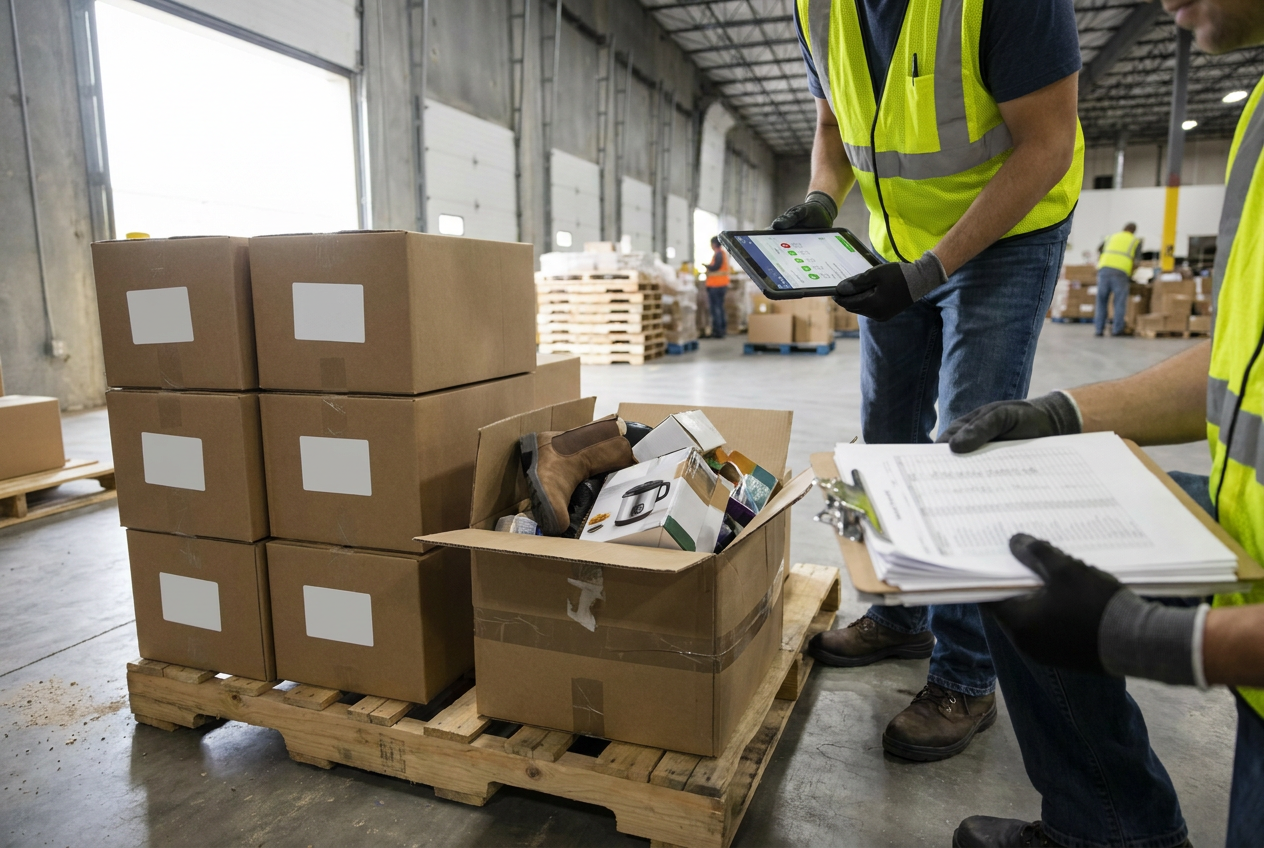
| Shelf pulls | Merchandise removed from retail shelves or displays | Price stickers, shelf wear, faded cartons, handling marks, missing packaging | Inspect packaging, count components and separate display pieces | Store exposure can affect presentation and completeness |
| Customer returns | Merchandise returned following a customer transaction | Use, defects, missing accessories, substitutions or no obvious issue | Verify identity, test safely, clean and document defects | Return reason and functionality may be unknown |
| Overstock | Excess inventory cleared from storage or selling channels | Aged stock, discontinued models, storage damage or seasonal mismatch | Check dates, models, quantities and packaging | Unused inventory may still be difficult to sell |
Shelf pulls
Shelf pulls are products removed from active retail inventory, often during resets, assortment changes or seasonal clearance. Some may appear untouched; others may have been handled repeatedly or used as displays. Do not assume every shelf pull is factory sealed or that packaging wear is its only issue.
Customer returns
Customer returns can include buyer-remorse purchases, incorrect orders, fit-related returns and products reported as defective. A return label does not prove a defect, but it also does not prove that someone tested the item. The reseller must distinguish cosmetic problems from functional and safety problems.
Overstock
Overstock generally means excess stock rather than merchandise returned by a customer. It can include discontinued lines, older packaging and quantities that exceed demand. Check expiration dates where applicable, compatibility and seasonal timing even when cartons look clean.
Key takeaway: Inventory history helps you plan inspection; the listing, manifest and your own checks determine how you handle individual items.
Condition grades, manifests and load formats
A condition grade is a seller’s description of merchandise quality or processing status. Terms such as A-grade, B-grade, untested and salvage are not universal standards. Ask what each term means for the specific listing, including whether it describes every unit or the load overall.
Salvage commonly indicates merchandise intended for repair, parts recovery or other limited uses. Do not interpret salvage as ordinary customer returns, or assume a numbered tier has the same meaning across suppliers. Mixed-condition inventory may require several resale and non-resale sorting streams.
A manifest is an inventory document, not automatically a testing report. Depending on the load, it may show product names, SKUs, UPCs, quantities, model numbers and reference retail prices. Ask whether it is final, estimated or illustrative, and whether quantities represent units, sets, cases or cartons.
Check these details before paying:
- Whether the manifest belongs to the exact lot offered.
- Whether condition notes apply at item level or load level.
- Whether testing methods and included accessories are documented.
- Whether photographs show the actual merchandise or representative inventory.
- Whether duplicate SKUs, size runs or seasonal products dominate the assortment.
Category-level loads identify a merchandise category without necessarily providing item-by-item detail. Buy them only if your operation can accommodate assortment uncertainty. A liquidation pallet describes the handling unit; a truckload describes shipment scale. Neither specifies condition.
Use the liquidation pallet inventory hub to explore available formats and the guide to pallet types to distinguish assortment choices. A full trailer still needs a listing-specific count, configuration and unloading plan; there is no universal pallet or piece count for every truckload.
Which inventory stream fits your resale operation?
Choose based on processing capacity and sales channel, not the most appealing condition label. A reseller with repair skills may handle some returns effectively, while a small clothing seller may prefer inventory that primarily needs sizing, photography and packaging checks. Neither choice establishes a financial outcome.
Shelf pulls may suit operations able to remove labels, improve presentation and disclose shelf wear. Overstock may suit sellers prepared for repeated SKUs and slower-moving sizes or models. Customer returns require room for unresolved items and staff who can distinguish a safe, complete product from one needing repair or removal from sale.
Category knowledge matters just as much as origin:
- Apparel needs size, stain, odor, fastening and matching-set checks.
- Tools need model verification, guards, batteries, chargers and safe functional assessment.
- Small appliances need component checks and category-appropriate testing.
- General merchandise requires multiple inspection methods rather than one universal checklist.
Compare general merchandise liquidation loads with liquidation truckload inventory according to your available space and labor. Product pages such as the Amazon General Merchandise Truckload and Macy’s Textile Truckload are places to check current descriptions—not evidence that every load shares a particular condition.
PalletCove is an independent reseller and is not affiliated with, endorsed by or sponsored by any retailer named. For a category-specific inspection framework, see the apparel liquidation pallet guide.
Sorting expectations after the load arrives
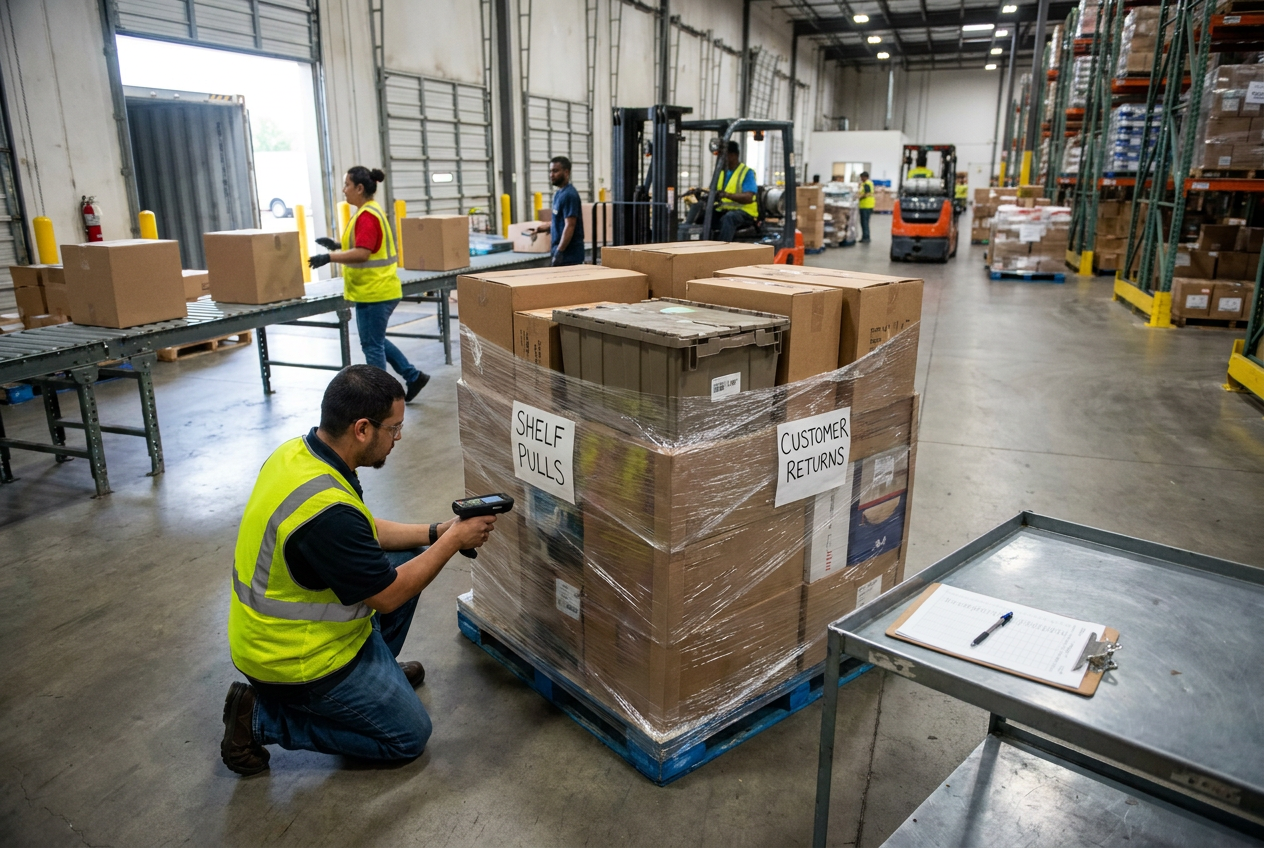
Establish a receiving area before delivery. Keep unprocessed merchandise separate from inventory approved for sale, and create a quarantine area for damaged, unidentified or potentially unsafe products.
A practical workflow is:
- Identify: Match product, model, size and quantity to available records.
- Inspect: Check packaging, seals, visible damage and signs of use.
- Check completeness: Count parts against an appropriate parts list where available.
- Test appropriately: Use trained personnel and suitable procedures; record what was actually tested.
- Route: Separate ready-to-list items, cleaning or repackaging work, repair candidates and items unsuitable for resale.
- Document: Photograph defects and write an accurate condition description for each resale listing.
For shelf pulls, expect presentation work but still check functionality where relevant. For overstock, focus on stock age, storage condition and repeated quantities. For customer returns, allow a separate troubleshooting stage rather than assuming a quick power-on check is sufficient.
Check applicable recalls and resale restrictions before listing. Cosmetics, food-contact goods, batteries, children’s products and personal-care merchandise can require extra scrutiny. Never sell an unsafe item simply because it was included in an as-is load.
Pricing, ordering and payment
Compare the listed load price with what you can verify: inventory detail, condition disclosures, category concentration and the resources needed to process it. A manifest’s reference retail total is not a forecast of what merchandise will sell for.
Freight is included in PalletCove’s listed price. Free shipping is the only delivery option on every order to all 48 contiguous states. Your operating budget should still account for your own receiving labor, storage, testing supplies, packaging, selling-platform costs and appropriate disposal or recycling.
Before placing an order:
- Review the exact listing, photographs and available manifest.
- Clarify condition terminology, testing status and missing information.
- Confirm your receiving address and unloading capabilities with the order desk.
- Review applicable terms, then use the stated ordering process.
- Retain the order confirmation, listing details and payment record.
The guide to buying liquidation pallets provides a broader purchase checklist. Avoid placing an order based only on a retailer name, advertised piece count or clean-looking exterior wrapping.
PalletCove accepts credit/debit card, ACH bank transfer and domestic bank wire. Consult the payment policy for applicable payment details; handling begins after payment clears, not merely when a transfer is initiated.
Sales tax on qualifying orders is covered by PalletCove. A resale certificate documents resale purchasing status where applicable; it is not automatically interchangeable with a business license. Ask what documentation and qualification requirements apply rather than assuming every order receives the same tax treatment.
Free shipping, timing and delivery preparation
Handling time is 1–3 business days after payment clears. Transit from Dallas is typically 3–7 business days. These are separate stages, and typical transit is not a guaranteed arrival date.
Individual pallet shipments may move by LTL, meaning less-than-truckload freight that shares trailer capacity with other shipments. A truckload shipment involves a larger receiving commitment and may occupy a full trailer. Confirm the actual shipment configuration and unloading requirements before ordering.
Give the order desk accurate information about site access, receiving hours, available equipment and staffing. Do not assume the driver will move merchandise into storage or that your location can accommodate every trailer configuration. Review the shipping policy and resolve receiving questions before dispatch.
The same free-shipping-only arrangement applies to buyers browsing liquidation pallets in Texas and liquidation pallets in Florida: freight is included in the listed price. Shipping coverage is all 48 contiguous states, not Alaska or Hawaii.
Delivery-day inspection and returns or claims
Receiving inspection serves a different purpose from merchandise testing. At delivery, focus first on the shipment’s observable condition and handling-unit count. Detailed item sorting follows once the load is safely received.
- Compare the shipment identifiers and pallet or carton counts with the delivery documents.
- Photograph the load before removing wrap, including visible crushing, punctures or disturbed packaging.
- Record observable damage or shortages on the delivery receipt as appropriate before signing.
- Preserve labels, packaging, photographs and receiving records.
- Report concerns promptly with the order number and a specific description.
All merchandise is sold as-is for resale. Do not assume ordinary retail returns, exchanges, warranties or a satisfaction guarantee apply. A defective unit in disclosed customer-return inventory is a different issue from documented transit damage or an alleged shipment discrepancy.
Review the refund and claims policy before paying for the applicable eligibility rules, reporting deadlines, evidence requirements and possible remedies. Do not discard disputed merchandise or arrange a return without instructions. Documentation supports review but does not guarantee claim approval.
Common mistakes that make comparisons misleading
The most frequent error is treating origin as a condition grade. Overstock can have storage damage, shelf pulls can be incomplete, and customer returns can appear unused while still needing verification.
Other avoidable mistakes include:
- Counting every manifested unit as saleable: Some may require work or be unsuitable for your channel.
- Ignoring duplicate inventory: Large quantities of one SKU need a different sales plan from a varied assortment.
- Buying beyond sorting capacity: Unprocessed inventory consumes space and delays accurate listing.
- Treating all tests as equivalent: A visual inspection does not establish functionality or safety.
- Skipping listing records: Save the description and manifest associated with the actual purchase.
- Assuming scale solves uncertainty: A larger load increases receiving and processing commitments rather than removing condition risk.
Frequently asked questions
Are shelf pulls better than customer returns?
Not universally. Shelf pulls may require less troubleshooting in some lots, but packaging wear, missing components and display use still matter. Compare the actual disclosures with your labor, category knowledge and sales channel.
Is overstock always new and sealed?
No. Overstock describes excess inventory, not a universal packaging or functional guarantee. Verify seals, storage condition, age and completeness rather than relying on the label alone.
Does a manifest guarantee working merchandise?
No. A manifest typically describes inventory identity and quantities, while testing and condition information must be stated separately. Ask whether the document is lot-specific and whether listed counts are final or estimated.
Can I buy customer returns without repair experience?
You can purchase them, but buying does not make technical inspection unnecessary. Choose categories you can assess safely and arrange qualified assistance where needed. Budget time and space for goods you cannot immediately approve for resale.
How does PalletCove shipping work?
Free shipping is the only delivery option on every order to all 48 contiguous states, with freight included in the listed price. Handling takes 1–3 business days after payment clears, and transit from Dallas is typically 3–7 business days. Confirm receiving arrangements before ordering.
Talk to PalletCove Liquidation
Compare inventory history, documented condition and your processing capacity before choosing a pallet or truckload. For listing-specific questions, contact our order desk or review current inventory.
- Business: PalletCove Liquidation LLC
- Address: 4820 Cove Industrial Blvd, Dallas, TX 75236
- Phone: (713) 819-3904
- Email: sales@palletcoveliquidation.com
- Hours: Mon–Fri 8:00 AM – 6:00 PM CT, Sat 9:00 AM – 2:00 PM CT, Sun closed