

Kitchenware liquidation lots can include frying pans, stockpots, baking dishes, utensils, plates, bowls and serving pieces. For an independent reseller, the challenge is not simply counting products. It is determining which pieces are safe to offer for their intended use, which sets are complete and which items need to be excluded from resale.
Non-electric kitchenware requires a different inspection process from appliances. A pan may have no electrical components to test, yet still have a loose handle, damaged cooking surface or distorted base. A boxed dinnerware set may look untouched while containing a cracked bowl or fewer place settings than its packaging describes.
This guide explains how to assess category-level pallets and truckloads from PalletCove Liquidation, with particular attention to food-contact surfaces, chipped pieces and incomplete sets. All merchandise is sold as-is for resale; a category label or familiar brand does not guarantee individual-item condition.
Understand the load before comparing quantities
A kitchenware liquidation lot is a bulk assortment offered for resale rather than a conventional wholesale order of individually selected, uniform products. Its contents may originate from overstock, shelf pulls, customer returns or other inventory dispositions. The listing should establish the scope; the word “kitchenware” alone does not establish materials, brands or completeness.
A liquidation pallet is a palletized buying unit. A truckload is a larger shipment, generally moved in a full trailer, whose pallet count and composition must be confirmed for that offer. Neither format automatically means the merchandise has been individually inspected.
Common buying formats include:
- Category-focused pallets containing cookware, tableware or utensils, sometimes mixed together.
- Mixed general merchandise loads that may include kitchen products alongside unrelated goods.
- Manifested lots with an itemized inventory document of varying detail.
- Unmanifested lots that leave more uncertainty about assortment and quantities.
- Salvage lots requiring especially careful separation of damaged or unusable merchandise.
Start with the liquidation pallets hub, then compare the buying units explained in the types of liquidation pallets guide. For larger receiving operations, the truckload buying guide helps frame the capacity questions to resolve before ordering.
The general merchandise category and truckloads category are broader inventory starting points, not assurances of a kitchen-only assortment.
Read condition grades and manifests together
A condition grade describes an inventory grouping, not a safety determination for every piece. Definitions can differ between offers, so read the actual listing language and ask what inspection, if any, supports it.
| Inventory description | What it generally describes | Kitchenware checks still needed |
|---|---|---|
| --- | --- | --- |
| Overstock | Excess inventory not sold through its original channel | Storage damage, missing components and packaging accuracy |
| Shelf pulls | Goods removed from selling displays or shelves | Handling marks, labels and exposed surfaces |
| Customer returns | Products returned after purchase | Use, residue, damage, substitutions and completeness |
| Mixed condition | Multiple conditions within one lot | Item-by-item sorting rather than one blanket grade |
| Salvage | Inventory designated for recovery rather than assumed ready resale | Whether any item is appropriate for its intended use |
A manifest should help you understand descriptions, quantities and identifiers. Where available, request brand, model, UPC, material, set size, condition notes and whether the count refers to pieces, packages or complete sets. Ten cartons of twelve-piece sets are not the same inventory as ten loose pieces.
Ask whether quantities are verified or estimated and whether photographs show the specific lot or representative inventory. Manifested retail figures, when provided, are not evidence of current selling prices or achievable resale value.
The Amazon General Merchandise Truckload listing illustrates a broader product format to evaluate against its current description. The 64 Oz Water Bottle Bulk listing is another product page to review for item-specific details. Neither name alone establishes kitchenware assortment, material safety or current availability.
PalletCove is an independent reseller and is not affiliated with, endorsed by or sponsored by any retailer named.
Inspect food-contact surfaces before presentation
Cleaning can remove soil; it cannot repair a damaged coating, establish an unknown glaze's composition or prove that a recalled product is suitable for sale. Establish a quarantine area for items awaiting identification or inspection, separate from inventory ready to list.
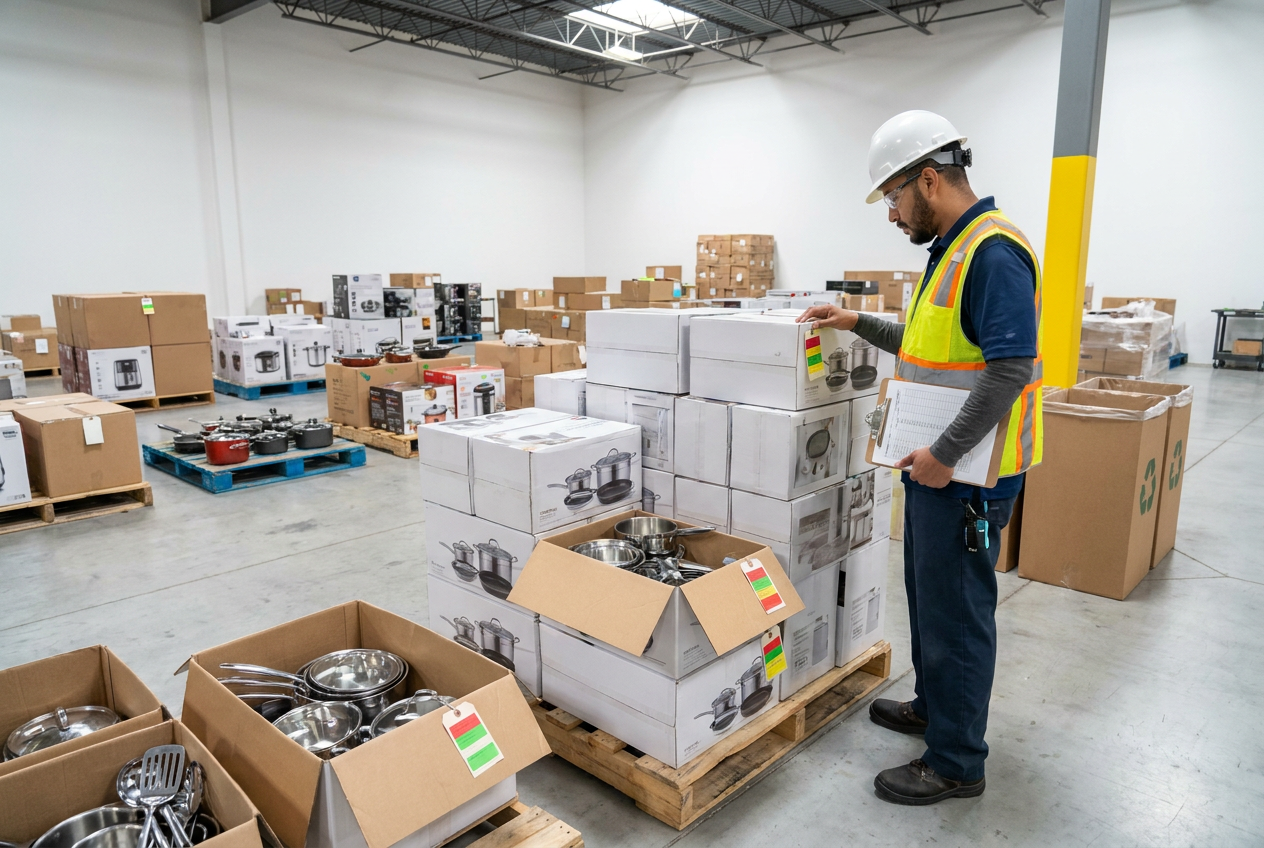
Cookware, bakeware and utensils
Inspect inside surfaces, outside bases, rims, rivets and handle attachments under good lighting. Check for wobble on a flat surface, loose components, sharp edges and evidence of repairs. Do not assume a lid fits safely because its diameter appears close.
Material-specific checks include:
- Nonstick cookware: peeling, blistering, flaking or gouges that compromise the coating. Keep compromised pieces out of cooking-use inventory.
- Stainless steel: deep pitting, cracks, sharp damage or separating bases. Distinguish removable discoloration from structural defects.
- Cast iron: cracks, unstable handles and corrosion. Surface rust and seasoning wear need separate assessment from structural damage; do not assume every rusty piece is recoverable.
- Enameled cookware: chips or cracks on cooking surfaces, rim damage and exposed underlying material.
- Glass bakeware: chips, cracks and substantial scratches. Do not conduct improvised thermal-shock tests or infer oven suitability from appearance.
- Wood, silicone and plastic utensils: splits, melting, sticky degradation, persistent odors and damaged seams that cannot be adequately cleaned.
Follow manufacturer care instructions where identifiable. Do not invent dishwasher-safe, induction-compatible, oven-safe or temperature-limit claims when markings and reliable product information are missing.
Tableware and uncertain materials
Run a visual inspection around plate rims, cup lips, handles and bowl interiors. Chips can leave sharp edges, while cracks and crazing warrant withholding pieces from food-use inventory pending reliable assessment.
Unknown, decorative or older ceramics should not be assumed suitable for food contact. Appearance does not establish lead or cadmium compliance, and a household screening swab is not a substitute for appropriate migration testing or reliable documentation. If suitability cannot be established, do not market the piece for eating or serving food.
Identify products and check applicable recalls before listing. In the United States, selling recalled consumer products is prohibited; follow the recall instructions rather than attempting to overcome the issue with an as-is disclaimer.
As-is describes the sale terms. It does not replace a reseller's responsibility to screen for recalls, damage and unsupported food-use claims.
Separate incomplete sets from unusable pieces
An incomplete set is not necessarily damaged. A sound dinner plate can be sold as a replacement piece, while a complete boxed set containing cracked plates still needs sorting.
Use three inventory groups: complete and inspected, incomplete but individually suitable for resale, and withheld from sale. Record the actual components instead of copying packaging claims. A cookware carton labeled “ten pieces” may count lids and accessories, not ten pans.
For replacement tableware, record the maker, pattern, dimensions, color and backstamp when available. Similar-looking patterns or different production runs may not match exactly. For cookware lids, document actual fit and avoid claiming manufacturer-approved compatibility without support.

Keep matching pieces together with internal inventory labels, but avoid adhesives on porous or food-contact surfaces. Photograph each item's actual condition, including missing components and cosmetic wear. Clearly distinguish inspected open-box goods from visibly used goods; cleaning does not make merchandise new.
Duplicate pieces can support replacement-piece listings, but they also consume shelf space. The guide to assessing duplicate items in liquidation pallets explains why repeated inventory deserves its own demand assessment.
Evaluate pricing and place an informed order
The listed price is the purchase starting point, and freight is included. Free shipping is the only delivery option on every order to all 48 contiguous states. PalletCove covers sales tax on qualifying orders; confirm qualification rather than assuming every transaction qualifies.
An average cost per manifested unit can help compare offers, but it is not the cost per saleable unit. Your internal budget should also account for inspection labor, cleaning supplies, protective packaging, storage, marketplace expenses and appropriate disposal. Do not assign presumed resale proceeds to unidentified or uninspected goods.
For a practical ordering sequence:
- Confirm the specific listing, buying unit, condition grade and available manifest.
- Ask whether the assortment excludes electric appliances if your business only handles non-electric kitchenware.
- Clarify quantity definitions, included components and material information.
- Review the sale terms and receiving requirements before payment.
- Provide accurate billing, delivery and receiving-contact information.
- Confirm any resale certificate documentation needed for your order and retain the invoice.
A resale certificate documents a qualifying resale purchase under applicable rules; it does not certify product safety or establish a condition guarantee.
Accepted payment methods are credit/debit card, ACH bank transfer and domestic bank wire. Review the payment policy for applicable details. Handling time begins after payment clears, not simply when a payment instruction is submitted.
Plan free shipping and delivery-day inspection
Handling takes 1–3 business days after payment clears. Transit from Dallas is typically 3–7 business days. These are separate stages, and typical transit is not a guaranteed arrival date.
Individual pallet shipments may move through LTL freight networks, while truckloads generally require full-trailer receiving arrangements. Confirm the delivery arrangement, unloading responsibilities and site suitability before ordering. Make sure your receiving area can accommodate the shipment and that someone can inspect it on arrival.
Buyers researching liquidation pallets in Texas and liquidation pallets in Florida receive the same free-shipping framework: freight is included in the listed price. Consult the shipping policy for the applicable procedures.
At delivery:
- Compare the shipment identifiers and pallet count with the delivery paperwork.
- Photograph all accessible sides before removing wrap or straps.
- Document crushed cartons, leaning stacks, torn wrap, wet packaging and visible breakage.
- Record visible damage or shortages on the delivery receipt before signing, following the carrier's process.
- Retain packaging, labels and paperwork while investigating discrepancies.
After unloading, open cartons methodically and record concealed damage with photographs tied to the shipment and item. Keep broken glass and ceramic fragments away from the sorting area, and use suitable protective equipment when handling damaged cartons.
Handle claims carefully and avoid common mistakes
All merchandise is sold as-is for resale. Do not assume that ordinary condition variation, incomplete sets or a disappointing assortment creates a right to return. Review the refund and claims policy before ordering for eligibility, deadlines, documentation and any authorization requirements.
If something appears inconsistent with the order or shipment, report it promptly with the order number, delivery documentation, manifest comparison and clear photographs. Separate transportation damage from inventory-condition concerns in your report. Do not send merchandise back without confirming the applicable procedure; submitting a claim does not guarantee approval or reimbursement.
Common buying mistakes include:
- Treating a condition grade as proof that every item is unused or complete.
- Counting lids, utensils and pans as interchangeable units when comparing lots.
- Assuming a mixed general merchandise load contains a predictable kitchenware share.
- Listing chipped tableware for food use with only a damage disclosure.
- Making material, temperature or compatibility claims based on appearance.
- Pricing the whole lot before determining which pieces can actually be offered.
- Discarding damaged packaging before documenting a receiving issue.
Maintain separate records for received quantity, inspected quantity and listed quantity. That distinction makes inventory control and any discrepancy report substantially clearer.
Frequently asked questions
Are kitchenware liquidation lots limited to non-electric products?
Not necessarily. A broad kitchen or general merchandise description can include appliances, so confirm the specific assortment if you only want cookware, utensils and tableware. The listing and available manifest should guide the purchase.
Can I resell chipped plates if I disclose the damage?
Disclosure alone does not make a chipped plate appropriate for food use. Sharp edges and compromised surfaces are reasons to withhold it from food-use inventory. Follow applicable safety requirements and dispose of unsuitable pieces appropriately.
Are incomplete cookware sets worth considering?
They can fit a business that sells individual replacement components, but demand and suitability must be assessed item by item. Confirm that each piece is structurally sound and describe exactly what is included. Do not represent an assortment as a complete manufacturer's set.
Is shipping included for pallet and truckload orders?
Yes. Free shipping is the only delivery option on every order to all 48 contiguous states, with freight included in the listed price. Handling is 1–3 business days after payment clears, followed by typical transit of 3–7 business days from Dallas.
Does a manifest guarantee the condition of each piece?
No. A manifest is an inventory reference whose detail and verification level should be clarified before purchase. It does not replace physical inspection, recall checks or confirmation of food-contact suitability.
Talk to PalletCove Liquidation
Before purchasing, contact our order desk to clarify the listing, manifest, condition information and receiving requirements. Browse current inventory for available offers rather than assuming a previous assortment remains available.
PalletCove Liquidation LLC
- Address: 4820 Cove Industrial Blvd, Dallas, TX 75236
- Phone: (713) 819-3904
- Email: sales@palletcoveliquidation.com
- Hours: Mon–Fri 8:00 AM – 6:00 PM CT, Sat 9:00 AM – 2:00 PM CT, Sun closed