

Lighting liquidation pallets can contain ceiling fixtures, wall sconces, portable lamps, replacement bulbs and installation accessories. The important buying question is not simply how many boxes are included. It is how many identifiable products fit your customers’ electrical systems, installation requirements and expectations for completeness.
A fixture with intact glass can still need a proprietary mounting bracket. An LED bulb can fit a socket but be unsuitable for its dimmer or enclosed housing. Evaluating these details before ordering helps a reseller plan sorting, qualified testing, replacement parts and accurate listings without assuming every item is ready to install.
PalletCove Liquidation supplies manifested and category-level liquidation pallets and full truckloads from Dallas, Texas. All merchandise is sold as-is for resale; a manifest, product label or condition grade should be read as specific information, not a promise of functionality or resale results.
1. Understand lighting load types and condition grades
A liquidation pallet is a bulk shipping unit containing merchandise offered for resale. A lighting-focused load may concentrate on one product family or mix fixtures, bulbs and accessories. A truckload increases the volume substantially, but a full trailer does not necessarily contain matching products or equal quantities per pallet.
Start with the liquidation pallets hub and the guide to types of liquidation pallets to distinguish buying formats. Availability and contents must be verified for the specific listing.
- Manifested loads: Include an inventory document with some combination of descriptions, model numbers, quantities and other fields. Detail and accuracy limitations matter.
- Category-level loads: Identify a broad merchandise category without necessarily identifying every unit. Do not infer a lighting-only mix from a general home-improvement description.
- Mixed general merchandise: May include unrelated products requiring different storage, testing and sales channels.
- Full truckloads: Require enough receiving space and labor to segregate fragile lighting from heavier goods.
Condition terminology also needs context:
| Condition description | What it generally describes | What still needs verification |
|---|---|---|
| --- | --- | --- |
| Overstock | Excess inventory outside normal sell-through | Storage wear, completeness and actual condition |
| Shelf pulls | Merchandise removed from retail shelves | Opened packages, display use and missing accessories |
| Customer returns | Items returned after purchase | Installation attempts, defects, substitutions and missing parts |
| Salvage | Merchandise designated for recovery or parts | Whether any safe resale or component recovery is feasible |
| Mixed condition | Multiple condition groups in one load | The actual distribution and item-level usability |
These terms are not universal testing standards. Ask what the seller’s condition grade means for that listing and whether it applies to the whole load or individual units.
2. Read the manifest beyond the item count
Request the available manifest before payment and establish whether quantities refer to individual bulbs, multipacks, fixtures or cartons. Ten boxes of six bulbs are different from ten individual bulbs, and a fixture carton may contain several fragile pieces rather than several fixtures.
Useful fields include manufacturer, model, UPC, quantity, voltage, fixture style, bulb base, finish and stated condition. Retail reference prices, when provided, are not reliable forecasts of achievable selling prices. The guide to buying liquidation pallets provides a broader purchasing framework.
Separate confirmed information from assumptions. A description such as “LED ceiling light” does not establish color temperature, dimmability, driver compatibility or whether the LED source is replaceable. Ask whether photographs show the actual lot or representative merchandise.
For browsing context, compare Home Depot category inventory with general merchandise liquidation. Listings such as HD GM Truckloads Pallets and Home Depot Tier 2 Truckload require their own contents review; their names do not establish lighting availability or a standardized condition grade.
PalletCove is an independent reseller and is not affiliated with, endorsed by or sponsored by any retailer named.
3. Match voltage, fixture type and bulb compatibility
Voltage and installation environment
Read the actual product label and manufacturer documentation. Residential line-voltage fixtures commonly use 120V in the United States, while some commercial lighting uses 277V or a stated input range. Low-voltage landscape and decorative lighting may require a specific transformer or power supply. Similar connectors do not establish electrical compatibility.
Check whether each product is hardwired, plug-in, battery-powered or supplied through a separate driver. Also verify dry, damp or wet location suitability. These ratings are not interchangeable, and an indoor fixture should not be described as outdoor-ready without supporting labeling.
Fixture families and fit
Sort by installation needs rather than appearance alone:
- Pendants and chandeliers: Check canopy dimensions, suspension components, weight and ceiling-height requirements.
- Flush mounts and sconces: Confirm mounting plates, box compatibility and shade attachment hardware.
- Recessed lighting: Identify housing compatibility, aperture size and insulation-contact or airtight labeling where applicable.
- Track lighting: Match the track system and adapter; visually similar heads may not interchange.
- Portable lamps: Inspect cords, plugs, switches, sockets, bases and shade supports.
- Landscape lights: Confirm supply requirements, connectors and environmental suitability.
Bulbs, drivers and controls
Bulb base and envelope shape describe different things. E26 identifies a screw-base size, while A19 describes a bulb shape and size designation. Check both physical fit and electrical requirements, including maximum permitted wattage.
LED compatibility requires additional checks: lumens, color temperature, color rendering information where supplied, dimmability and enclosed-fixture suitability. A dimmable bulb is not necessarily compatible with every dimmer. Integrated LED fixtures may require a model-specific driver or light engine rather than a replaceable bulb.
Smart lighting may need a hub, app, supported wireless protocol or account reset. Confirm current manufacturer support rather than assuming connected features remain usable.
A fixture is not resale-ready merely because it lights up: compatibility, safe condition, complete mounting parts and accurate disclosure all matter.
4. Inspect installation hardware and fragile components
Missing hardware can turn an otherwise intact product into a parts-sourcing project. Compare contents against the manufacturer’s parts diagram when available, keeping each fixture’s accessories together in a labeled bag.
Look for mounting crossbars or plates, specified screws, canopies, threaded stems, suspension chains, retaining rings, gaskets and strain-relief components. Lamps may need a harp, finial or shade adapter. Do not substitute arbitrary fasteners or components where the manufacturer specifies particular parts.
Glass and decorative pieces deserve separate attention. Check shade rims, drilled holes, corners and attachment points for chips or cracks. Inspect acrylic diffusers for fractures and metal housings for distortion that could prevent secure assembly. A chipped mounting edge can matter more than a visible cosmetic scratch.
Replacement shades must match dimensions, fitter style and attachment method. A similar-looking shade is not proof of fit. Proprietary glass, remote controls and drivers may be unavailable, so establish availability before assigning a repair budget.
The guide to box damage versus product damage explains why crushed packaging and actual merchandise condition should be evaluated separately.

5. Build a safe testing and cost-allocation workflow
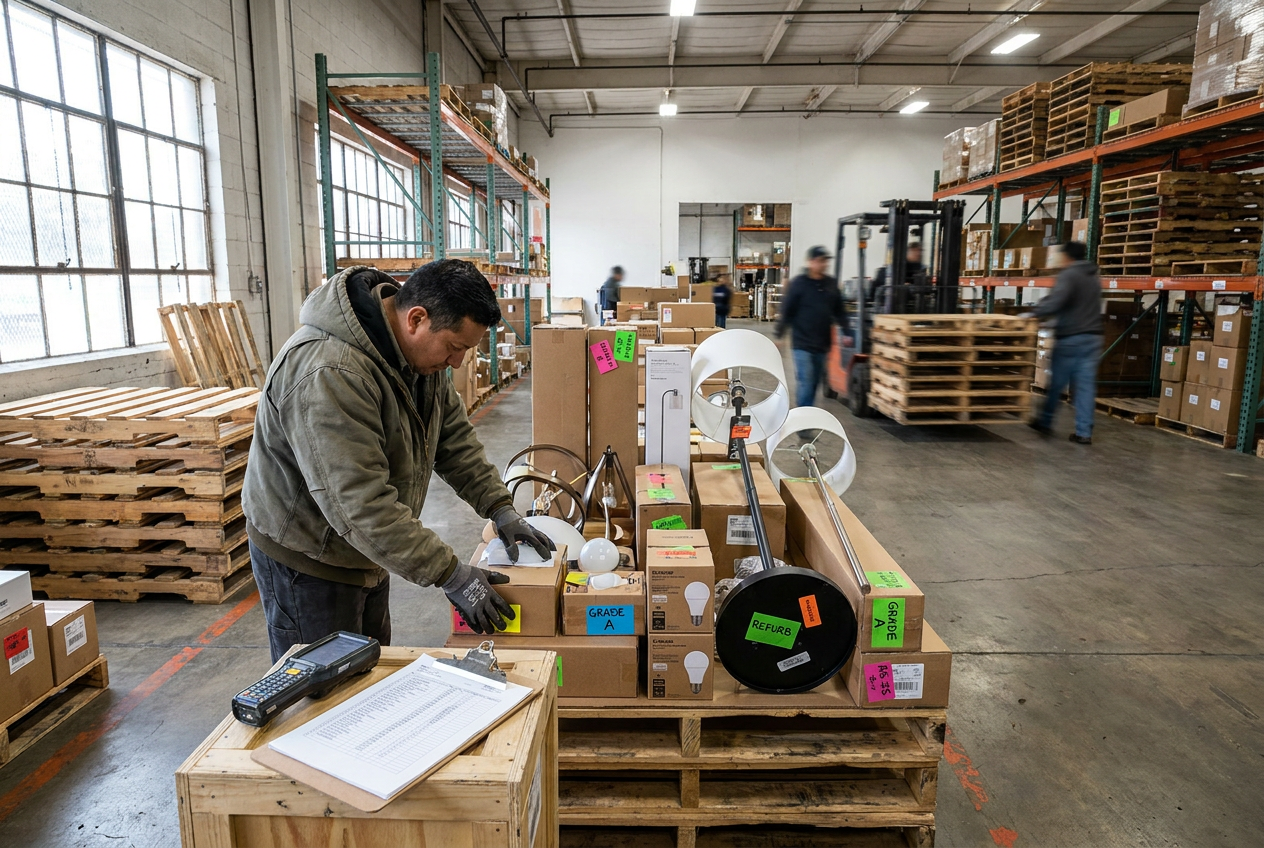
Set up separate areas for uninspected merchandise, inspection candidates, incomplete items and quarantined products. Record model numbers and check relevant recall information before offering merchandise for sale. Follow applicable recall instructions rather than treating recalled products as ordinary resale stock.
Do not energize fixtures with damaged wiring, cracked sockets, exposed conductors, moisture damage or uncertain electrical specifications. Hardwired and unfamiliar commercial equipment should be evaluated by a qualified person using an appropriate setup. A brief power-on check does not establish electrical safety or remaining service life.
Record what was actually checked: visual condition, included parts, functional observations and unresolved issues. Avoid broad claims such as “fully tested” unless your documented process supports them. Do not assume a manufacturer warranty transfers through liquidation.
For pricing analysis, start with the listed load price; freight is included. Add your own receiving labor, sorting, qualified testing, appropriate replacement parts, storage, packaging, marketplace expenses and disposal costs. Sales tax on qualifying orders is covered by PalletCove.
Allocate costs consistently across usable inventory rather than treating every manifest unit as equally marketable. Distinguish ready-to-list products from repair candidates and unsellable material. This is a planning method, not a profit or resale-value guarantee.
6. Confirm the order, payment and free shipping
Before paying, confirm the listing identifier, selling unit, price, manifest availability, condition description and any stated quantity limitations. Ask whether the minimum order is a pallet, a grouped lot or a truckload; do not assume individual fixtures can be selected from a bulk load.
Use this pre-order sequence:
- Match the load’s product mix to your customers and inspection capabilities.
- Resolve voltage, condition and quantity ambiguities in writing.
- Confirm the delivery address, receiving contact and unloading arrangements.
- Review the applicable order and policy terms.
- Pay using credit/debit card, ACH bank transfer or domestic bank wire.
If you hold a resale certificate, ask what documentation is needed for your order. Do not assume every order qualifies for tax coverage; PalletCove covers sales tax on qualifying orders.
Free shipping is the only delivery option on every order to all 48 contiguous states. Freight is included in the listed price. Handling takes 1–3 business days after payment clears, and transit from Dallas is typically 3–7 business days. These are separate stages, not a guaranteed arrival date.
Review the shipping policy and prepare for the shipment format. A pallet may move through LTL service, while a truckload may occupy a full trailer; confirm the actual arrangement and suitable unloading equipment before dispatch.
Buyers comparing liquidation pallets in Texas and liquidation pallets in Florida receive the same free-shipping inclusion, although transit details depend on the destination.
7. Inspect the load on delivery day
Prepare a clear, dry staging area with room to document pallets before breaking down the load. Keep heavy cartons away from loose glass and avoid stacking loads on fragile fixture packaging.
At receipt:
- Compare the shipment identifiers and handling-unit count with the delivery paperwork.
- Photograph the load, labels, wrapping and any visible damage before moving contents unnecessarily.
- Note visible damage or shortages accurately on delivery documents when possible.
- Preserve packaging and relevant labels while investigating discrepancies.
- Count and identify individual contents as you unpack, then reconcile them against the available manifest.
Distinguish receiving observations from later inspection findings. A missing pallet, a crushed carton and a fixture missing screws are different issues and need different documentation. Do not describe concealed contents as inspected if only the wrapped load was visible.
8. Handle discrepancies and avoid common buying mistakes
All merchandise is sold as-is for resale. That does not establish a particular claims remedy, and unexpected condition should not be treated as automatically eligible for return. Review the refund and claims policy before ordering for applicable eligibility, deadlines, evidence requirements and procedures.
Report concerns promptly with the order number, delivery date, item or pallet identifiers, photographs and a clear description. Ask for instructions before returning or disposing of merchandise relevant to a claim. Keep hazardous items isolated and handle them safely.
Common mistakes include confusing bulb packs with individual units, assuming “LED” means dimmable, treating a category name as a contents guarantee, and overlooking proprietary mounting hardware. Other costly errors are budgeting no inspection time, mixing parts between models and listing unverified voltage or location ratings.
Fluorescent lamps and some other lighting products require special disposal handling. Follow local requirements for damaged lamps, electronic drivers and batteries rather than placing all rejected inventory in ordinary waste.
Frequently asked questions
Are lighting liquidation pallets always manifested?
No. A load may be manifested or sold at category level with less item-level detail. Confirm what documentation exists and whether counts describe units, packs or cartons before ordering.
Can I assume a returned light works if the box looks new?
No. Customer returns may have defects, missing components or signs of installation despite clean packaging. Inspect the actual product and document any qualified testing performed.
Can I replace missing bulbs with any LED bulb?
No. Match the base, physical dimensions, voltage and fixture restrictions, then check dimmer and enclosure compatibility. Integrated LED products may not accept replacement bulbs at all.
Is shipping included for a single pallet?
Yes. Free shipping is the only delivery option on every order to all 48 contiguous states, and freight is included in the listed price. Handling is 1–3 business days after payment clears; transit is typically 3–7 business days from Dallas.
Can incomplete lighting merchandise be returned?
Do not assume incomplete merchandise qualifies for a return. Products are sold as-is for resale, and the applicable policy and order terms govern any eligible claim. Preserve evidence and request instructions promptly.
Talk to PalletCove Liquidation
Discuss your preferred fixture categories, manifest needs and receiving setup with PalletCove Liquidation LLC before choosing a load. You can contact our order desk with compatibility questions and review current inventory for available listings.
- Business: PalletCove Liquidation LLC
- Address: 4820 Cove Industrial Blvd, Dallas, TX 75236
- Phone: (713) 819-3904
- Email: sales@palletcoveliquidation.com
- Hours: Mon–Fri 8:00 AM – 6:00 PM CT, Sat 9:00 AM – 2:00 PM CT, Sun closed