
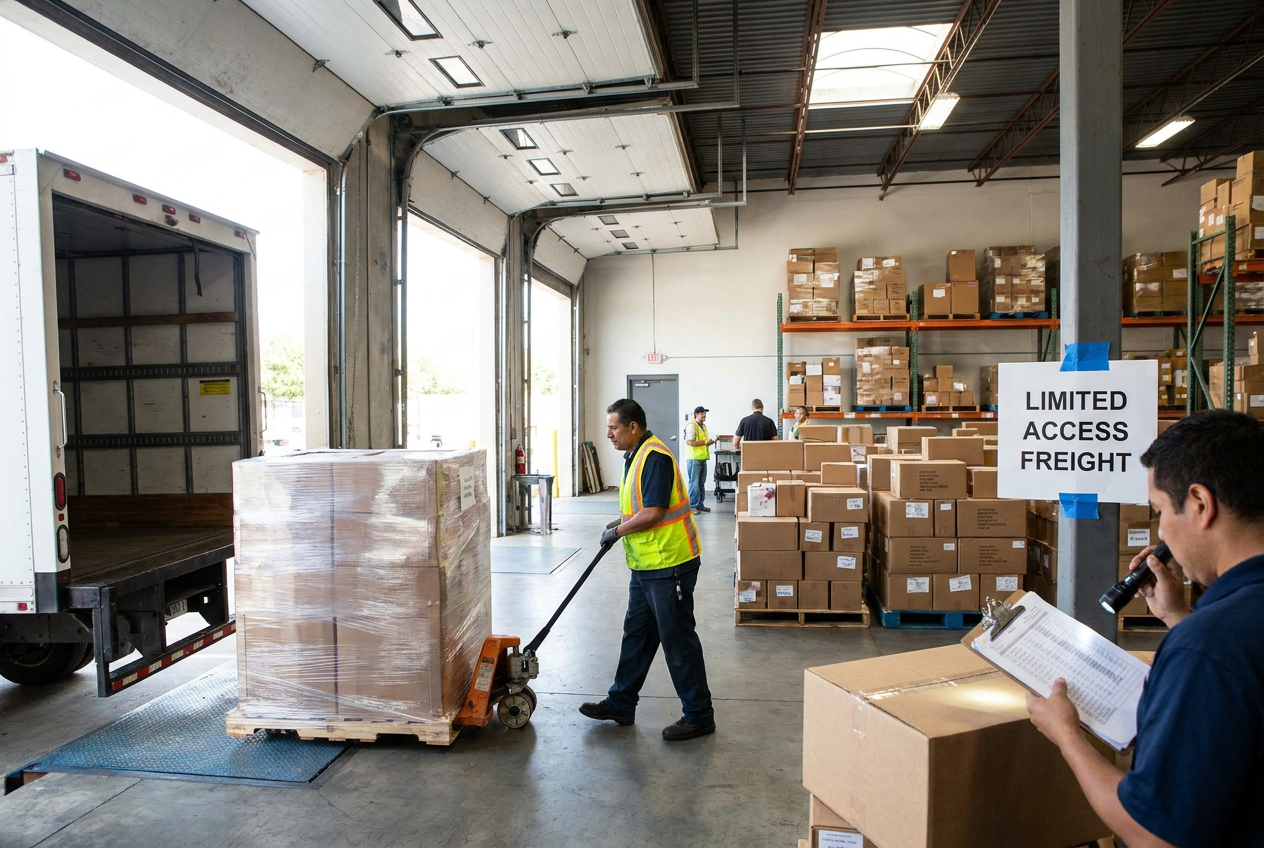
A liquidation pallet can fit your inventory plan and still be difficult to receive at your address. Gates, restricted receiving hours, narrow entrances and missing unloading equipment can all affect how a carrier plans the stop. That is why understanding limited access freight delivery matters before placing a pallet or truckload order.
PalletCove Liquidation supplies independent resellers from Dallas, Texas. Free shipping is the only delivery option on every order to all 48 contiguous states, and freight is included in the listed price. Describing your location accurately helps coordinate delivery; it does not change that shipping policy.
This guide explains how carriers evaluate receiving locations, what information to share before ordering, and how to connect transportation planning with manifests, condition grades and delivery-day documentation.
What limited access freight delivery means
Limited access freight delivery generally describes service to a location where entry, movement or receiving procedures differ from a conventional commercial loading dock. The carrier’s service rules determine the classification; there is no single checklist applied identically by every carrier.
Common examples include construction sites, schools, places of worship, farms, storage facilities and secured properties. A business at one of these locations may receive freight regularly but still require additional coordination because a driver cannot simply approach an open dock during normal business hours.
| Location feature | Why it matters | What the buyer should disclose |
|---|---|---|
| --- | --- | --- |
| Guardhouse or controlled gate | Entry may require advance authorization | Visitor process and receiving contact |
| School or institutional campus | Receiving may be restricted to designated areas | Building, entrance and approved hours |
| Self-storage facility | Truck routes and unloading space may be limited | Facility rules and unloading location |
| Farm or rural property | Roads and turning space may constrain access | Surface conditions and vehicle restrictions |
| Construction site | Access routes can change | Current entrance and site supervisor |
| Home-based business | Residential access may differ from commercial receiving | Actual property use and unloading equipment |
Residential service, limited access, appointments and liftgate requirements describe different aspects of delivery. A location can involve more than one. A liftgate lowers freight from the trailer to ground level; it does not make an unsuitable road, steep driveway or blocked entrance usable.
A business name, commercial registration or resale certificate does not establish that an address has suitable freight access. Describe the physical site rather than selecting the label that sounds most convenient.
The most useful delivery description explains how a truck enters, where it stops, who receives it and how the freight comes off.
What to disclose before placing an order
Provide receiving information before committing to inventory, especially when the site is new to you. Carrier acceptance and the practical unloading plan should be clarified rather than assumed.
Give PalletCove the following details:
- Complete street address, suite or unit number, business name and delivery contact’s phone number.
- Actual location type: warehouse, storefront, residence, storage unit, farm, school or another property.
- Gate procedures, security screening, appointment requirements and receiving hours.
- Entrance width, turning constraints, posted vehicle restrictions and overhead obstructions.
- Whether the approach and unloading area are paved, level and accessible in poor weather.
- Whether you have a dock, forklift or other suitable unloading equipment, including relevant capacities.
- Whether ground-level unloading or a liftgate may be needed.
- Whether the property owner or facility manager must authorize the delivery.
A useful message might read: “Our resale business operates from a gated storage facility. Receiving is permitted weekdays from 10 a.m. to 3 p.m. There is no dock or forklift. The manager must open the gate, and we need confirmation that the proposed unloading method is suitable.”
Share photographs or a site diagram if the entrance is difficult to explain. Never assume a driver can use a neighboring property, block a public road or back through an unsafe approach. If your location cannot support the shipment, discuss a suitable receiving address before ordering rather than changing destinations after dispatch.
Match the load type to your receiving capacity
A pallet order and a full trailer require different receiving plans. Start with the liquidation pallets inventory hub, then use the guide to buying liquidation pallets and guide to buying liquidation truckloads to compare order sizes with your available space and equipment.
LTL pallet shipments
LTL means less-than-truckload transportation: your freight shares trailer capacity with other shipments. Freight may move through terminals, so stable packaging, readable labels and accurate shipment details matter.
Confirm the expected pallet count, dimensions and weight when available. A pallet jack needs an appropriate surface and cannot substitute for equipment that lowers freight from a trailer. Oversized or unusually heavy pallets also need an equipment-specific unloading plan.
Truckloads and full trailers
Truckload describes a larger shipment using truckload transportation, but the listing and shipping arrangement should establish the actual configuration. Do not infer an exact pallet count, trailer size or unloading method from the word alone.
Ask whether the load is palletized, floor-loaded or mixed. Floor-loaded merchandise requires a different labor and handling plan from pallets that can be removed with a forklift. Unless confirmed otherwise, do not assume a full trailer will have liftgate equipment or that the driver will unload individual cartons.
Browse truckload liquidation inventory and general merchandise liquidation lots with receiving capacity in mind. Product pages such as the Amazon General Merchandise Truckload and Macy’s Textile Truckload are starting points for checking individual listing details, not proof that every load has identical dimensions or contents.
PalletCove is an independent reseller and is not affiliated with, endorsed by or sponsored by any retailer named.
Read manifests and condition grades before buying
A manifest describes a lot’s listed contents. Depending on the listing, it may include descriptions, quantities, model identifiers or other item information. A category-level lot instead identifies a broader merchandise grouping and may not provide the same item-level detail.
Neither format should be treated as a testing report unless testing is expressly documented. Check whether quantities refer to individual pieces, multipacks or cases, and ask whether the document covers the exact offered lot.
Condition grade terminology also needs context:
- Customer returns: Merchandise returned by customers; usage, functionality, packaging and completeness can vary.
- Overstock: Excess inventory; the label alone does not establish packaging condition or testing status.
- Shelf pulls: Goods removed from selling displays or shelves, potentially with labels or handling wear.
- Salvage: Merchandise generally intended for repair, parts recovery or material recovery rather than assumed ready-to-sell use.
All PalletCove merchandise is sold as-is for resale. Read the specific listing and request clarification where a condition grade is undefined. Do not assume that a tier number has the same meaning across suppliers, or that every unit within a mixed lot has the same condition.
For products requiring components, review the guide to missing accessories in liquidation lots. Missing chargers, fasteners or installation hardware affect sorting and evaluation after receipt; those issues are different from visible transportation damage.
Understand pricing, ordering and payment
PalletCove’s listed price includes freight. Free shipping is the only delivery option on every order to all 48 contiguous states. Buyers researching liquidation pallets in Texas or liquidation pallets in Florida should disclose receiving restrictions even though shipping is included.
An included transportation cost does not establish that every physical destination is serviceable by every vehicle. Confirm the receiving arrangement and review the shipping policy before ordering.
Use this sequence:
- Select the lot and review its description, manifest availability and condition disclosures.
- Confirm quantity, packaging configuration and available shipment dimensions.
- Submit your address, site restrictions and unloading plan.
- Resolve unclear inventory or delivery details before payment.
- Pay using credit/debit card, ACH bank transfer or domestic bank wire.
- Keep the order confirmation and monitor shipment communications.
These are the accepted payment methods; consult the payment policy for applicable instructions. Verify payment information through an established business contact before sending funds, particularly if instructions unexpectedly change.
Sales tax on qualifying orders is covered by PalletCove. Ask what documentation is needed to establish qualification, and provide a valid resale certificate when requested. A resale certificate is a tax document, not permission to receive commercial freight at a restricted property.
Handling takes 1–3 business days after payment clears. Transit is typically 3–7 business days from Dallas. These are separate stages, not a guaranteed arrival date; receiving restrictions and appointment coordination should be discussed early.
Prepare the site before the truck arrives
Assign a receiving contact who can answer the carrier and be present during the agreed delivery window. Give that person the order information, expected shipment details and authority to document exceptions.
Clear the access route and unloading area. Check that doors, gates and overhead clearances suit the planned vehicle and equipment. Keep pedestrians and unrelated vehicles away from the work area, and use trained operators for powered equipment.
Confirm these practical details before delivery day:
- Where the driver should enter and safely stop.
- Who will provide access if a gate or security desk is involved.
- Which equipment will unload the freight and who will operate it.
- Where pallets or cartons will be staged without blocking exits.
- Whether any requested placement beyond the unloading point has been confirmed.
Do not assume freight service includes inside placement, unpacking, sorting or moving merchandise to an upper floor. Likewise, a delivery appointment should not be interpreted as an exact arrival minute unless that arrangement has been specifically confirmed.

Inspect delivery and document any concerns
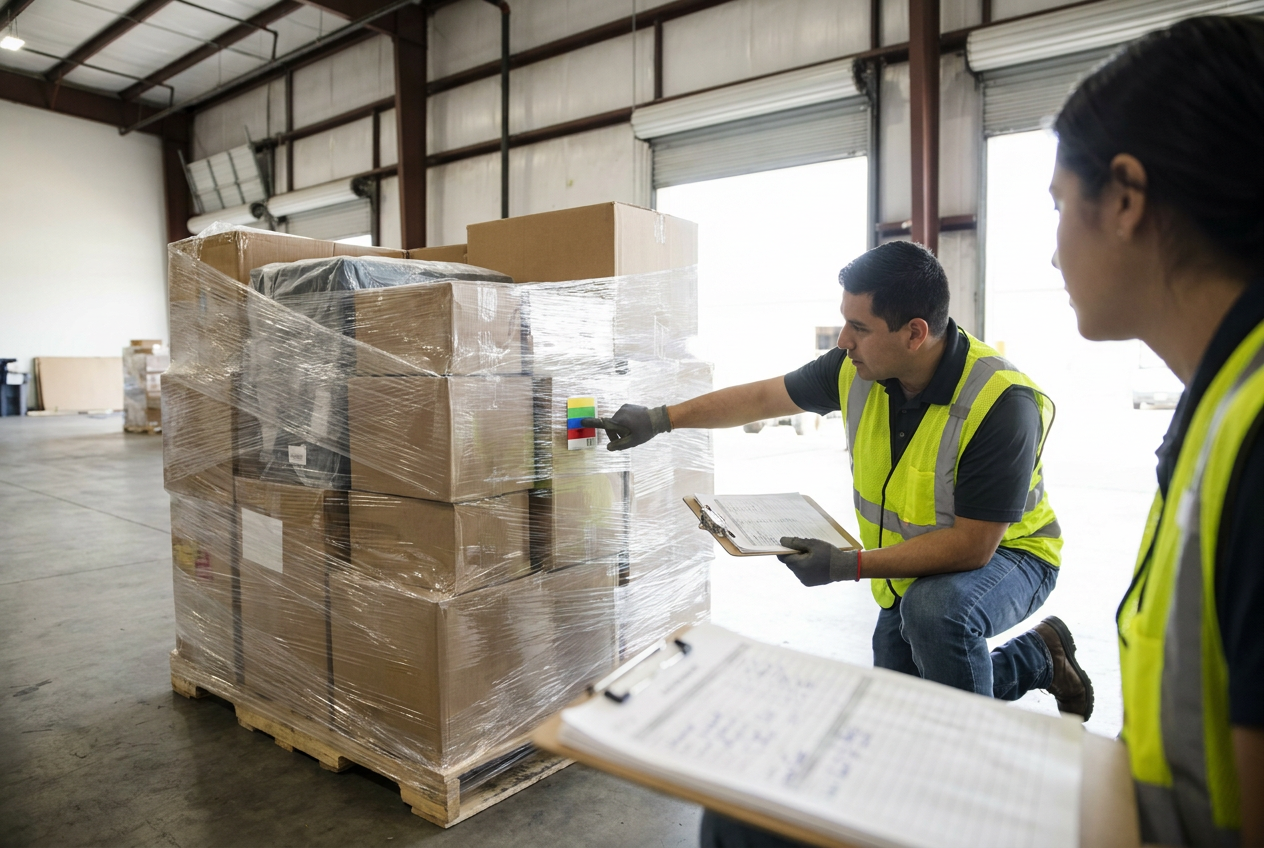
Inspect the shipment safely before signing the delivery receipt. You usually cannot fully test a liquidation load while the driver waits, but you can document its visible transportation condition.
- Match shipment identifiers to your order and receiving paperwork.
- Count accessible handling units, such as pallets or cartons, against the shipping documents.
- Check for crushed packaging, shifted loads, broken wrap, wet cartons or visible punctures.
- Photograph the shipment’s overall condition, labels and specific concerns.
- Record observable shortages or damage on the delivery receipt before signing, and keep a copy.
- Report concerns promptly to PalletCove and preserve packaging and relevant documents.
Use precise descriptions such as “one pallet has torn wrap and two crushed outer cartons” rather than a vague notation. If you cannot verify a count, state what you could actually observe. Do not enter an unsafe trailer or attempt to stabilize a leaning pallet by hand.
After unloading, separate transportation concerns from inventory-condition findings. A previously used item in a customer-returns lot is not automatically a freight claim. For concealed concerns, record when they were discovered and retain supporting photographs.
Review the refund and claims policy for applicable requirements and deadlines. As-is merchandise does not carry a blanket return promise, and reporting a concern does not guarantee a refund or replacement. If damage is severe or refusal seems necessary, seek instructions promptly rather than assuming refusal automatically resolves the order.
Frequently asked questions
Does a business address automatically avoid limited access classification?
No. Carriers evaluate the actual site and their service rules, not just the business name. A commercial operation behind a security gate or inside a storage facility may still need restricted-site coordination.
Is free shipping available for limited-access locations?
Free shipping is PalletCove’s only delivery option on every order to all 48 contiguous states, with freight included in the listed price. Disclose the location’s restrictions before ordering so the delivery arrangement can be evaluated. Included shipping does not mean any vehicle can safely reach any unloading point.
Can I receive a liquidation pallet without a loading dock?
Potentially, but the unloading method must be confirmed in advance. Describe the ground surface, available equipment and any liftgate need. Do not assume the driver can manually unload heavy merchandise.
How long does delivery take after I pay?
Handling is 1–3 business days after payment clears, followed by typical transit of 3–7 business days from Dallas. Appointment requirements, carrier scheduling and site access can affect the receiving date. Arrange labor around confirmed shipment information rather than an assumed calendar date.
What mistakes cause the most avoidable receiving problems?
Common mistakes include describing a residence as a warehouse, omitting gate restrictions, assuming unloading equipment will be supplied and ordering more freight than the site can safely stage. Other avoidable problems include treating a manifest as a condition guarantee and signing without documenting visible damage. Resolve site and inventory questions before payment whenever possible.
Talk to PalletCove Liquidation
Before ordering, share your delivery address, location type, access restrictions and unloading equipment. Include the lot you are considering so inventory questions and receiving requirements can be reviewed together.
PalletCove Liquidation LLC
- Address: 4820 Cove Industrial Blvd, Dallas, TX 75236
- Phone: (713) 819-3904
- Email: sales@palletcoveliquidation.com
- Hours: Mon–Fri 8:00 AM – 6:00 PM CT, Sat 9:00 AM – 2:00 PM CT, Sun closed
To discuss your receiving plan, contact our order desk. When you are ready to compare available lots, browse current inventory.