
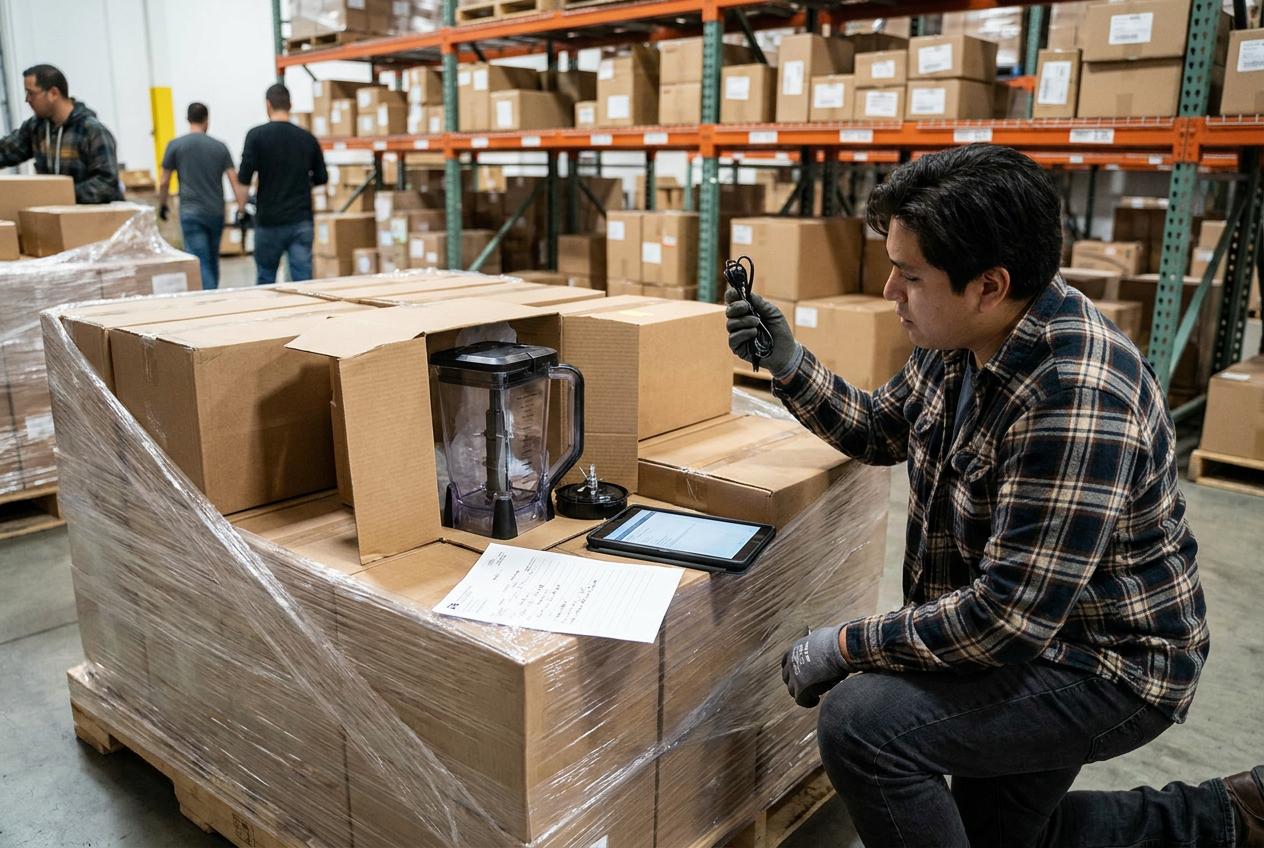
A manifest can identify a vacuum, cordless drill, or countertop appliance without saying whether its charger, battery, lid, or attachments are included. That gap matters: identifying the main product is not the same as documenting a complete, usable set.
Evaluating missing accessories in liquidation lots means answering three separate questions: What should accompany this exact model? What is actually included? Can any missing component be replaced safely and economically? This guide explains how independent resellers can work through those questions before buying a liquidation pallet or committing to a full truckload.
What accessory completeness means in liquidation
An accessory is a component supplied with, attached to, or required by the main product. Some accessories are optional conveniences; others are essential to operation or safety. A missing cosmetic trim piece is not equivalent to a missing blade guard, pressure-rated lid, or proprietary power supply.
Also distinguish accessory shortage from unit shortage. A manifest listing ten appliances may describe ten main units, not ten complete retail kits. Missing one appliance and missing one appliance’s measuring cup are different discrepancies.
Condition terminology helps frame the investigation, but it does not replace component-level evidence:
| Inventory description | What to investigate | What not to assume |
|---|---|---|
| --- | --- | --- |
| Overstock | Package seals, bundle identifiers, storage effects | Every package contains the same bundle |
| Shelf pulls | Open packaging, display use, detached components | Display accessories stayed with the unit |
| Customer returns | Swapped parts, incomplete kits, use and damage | A returned item includes its original accessories |
| Salvage | Missing assemblies, unsafe damage, recoverable parts | An accessory purchase will restore operation |
A condition grade is a seller-defined classification, not a universal completeness standard. Ask what the grade means for the specific offer and whether testing included accessories. PalletCove merchandise is sold as-is for resale; a grade or product name is not a guarantee of condition.
For broader context, use the liquidation inventory overview alongside the guide to liquidation pallet types.
Verify the manifest against the exact product bundle
The central problem with an incomplete manifest is uncertainty, not necessarily a confirmed shortage. An omitted accessory field means “not documented” unless other evidence establishes what is included.
Build a component checklist
- Identify the exact unit. Record the manufacturer, model number, regional suffix, revision, UPC where available, and any kit or bundle SKU.
- Find the original contents list. Use the manufacturer’s manual, packaging list, parts diagram, or model-specific support documentation.
- Separate configurations. A bare tool and a starter kit can share a tool model while differing in battery, charger, and case contents.
- Ask for available evidence. Request actual-lot photographs, readable model labels, component counts, and clarification of any manifest completeness fields.
- Record uncertainty explicitly. Use “confirmed present,” “confirmed missing,” and “unverified” rather than marking undocumented components as included.
For each manifest line, track expected components, observed components, replacement part numbers, evidence source, and the date checked. Save the original listing and manifest version so later edits do not erase your purchasing record.
Ask whether a quantity represents individual items, multipacks, kits, or cartons. Likewise, determine whether photographs show the offered lot, a sample, or representative merchandise. A stock image showing a charger does not establish that the charger is in the pallet.
If inspection or sampling is available, include different models, package states, and locations within the load. Findings from accessible top-layer cartons should not be treated as proof of completeness across a truckload.
Check replacement compatibility before sourcing parts
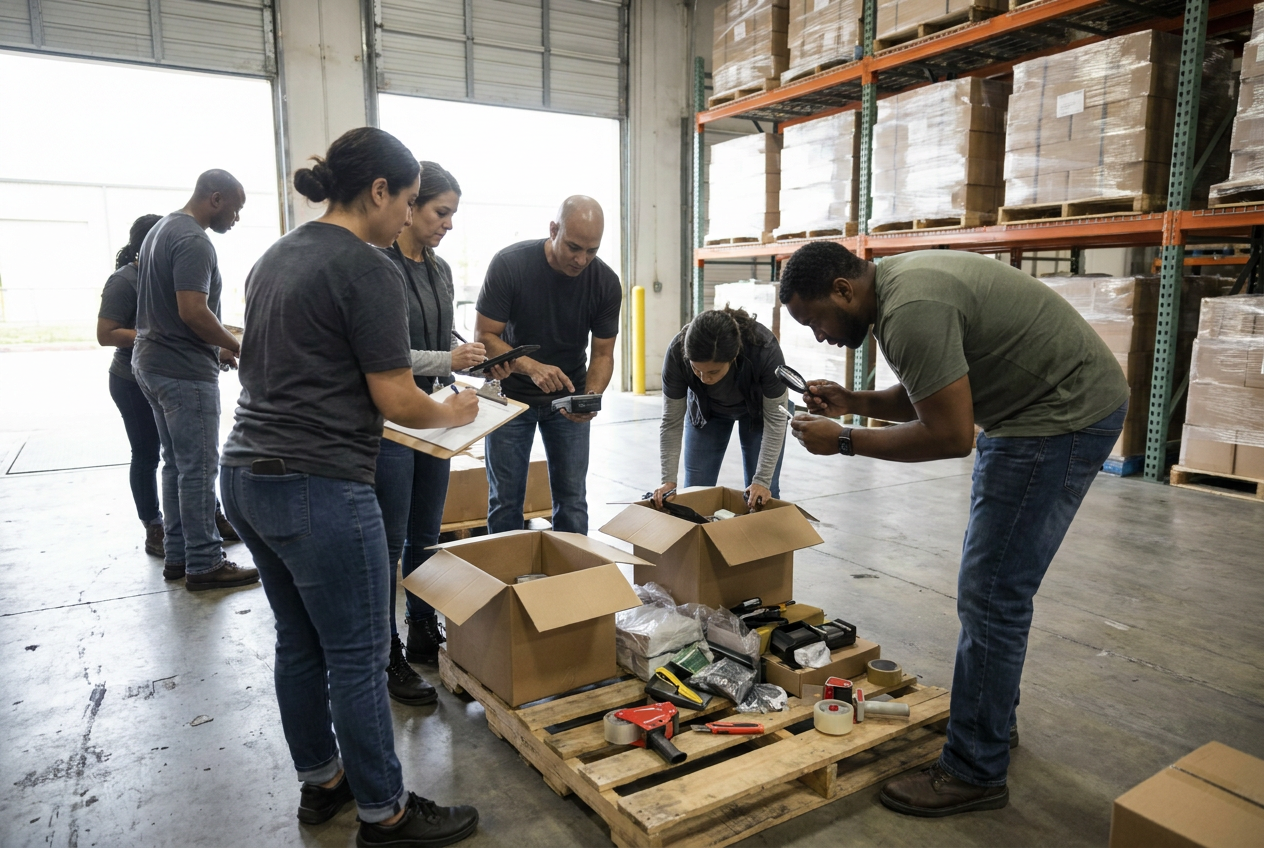
A replacement is useful only if it fits the exact product and performs its intended function safely. Similar appearance, matching brand names, and a connector that physically fits are insufficient evidence.
Electrical and electronic components
For external power supplies, verify the manufacturer’s requirements for output voltage, AC or DC output, polarity, connector dimensions, and adequate current capacity. Confirm any required charging or communication protocol. Higher wattage alone does not establish compatibility.
Battery packs require checks for platform, voltage, chemistry, physical interface, and charging-system compatibility. Do not bypass protection circuits or improvise adapters to make a pack fit. Remotes and control modules may also require a specific revision, pairing procedure, firmware version, or receiver.
Mechanical, food-contact, and safety components
Check dimensions, mounting points, thread specifications, seals, tolerances, and the manufacturer’s supported part number. Blender jars can look interchangeable while differing in couplers or locking mechanisms. Appliance bowls, lids, and gaskets may depend on model-specific interlocks or pressure ratings.
Use manufacturer-specified replacements where required for safety-critical functions. If compatibility cannot be established, hold the item out of operational resale rather than testing an improvised substitute. Check applicable recalls before proceeding; an unresolved recall is not merely an accessory-sourcing issue.
For equipment with blades, guards, fuel systems, or other repair concerns, the outdoor power equipment repair-or-pass guide provides a related decision framework.
Validate a sample before buying in bulk
Where feasible, order one verified replacement and assess it on the exact model before purchasing a batch. Document fit, normal operation, supported functions, and the test procedure. A successful power-on test does not establish that every function works or that all units in the lot are equivalent.
Decide whether to source, sell incomplete, or skip
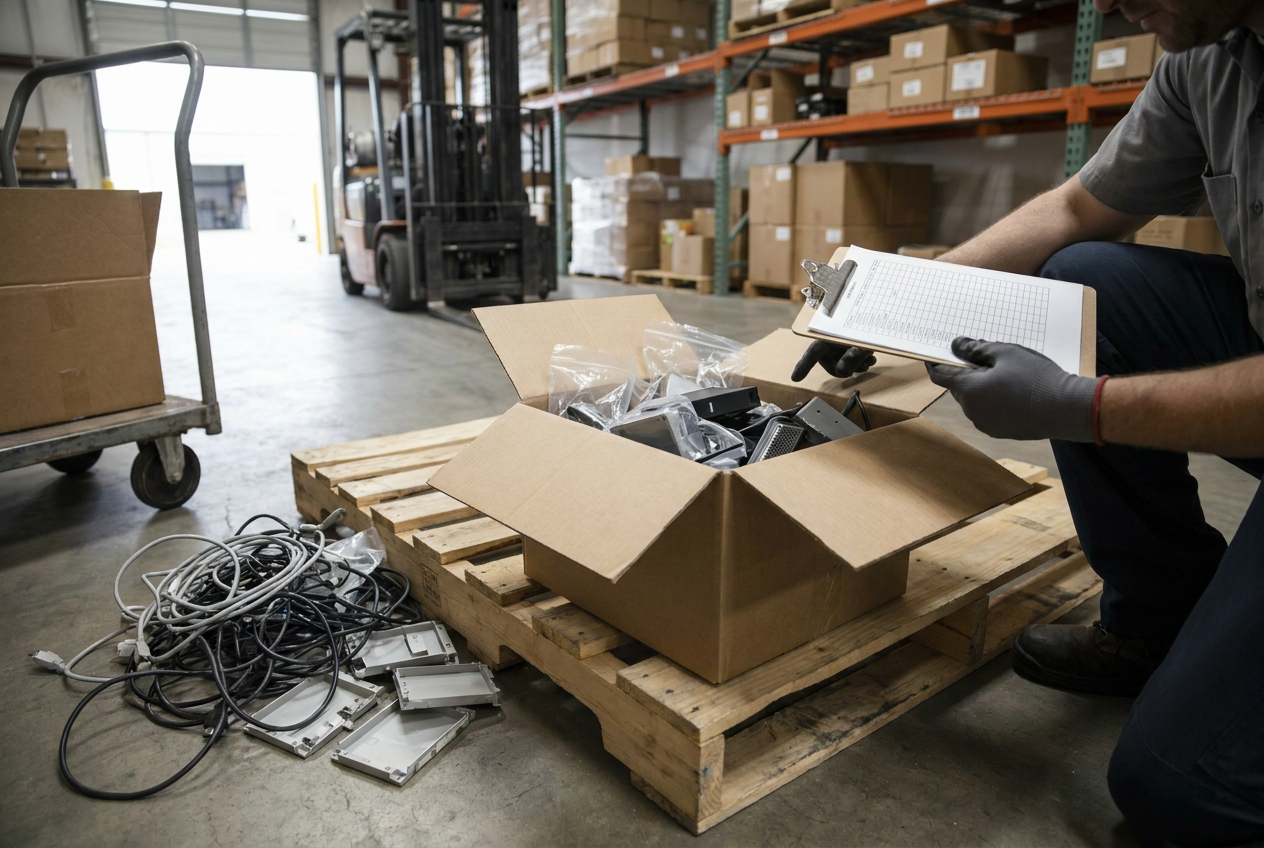
Evaluate missing accessories at both the unit level and the lot level. A reasonably priced replacement can still create an impractical project when multiplied across many different models.
Use this internal calculation:
Preparation cost per unit = allocated merchandise cost + replacement components + inbound parts costs + testing and cleaning labor + repackaging + applicable selling expenses.
For PalletCove orders, freight is included in the listed price. Do not add a separate delivery charge to the merchandise allocation. Costs associated with sourcing replacement components are a different purchasing decision.
| Decision | Evidence supporting it | Reasons to reconsider |
|---|---|---|
| --- | --- | --- |
| Source replacements | Exact part identified, available supply, practical test process | Backorders, revision uncertainty, costly labor |
| Sell incomplete | Safe, lawful sale with specific disclosure and suitable buyer demand | Missing safety components or misleading presentation |
| Use as a parts donor | Verified reusable components with traceable compatibility | Unknown condition or insufficient testing capacity |
| Skip the lot | Critical uncertainty exceeds your capacity or budget | Better documentation may change the assessment |
Set a maximum parts budget and a maximum sourcing time before buying. Include time spent identifying models, contacting suppliers, waiting for parts, and handling customer questions. Do not use the manifest’s retail reference figures as evidence of achievable resale prices.
Source a missing accessory only when you can verify the exact replacement, support a safe test process, and justify the total preparation effort—not merely because the main unit looks valuable.
An incomplete-item listing should name what is present, what is absent, and what was tested. “Untested” does not mean “working,” and “parts only” does not remove applicable product-safety obligations.
Match the load type to your verification capacity
A manifested liquidation pallet can support model-by-model review when its identifiers are detailed enough. Category-level inventory may provide only broad merchandise descriptions, leaving more of the component audit until after arrival. Neither format automatically establishes completeness.
A mixed pallet may require many separate sourcing decisions. A repeated-model lot can simplify parts identification, but one shared missing proprietary component can affect numerous units. A truckload magnifies both warehouse demands and the consequences of a mistaken compatibility assumption.
Compare the liquidation pallets hub, general merchandise inventory, and truckload inventory according to your storage, sorting, and testing capacity—not just item count.
For offers such as the Bulk Hamilton Beach Truckload, investigate appliance-model variation and removable food-contact components. For Home Depot Tool and Hardware Truckload inventory, distinguish bare tools from kits and verify batteries, chargers, guards, and attachment hardware. These are due-diligence questions, not statements about current contents or availability.
PalletCove is an independent reseller and is not affiliated with, endorsed by, or sponsored by any retailer named.
Ordering, payment, and free shipping
Before ordering, confirm the offered quantity, manifest version if provided, condition description, listed price, and any written clarification of accessory contents. Ask what information is unavailable as well as what has been verified.
PalletCove accepts credit/debit card, ACH bank transfer, and domestic bank wire. Handling takes 1–3 business days after payment clears. Transit from Dallas is typically 3–7 business days, separate from handling time.
Free shipping is the only delivery option on every order to all 48 contiguous states. Freight is included in the listed price. The same policy applies whether you are reviewing liquidation pallets in Texas or liquidation pallets in Florida.
A pallet shipment may move by LTL, while a truckload may occupy a full trailer. Confirm the receiving address, site access, appointment process, and unloading arrangements before dispatch. Review the shipping policy for the applicable delivery terms.
Sales tax on qualifying orders is covered by PalletCove. Confirm whether your order qualifies and whether a resale certificate or other documentation is needed; do not assume every transaction has identical documentation requirements.
Inspect delivery and preserve component evidence
Prepare a receiving area where loose components will not become separated from their cartons. Have the order documents, camera, labels, and a receiving log ready.
- Check shipment identity and count. Compare pallet or handling-unit counts with the delivery paperwork.
- Photograph before opening. Record wrap, carton condition, labels, and visible damage or disturbance.
- Document visible exceptions. Note observed shortages or damage accurately on the delivery record before signing where possible, following carrier procedures.
- Preserve packaging. Keep labels, wrapping, cartons, and packing materials while any discrepancy is reviewed.
- Audit contents after safe unloading. Match units to manifest lines and keep each item’s loose parts in a labeled container.
- Isolate questionable items. Do not power damaged electrical products or charge suspect batteries simply to complete a receiving checklist.
Keep carrier-level observations separate from the detailed merchandise audit. Intact wrapping does not prove accessory completeness, and a missing charger found during unpacking does not by itself establish transit loss.
Claims, returns, and avoidable mistakes
All PalletCove merchandise is sold as-is for resale. Do not assume missing accessories qualify for a return, replacement, credit, or other remedy. Read the refund policy before purchase and confirm applicable reporting procedures, deadlines, and evidence requirements.
If a discrepancy arises, report it promptly with the order number, affected manifest lines, photographs, counts, and the relevant written description. Distinguish documented contents that are absent from components that were never represented as included. Keep merchandise and packaging available while following the review instructions; submitting a claim does not guarantee approval.
Common mistakes include:
- Treating a product title or retail photograph as an included-components list.
- Assuming one brand uses interchangeable chargers, batteries, or lids.
- Buying replacement parts before checking whether the main unit functions.
- Mixing loose accessories across models without recording their origin.
- Ignoring labor and storage while waiting for scarce components.
- Describing an assembled kit as original when replacement components were substituted.
Frequently asked questions
Does a manifest guarantee that accessories are included?
No. A manifest may identify products and quantities without documenting components. Look for explicit contents statements and confirm how the seller uses kit descriptions and quantity fields.
Are overstock pallets always complete?
No. Overstock describes an inventory source or status, not a universal guarantee of completeness. Check package condition and the exact bundle identifier rather than relying on the label alone.
Can I use a universal charger or adapter?
Only when compatibility with the exact product is established through reliable specifications. Connector fit alone does not verify voltage, polarity, charging protocol, or safe operation.
Can incomplete items be resold without replacements?
Sometimes, provided the sale is lawful, the item is suitable for that sale, and the listing clearly discloses missing components and testing limits. Unsafe or recalled products require separate assessment; describing them as incomplete does not resolve those issues.
What if accessory information is unavailable before ordering?
Treat completeness as unverified and evaluate whether your operation can absorb the sourcing, testing, and storage uncertainty. If a critical proprietary component determines usability and its availability cannot be established, skipping the lot may be the more disciplined choice.
Talk to PalletCove Liquidation
Bring the listing, model identifiers, and your accessory checklist when you contact our order desk. Review current inventory and ask what documentation is available before committing to a pallet or truckload.
- Business: PalletCove Liquidation LLC
- Address: 4820 Cove Industrial Blvd, Dallas, TX 75236
- Phone: (713) 819-3904
- Email: sales@palletcoveliquidation.com
- Hours: Mon–Fri 8:00 AM – 6:00 PM CT, Sat 9:00 AM – 2:00 PM CT, Sun closed