
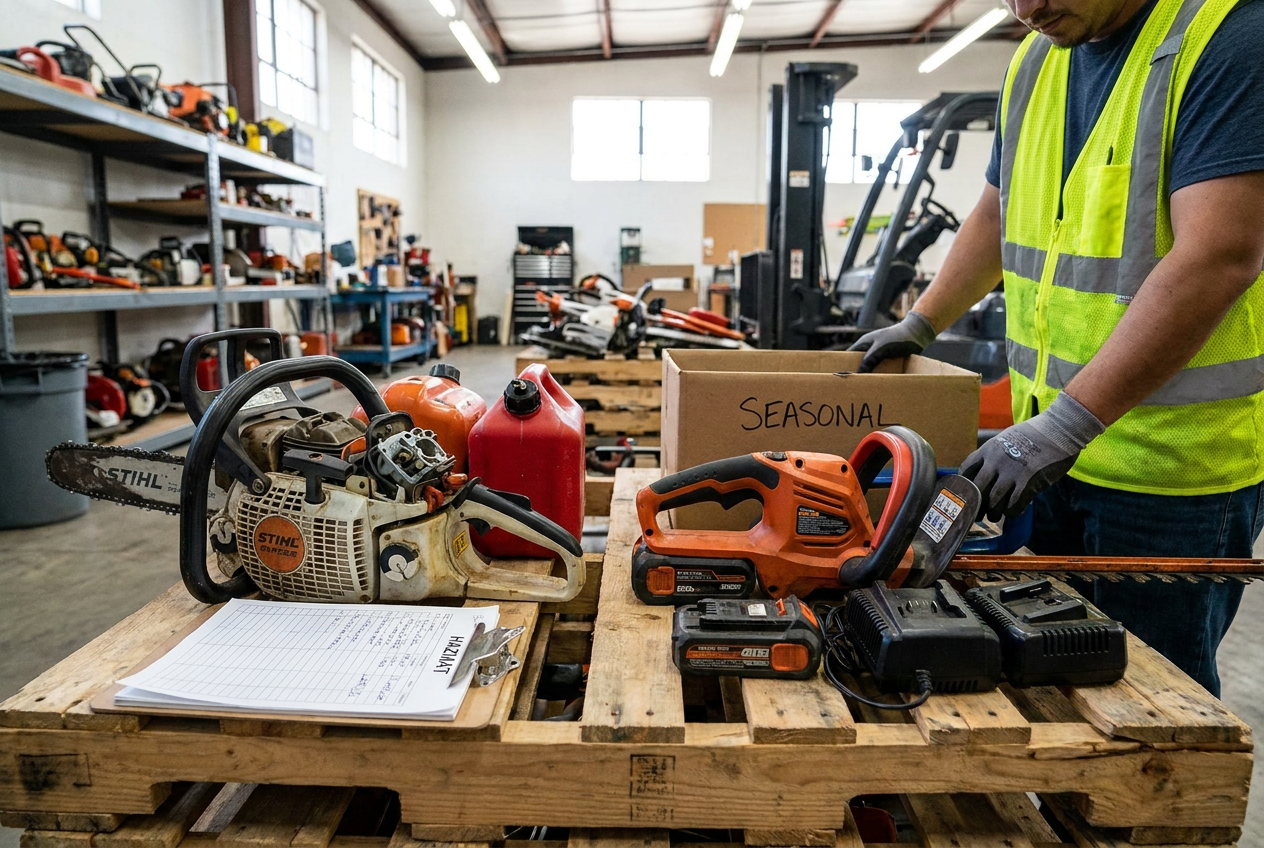
Outdoor power equipment liquidation can include mowers, string trimmers, blowers, chainsaws, pressure washers, and related accessories. For an independent reseller, the important question is not simply whether a machine looks repairable. It is whether you can diagnose it safely, source the correct components, document its condition, and sell it within a realistic seasonal window.
Gas-powered and battery-powered equipment create different uncertainties. A gas mower may need fuel-system work but have a serviceable engine; a cordless mower may look complete while lacking an expensive, model-specific battery. Neither power source is automatically the better buy.
PalletCove Liquidation supplies manifested and category-level liquidation pallets and full truckloads from Dallas, Texas. All merchandise is sold as-is for resale. This guide explains what to verify before ordering and how to separate repair candidates from equipment that belongs in a parts or disposal workflow.
Understand the load before evaluating the machines
A liquidation pallet is a consolidated lot offered for resale, not a promise that every item works. A truckload contains a larger shipment that may occupy a full trailer. Equipment can arrive mixed with hardware, accessories, or other merchandise, depending on the listing.
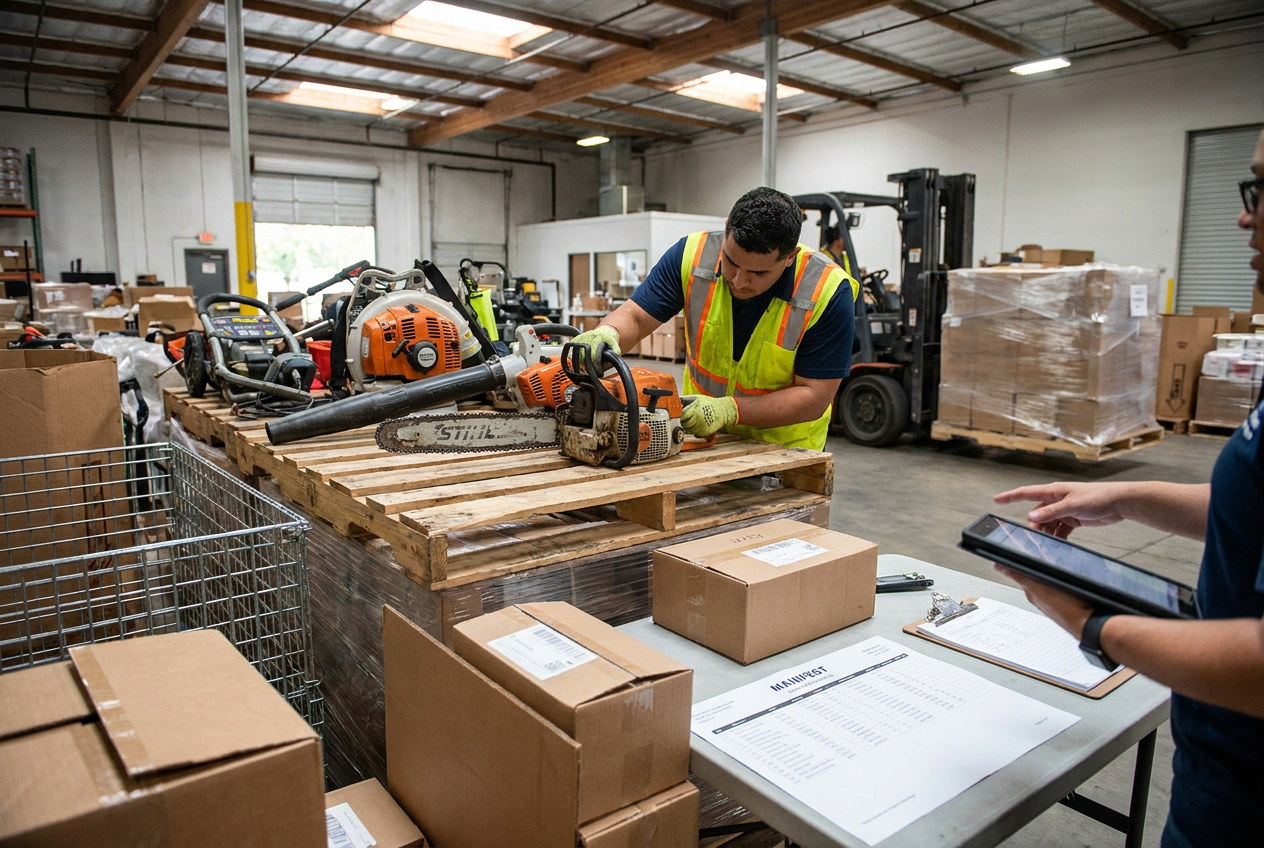
A manifested load has an itemized inventory reference. A category-level load identifies a merchandise category without necessarily providing an exact model-by-model breakdown. Neither description alone establishes tested functionality or completeness.
Start with the liquidation pallets hub and the guide to types of liquidation pallets. Buyers considering larger volumes should review buying liquidation truckloads, particularly before committing space and labor to bulky equipment.
Browse the Home Depot liquidation category and truckload inventory category as starting points, not as evidence of a specific equipment mix. Review the actual descriptions for HD GM Truckloads Pallets and the Home Depot Tool and Hardware Truckload; their names do not establish outdoor equipment quantities, testing, or included batteries.
PalletCove is an independent reseller and is not affiliated with, endorsed by, or sponsored by any retailer named.
Read condition grades and manifests critically
A condition grade is useful only when you know its definition. Industry terms are not universal testing standards, and a listing-specific description should take priority over assumptions.
- Overstock: Excess inventory; this does not independently prove working condition or complete accessories.
- Shelf pulls: Merchandise removed from selling space, potentially with handling wear or packaging changes.
- Customer returns: Previously purchased merchandise returned for reasons that may be unknown.
- Salvage: Equipment intended for substantial repair, component recovery, or another clearly disclosed non-working use.
- Untested: No confirmed operational result; it does not mean either working or defective.
Ask whether the manifest records manufacturer, exact model, quantity, power source, included accessories, and any test notes. Clarify whether a line represents a complete kit, a bare tool, or an accessory. Check whether photos show the actual lot or are representative.
For gas units, useful notes include cold-start behavior, running behavior, visible leaks, and mechanical damage. For cordless units, seek separate information about the tool, battery, and charger. A motor spinning briefly does not establish battery capacity, performance under load, or safe operation.
Keep the listing and manifest version associated with the order. An inventory reference cannot eliminate hidden defects, but it gives you a consistent basis for receiving and sorting.
Gas versus battery: match the repair to your capabilities
| Decision factor | Gas-powered equipment | Battery-powered equipment |
|---|---|---|
| --- | --- | --- |
| Diagnostic skills | Fuel, ignition, compression, and mechanical checks | Compatible power supply, contacts, controls, motor, and electronics checks |
| Common uncertainty | Storage history, stale fuel, internal engine wear | Battery health, charging faults, proprietary electronics |
| Missing components | Air box, fuel cap, recoil assembly, guards, attachments | Battery, charger, safety key, guards, attachments |
| Useful shop capability | Small-engine tools and manufacturer service information | Known-good compatible test equipment and electrical diagnostic skills |
| Strong reason to pass | Serious structural damage or repairs outside shop capability | Damaged battery, unavailable controller, or unsafe modifications |
When gas equipment fits your operation
Gas units may suit a reseller with small-engine experience and reliable parts sourcing. Troubleshooting should follow the manufacturer's service procedure, rather than replacing parts until a machine starts. Check oil condition and level where applicable, fuel-system integrity, safety controls, and the cutting or driven assembly before a starting attempt.
Do not assume every non-starting engine needs a carburetor cleaning. Low compression, impact damage, or a seized pressure-washer pump changes the repair decision. Two-stroke equipment also requires the correct fuel preparation specified for that model.
When battery equipment fits your operation
Cordless equipment can be easier to test when your shop already owns a manufacturer-approved battery and charger for the exact platform. Compatibility depends on the system and model, not voltage alone. Inspect housings, contacts, wiring, interlocks, and attachments before applying power.
A known-good battery can help distinguish tool faults from pack faults. However, rebuilding battery packs or bypassing protection circuits is not a routine reseller repair. Treat that work as outside scope unless performed by appropriately equipped specialists.
Repair only when you can identify the fault, obtain the correct parts, and verify safe operation without bypassing protective systems.
Price missing components before committing
A bare tool can be an intentional product configuration, not a defective return. The purchasing issue is whether the listing describes it accurately and whether your intended buyer needs a complete kit.
Record missing components by exact model:
- Batteries and chargers, including approved compatibility and replacement availability.
- Mower bags, discharge chutes, handles, knobs, and safety keys.
- Trimmer heads, guards, shafts, and approved cutting attachments.
- Chainsaw bars, chains, covers, and chain-brake components.
- Pressure-washer hoses, guns, nozzles, and connectors with suitable ratings.
Separate convenience accessories from safety-critical parts. Equipment should not be represented as ready to operate if a required guard or protective control is missing or defective. Do not improvise replacements simply because they physically fit.
For each candidate, obtain current parts pricing and availability before approving the repair. Unavailable parts can turn a modest-looking job into indefinite storage. Donor parts also require verified compatibility and inspection; cannibalizing one machine reduces the inventory available elsewhere.
Handle fuel and batteries as transport issues, too
Gas equipment may retain fuel or vapors even when a tank appears empty. Before moving or storing it, inspect for leaks and follow the manufacturer’s handling instructions. Do not drain fuel into improvised containers or dispose of it through drains or ordinary trash.
Any draining, purging, packaging, or shipment preparation must follow applicable transport rules and carrier requirements. An apparently empty tank is not proof that a machine is unrestricted freight. Keep equipment upright and secured where required, and disclose its condition accurately when arranging onward shipment.
Lithium-ion batteries introduce a different set of requirements. Classification, battery energy rating, condition, and whether the battery is shipped alone, packed with equipment, or installed can affect packaging, marking, documentation, and carrier acceptance. Damaged or defective batteries may face substantially different restrictions.
Do not charge packs showing swelling, impact damage, leakage, unusual heat, or compromised housings. Keep suspect equipment out of the normal testing workflow and obtain qualified handling guidance. For smoke, hissing, or active overheating, withdraw and contact emergency services rather than continuing inspection.
Review shipping liquidated lithium batteries before planning resale shipments. Included inbound freight does not remove your responsibilities when you later ship equipment to a customer.
Build a repair budget around seasonality
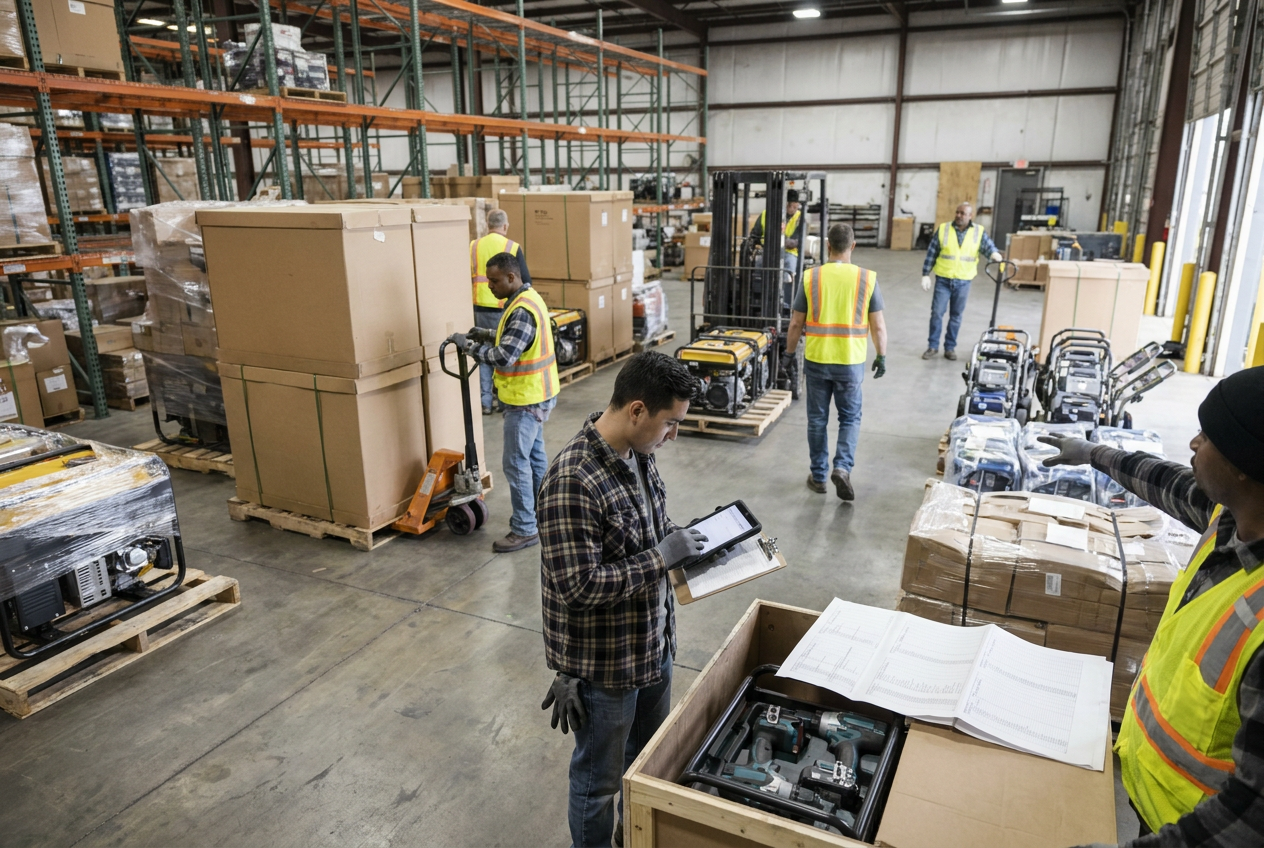
The listed load price is the purchase starting point, not the complete cost of making equipment sale-ready. Freight is included in PalletCove’s listed price. Allocate that purchase cost across the load using a consistent internal method, then track parts, labor, consumables, storage, testing, selling expenses, and lawful disposal separately.
Set a repair authorization limit before disassembly. A useful worksheet records:
- Exact model and initial condition.
- Diagnostic time allowed before reassessment.
- Confirmed fault and parts availability.
- Expected repair and verification labor.
- Missing-component costs and safety checks.
- Target listing date and fallback disposition.
Do not treat every manifest line as a saleable machine. Some items may become parts inventory or require disposal, and a repair estimate is not a profit forecast.
Seasonality is local. Mowing and trimming demand generally follows growing conditions, while leaf-clearing and snow-related equipment have different windows. Weather, storage space, and local buyer preferences matter more than a universal calendar.
Resellers exploring liquidation pallets in Texas and liquidation pallets in Ohio should build their own regional sales calendars. Buy only what your shop can inspect and prepare within a useful selling window; a repair backlog can absorb space long after the relevant season.
Order, receive, and document the shipment
Before payment, confirm the lot identifier, quantities described, manifest availability, condition language, included components, and delivery requirements. Review the liquidation purchase order terms guide for information worth recording in writing.
PalletCove accepts credit/debit card, ACH bank transfer, and domestic bank wire. Handling takes 1–3 business days after payment clears; transit is typically 3–7 business days from Dallas. These are separate stages, not a guaranteed arrival date.
Free shipping is the only delivery option on every order to all 48 contiguous states, and freight is included in the listed price. Read the shipping policy before ordering. Sales tax on qualifying orders is covered by PalletCove; ask what business information or resale certificate documentation is needed for your order.
A pallet shipment may travel by LTL, while a larger order may use a full trailer. Confirm the receiving location’s access, unloading arrangements, and available equipment before dispatch.
On delivery day:
- Compare visible pallet or handling-unit counts with the delivery paperwork.
- Photograph the load, labels, wrapping, and visible damage before unpacking.
- Note observable shortages or damage specifically on the delivery receipt where possible.
- Retain packaging and supporting documents while investigating discrepancies.
- Reconcile the contents with the order description and manifest before testing.
Do not rush to start engines or charge batteries on the receiving dock. Move accepted goods into a controlled inspection workflow first.
Understand claims and avoid expensive assumptions
All merchandise is sold as-is for resale. Read the refund and claims policy before paying to understand applicable eligibility, reporting procedures, deadlines, and required evidence. Do not assume a non-working customer return qualifies for a refund, replacement, or credit.
Distinguish expected merchandise-condition uncertainty from a shipment discrepancy or transit damage. Contact the order desk promptly with the order number, photographs, delivery documentation, and affected item identifiers. Neither a report nor a delivery notation guarantees a remedy; the applicable terms and facts govern review.
Common buying mistakes include treating a manifest as a test report, assuming batteries are included, using retail references as resale forecasts, and buying more repair work than the shop can process. Also check exact models against applicable recall information before resale. As-is purchasing does not remove a reseller’s safety obligations or justify inaccurate condition descriptions.
Frequently asked questions
Is gas or battery equipment better for a first liquidation purchase?
Choose the platform your shop can diagnose safely with tools and service information already available. Gas favors small-engine capability; cordless equipment favors access to compatible test batteries, chargers, and model-specific parts. Neither is automatically lower risk.
Does a manifest mean every machine is complete and working?
No. A manifest is an inventory reference unless it explicitly provides additional verified information. Read the listing’s condition definitions and ask what testing, if any, supports its descriptions.
Can I sell equipment without its battery or charger?
A bare tool may be saleable when its identity, condition, and missing components are clearly disclosed. Do not present it as a complete kit, and identify compatibility accurately without implying that any same-voltage battery will work.
Is shipping included for outdoor power equipment orders?
Yes. Free shipping is PalletCove’s only delivery option on every order to all 48 contiguous states, with freight included in the listed price. Handling is 1–3 business days after payment clears, followed by typical transit of 3–7 business days from Dallas.
What should make me pass on a repair?
Pass when you cannot diagnose the fault safely, obtain correct parts, or verify the finished machine’s safe operation. Structural damage, compromised battery packs, unavailable electronics, and repairs beyond your shop’s capabilities are strong reasons to stop and reassess disposition.
Talk to PalletCove Liquidation
Discuss the specific load before deciding whether it fits your repair bench, receiving setup, and seasonal plan. Ask about the available manifest, condition description, and component information rather than assuming every lot has the same contents.
PalletCove Liquidation LLC
4820 Cove Industrial Blvd, Dallas, TX 75236
Phone: (713) 819-3904
Email: sales@palletcoveliquidation.com
Hours: Mon–Fri 8:00 AM – 6:00 PM CT, Sat 9:00 AM – 2:00 PM CT, Sun closed.
For load-specific questions, contact our order desk or browse current inventory.