
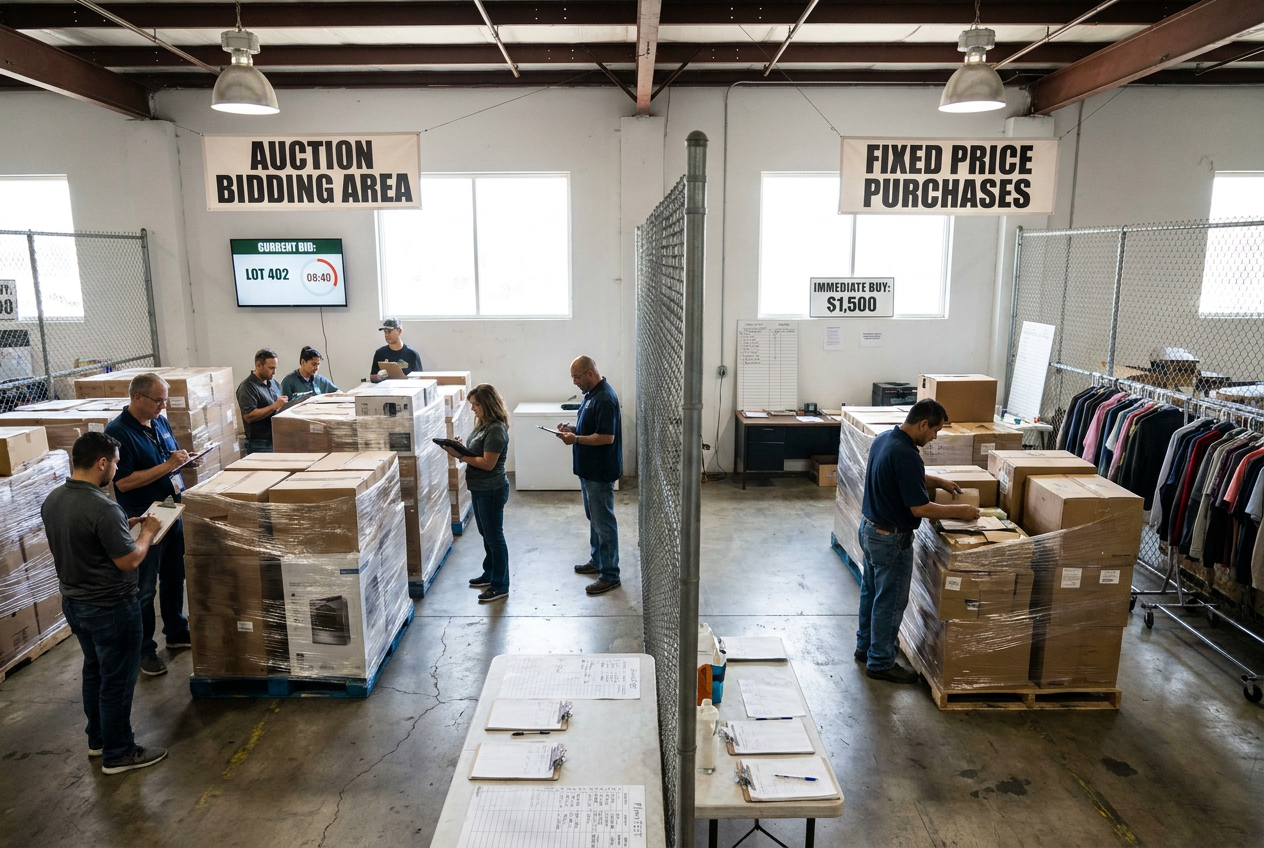
Choosing between liquidation auctions vs fixed price is a purchasing decision, not a shortcut to better merchandise. The buying format determines how the price is set, when you must commit funds and how certain you can be that you will secure a particular lot. It does not establish the condition or resale potential of its contents.
PalletCove Liquidation is a wholesale liquidation supplier in Dallas, Texas, selling manifested and category-level liquidation pallets and full truckloads to independent resellers. Whether you are stocking a bin store, selling online or supplying a local shop, compare the purchase terms and the inventory evidence separately.
This guide explains the two formats without assuming that every auction follows identical rules. Auction examples describe common marketplace practices, not a claim that PalletCove offers each bidding feature or charges a buyer premium.
How auctions and fixed-price buying differ
A liquidation auction invites buyers to bid on a defined lot during a stated period. The winning purchase price depends on the auction rules, competing bids and any reserve requirement. A fixed-price listing presents an asking price that a buyer can accept without competing through successive bids.
| Decision point | Liquidation auction | Fixed-price purchase |
|---|---|---|
| --- | --- | --- |
| Price formation | Bids establish the closing price | Seller states the purchase price |
| Purchase certainty | You can be outbid or fail to meet a reserve | No bidding contest, but availability and acceptance still matter |
| Timing | Closing time controls the bidding window | You can decide while the listing remains available |
| Buyer premium | May apply under the auction terms | Check the listed price and checkout terms |
| Payment deadline | Often tied to auction close or invoice issuance | Defined by checkout or invoice terms |
| Condition evidence | Depends on the lot description and manifest | Depends on the listing description and manifest |
An auction can suit a reseller with flexible sourcing and time to review closing rules. Fixed-price buying can suit someone who needs a defined purchasing amount before committing. Neither format removes the need to inspect the listing.
Choose the buying format for price control and scheduling; choose the merchandise from its manifest, condition description and fit with your operation.
Start with the liquidation pallets inventory hub to establish the size and type of purchase you actually need.
Bidding rules, premiums and purchase certainty
Read the rules before entering a bid
Auction rules are contractual terms, not interface details. Before bidding, establish:
- Whether bids are binding and whether withdrawals are permitted.
- The minimum starting bid and required bid increments.
- Whether a reserve price must be reached before the lot can sell.
- Whether proxy bidding automatically raises your bid up to a maximum.
- Whether late bids extend the closing time through a soft close.
- Whether the stated amount buys the entire lot or is multiplied by units or pallets.
- What event starts the payment deadline and what happens after nonpayment.
A displayed leading bid is not necessarily a completed purchase. You may be outbid, the reserve may remain unmet, or the seller may need to confirm the award under the stated terms.
Calculate the premium before choosing a ceiling
A buyer premium is an auction charge calculated according to the platform’s rules, often as a percentage of the winning bid. For illustration only, a $2,000 winning bid with a 10% buyer premium creates a $2,200 subtotal before any other applicable non-delivery amounts. That example is not a PalletCove fee schedule.
If your acquisition ceiling is $2,200 and the only addition is a 10% premium, your maximum bid is $2,000: divide the ceiling by 1.10. Do not enter your full spending ceiling as the bid and calculate the premium afterward.
Fixed-price buying avoids uncertainty about the winning bid, but a listing or cart should not be treated as an inventory reservation without confirmation. Verify the exact lot, availability and order acceptance before scheduling labor around it.

Compare load types, condition grades and manifests
A liquidation pallet is a palletized inventory lot. A truckload is a larger purchase whose pallet count, dimensions and trailer utilization should be confirmed from the listing. Do not assume that every truckload contains the same number of pallets or fills every available position in a full trailer.
A manifested load includes an inventory record, although its detail varies. A category-level load is described primarily by merchandise category rather than a complete item-by-item inventory. Either description can appear alongside mixed conditions; neither is itself a condition grade.
For scale and assortment planning, review the types of liquidation pallets and the truckload buying guide. Then compare general merchandise inventory with available truckload listings rather than assuming that two similarly priced loads are equivalent.
Interpret condition terms carefully
- Overstock: Excess inventory that did not sell through the original channel. Packaging and storage history still require attention.
- Shelf pulls: Merchandise removed from sales floors, potentially carrying labels, display wear or packaging damage.
- Customer returns: Items returned by customers for varied reasons. Functionality, completeness and prior use can differ within one lot.
- Salvage: Inventory that may require repair, parts recovery or recycling rather than ordinary resale.
Condition grades are not universal. One seller’s numbered tier may mean something different from another seller’s tier. Ask for the actual definition and whether testing was performed; untested does not mean functional.
Read the manifest as evidence, not a warranty
Look for item descriptions, identifiers, quantities, condition notes and whether quantities count individual pieces, cases or sets. Check for duplicate rows, missing accessories and distinctions between estimated and verified counts. Reference retail figures are not evidence of achievable resale prices.
For example, compare the current descriptions of the Amazon General Merchandise Truckload and the Macy’s Textile Truckload. Their product names alone do not establish current quantities, testing status or completeness. PalletCove is an independent reseller and is not affiliated with, endorsed by or sponsored by any retailer named.
Build a budget and choose the appropriate format
Separate the purchase amount from the work needed after arrival. A reseller may need funds for sorting, testing, cleaning, replacement packaging, storage, marketplace selling costs and responsible disposal. These operating needs exist even when the merchandise is inexpensive.
Use this sequence before bidding or checking out:
- Identify the sales channels that can handle the category and condition.
- Estimate how much inventory your team can process without creating a backlog.
- Set aside working capital for processing and ordinary business expenses.
- Establish a maximum acquisition amount independent of reference retail figures.
- Compare equivalent loads using the available descriptions, not price alone.
For PalletCove orders, freight is included in the listed price. Free shipping is the only delivery option on every order to all 48 contiguous states. Sales tax on qualifying orders is covered by PalletCove; verify qualification rather than assuming every order is treated identically.
An auction is more suitable when you can lose a lot and continue sourcing without disrupting operations. Fixed price is more suitable when a known purchase amount and a shorter decision process matter. Purchase certainty still depends on availability, confirmation and payment—not merely seeing a product online.
Ordering, payment deadlines and clearance
Before committing, save the listing, manifest version and written answers to material questions. Confirm the quantity being purchased, the condition description and the delivery address. A business name on an invoice does not replace accurate receiving details.
PalletCove accepts credit/debit card, ACH bank transfer and domestic bank wire. Review the payment policy and the deadline shown in your order documents. No universal auction payment deadline applies across sellers, and a specific PalletCove deadline should not be inferred from a general comparison article.
Ask whether an auction deadline is measured from closing, award notification or invoice issuance. Confirm the time zone and whether cleared funds, rather than payment initiation, are required by that deadline. Arrange funds before bidding instead of assuming there will be time to resolve a transfer problem afterward.
For PalletCove, handling takes 1–3 business days after payment clears. Sending a transfer is not necessarily the same as funds clearing, so do not calculate shipment timing from the moment you submit payment.
If you use a resale certificate, provide accurate, current documentation when requested and confirm any requirements before checkout. Keep the order confirmation, payment record and tax documentation together for bookkeeping.
Free shipping and delivery-day inspection
PalletCove ships from Dallas with handling of 1–3 business days after cleared payment; transit is typically 3–7 business days from Dallas. Handling and transit are separate stages, and typical transit is not a guaranteed arrival appointment. See the shipping policy before planning your receiving schedule.
The same free-shipping delivery model applies to liquidation pallets in Texas and liquidation pallets in Florida, as well as the other contiguous states. The service area does not include Alaska or Hawaii.
A pallet shipment may travel as LTL, or less-than-truckload freight, while a larger order may require a full trailer. Confirm the shipment configuration and the receiving setup needed for your location. Provide a reachable contact and ensure the receiving area, unloading equipment and staff are ready.

At delivery:
- Match the shipment identifiers and visible pallet count to the receiving documents.
- Inspect accessible wrap, cartons and pallets for visible damage or disturbance.
- Photograph the load before unloading or breaking down the packaging when practical.
- Record specific visible damage or shortages on the delivery receipt before signing.
- Keep copies of the receipt and preserve relevant packaging and labels.
- Reconcile the contents against the listing and manifest during controlled unpacking.
A delivery receipt records what was observable at handoff; it does not establish that every enclosed item works. Use the liquidation pallet inspection guide to organize the later item-level checks.
As-is sales, claims and common mistakes
All PalletCove merchandise is sold as-is for resale. Do not interpret an auction win, fixed-price purchase or manifest as a promise of profit, resale value or guaranteed condition.
Read the refund and claims policy before buying. Do not assume that customer-return merchandise can itself be returned to the liquidation seller because you dislike the assortment or discover ordinary condition variability. Any claim eligibility, reporting deadline and remedy depend on the applicable terms and documented circumstances.
If an issue arises, separate visible transit damage, a possible shipment shortage and an alleged listing discrepancy. Report the order number, affected items or pallets, photographs and a factual description promptly. Preserve evidence and follow the policy’s instructions; documentation does not automatically establish entitlement to a refund or replacement.
Common buying mistakes include chasing a bid beyond a preset ceiling, overlooking a premium, treating stock photographs as exact-lot evidence and assuming a condition grade is standardized. Others include confusing payment submission with clearance, planning around an unconfirmed arrival date and buying more inventory than the receiving team can process. Each mistake is avoidable before the purchase becomes binding.
Frequently asked questions
Are liquidation auctions always cheaper than fixed-price lots?
No. Competing bids and a buyer premium can change the final acquisition amount. Compare similar quantities, condition descriptions and manifest detail rather than treating a low opening bid as the purchase price.
Does a fixed price guarantee that I will receive the lot?
A fixed price removes competitive bidding, not every availability or fulfillment contingency. Confirm order acceptance and payment requirements before treating inventory as secured.
Does a manifest guarantee working merchandise?
No. A manifest records inventory information at the level described by the seller; it is not automatically a testing report or condition guarantee. Check the listing’s testing disclosures and remember that PalletCove merchandise is sold as-is for resale.
What are PalletCove’s shipping and payment options?
Free shipping is the only delivery option on every order to all 48 contiguous states, with freight included in the listed price. Payment methods are credit/debit card, ACH bank transfer and domestic bank wire. Handling is 1–3 business days after payment clears, followed by typical transit of 3–7 business days from Dallas.
Should a first-time reseller buy a pallet or truckload?
Choose according to receiving capacity, working capital and processing experience rather than the buying format alone. A smaller purchase limits the amount of inventory you must sort at once, while a truckload requires more space and operational planning. Neither size guarantees a particular outcome.
Talk to PalletCove Liquidation
Before committing, ask about the current listing, manifest availability, condition definitions and receiving requirements. Compare those answers with your budget and processing capacity, then contact our order desk or review current inventory.
PalletCove Liquidation LLC
- Address: 4820 Cove Industrial Blvd, Dallas, TX 75236
- Phone: (713) 819-3904
- Email: sales@palletcoveliquidation.com
- Hours: Mon–Fri 8:00 AM – 6:00 PM CT, Sat 9:00 AM – 2:00 PM CT, Sun closed