

A liquidation purchase has more than one cost number. The listed price tells you what you pay for the lot; your cost floor also depends on how many units you can sell, the work required to prepare them and the deductions taken when an order closes.
A liquidation inventory break even worksheet organizes those costs without forecasting resale prices or profits. Its purpose is to identify the revenue needed to recover a defined set of expenses—not to claim that buyers will pay that amount.
For PalletCove Liquidation orders, the starting point is straightforward: free shipping is the only delivery option on every order to all 48 contiguous states, and freight is included in the listed price. Keep that fact separate from your own testing, storage, fulfillment and labor costs.
What liquidation inventory break even actually measures
Break-even occurs when revenue retained after selling deductions equals the costs assigned to the inventory. A cost floor is therefore a recovery threshold, not an appraisal, recommended listing price or promise of demand.
Use two views:
- Cash-cost floor: acquisition and other out-of-pocket expenses attributable to the lot.
- Operating-cost floor: cash costs plus owner labor and a consistent share of overhead, such as storage and equipment use.
An unpaid hour still consumes capacity. Showing owner labor separately makes the worksheet useful without confusing it with a cash payment. If staff wages already appear in labor, do not include the same wages again in overhead.
Before any sales occur, this calculation is provisional because quantities and processing costs remain uncertain. After inspection and testing, replace assumptions with actual counts and logged expenses. After sales, reconcile actual receipts, refunds and platform deductions.
Your cost floor tells you what the inventory must recover under stated assumptions; it does not tell you what the inventory is worth in the resale market.
Match the worksheet to the load and condition
A single liquidation pallet and a full truckload use the same arithmetic, but they create different counting, handling and storage workloads. Start with the liquidation pallets hub and the guide to liquidation pallet types to distinguish purchase formats.
Manifested versus category-level inventory
A manifest may identify descriptions, quantities, model numbers, identifiers and condition information. Check which fields are actually provided and whether counts describe individual pieces, sets, cartons or another unit. A listed retail reference is not a recoverable-cost figure or evidence of a future selling price.
Category-level inventory describes a merchandise group without necessarily providing item-level detail. Leave unknown quantities marked as unknown rather than treating every piece as sellable. Compare the scope of general merchandise liquidation with liquidation truckloads, then evaluate the specific listing.
For example, the Bulk Hamilton Beach Truckload listing and Shoes Truckload listing require different intake questions. Appliances may need functional checks and accessory verification; footwear may require pair matching, size recording and inspection. Confirm current listing details rather than inferring condition or quantity from a title.
Condition grades are inputs, not guarantees
Common industry descriptions include:
- Overstock: excess inventory; inspect packaging, completeness and storage-related issues.
- Shelf pulls: merchandise removed from selling displays or shelves, potentially with labels or packaging wear.
- Customer returns: goods returned by buyers, with potentially varied use, completeness and functionality.
- Salvage: inventory that may require repair, parts recovery or disposal rather than ordinary resale.
Grade names and tier labels are not universal standards. Ask what the particular condition grade means for that listing. All PalletCove merchandise is sold as-is for resale; no grade should replace your own inspection and testing.
PalletCove is an independent reseller and is not affiliated with, endorsed by or sponsored by any retailer named.
Build a worksheet with a clear cost boundary
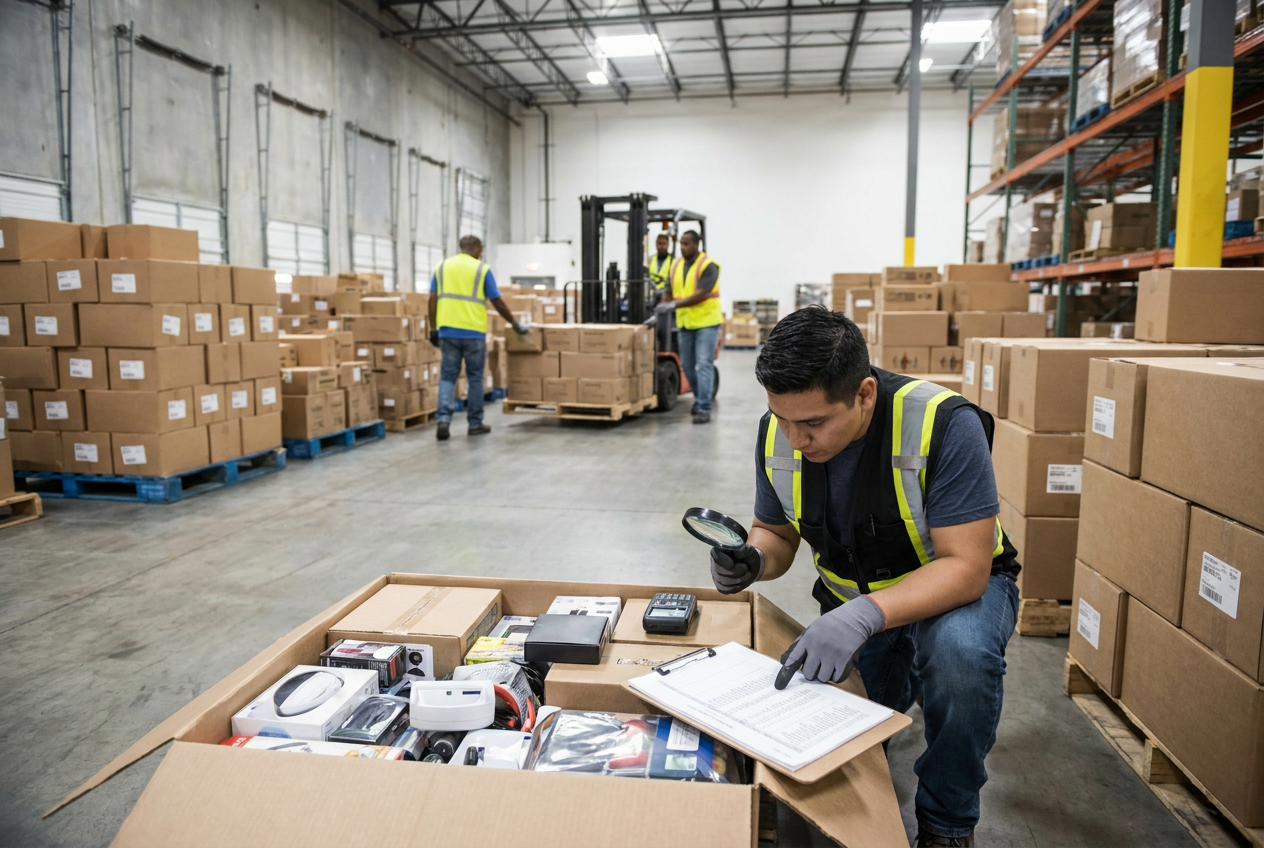
Create one worksheet per lot, with purchase reference, receipt date, manifest version and the period being measured. Maintain supporting receipts and time logs. The mixed-lot inventory cost allocation guide can help when one purchase contains dissimilar categories.
| Worksheet line | What to enter | Counting rule |
|---|---|---|
| --- | --- | --- |
| Acquisition, A | Actual listed purchase amount paid | Includes inbound freight for PalletCove orders |
| Separate inbound freight | $0 additional | Do not duplicate freight already included |
| Purchase sales tax | Actual amount paid, if any | PalletCove covers sales tax on qualifying orders |
| Intake and testing | Consumables and outside testing expense | Put testing time in labor |
| Repairs and preparation | Authorized parts, cleaning and replacement packaging | Track actual spending by item where practical |
| Labor | Hours multiplied by your chosen hourly cost | Separate paid staff and owner time |
| Storage and overhead | Documented allocation for a defined period | Avoid counting expenses already assigned elsewhere |
| Disposal | Actual recycling or disposal expense | Do not assume unusable goods have recovery value |
| Selling costs | Platform, payment, packaging and fulfillment costs | Separate fixed and percentage-based amounts |
| Net sellable units, S | Verified units available for sale | Exclude incomplete, unsafe or otherwise unsellable units |
Use C for the total lot cost before transaction-dependent selling costs. Acquisition, processing, labor and allocated overhead belong in C. A selling expense already included in C must not also be deducted per order.
Record received, inspected, sellable, pending and unsellable counts separately. Pending units are not confirmed sellable stock. If two pieces form one complete saleable set, count one selling unit, not two.
The basic pre-selling-cost floor is:
Cost per sellable unit = C ÷ S
When S is zero, there is no meaningful per-unit floor. Investigate disposition options without assigning speculative proceeds to them. If quantities remain unknown, show explicitly labeled quantity scenarios rather than presenting one count as fact.
Work through a cost-only example
The following figures are illustrative worksheet inputs, not PalletCove prices, condition rates or resale forecasts.
Assume a reseller records:
- Listed lot price, with freight included: $2,400.
- Testing supplies: $90.
- Cleaning and preparation materials: $60.
- Labor: 18 hours × $20 = $360.
- Allocated storage for the measured period: $100.
- Disposal expense: $50.
The total cost pool is $3,060. This example has no separately paid purchase sales tax; use the actual treatment shown on your order.
Inspection identifies 120 received units, of which 24 are unsellable and 96 are sellable. The pre-selling-cost floor is therefore:
$3,060 ÷ 96 = $31.875, or approximately $31.88 per sellable unit.
Dividing by all 120 received units would produce $25.50, understating the amount each sellable unit must recover. The cost of unsellable merchandise remains within the acquisition pool; do not add its acquisition cost a second time as another expense.
The $31.88 figure is only a blended allocation. It does not establish identical value for different products. For mixed inventory, assign directly traceable repair and testing costs to specific items, then allocate shared costs consistently by a documented driver such as unit count, handling time or storage usage. Subgroup allocations must add back to the original total.

Add marketplace fees without predicting selling prices
Percentage-based marketplace fees depend on transaction revenue, so adding a flat estimate to every unit can obscure the calculation. Instead, solve for the gross revenue required to leave enough after deductions.
For a simplified channel model, define:
- C: cost pool before selling costs.
- S: number of sellable units included in the recovery calculation.
- f: combined proportional fee rate, expressed as a decimal.
- k: fixed selling and fulfillment cost per unit, assuming one unit per order.
Then:
Required gross revenue per unit = (C ÷ S + k) ÷ (1 − f)
Using the example, suppose an illustrative fee structure deducts 12% of gross revenue and fixed selling costs total $4 per unit. The threshold is ($31.875 + $4) ÷ 0.88 = approximately $40.77. That number is a mathematical recovery requirement, not a prediction that an item can sell for $40.77.
Check the marketplace’s actual fee schedule. Charges can vary by category, subscription, order value and the amount on which fees are assessed. Fees assessed on buyer-paid shipping or collected tax require those bases to be modeled correctly. Taxes collected for remittance are not inventory revenue.
For multiple units per order, track fixed fees by order rather than automatically charging each unit. Include your own outbound postage, packaging and fulfillment labor where applicable; PalletCove’s included inbound freight does not cover your later shipments to customers.
The formula assumes the modeled units sell and costs remain unchanged. Unsold stock means the lot may remain unrecovered. After transactions occur, use actual net receipts and revise for refunds, returns processing and additional storage instead of assuming recovery is complete.
Order, receive and document the inventory
Before ordering, reconcile the listing description, available manifest, condition information, quantity basis and your processing capacity. Use the liquidation pallet buying guide for purchase preparation, and verify whether a larger purchase requires an LTL receiving plan or a full trailer unloading plan.
PalletCove accepts credit/debit card, ACH bank transfer and domestic bank wire. Handling takes 1–3 business days after payment clears; transit is typically 3–7 business days from Dallas. These are separate stages, so do not treat transit time as the complete order timeline.
Free shipping is the only delivery option for every order to all 48 contiguous states. Buyers researching liquidation pallets in Texas or liquidation pallets in Florida use the same included-freight acquisition approach. Review the shipping policy and confirm receiving requirements before scheduling staff.
Sales tax on qualifying orders is covered by PalletCove. Ask which documentation applies to your order and whether a resale certificate is needed; do not assume qualifying treatment without confirmation or add covered tax as an expense.
Delivery-day inspection and claims
- Match shipment identifiers and visible pallet or carton counts to delivery paperwork.
- Photograph the load, wrapping and visible damage before unloading or disturbing packaging, when safe.
- Record observable shortages or damage on delivery paperwork and retain a copy.
- Reconcile received merchandise against the available manifest during intake.
- Preserve labels, packaging, photographs and affected items while seeking instructions.
Delivery documentation records transport observations; it does not establish functionality. Test separately, quarantine unsafe items and check applicable resale restrictions or recalls before listing goods.
Read the returns and claims policy before purchasing. All merchandise is as-is for resale, so do not assume ordinary retail returns, warranty coverage or an automatic credit. Ask the order desk about applicable reporting deadlines, evidence and available remedies; do not subtract a requested claim from your cost pool until its resolution is confirmed.
Common mistakes that distort the cost floor
- Using manifest retail totals as revenue. Descriptive reference values do not establish realizable proceeds.
- Double-counting freight. PalletCove’s listed price already includes it.
- Treating every received piece as sellable. Verify completeness, safety and function first.
- Ignoring owner labor. Maintain both cash and operating views if needed.
- Mixing fee bases. A percentage of gross sales is not the same as a percentage of net receipts.
- Allocating away difficult inventory. Shared costs must remain fully accounted for across the lot.
- Stopping the clock too early. Update storage, repeat testing, returns and disposal through the measured period.
Keep original assumptions beside revised actuals. That audit trail reveals whether cost changes came from quantity, processing time or selling deductions without relying on a price forecast.
Frequently asked questions
Is break-even the same as my listing price?
No. Break-even is the revenue threshold required to recover specified costs under stated assumptions. Your worksheet does not establish market demand or guarantee a sale at that amount.
How do I calculate break-even without a manifest?
Start with known acquisition costs and label quantities as unverified. Use clearly marked scenarios for planning, then calculate a verified per-unit floor after counting and testing category-level inventory.
Should unsellable units carry any cost?
Their acquisition cost remains part of the lot’s total cost pool. Spread the recovery requirement across sellable units, add actual disposal expenses and record any later recovery only when realized.
Do I add inbound freight to a PalletCove order?
No additional inbound freight amount is needed: freight is included in the listed price. Free shipping is the only delivery option on every order to all 48 contiguous states.
Can I exclude labor from the worksheet?
You can show a cash-only view, but label it clearly and distinguish unpaid owner time from paid labor. An operating-cost view should also include owner time at a documented rate so processing requirements remain visible.
Talk to PalletCove Liquidation
For listing details, available manifest information and order questions, contact our order desk or review current inventory. Confirm the facts of the specific lot before completing your cost worksheet.
PalletCove Liquidation LLC
- Address: 4820 Cove Industrial Blvd, Dallas, TX 75236
- Phone: (713) 819-3904
- Email: sales@palletcoveliquidation.com
- Hours: Mon–Fri 8:00 AM – 6:00 PM CT, Sat 9:00 AM – 2:00 PM CT, Sun closed