
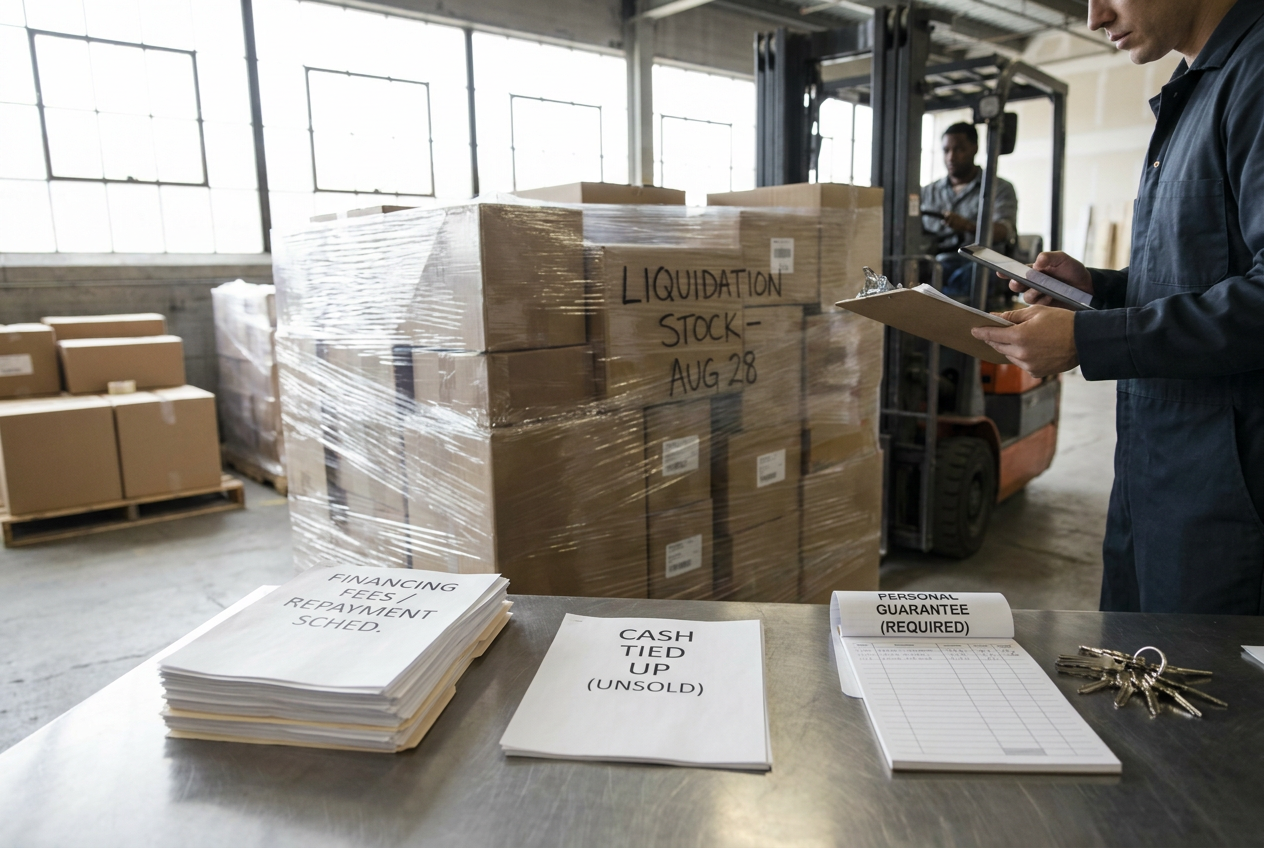
Liquidation inventory financing lets a reseller purchase stock using borrowed funds rather than paying entirely from existing cash. It can preserve working capital, but it also creates repayment obligations before merchandise is necessarily inspected, listed or sold. The useful comparison is not simply which lender offers the lowest advertised rate; it is which obligation your business can carry if sales arrive late.
For a liquidation pallet or full truckload, borrowing costs interact with uncertain quantities, condition grades, missing parts and selling time. A purchase that appears affordable at checkout can strain cash flow once sorting, storage and repayments overlap. Financing does not establish resale value or make a load suitable for your operation.
PalletCove Liquidation supplies manifested and category-level inventory from Dallas, Texas. This guide separates the inventory purchase from the borrowing decision and explains how to compare both without assuming that debt guarantees a successful purchase.
What liquidation inventory financing actually covers
Inventory financing can mean a loan secured by stock, a business line of credit, a term loan used to buy merchandise or a credit-card balance. Some products marketed to resellers are broader working-capital arrangements rather than inventory-specific loans. Their pricing, collection methods and legal terms can differ substantially.
A lender may advance funds to your business, after which you pay the supplier through an accepted method. Do not assume supplier payment acceptance means the supplier provides credit, endorses a lender or offers installment terms. This article does not establish a PalletCove financing program.
Start with the liquidation buying overview if you are new to secondary-market merchandise, then use the liquidation pallets inventory hub to understand the purchasing format you are considering.
The safest financing comparison starts with repayment capacity if the load sells slowly—not with an optimistic estimate of what everything might sell for.
Compare fees, repayment schedules and guarantees
Ask each provider for a written proposal using the same funding amount and expected payoff date. Compare net usable proceeds, total scheduled repayment and every mandatory charge. A low headline rate can obscure an upfront deduction or an aggressive collection schedule.
| Funding structure | Costs to examine | Repayment timing | Security and personal exposure |
|---|---|---|---|
| --- | --- | --- | --- |
| Business credit card | Purchase APR, annual fee, late fees and promotional expiration | Monthly minimums; carrying balances can extend interest costs | Personal guarantees are common; verify the agreement |
| Business line of credit | Interest, draw fees, maintenance fees and renewal costs | Monthly or more frequent payments; maturity may require payoff | May involve a personal guarantee and business-asset lien |
| Term loan | Interest, origination charges and prepayment terms | Fixed installments beginning on the contractual date | Collateral and guarantees vary by lender |
| Inventory-secured facility | Interest, appraisal or audit costs and reporting fees | Payments plus borrowing-base reviews | Eligible stock may secure the loan; guarantees can also apply |
| Revenue-based advance | Fixed repayment amount, collection charges and reconciliation terms | Often daily or weekly collections | Guarantees, liens and default provisions depend on the contract |
A factor rate is not an annual percentage rate. For example, a hypothetical $10,000 advance with a 1.25 factor requires $12,500 in repayment before any additional charges. Its annualized cost depends on repayment timing; it should not be described as a 25% APR.
For a simple loan with no interim principal payments, $10,000 at 18% annual simple interest for 90 days would generate about $444 in interest using a 365-day year. A separate $300 origination charge brings that illustrative borrowing cost to about $744. Actual amortization, accrual conventions and fees can change the result.
Read beyond the rate
- Confirm whether fees reduce the cash disbursed or are added to the balance.
- Ask whether early payoff reduces interest or leaves a fixed charge unchanged.
- Check variable-rate adjustments, default rates and automatic-debit authorization.
- Identify collateral, any UCC lien and restrictions on obtaining other financing.
- Read personal-guarantee language, including any continuing liability after the business closes.
A personal guarantee can make an owner responsible for covered business debt. An LLC does not erase a signed personal guarantee. Have a qualified adviser review terms you do not understand.

Measure the cash gap before borrowing
Your cash-conversion cycle starts when money leaves the business and ends when usable sales proceeds arrive. Between those points are payment clearance, handling, transit, receiving, inspection, testing, listing, selling and marketplace settlement. Repayments may begin before that sequence is complete.
For PalletCove orders, handling takes 1–3 business days after payment clears. Transit is typically 3–7 business days from Dallas. Treat those as planning inputs, not a guaranteed date when inventory will be ready to sell.
Build a weekly cash forecast with three scenarios: expected sales, slower sales and no sales during the first repayment period. Include:
- Opening cash and the loan's net proceeds.
- Inventory payment and scheduled debt payments.
- Sorting labor, testing supplies, repair parts and packaging.
- Storage, selling-platform fees and customer-return reserves.
- The delay between a sale and funds becoming available.
A useful planning measure is the peak funding gap: the largest cumulative cash shortfall before available sales proceeds catch up with outflows. Keep an operating reserve beyond that gap instead of spending every available dollar on stock.
Suppose a hypothetical load costs $8,000 and preparation requires another $1,000. If $2,000 of the acquisition cost remains allocated to unsold merchandise after 60 days, that cash has not returned simply because other items sold. An inventory ledger is not a bank balance, and unsold units may eventually require markdowns, repair or disposal.
Match financing to the load and its condition
A smaller liquidation pallet can limit the amount exposed to one purchase. A full trailer requires more receiving space, sorting capacity and cash, even if a quoted unit cost appears attractive. Consult the guide to buying liquidation truckloads before financing a quantity your team has not processed before.
A manifested load includes an itemized inventory record, but the fields and level of detail vary. Request the applicable manifest and clarify whether counts, descriptions and condition notes are verified, estimated or otherwise qualified. Listed retail references are not evidence of achievable selling prices.
Category-level loads describe a merchandise grouping without necessarily providing an item-by-item list. Their cash-flow forecasts should reflect greater uncertainty about the mix. Compare general merchandise inventory with truckload inventory listings based on handling requirements, not just the purchase amount.
Condition grades affect work and timing
There is no single universal grading system across liquidation suppliers. Use the specific listing's definitions rather than assuming a familiar label means the same thing everywhere.
- Overstock: Excess inventory; verify packaging, age and any stated inspection limits.
- Shelf pulls: Items removed from selling displays or shelves; packaging and labels may vary.
- Customer returns: Previously returned merchandise that may need testing, cleaning or parts checks.
- Salvage: Inventory that may require repair, parts harvesting or disposal rather than ordinary resale.
All PalletCove merchandise is sold as-is for resale. A condition grade does not guarantee every item's condition, functionality, completeness or resale value.
For specific comparisons, review the current details of the Amazon General Merchandise Truckload and Shoes Truckload. Do not infer piece counts, brands, sizes or condition from a product name alone. PalletCove is an independent reseller and is not affiliated with, endorsed by or sponsored by any retailer named.
Some lenders exclude salvage, aged stock or difficult-to-value goods from eligible collateral. Others reduce borrowing availability as stock ages. Confirm how the lender values liquidation inventory before relying on it to support a credit line.
Price, order and pay without hidden assumptions
PalletCove's listed price includes freight. Free shipping is the only delivery option on every order to all 48 contiguous states. Sales tax on qualifying orders is covered by PalletCove; confirm eligibility rather than applying that statement to every transaction.
Whether researching liquidation pallets in Texas or liquidation pallets in Florida, use the same included-freight pricing rule. Financing expenses are separate obligations under your agreement with the funding provider, not evidence of additional supplier payment terms.
Use this ordering sequence:
- Confirm the listing, availability, load format, condition description and manifest status.
- Review receiving requirements and your ability to unload and store the shipment.
- Confirm the final order amount and whether sales-tax coverage applies.
- Obtain financing disclosures and verify that net proceeds cover the planned payment.
- Pay using credit/debit card, ACH bank transfer or domestic bank wire.
- Retain the order confirmation, listing details, manifest and payment records.
Those are PalletCove's accepted payment methods; consult the payment policy before arranging payment. Debit-card payments use available funds rather than creating credit. ACH and domestic bank wire describe how money moves, not whether its source is borrowed.
A resale certificate documents qualifying resale purchases under applicable rules; it is not financing approval. Ask what documentation is needed for your order and keep appropriate tax records.
Plan receiving, inspection and claims before repayment starts
A pallet shipment may move through an LTL network, while a truckload may occupy a full trailer. Confirm the actual shipment arrangement and receiving instructions for your order. Ensure the receiving team, space and unloading equipment are ready; review the shipping policy for applicable requirements.
On delivery day:
- Compare shipment identifiers and the visible pallet or package count with the delivery documents.
- Photograph the load, wrapping, labels and visible damage before disturbing it, where safe.
- Record visible shortages or damage accurately on the delivery paperwork before signing.
- Save relevant packaging and reconcile the inventory against any applicable manifest.
- Report concerns promptly with the order number, photographs and supporting records.
Visible delivery damage and an item's underlying liquidation condition are different issues. A signed receipt does not establish that every unit functions, and an as-is purchase should not be treated like ordinary retail inventory with routine returns.
Read the refund and claims policy before payment for applicable eligibility, deadlines and procedures. Do not assume a return, refund, replacement or claim approval is available. A pending claim does not automatically suspend your lender's repayment schedule.

Common financing mistakes to avoid
Borrowing against retail references. Base forecasts on your own relevant sales history and conservative assumptions, not a manifest's retail column. Deduct selling expenses before estimating cash available for debt service.
Ignoring preparation bottlenecks. A backlog of untested goods delays receipts while debt continues. The guide to missing accessories in liquidation lots can help you evaluate whether sourcing parts is practical.
Comparing payments instead of total cost. Smaller installments may last longer and cost more. Compare both the payment burden and total dollars repaid over the same expected holding period.
Financing a larger load just because credit is available. A lender's approval is not an assessment of your merchandising skills, warehouse capacity or demand. Reduce purchase size when your downside forecast cannot support repayments.
Treating repeated refinancing as a sales strategy. Rolling debt forward can increase costs while the same slow stock remains unsold. Establish review dates and a plan for markdowns, alternative sales channels or disposal without assuming those actions will recover the purchase cost.
Frequently asked questions
Does PalletCove offer liquidation inventory financing?
This guide does not announce a PalletCove loan or installment program. Accepted payment methods are credit/debit card, ACH bank transfer and domestic bank wire; any outside borrowing requires its own agreement.
Which financing option has the lowest real cost?
There is no universally cheapest option. Compare net proceeds, total repayment, fees, payment frequency and early-payoff terms using the same purchase amount and realistic payoff date.
Can I finance customer returns or salvage?
Eligibility depends on the lender and its collateral rules. Customer returns and salvage can be difficult to value, so confirm eligibility and valuation deductions before committing to an order.
Is shipping included when I buy with borrowed funds?
Yes. Freight is included in PalletCove's listed price, and free shipping is the only delivery option on every order to all 48 contiguous states, regardless of whether your payment funds were borrowed.
What happens if the inventory does not sell?
Repayment obligations generally continue according to the financing contract even when stock remains unsold. Budget for slower sales, ongoing storage and possible disposition costs before borrowing, and contact your lender early if payment difficulty develops.
Talk to PalletCove Liquidation
Ask about the current listing, available manifest, condition description and receiving requirements before committing funds. PalletCove can address order details; your financing provider must explain borrowing costs, collateral and personal guarantees.
PalletCove Liquidation LLC
4820 Cove Industrial Blvd, Dallas, TX 75236
Phone: (713) 819-3904
Email: sales@palletcoveliquidation.com
Hours: Mon–Fri 8:00 AM – 6:00 PM CT, Sat 9:00 AM – 2:00 PM CT, Sun closed
To clarify a purchase, contact our order desk or review current inventory.