
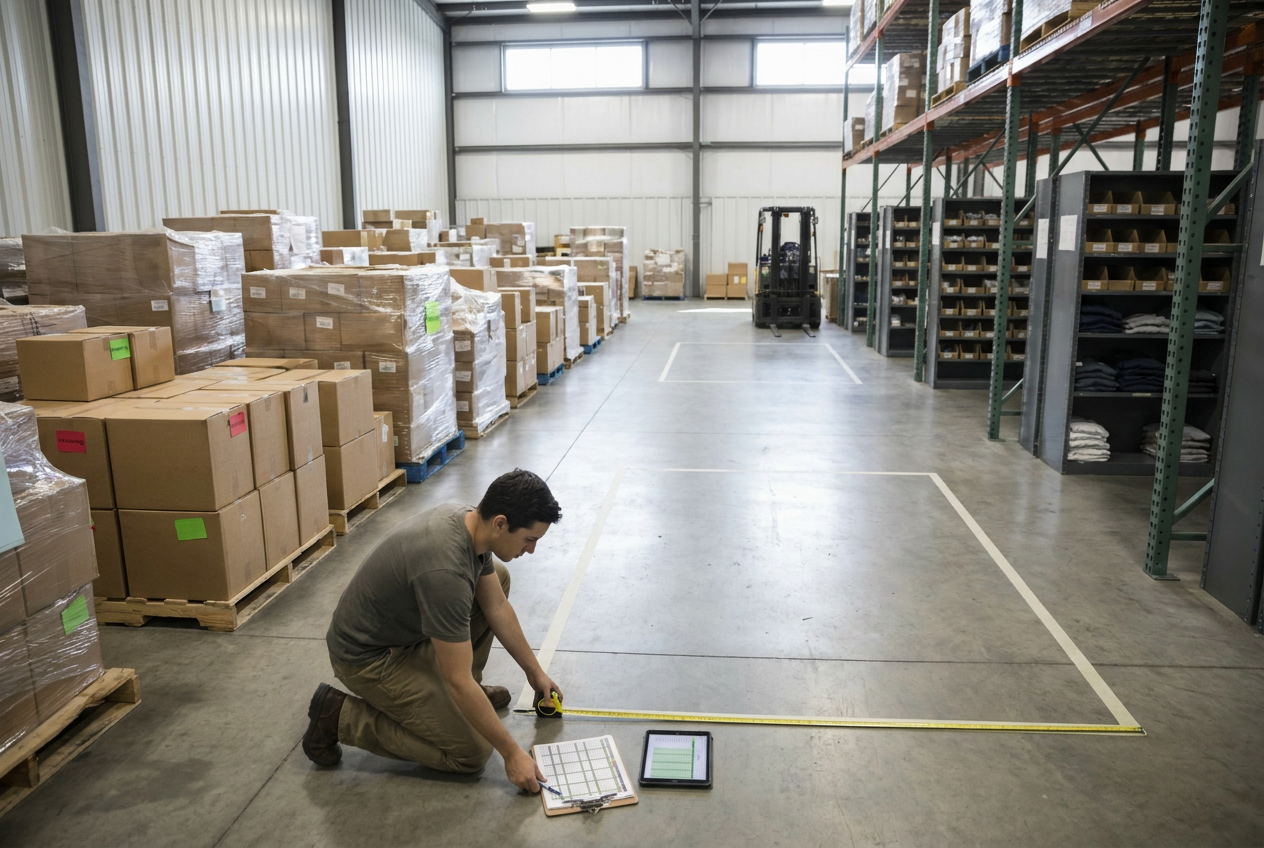
Buying a truckload before measuring your receiving area can leave inventory blocking the very space needed to inspect and sell it. Liquidation inventory storage is more than finding room for wrapped pallets: it includes unloading, sorting, testing, shelving, picking, and isolating goods that cannot yet enter your resale workflow.
For an independent reseller, the useful capacity number is not how many pallets can physically fit inside a building. It is how much inventory the operation can receive and process while keeping exits, equipment routes, and sale-ready stock accessible. Plan around the actual load, your equipment, and your processing pace before placing an order with PalletCove Liquidation.
Understand the load before measuring storage
A liquidation pallet is a unitized lot of merchandise sold for resale. A truckload is a larger shipment, but the term alone does not establish pallet count, loaded height, weight, or whether the shipment fills a full trailer. Confirm those details for the specific listing rather than assuming every truckload has the same layout.
The liquidation pallets hub provides a starting point for smaller purchases. Use the guide to pallet types and truckload buying guide to distinguish buying formats before comparing capacity requirements.
Manifested versus category-level inventory
A manifest is an inventory document that may list item descriptions, quantities, identifiers, and other available details. Check which fields are supplied and whether the document describes the offered lot. A manifest is not automatically a packing diagram, dimensional survey, or guarantee of individual-item condition.
A category-level lot describes an assortment, such as tools or general merchandise, without necessarily identifying every unit. That uncertainty makes flexible shelving and sorting space important. Ask about bulky items, oversized cartons, loose goods, and estimated pallet dimensions before reserving floor positions.
Condition grades change the workflow
Condition grade terminology is not universal. Use the listing's definition rather than assuming a grade means the same thing across suppliers.
| Inventory description | What it generally describes | Storage planning implication |
|---|---|---|
| --- | --- | --- |
| Overstock | Excess inventory that was not sold through its original channel | Allow verification and packaging checks before shelving |
| Shelf pulls | Merchandise removed from retail display or selling space | Provide room to inspect labels, packaging, and completeness |
| Customer returns | Goods returned by customers, with potentially varied issues | Separate untested units from inspected inventory |
| Salvage | Goods offered for parts, repair, recovery, or similar uses | Reserve controlled space for evaluation and disposition |
These descriptions do not establish a guaranteed condition. All PalletCove merchandise is sold as-is for resale.
Calculate floor space with a usable-space model
Start with a measured floor plan. Deduct offices, restrooms, columns, fixed equipment, utilities, and areas that must remain unobstructed. Mark receiving doors and the route from those doors to storage. Gross building square footage is not usable inventory capacity.
For a rectangular pallet, calculate its footprint as follows:
Footprint in square feet = length in inches × width in inches ÷ 144.
A 48-by-40-inch pallet occupies approximately 13.33 square feet. Twenty such pallets occupy about 267 square feet before any access space. That figure is only their combined footprint—not a sufficient warehouse size.
Use actual outside dimensions when cartons overhang the pallet. Also check loaded height and weight; equal footprints can represent very different handling problems.
Worked example: planning for 20 pallets
The following is an illustrative allocation, not a recommended minimum or a code-compliant layout:
| Space allocation | Example allowance |
|---|---|
| --- | ---: |
| Twenty incoming pallet footprints | 267 sq. ft. |
| Inspection and sorting area | 180 sq. ft. |
| Sale-ready shelving footprint | 240 sq. ft. |
| Hold area for unresolved goods | 80 sq. ft. |
| Packing and outgoing staging | 120 sq. ft. |
| Equipment routes and access aisles | 420 sq. ft. |
| Illustrative usable area required | 1,307 sq. ft. |
Replace every allowance with a measured requirement. Shelving capacity must be checked separately: 240 square feet of shelving footprint does not establish how many cartons its shelves can safely hold. Avoid double-counting receiving space as permanent storage if another shipment will need that same area.
The pallet footprint is the beginning of a storage estimate, not the finished capacity calculation.
Separate incoming, processing, and sale-ready goods
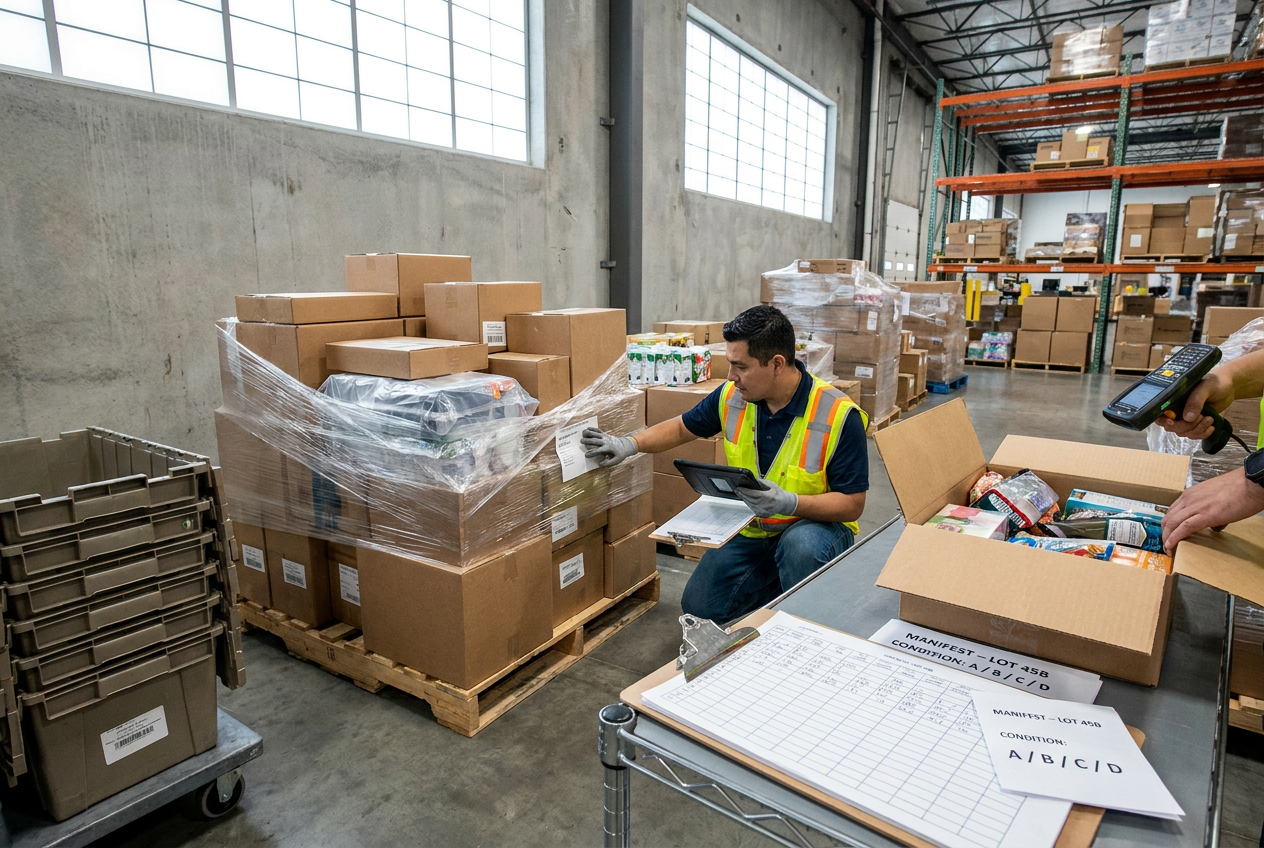
Create a one-direction workflow wherever practical: receiving, inspection, processing, sale-ready storage, then outbound staging. Physical separation prevents untested customer returns from being mistaken for ready-to-list merchandise.
Use clearly labeled zones:
- Incoming: Wrapped or unopened lots awaiting count verification.
- Processing: Goods being sorted, checked, cleaned, or tested where appropriate.
- Hold: Items with unresolved identification, damage, completeness, or safety concerns.
- Sale-ready: Items assessed and described accurately for your intended resale channel.
- Outbound: Packed orders awaiting dispatch.
Assign each lot an identifier tied to the order and manifest. Record a location and status for each item or manageable group. A simple spreadsheet can work if updates happen when goods move, rather than at the end of the week.
General merchandise often needs adaptable bins and shelves; browse general merchandise lots with that variability in mind. When reviewing truckload inventory, consider the volume that will remain in processing rather than looking only at inbound pallet count.
Match purchases to processing capacity
If your team can process two pallets per working day, a 20-pallet load represents roughly ten working days of processing under that assumption. Receiving another similar load halfway through could create a backlog unless adequate reserve space exists.
Measure your own pace over several lots. Testing requirements, item counts, missing parts, and listing work can change it substantially. Plan for slower lots and remember that processed inventory still occupies space until it leaves the building.
Check rack ratings, stacking, and access aisles
Vertical storage can increase capacity, but empty overhead space is not automatically usable storage. Verify the rack configuration, posted capacities, pallet compatibility, and load placement before assigning elevated positions.
- Check pallet weight against applicable beam-level and rack-bay limits.
- Include the pallet and packaging in the supported load.
- Do not assume a rating applies equally to concentrated and evenly distributed loads.
- Have damaged, altered, or unmarked racks evaluated by a qualified professional.
- Confirm floor suitability and anchoring requirements for the proposed installation.
- Store heavier items in positions compatible with equipment limits and safe handling.
Do not stack loaded pallets merely because the cartons appear sturdy. Confirm whether the load is stackable, whether the packaging supports the upper load, and whether the stack remains stable. When stackability is unknown, plan a separate position for each pallet.
Aisle width depends on equipment, load dimensions, turning requirements, and applicable safety rules. A pedestrian picking aisle is not a forklift operating aisle. Use equipment specifications and qualified local guidance; preserve required exits, electrical access, fire protection clearances, and pedestrian routes.
Check door dimensions, thresholds, dock access, and the entire movement route. A load that fits on a rack may still be too tall for the receiving doorway.

Compare prices alongside storage demands
Compare the listed lot price with the resources needed to handle that particular assortment. PalletCove includes freight in the listed price. Free shipping is the only delivery option, on every order, to all 48 contiguous states. PalletCove also covers sales tax on qualifying orders.
Your own operating budget should account for space, shelving, handling equipment, labor, testing supplies, packaging, and appropriate disposal or recycling. These expenses are separate from the inventory's listed price and vary by operation. Neither a manifest nor a large piece count establishes profit or resale value.
Product names can suggest different planning questions. For a Bulk Hamilton Beach Truckload, request carton dimensions and applicable inspection requirements. For a Macy’s Textile Truckload, verify packaging, assortment, and shelving needs rather than inferring volume from the title. Confirm current listing details and availability before ordering.
PalletCove is an independent reseller and is not affiliated with, endorsed by, or sponsored by any retailer named.
Keep storage and handling records connected to each lot. The mixed-lot inventory cost allocation guide can help structure that accounting without treating estimated retail figures as realized revenue.
Confirm the order and receiving schedule
Before paying, reconcile the listing with your space plan:
- Confirm the lot identity, condition description, and available manifest.
- Request available pallet counts, dimensions, weights, and stackability information.
- Identify unresolved uncertainties and reserve space for them.
- Confirm destination access and suitable unloading equipment.
- Arrange staff coverage and clear the receiving route.
- Review payment, shipping, and claim terms before committing.
PalletCove accepts credit/debit card, ACH bank transfer, and domestic bank wire. Handling takes 1–3 business days after payment clears; transit is typically 3–7 business days from Dallas. Treat handling and transit as separate stages, not a guaranteed arrival appointment.
A smaller pallet shipment may move by LTL, or less-than-truckload freight, while a larger order may require a dedicated full trailer. Confirm the arrangement for the specific shipment and who performs unloading. Do not assume the delivery vehicle provides your warehouse handling equipment.
Review the shipping policy when arranging receipt. Buyers researching liquidation pallets in Texas and liquidation pallets in Florida receive the same free-shipping-only delivery offering; actual transit timing depends on the destination and shipment.
Have business and destination information ready. If a resale certificate is relevant to your qualifying order, ask what documentation is required rather than assuming a business name alone establishes eligibility.
Inspect delivery and preserve claim documentation
Prepare a receiving log with the order identifier, expected handling-unit count, and space for discrepancies. Have a camera and an unobstructed staging area ready before the vehicle arrives.
During receipt:
- Compare the handling-unit count and labels with delivery paperwork.
- Photograph the load, wrapping, pallet damage, and visible carton damage when safely accessible.
- Record observed shortages or damage specifically on delivery paperwork before signing where possible.
- Retain copies of signed documents and relevant packaging.
- Move unstable or suspect goods to a controlled area rather than ordinary picking shelves.
After unloading, reconcile contents against the available manifest and record differences by item identifier and quantity. Distinguish visible transit damage from an item's underlying condition; they are not necessarily the same issue. Never power on visibly unsafe electrical goods simply to finish intake faster.
All merchandise is sold as-is for resale. Do not assume a retail-style return right, a warranty, or automatic reimbursement. Read the refund and claims policy before ordering for applicable eligibility, deadlines, evidence requirements, and procedures. Report concerns promptly with the order number, photographs, paperwork, and an itemized description; documentation does not itself guarantee a claim outcome.
Common avoidable mistakes include counting aisle space as storage, relying on unsupported stacking, mixing lots before reconciliation, and scheduling the next truckload before clearing the first. Each can undermine an otherwise workable floor plan.
Frequently asked questions
How much space does one liquidation pallet need?
A 48-by-40-inch pallet has a footprint of approximately 13.33 square feet. Actual storage needs are larger because you must account for overhang, access, inspection, and safe handling. Confirm the specific pallet's dimensions rather than treating that example as universal.
Can I keep liquidation inventory in a garage?
Possibly, if the premises are suitable for the goods and the operation is permitted there. Check access, floor suitability, moisture, security, fire safety, and local use restrictions. A garage's square footage alone does not establish that it can receive or safely store a truckload.
Does a manifest provide enough information to plan storage?
Not necessarily. A manifest may identify units without providing carton dimensions, pallet weights, or loaded heights. Request the missing physical details and use a conservative layout when information remains unavailable.
Should customer returns go directly onto sale-ready shelves?
No; keep unprocessed goods separate until you have performed the checks appropriate to the merchandise. Record the resulting status and any limitations needed for an accurate resale description. A condition grade is not a substitute for your intake process.
When should I order another truckload?
Order when you have both receiving capacity and a realistic processing plan for the added inventory. Include unsold stock, unresolved goods, and outgoing orders in that calculation. An empty loading area is not sufficient if the sorting area and racks are already full.
Talk to PalletCove Liquidation
Before purchasing, bring your usable floor dimensions, receiving-door measurements, equipment details, and expected processing pace to the order discussion. Ask which load details are available so you can match the inventory to your operation.
PalletCove Liquidation LLC is located at 4820 Cove Industrial Blvd, Dallas, TX 75236.
- Phone: (713) 819-3904
- Email: sales@palletcoveliquidation.com
- Hours: Mon–Fri 8:00 AM – 6:00 PM CT, Sat 9:00 AM – 2:00 PM CT, Sun closed
To discuss load information and receiving arrangements, contact our order desk. Compare available lots in current inventory after checking your floor plan and storage limits.