
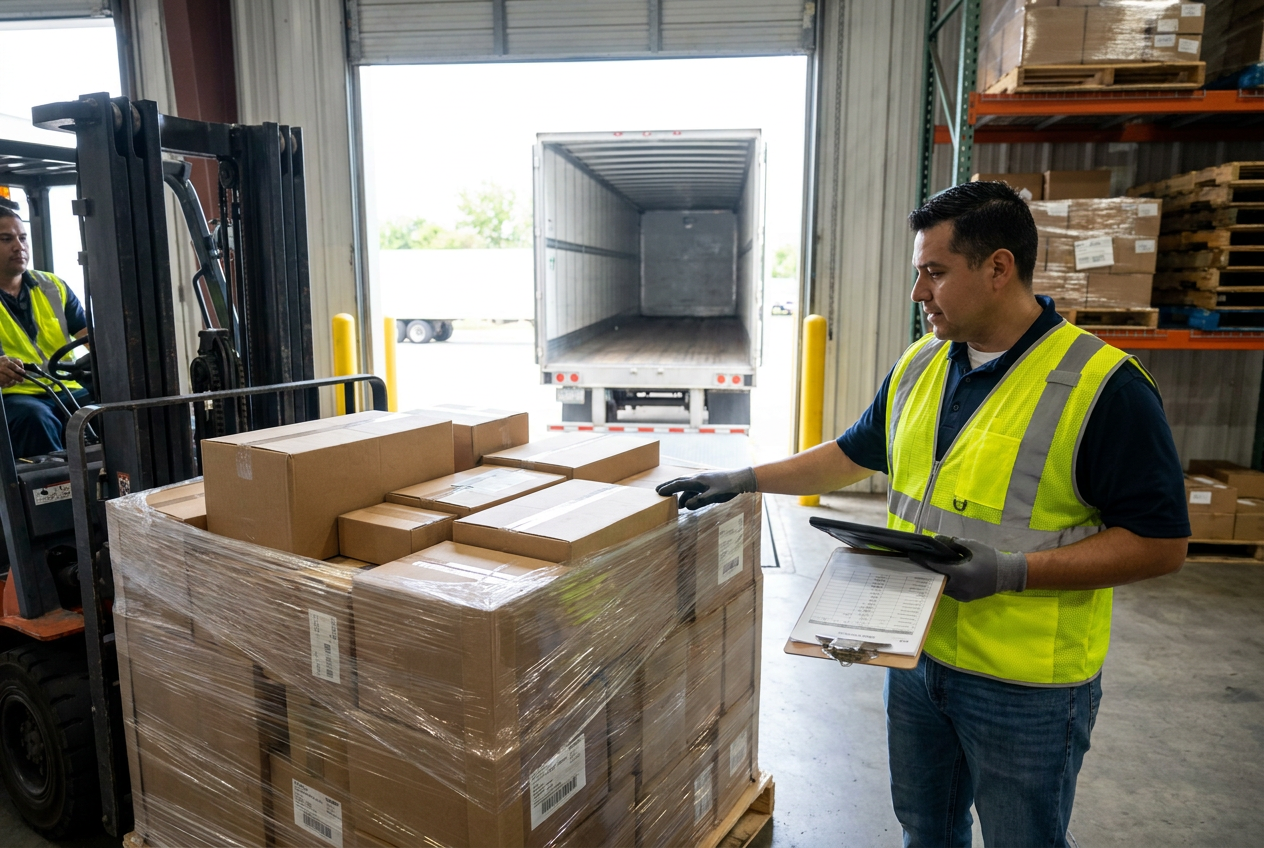
Liquidation pallet freight shipping is the movement of bulk resale merchandise on pallets or in larger trailer loads rather than through ordinary parcel delivery. For an independent reseller, understanding that process matters: you need space for the shipment, someone available to receive it and a clear inspection routine before inventory enters your workflow.
At PalletCove Liquidation, free shipping is the only delivery option on every order to all 48 contiguous states. Freight is included in the listed price. Handling takes 1–3 business days after payment clears, and transit from Dallas typically takes another 3–7 business days.
This guide explains what those windows mean, how pallet and truckload deliveries differ, what to confirm before ordering and how to document delivery issues. All merchandise is sold as-is for resale, so transportation planning and inventory evaluation should happen together.
What free freight shipping includes in your buying plan
The listed price includes freight whether you buy a liquidation pallet or a full truckload. Free shipping is the only delivery option; it is not a limited promotion or a benefit tied to a minimum order. The delivery area covers all 48 contiguous states, not Alaska or Hawaii.
The same freight-included structure applies when shopping for liquidation pallets in Texas or liquidation pallets in Florida. Distance can affect routing and actual arrival timing, but it does not change that shipping commitment.
PalletCove also covers sales tax on qualifying orders. Confirm whether your order qualifies rather than assuming every purchase receives identical tax treatment. Keep your business details and resale certificate available where applicable; a resale certificate documents qualifying resale purchases and is not a substitute for reviewing order requirements.
Free freight simplifies the purchase price, but successful receiving still requires a suitable delivery location, unloading preparation and careful inspection.
Review the freight shipping policy before purchasing, especially if your location has limited access or unusual receiving requirements. Free shipping does not mean every delivery site can accommodate the same truck or unloading method.
Know the load type, condition grade and manifest
A liquidation pallet is a palletized lot of merchandise sold for resale. A truckload is a larger shipment occupying substantial trailer capacity, potentially a full trailer. Neither term alone tells you the merchandise condition, item count or unloading requirements.
Start with the liquidation pallets inventory hub and the guide to liquidation pallet types to distinguish the purchasing formats.
LTL versus a full trailer
LTL means less-than-truckload freight: your shipment shares trailer space with other shipments and may move through freight terminals. A full-trailer shipment uses a trailer for the larger load rather than sharing space in the same way. Actual routing and handling depend on the shipment arrangement.
A truckload listing does not automatically establish whether merchandise arrives palletized or floor-loaded. Floor-loaded merchandise is placed directly in the trailer and generally requires a different receiving plan. Confirm the loading configuration instead of estimating it from a product name.
Condition descriptions are not universal guarantees
| Description | General meaning | What to check before ordering |
|---|---|---|
| --- | --- | --- |
| Customer returns | Merchandise returned by previous purchasers | Testing status, missing parts and packaging disclosures |
| Overstock | Inventory removed from excess stock | Storage wear, age and listing-specific limitations |
| Shelf pulls | Goods removed from selling shelves | Labels, display wear and packaging changes |
| Salvage | Goods intended for repair, parts recovery or material recovery | Processing needs, safety and disposal requirements |
| Mixed condition | A lot containing more than one condition category | Whether the listing explains the mix |
A condition grade describes the seller's classification, not a universal industry standard. Do not assume grades or tiers mean the same thing across suppliers. The shelf pulls, customer returns and overstock guide provides additional context for comparing these sources.
Manifested versus category-level inventory
A manifest is an inventory record that may include descriptions, quantities, identifiers and other lot details. It helps you plan sorting and storage, but it is not automatically an item-by-item test report. Check whether a manifest is specific to the offered lot and how the listing describes its scope.
Category-level lots describe the merchandise category without necessarily providing a detailed item list. Neither a category label nor a manifest overrides an as-is sale or establishes a guaranteed resale outcome.
Review the listing, place the order and clear payment
Compare merchandise fit before focusing on delivery. The general merchandise category and truckload inventory category represent different ways to browse; each individual listing still needs its own review.
For example, compare the information provided on the Amazon General Merchandise Truckload listing and the Macy’s Textile Truckload listing. Use each page's current description to assess the offered merchandise rather than assuming identical packaging, quantities or condition. PalletCove is an independent reseller and is not affiliated with, endorsed by or sponsored by any retailer named.
Follow this prepayment sequence:
- Confirm whether you are buying a pallet, multiple pallets or a truckload.
- Review the manifest, condition grade and any stated exclusions or limitations.
- Ask about shipment dimensions, weight, pallet count and loading configuration where these are not clear.
- Supply the complete delivery address, receiving contact, working phone number and business hours.
- Explain access restrictions and available unloading equipment before dispatch.
- Review the listed total, applicable sales tax qualification and order terms.
- Pay by credit/debit card, ACH bank transfer or domestic bank wire.
Those are the available payment methods. The handling clock begins after payment clears, not when a transfer is initiated or an order is first submitted. Clearance timing can vary by method and banking circumstances.
For a broader purchasing checklist, use the guide to buying liquidation pallets. Save the listing, manifest if supplied, order confirmation and payment record so you can compare the delivered shipment with the purchase documentation.
Understand handling time and transit from Dallas
Handling and transit are separate stages. Handling covers preparation before the shipment leaves; transit covers its movement from Dallas toward the destination.
| Stage | Timing or trigger | Buyer action |
|---|---|---|
| --- | --- | --- |
| Payment clearance | Depends on payment processing | Confirm that payment has cleared |
| Handling | 1–3 business days after clearance | Resolve address and receiving details |
| Transit | Typically 3–7 business days from Dallas | Monitor available shipment updates |
| Final delivery coordination | Based on routing and receiving arrangements | Confirm the appointment or delivery window |
Adding the handling and typical transit ranges gives a planning estimate of roughly 4–10 business days after payment clears. It is not a guaranteed arrival date. Weekends, holidays, weather, routing interruptions and appointment availability can affect the calendar date you actually receive the load.
Do not schedule a sales event or promise customers specific merchandise based solely on the earliest possible arrival. Leave time after delivery for counting, sorting, testing where appropriate and preparing items for resale.
Prepare for the delivery appointment and unloading
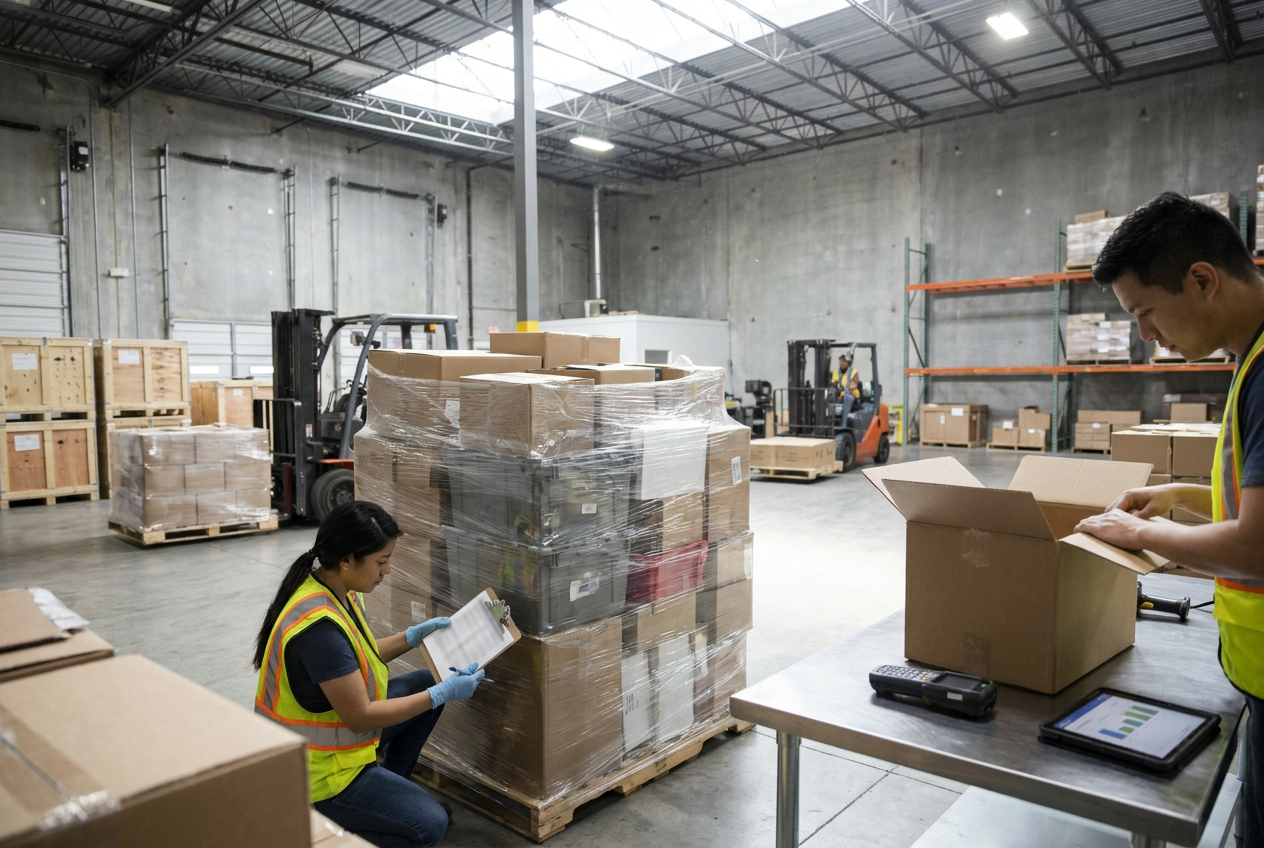
Freight delivery is not the same as leaving a parcel at a doorstep. Ask how final delivery will be coordinated for your shipment and whether the carrier requires an appointment. A transit estimate is not itself a confirmed appointment.
Keep the receiving phone available and respond promptly to scheduling messages. Confirm the date, expected window, address and any instructions needed to enter the property. If an update shows the freight near your destination, do not assume it is already scheduled for delivery.
Match the site to the shipment
Before dispatch, explain whether the destination is a warehouse, storefront, storage facility or residence. Describe any narrow approach, gated entry, restricted street access, steep surface or limited turning space.
Confirm these details with the order desk:
- Whether there is a suitable loading dock or forklift.
- How the freight will move from the truck to the receiving area.
- Whether a pallet jack can operate on the available level, hard surface.
- Who is responsible for unloading and what equipment is required.
- Whether the shipment is palletized or floor-loaded.
- Whether the location imposes receiving-hour restrictions.
Do not assume inside placement, unpacking or movement into individual storage units is part of the delivery arrangement. Clarify the handoff point in advance.
For a full trailer, reserve enough receiving space and appropriate labor for the confirmed load configuration. Keep customers and untrained personnel away from unloading operations, and use equipment only within its rated capacity.
Inspect the delivery before signing
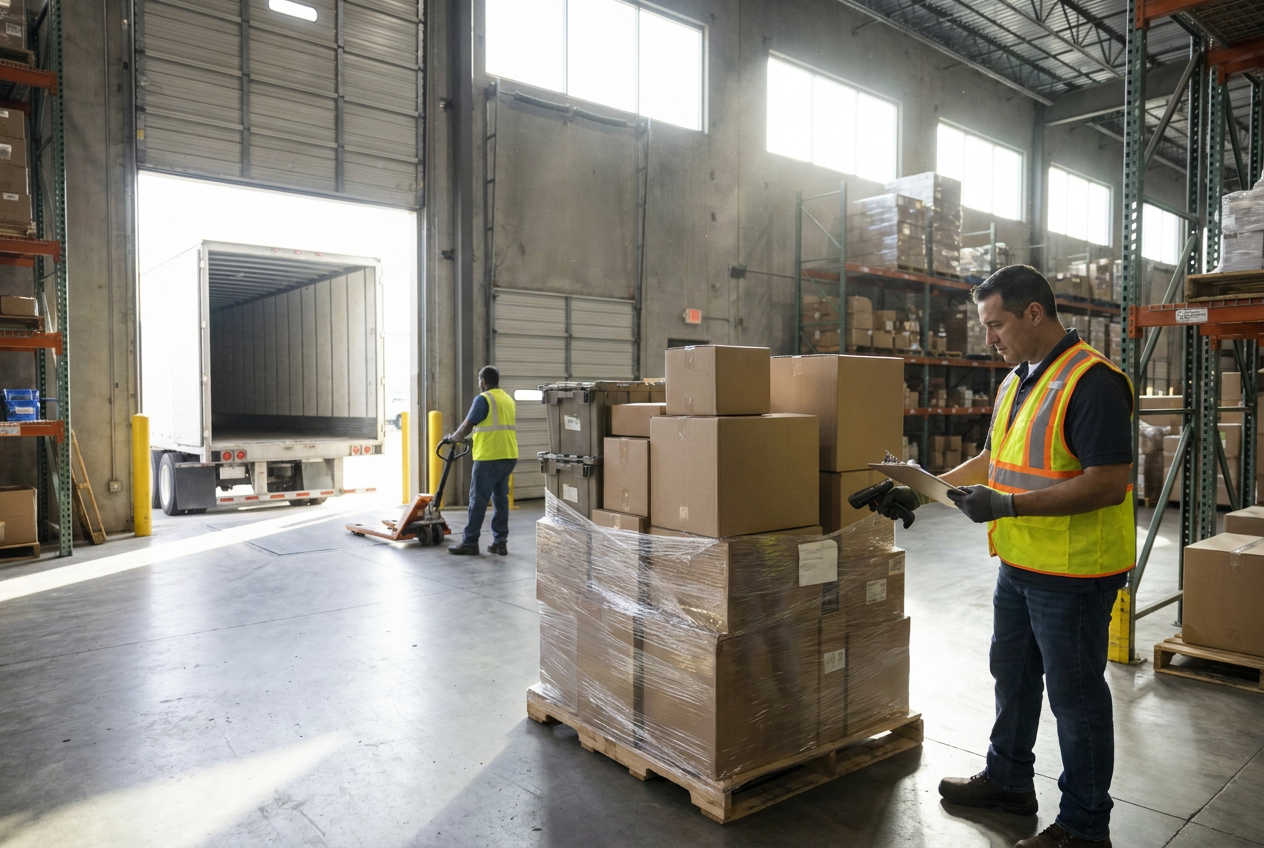
Delivery-day inspection serves two purposes: checking the freight handoff and preserving evidence of visible transportation problems. It is different from testing every resale item. A sealed pallet can look intact while containing merchandise with preexisting as-is condition issues.
Use a consistent receiving checklist:
- Match the shipment. Compare order identifiers and destination details with the delivery paperwork.
- Count handling units. Count accessible pallets or other listed units against the freight documents. A pallet count is not an item count.
- Inspect accessible surfaces. Look for crushed corners, punctured cartons, broken boards, displaced wrap, moisture or leaning stacks.
- Photograph the load safely. Capture overall views and close-ups before moving or opening damaged packaging when practical.
- Record specific exceptions. Ask that visible damage or shortages be noted on the delivery receipt or proof of delivery before signing.
- Keep the paperwork. Retain a copy of the signed receipt and any exception notes.
Specific wording is more useful than a vague statement such as “damaged.” For example, describe “one pallet with torn wrap and two crushed outer cartons” if that is what you observe. Do not guess at concealed damage or record an item shortage before counting the contents.
If a load appears unsafe or seriously compromised, contact the order desk promptly for instructions before deciding whether to accept or refuse it. Never climb into an unstable load to obtain photographs.
Handle discrepancies, returns and claims carefully
Once the freight is safely received, compare the contents with the applicable order description and manifest. Separate three issues: visible transportation damage, a possible shipment discrepancy and merchandise condition disclosed under the as-is sale. They are not interchangeable.
If you discover a problem, preserve:
- The order number and shipment identifiers.
- The listing and manifest supplied for the purchase.
- Delivery receipts with any exception notes.
- Photos of wrapping, labels, pallets, cartons and affected merchandise.
- A factual count and description of the discrepancy.
Contact PalletCove promptly and review the returns and refund policy for applicable requirements, deadlines and available remedies. Do not invent your own reporting window or assume documentation guarantees a refund, replacement or claim approval. Retain packaging and affected goods while seeking instructions; do not return merchandise without authorization.
Common mistakes include signing without checking accessible freight, discarding wrapping before documenting a problem, confusing a pallet count with a piece count and treating every untested or incomplete return as transportation damage. Another is assuming as-is goods can be returned simply because the sorting effort exceeds expectations.
Frequently asked questions
Is freight shipping free on every liquidation order?
Yes. Free shipping is PalletCove's only delivery option on every order to all 48 contiguous states, and freight is included in the listed price. Alaska and Hawaii are outside this delivery area.
How long does liquidation pallet freight shipping take?
Handling takes 1–3 business days after payment clears, followed by typical transit of 3–7 business days from Dallas. Treat the combined range as a planning estimate, not a guaranteed delivery date. Confirm final scheduling separately.
Can I receive a pallet without a loading dock?
Tell the order desk before dispatch if you do not have a dock or forklift. Suitability depends on truck access, shipment configuration and the unloading arrangement. Confirm the receiving plan rather than assuming a particular method will be available.
Does a manifest guarantee working merchandise?
No. A manifest describes inventory and may provide quantities or identifiers, but it is not automatically a functional test record. All merchandise is sold as-is for resale, subject to the specific listing and applicable terms.
What should I do if damage is found after unloading?
Photograph the affected merchandise and packaging, retain your delivery documents and contact PalletCove promptly. Follow the applicable policy requirements for reporting and review. Concealed damage is not established merely because an as-is item does not work.
Talk to PalletCove Liquidation
Before ordering, confirm your lot details, receiving location and unloading plan. For shipment preparation questions, contact our order desk; to compare available merchandise, browse current inventory.
- Business: PalletCove Liquidation LLC
- Address: 4820 Cove Industrial Blvd, Dallas, TX 75236
- Phone: (713) 819-3904
- Email: sales@palletcoveliquidation.com
- Hours: Mon–Fri 8:00 AM – 6:00 PM CT, Sat 9:00 AM – 2:00 PM CT, Sun closed