

Finding liquidation suppliers in dallas is easier than determining which seller can document the inventory, explain the sale, and fulfill the order. A listing photo and a low advertised price are not enough. Before paying, a reseller should be able to connect a legal business, a specific lot, an invoice, and written terms.
This checklist explains how to verify those connections when buying a liquidation pallet or truckload. It also separates supplier due diligence from inventory risk: a legitimate seller can still offer untested customer returns, incomplete merchandise, or salvage that does not fit your operation.
PalletCove Liquidation supplies manifested and category-level liquidation pallets and full truckloads from Dallas, Texas. All merchandise is sold as-is for resale. The goal of vetting is to understand what you are purchasing—not to eliminate uncertainty or assume a particular resale outcome.
1. Verify the supplier’s legal identity
Start with the entity taking your payment, not the retailer name printed on cartons. Request the legal business name, business address, working phone number, business email, and an invoice identifying the seller. Check the details against applicable Texas business records and the supplier’s published contact information.
A registration record helps establish identity, but it does not prove ownership of a particular load, product quality, or reliable fulfillment. Likewise, a map listing or social profile is supporting information, not a substitute for a documented transaction.
Before approving payment, check:
- Whether the invoice name matches the business you contacted.
- Whether the payment recipient matches the seller or has a documented explanation.
- Whether replies come from a consistent business communication channel.
- Whether the invoice identifies the lot, quantity basis, price, and applicable terms.
- Whether last-minute changes to payment instructions have been independently verified.
Retailer branding does not establish a supplier relationship. PalletCove is an independent reseller and is not affiliated with, endorsed by, or sponsored by any retailer named. For background on how inventory enters this market, read the liquidation sourcing overview.
2. Confirm warehouse access and authority to sell
A warehouse address establishes a location, not control over everything inside it. Ask where the offered inventory is physically located and whether the seller owns it or has documented authority to sell it on another owner’s behalf.
Request recent lot-specific photos showing pallet labels, identifying marks, and packaging. Where practical, ask for a dated video walkthrough that connects the lot identifier to the goods. Generic warehouse footage cannot establish that a particular load is available.
Questions to ask about access
Ask whether an inspection appointment is available, what an inspection would cover, and whether opening cartons or testing items is permitted. Do not assume walk-in warehouse access. If an inspection is unavailable, request alternative documentation and decide whether the remaining uncertainty is acceptable.
For PalletCove, confirm any inspection arrangements with the order desk before traveling. An inspection inquiry is not a pickup arrangement: free shipping is the only delivery option on every order.
Warning signs include an unexplained ship-from location, refusal to identify the contracting seller, and repeated use of identical photos for supposedly different lots. None alone proves fraud, but unresolved contradictions are a reason to pause.
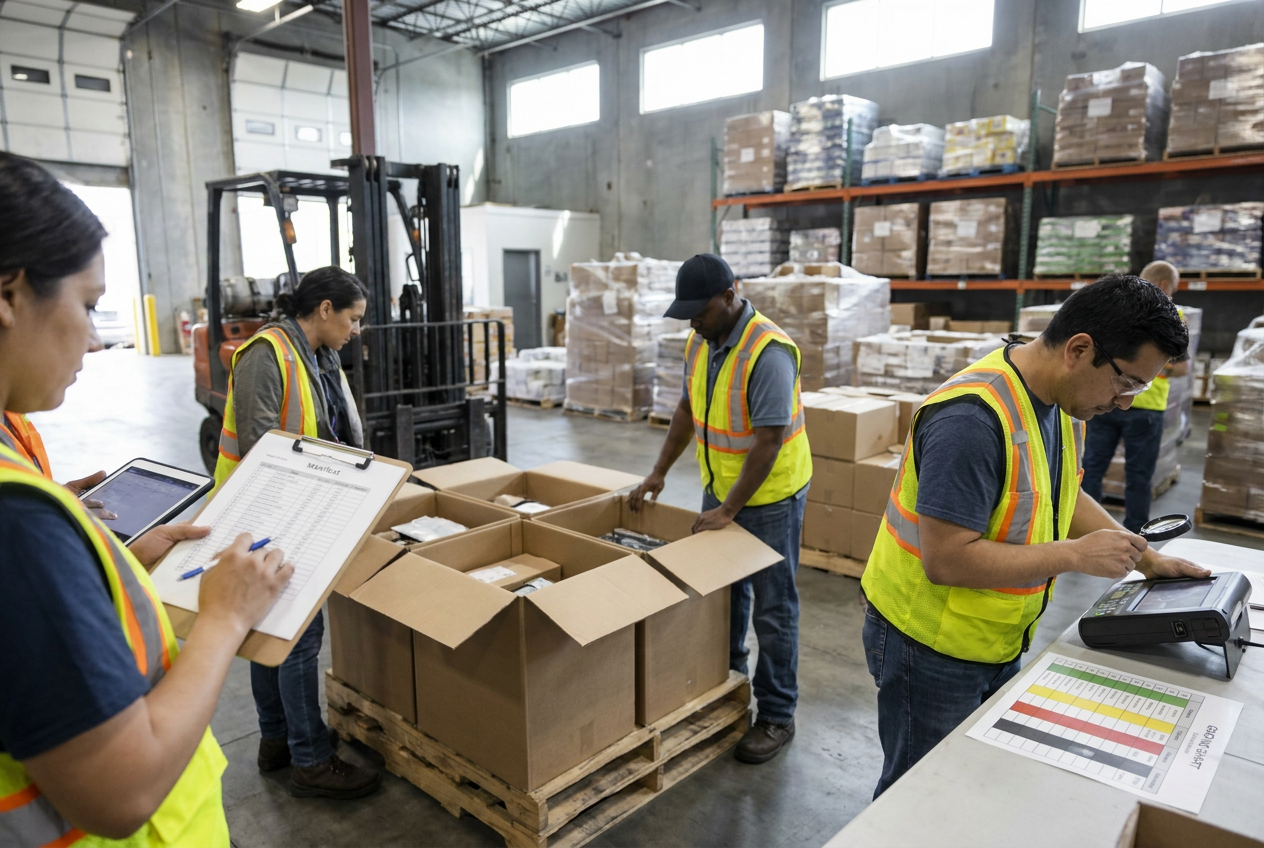
3. Distinguish load types from condition grades
A liquidation pallet is a bulk handling unit of merchandise offered for resale. A truckload is a larger purchase shipped in a trailer; its actual pallet count, piece count, and composition must come from the listing or written order details. Never infer a standard quantity from the word “truckload.”
A manifested lot includes an inventory list. A category-level lot is described primarily by merchandise type, such as tools or general merchandise, rather than necessarily identifying every item. Review the liquidation pallet inventory hub and the guide to pallet types before choosing your buying format.
| Term | What it generally describes | What to verify |
|---|---|---|
| --- | --- | --- |
| Customer returns | Merchandise returned by a customer | Testing, completeness, use, and packaging status |
| Overstock | Inventory held beyond the seller’s needs | Storage wear, age, and item-specific exceptions |
| Shelf pulls | Goods removed from retail display or sale | Labels, display wear, and missing packaging |
| Salvage | Merchandise potentially suited to repair, parts, or recovery | Damage, safety concerns, and disposal needs |
| Mixed-condition lot | Multiple conditions within one purchase | Written condition scope and any known exclusions |
Condition grades are not universal. One seller’s “Grade A” or “Tier 2” may mean something different elsewhere. Request the supplier’s definition rather than importing assumptions from another transaction. Untested does not mean working, and original packaging does not prove that an item is unused.
Compare the general merchandise category with the truckload inventory category to understand the difference between merchandise mix and purchase scale. Neither category label establishes condition.
4. Read the manifest as evidence, not a guarantee
A useful manifest connects directly to the offered lot and explains its fields. Request the version date, lot identifier, quantity basis, and any written limitations. Ask whether quantities refer to individual units, cases, multipacks, or assorted sets.
Check for:
- Item descriptions and model numbers where available.
- SKU or UPC identifiers that distinguish similar products.
- Duplicate lines and inconsistent quantity totals.
- Condition notes, testing status, and missing-component disclosures.
- Whether photos show the actual lot or representative inventory.
- Whether the list is final or subject to an expressly disclosed revision process.
Any retail reference figures are not a prediction of resale value. Build a purchasing decision around your own operating costs, ability to process the merchandise, and tolerance for unsellable units—not a headline retail total.
Product titles also need interpretation. The Amazon General Merchandise Truckload listing and Macy’s Textile Truckload listing describe different inventory concepts, but their current written descriptions must establish what is offered. Do not infer testing, unit counts, or availability from the titles alone.
For category-level inventory without an itemized manifest, ask exactly what is known and unknown. If your sales channel requires specific models or complete sets, a loosely specified assortment may be unsuitable even when accurately described.
5. Confirm pricing and payment terms before transferring funds
At PalletCove, freight is included in the listed price. Free shipping is the only delivery option, applies to every order, and covers all 48 contiguous states. Sales tax on qualifying orders is covered by PalletCove; confirm whether your order qualifies before payment.
Your acquisition price is still only one part of your operating budget. Allow for unloading capability, storage, sorting labor, testing supplies, replacement packaging, marketplace charges, and responsible disposal when assessing whether a load fits your business.
PalletCove accepts credit/debit card, ACH bank transfer, and domestic bank wire. Review the payment terms and methods, including when payment is considered cleared. Do not assume that initiating a transfer starts handling immediately.
For ACH or wire instructions, verify the recipient through a known business contact, especially after an emailed change. Payment protections and recovery procedures differ by method and institution; never assume a completed transfer can be reversed.
Keep your resale certificate and business records current. Ask what documentation is needed for your order, and distinguish purchase documentation from your obligations when you later resell merchandise.
A credible transaction connects the seller’s identity, the actual lot, the invoice, and the written policies before money changes hands.
6. Document the order and plan free shipping
Turn the agreed details into a record you can retain. A sensible ordering sequence is:
- Choose the lot and confirm current availability.
- Save its description, photos, manifest, and condition disclosures.
- Confirm the seller, total price, payment method, and applicable policies.
- Supply accurate recipient and delivery-address information.
- Confirm receiving requirements and then submit payment.
- Retain the payment confirmation, order acknowledgment, and shipment updates.
PalletCove’s handling time is 1–3 business days after payment clears. Transit is typically 3–7 business days from Dallas. These are separate stages, and typical transit is not a guaranteed arrival date. Consult the free shipping policy before scheduling receiving staff.
An LTL shipment shares trailer space with other freight. A full trailer moves a larger load as a dedicated trailer shipment; neither term tells you the exact merchandise count. Confirm the shipment format and the equipment and space needed to receive it safely.
Provide accurate information about dock access, available unloading equipment, vehicle clearance, and delivery restrictions. Resolve compatibility before ordering rather than assuming the driver can accommodate an unsuitable receiving site.
The same free-shipping-only approach applies to buyers reviewing liquidation pallets in Texas and liquidation pallets in Florida, as it does throughout the 48 contiguous states.
7. Inspect and document delivery before sorting
Delivery-day records help distinguish visible transportation damage from merchandise condition inside the lot. Have the order details and shipment paperwork available, along with a camera and a receiving checklist.
Before signing, where safe and permitted:
- Compare the delivered pallet or handling-unit count with the paperwork.
- Check visible labels against the order’s identifiers.
- Photograph all accessible sides, wrap, cartons, and visible damage.
- Record specific visible shortages or damage on the delivery receipt.
- Retain a copy of the signed receipt and any carrier documentation.
Avoid vague notes when a specific observation is possible. “One pallet with torn wrap and crushed lower cartons” documents more than “damaged.” Do not claim to have inspected concealed merchandise that remains sealed.
After unloading, photograph opening and sorting, preserve relevant packaging, and record discrepancies against the manifest or written description. Separate unsafe or damaged goods from saleable inventory pending assessment. Check applicable recalls and product-safety requirements before resale, particularly for electrical goods and children’s products.
Use the delivery-to-inventory pallet inspection guide to structure your receiving records. A delivery notation supports documentation; it does not itself establish claim eligibility or guarantee a remedy.

8. Read returns and dispute policies before paying
All PalletCove merchandise is sold as-is for resale. That makes the written description and policy especially important; it is not a reason to skip reading either one. Review the refund and claims policy before approving an order.
Ask the seller to identify, in writing:
- Which issues, if any, are eligible for review.
- The deadline and required channel for reporting an issue.
- The supporting photos, receipts, and inventory records required.
- How shortages, incorrect lots, and transportation damage are handled.
- Whether any return requires authorization.
- What remedies may apply if a claim is accepted.
Do not invent a reporting window or assume ordinary retail return rights apply. If a policy does not answer a material question, obtain clarification before purchase. Report concerns promptly and preserve evidence, but do not treat submitting a claim as approval.
Common mistakes include relying on verbal exceptions, discarding packaging before documenting damage, confusing an untested return with a guaranteed working item, and buying a full trailer without enough processing capacity. Another is assuming a payment dispute replaces the supplier’s claims procedure. Keep the purchase record intact and follow the applicable written process.
Frequently asked questions
How can I verify liquidation suppliers in Dallas?
Match the legal seller, address, invoice, and payment recipient, then request evidence tied to the actual lot. Business records help establish identity but do not establish inventory ownership or condition by themselves.
Can I visit the warehouse or pick up an order?
Ask the order desk whether an inspection appointment is available before traveling; do not assume walk-in access. PalletCove’s only delivery option is free shipping on every order, not pickup.
Does a manifest guarantee working products?
No. A manifest identifies inventory information within its stated scope; it is not automatically a testing report or condition guarantee. Confirm condition definitions and limitations separately, and remember that all merchandise is sold as-is for resale.
How much is shipping, and how long does delivery take?
Shipping is free on every PalletCove order to all 48 contiguous states, with freight included in the listed price. Handling takes 1–3 business days after payment clears, followed by transit typically taking 3–7 business days from Dallas.
What payment methods does PalletCove accept?
PalletCove accepts credit/debit card, ACH bank transfer, and domestic bank wire. Confirm payment instructions and clearance requirements before submitting funds, and retain the invoice and confirmation.
Talk to PalletCove Liquidation
Before purchasing, bring your lot questions, receiving requirements, and documentation needs to PalletCove Liquidation LLC. Request clarification on any inventory description or policy you do not understand before paying.
- Address: 4820 Cove Industrial Blvd, Dallas, TX 75236
- Phone: (713) 819-3904
- Email: sales@palletcoveliquidation.com
- Hours: Mon–Fri 8:00 AM – 6:00 PM CT, Sat 9:00 AM – 2:00 PM CT, Sun closed
To discuss a specific pallet or truckload, contact our order desk and review current inventory.