
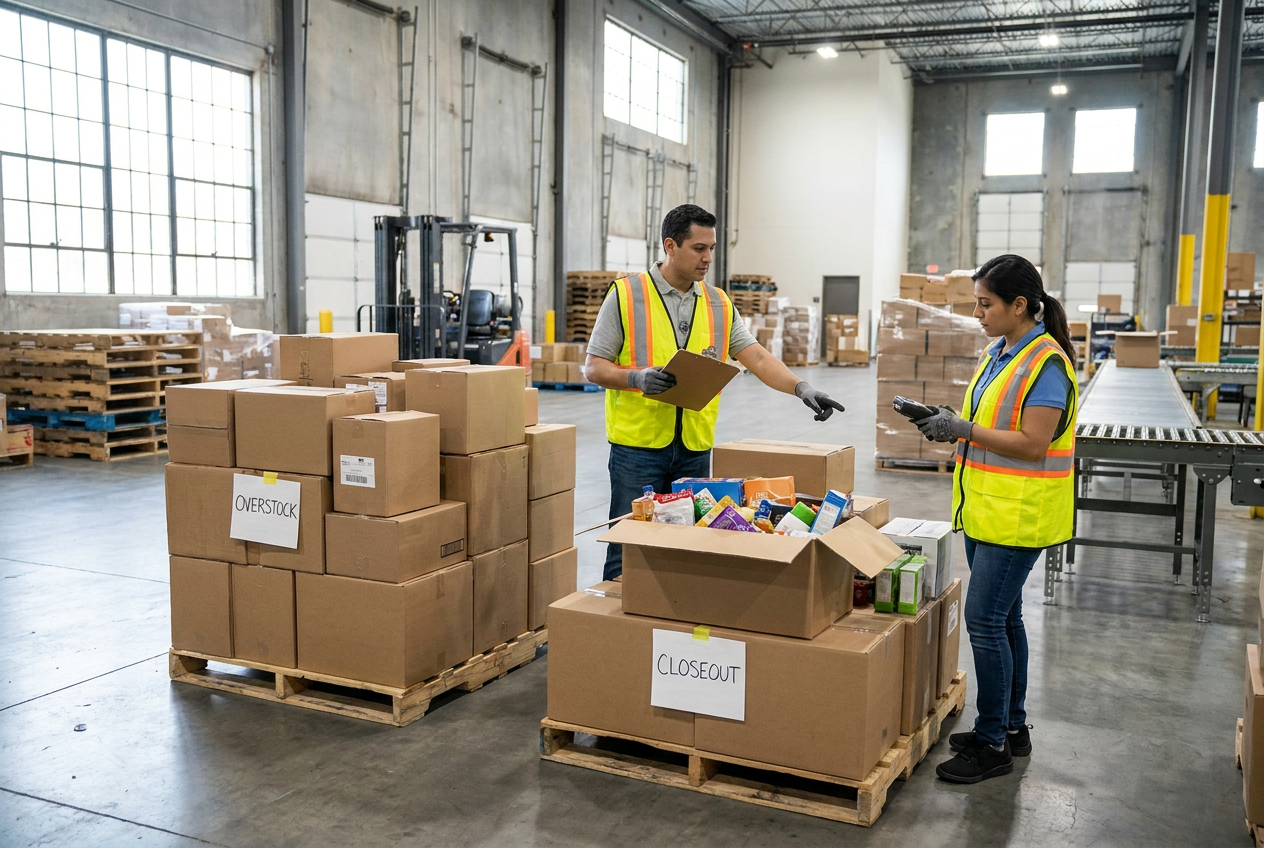
Overstock and closeout inventory can look similar on a warehouse floor: boxed goods, wrapped pallets, and products priced for bulk purchase. But the reasons those goods entered liquidation can affect what you receive, whether you can source similar merchandise again, and how consistently you can stock your resale business.
The practical difference in overstock vs closeout inventory is not simply price or condition. Overstock usually describes excess supply; closeout usually describes inventory being cleared from a particular selling program, assortment, or business. Neither term, by itself, establishes a condition grade or guarantees a repeatable supply.
PalletCove Liquidation supplies manifested and category-level liquidation pallets and full truckloads to independent resellers. This guide explains how to evaluate those offers without treating a sourcing label as a substitute for lot-specific information.
What overstock and closeout inventory actually mean
Overstock inventory is merchandise that exceeds the quantity a seller needs or expects to sell through its normal channels. It can result from forecasting errors, excess purchasing, seasonal demand shifts, canceled orders, or warehouse consolidation. A product may remain active in regular distribution even while surplus units enter liquidation.
Closeout inventory is merchandise being cleared because a seller is ending its involvement with that stock. The reason might be a discontinued product, packaging change, assortment reset, seasonal exit, store closure, or business closure. A closeout does not necessarily mean the manufacturer has stopped making the product; one seller may simply stop carrying it.
| Buying factor | Overstock inventory | Closeout inventory |
|---|---|---|
| --- | --- | --- |
| Typical origin | Supply exceeds current demand | Seller exits a product, assortment, or selling program |
| Product lifecycle | May still be active | May be discontinued, replaced, or removed by one seller |
| Replenishment potential | Additional surplus may appear, but is uncertain | Exact replenishment may be limited or unavailable |
| Assortment pattern | Can be concentrated in repeated SKUs | Can include remaining sizes, colors, or configurations |
| Condition implication | Does not independently establish condition | Does not independently establish condition |
| Main buying question | Can you absorb the surplus quantity? | Can you sell the remaining assortment without needing matching stock? |
These categories can overlap. Excess units cleared during an assortment exit may reasonably be described as both overstock and closeout. For broader sourcing context, the liquidation inventory overview explains the market these terms sit within.
Key takeaway: Overstock and closeout explain why inventory is being sold, not exactly what condition every unit is in or whether the same inventory will be available again.

How origin affects replenishment and assortment consistency
An overstock offer may contain many identical units because a buyer ordered too deeply into one SKU. That can simplify photography and listing work, but it concentrates demand risk. A reseller still needs enough customers for the same model, size, color, or specification.
Closeouts often reflect what remains after earlier sales. An apparel lot might have uneven size runs; a home-goods lot might contain discontinued colors without matching pieces. These are possible patterns, not universal rules: a closeout can also contain a large, consistent block of one product.
Ask what is ending—and for whom
Before treating a closeout as discontinued stock, ask whether the manufacturer ended production or a seller merely removed the item from its assortment. That distinction matters for replacement parts, compatible accessories, ongoing customer searches, and future sourcing.
Also distinguish three kinds of consistency:
- Within-lot consistency: How similar are the units in this purchase?
- Between-lot consistency: How closely might another available lot resemble it?
- Replenishment consistency: Can you source the same SKU repeatedly over time?
One does not establish the others. A uniform pallet available today is not evidence of a continuing supply agreement. Build repeat listings only around stock you actually control, and avoid promising customers future availability based on a liquidation label.
Choose the load type and condition grade separately
A liquidation pallet is a shipping and purchasing unit, not a condition category. A truckload increases the quantity and receiving commitment, but it does not automatically improve assortment quality or documentation.
Common offer structures include:
- Manifested pallets: An itemized inventory record provides some visibility into the offered merchandise.
- Category-level pallets: The offer identifies a merchandise category, but may provide less SKU-level detail.
- Mixed general merchandise: Multiple product types require broader sorting, storage, and selling capabilities.
- Category-focused truckloads: Larger purchases concentrate on a merchandise family or sourcing program.
- Full trailer purchases: Receiving space, unloading capacity, and processing throughput become central buying considerations.
The guide to liquidation pallet types can help separate these formats. Compare general merchandise inventory with truckload inventory based on your operation, not just the apparent size of the deal.
Condition terms are not interchangeable
Overstock may be unused, but storage wear, damaged packaging, missing components, or other issues can still occur. Shelf pulls have been removed from selling floors and may carry labels, handling marks, or display wear. Customer returns have been returned after purchase and may have uncertain use, completeness, or functionality. Salvage generally signals merchandise requiring substantial repair, parts harvesting, recycling, or other specialized handling.
Condition grades are not standardized across the entire industry. Ask what a grade means for the specific listing, whether testing occurred, and whether the description applies to every unit or to the lot overall. All PalletCove merchandise is sold as-is for resale; a sourcing label is not a condition guarantee.
Read the manifest before evaluating the opportunity
A manifest is useful only when you understand its scope. It may list SKU identifiers, descriptions, quantities, models, sizes, or reference retail figures. Do not assume it contains every field, reflects individual testing, or guarantees exact counts unless the applicable offer terms explicitly establish that.
Use this review sequence:
- Confirm the manifest belongs to the exact lot being considered and identify its date or version.
- Check whether quantities represent individual units, cases, multipacks, or sets.
- Group repeated SKUs to see where the purchase is concentrated.
- Review sizes, colors, model numbers, compatibility, and packaging details.
- Identify any stated condition mix, testing limitations, or quantity qualifications.
- Flag items requiring expiration checks, recall screening, restricted-channel approval, or specialized handling.
A high piece count can mean many inexpensive accessories rather than a broad assortment. A reference retail total is not an estimate of realizable sales, and an item description is not proof of completeness.
For example, review the current details of the Bulk Hamilton Beach Truckload and Macy’s Textile Truckload for their respective merchandise requirements. Product names alone do not establish whether a particular offer is overstock, closeout, customer returns, or a mixture.
PalletCove is an independent reseller and is not affiliated with, endorsed by, or sponsored by any retailer named. Retailer references identify sourcing context, not a partnership.
Compare pricing using your actual processing costs
First establish what the listed price buys: one pallet, several pallets, a defined lot, or a full truckload. Then confirm the stated quantities and whether they are exact or approximate. Do not compare two offers by pallet count alone; carton dimensions and product density can differ substantially.
At PalletCove, freight is included in the listed price. Free shipping is the only delivery option on every order to all 48 contiguous states. Sales tax on qualifying orders is covered by PalletCove.
Your internal budget should still account for the work required after arrival:
- Receiving and storage space.
- Sorting, testing, cleaning, and identifying merchandise.
- Replacement packaging or components where practical.
- Marketplace commissions and your outbound fulfillment expenses.
- Unsellable inventory handling and applicable disposal requirements.
A basic planning measure is listed purchase price divided by stated unit count. That produces an average acquisition cost per stated unit—not a forecast of sellable-unit cost or profit. After processing, use verified counts and actual expenses to understand the purchase more accurately.
Overstock may reduce listing labor when many units match, while a fragmented closeout may require more individual listings. Either can be unsuitable if your sales channels cannot absorb the quantity or assortment. Review demand and your own sales history without assuming a stated retail figure predicts resale results.
Ordering, payment, and free shipping from Dallas
Start with the liquidation pallets hub and narrow your selection by merchandise type, documentation, and processing capacity. Before paying, resolve any uncertainty about the offered lot, condition terminology, count basis, and receiving requirements.
A practical ordering checklist is:
- Save the listing, available manifest, and applicable terms for your records.
- Confirm your business and delivery information, including receiving hours and site access.
- Ask what unloading arrangements and equipment your location needs.
- Have your resale certificate available when applicable; do not assume every order qualifies for the same tax treatment.
- Select an accepted payment method and retain the payment confirmation.
PalletCove accepts credit/debit card, ACH bank transfer, and domestic bank wire. Handling time is 1–3 business days after payment clears. Transit is typically 3–7 business days from Dallas; handling and transit are separate stages, and typical timing is not a guaranteed arrival date.
Pallet shipments may travel by LTL, meaning less-than-truckload freight, while a larger purchase may require a full trailer. Confirm the actual shipment configuration rather than inferring it from the word “truckload.”
Buyers researching liquidation pallets in Texas and liquidation pallets in Florida receive the same free-shipping-only delivery option. Review the shipping policy for applicable delivery terms. Coverage is all 48 contiguous states; it does not extend to Alaska or Hawaii.

Delivery-day inspection, returns, and claims
Prepare a clear receiving area and assign someone to document the shipment. On arrival, compare the shipment identifiers and handling-unit count with the delivery paperwork. A pallet count is not an item count; checking the outer shipment does not complete your merchandise reconciliation.
Before signing, where inspection is possible:
- Photograph the shipment, labels, wrapping, and visible damage.
- Look for crushed cartons, broken pallets, moisture, or disturbed packaging.
- Record visible shortages or damage accurately on the delivery receipt.
- Retain delivery paperwork and preserve relevant packaging.
After unloading, separate and count merchandise against the available manifest. Record discrepancies by SKU or description, quantity, and observed issue. Keep transit damage, missing merchandise, and product-condition findings distinct rather than grouping everything into one unsupported complaint.
The liquidation pallet inspection guide provides a delivery-to-inventory workflow. Do not energize wet or visibly damaged electrical goods; quarantine questionable items until appropriately assessed.
All merchandise is sold as-is for resale. Do not assume consumer-style returns, exchanges, warranties, or reimbursement rights apply. Read the returns and claims policy before ordering, including any reporting requirements, deadlines, exclusions, and documentation rules. Report concerns promptly through the stated process; photographs or receipt notes support review but do not guarantee approval.
Common mistakes include discarding packaging too early, mixing separate lots before counting, assuming every overstock unit is retail-ready, and expecting an exact replacement assortment from a closeout. Check applicable recalls and resale restrictions before offering goods to customers, regardless of their sourcing label.
Frequently asked questions
Is overstock inventory always new?
No. Overstock describes excess supply, not a universal condition standard. Merchandise may be unused yet have packaging damage, storage wear, or other issues, so review the specific condition description and any testing information.
Is closeout inventory the same as customer returns?
No. Closeout describes a seller clearing inventory, while customer returns describes merchandise returned after purchase. A liquidation offer can contain overlapping inventory streams, so the listing and manifest matter more than a single label.
Which is better for repeat inventory: overstock or closeout?
Overstock may offer another sourcing opportunity while a product remains active, but surplus availability is unpredictable. Closeouts may be harder to replenish, especially when production has ended or remaining stock is exhausted. Neither should be treated as guaranteed recurring supply.
Should a new reseller buy a pallet or a truckload?
Choose according to receiving capacity, storage, available capital, and processing throughput. A smaller purchase can limit operational exposure while you learn a category, but its suitability still depends on the assortment and condition. A truckload requires a workable plan for every part of the inventory, not just the most attractive items.
Does PalletCove include shipping in the inventory price?
Yes. Freight is included in the listed price, and free shipping is the only delivery option on every order to all 48 contiguous states. Handling takes 1–3 business days after payment clears, followed by transit typically taking 3–7 business days from Dallas.
Talk to PalletCove Liquidation
Choose inventory by origin, documented condition, assortment fit, and receiving capacity—not by the overstock or closeout label alone. For lot-specific questions, contact our order desk or review current inventory.
PalletCove Liquidation LLC
4820 Cove Industrial Blvd, Dallas, TX 75236
Phone: (713) 819-3904
Email: sales@palletcoveliquidation.com
Hours: Mon–Fri 8:00 AM – 6:00 PM CT, Sat 9:00 AM – 2:00 PM CT, Sun closed.