
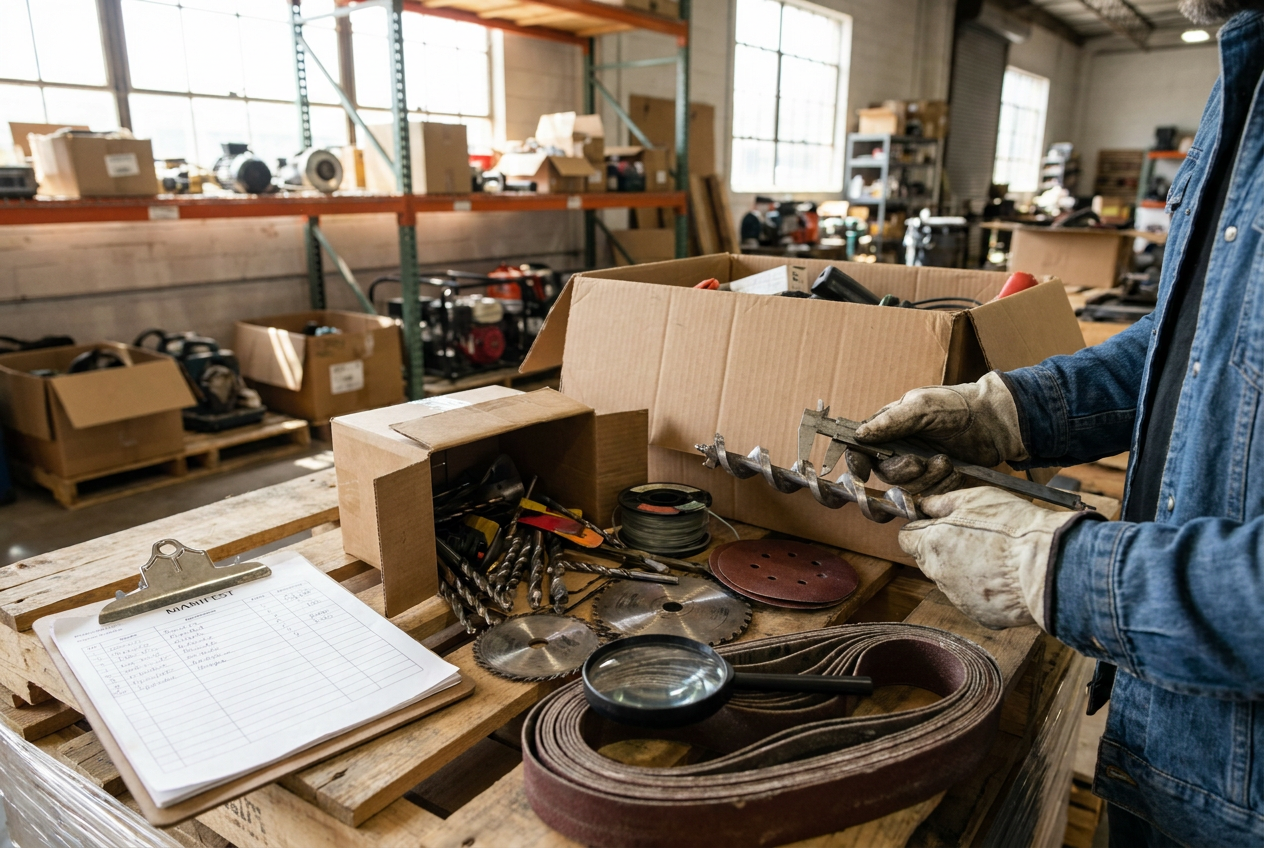
Power tool accessory lots can contain drill bits, driver bits, saw blades, sanding supplies and attachments for tools or outdoor power equipment. A high piece count does not reveal whether those items fit your customers’ equipment, remain safe to use or form complete, identifiable products.
For an independent reseller, compatibility comes before quantity. A blade with the wrong arbor, an unmarked abrasive wheel or a trimmer attachment with an incompatible drive connection creates a different problem from a scuffed package. The useful buying question is not simply how many accessories are included, but how many can be identified, inspected and accurately described.
PalletCove Liquidation supplies category-level liquidation pallets and full truckloads from Dallas, Texas. This guide explains how to evaluate accessory-heavy inventory without treating a category label, condition grade or estimated retail total as a guarantee.
Understand the lot and load type
A power tool accessory lot is a grouped quantity of consumables or attachments rather than necessarily a collection of powered tools. Accessories may appear in a dedicated assortment or within a broader tool, hardware or general merchandise load. Never assume an accessory-heavy load is accessory-only.
A liquidation pallet is a handling unit, not a standardized assortment. A truckload generally involves a full trailer shipment, but pallet count, dimensions and contents must come from the specific listing. Smaller pallet shipments commonly move by LTL, meaning less-than-truckload freight, alongside other shipments.
Start with the liquidation pallets hub and the liquidation overview guide to distinguish the sales format from the merchandise description. For larger purchases, the guide to buying liquidation truckloads helps frame receiving capacity and processing requirements.
Browse the Home Depot liquidation category and general merchandise category as search starting points, not proof of particular contents. Likewise, the Home Depot Tool and Hardware Truckload listing and HD GM Truckloads Pallets listing require their own current descriptions and documentation. Product names alone do not establish accessory counts or availability.
PalletCove is an independent reseller and is not affiliated with, endorsed by or sponsored by any retailer named.
Read condition grades as sorting clues
All merchandise is sold as-is for resale. A condition grade describes an assortment under the seller’s grading system; it does not certify every accessory inside. Ask what each grade means for the specific lot.
| Inventory description | What it generally indicates | Accessory-specific checks |
|---|---|---|
| --- | --- | --- |
| Overstock | Excess inventory rather than a stated history of consumer use | Storage corrosion, aged adhesives and damaged packaging |
| Shelf pulls | Merchandise removed from retail shelves | Missing components, faded labels and opened packs |
| Customer returns | Merchandise returned by customers | Use, substitution, incomplete kits and hidden damage |
| Salvage | Inventory requiring significant sorting or recovery | Unusable pieces, disposal needs and safety limitations |
These descriptions are not interchangeable with “new,” “tested” or “complete.” An intact outer carton may contain mixed inner conditions. An opened kit may have its most useful sizes missing, while a loose accessory may be unused but impossible to identify confidently.
Separate package appearance from functional condition. Record whether wear, completeness and fitment were actually inspected or remain unknown. Quarantine questionable cutting and rotating accessories rather than treating them as ready for use.
Check fitment before counting useful inventory
The useful unit is an identifiable, compatible accessory—not merely an object counted on a manifest.
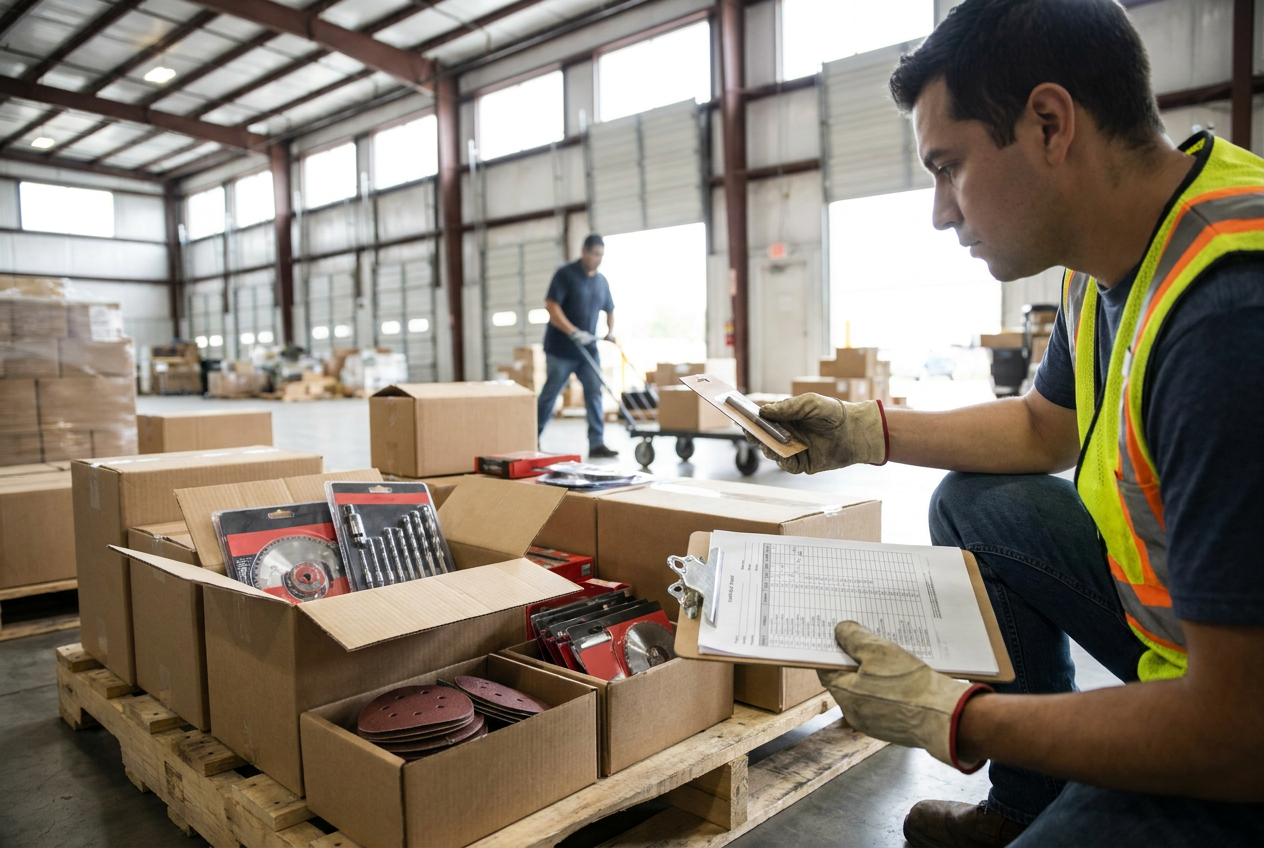
Drill bits and driver accessories
Check shank type and dimensions first. Round shanks require suitable chuck capacity; a quarter-inch hex interface differs from SDS-plus or SDS-max. Those rotary-hammer systems are not interchangeable merely because both use slotted shanks.
Match cutting geometry to the intended material. Wood, metal and masonry bits perform different jobs. Record diameter, working length and readable manufacturer markings. On hole saws, verify the arbor connection, pilot bit and required retaining components.
Inspect for chipped cutting edges, bent shafts, damaged flutes and heavy corrosion. Driver bits need intact profiles, not rounded corners. Confirm impact-use suitability from markings or manufacturer documentation; a hex shank alone does not establish it.
Saw blades and abrasive wheels
For circular blades, verify diameter, arbor size, tool type, material application and rated speed. Tooth count helps describe a blade but cannot establish compatibility by itself. Inspect for cracks, missing teeth, distortion and damaged mounting holes.
Jigsaw blades may use different shank systems. Reciprocating blades still need an appropriate material rating, length and thickness for the application. Oscillating multi-tool accessories require the correct mounting interface; “universal” packaging is not a substitute for model-level confirmation.
Grinding and cut-off wheels need correct dimensions, mounting specifications and application ratings. The accessory’s maximum rated speed must meet or exceed the tool’s operating speed, with compatibility confirmed against the tool instructions. Reject cracked or damaged wheels and check any manufacturer shelf-life or expiry guidance. Never improvise a mounting arrangement or remove a guard to make an accessory fit.
Sanding supplies and backing components
Record disc diameter, belt width and circumference, sheet size, grit and attachment system. Hook-and-loop discs are not equivalent to pressure-sensitive adhesive discs. Dust-hole patterns also matter when the tool depends on extraction through its pad.
Check for clogged abrasive, torn edges, loose grit, deteriorated adhesive and belt-seam separation. A backing pad needs its own thread or mounting specification verified. A large quantity of one unusual belt size may serve a much narrower customer base than its count suggests.
Outdoor power equipment attachments
For mower blades, verify length, center-hole shape, mounting details and the specified equipment models. Similar-looking blades are not necessarily substitutes. For chainsaw chains, match pitch, gauge and drive-link count to the bar and equipment; bar length alone is insufficient.
Trimmer heads require the correct thread size, thread direction and mounting hardware. Line diameter must suit the head and equipment instructions. Split-shaft attachments need the specified coupler and drive connection, while powered attachments may also depend on an approved electrical platform.
Do not guess compatibility from brand name alone. Use exact part numbers and manufacturer fitment references, and do not straighten damaged blades or assemble speculative adapter combinations for resale.
Audit the manifest and available evidence
A manifest is an inventory document, not necessarily a physical inspection report. Ask whether it is itemized, estimated or representative, and whether quantities describe individual accessories, retail packs, kits or cartons.
Use this sequence before committing:
- Match SKU, UPC, model and part numbers to identifiable products.
- Separate powered tools from accessories and unrelated hardware.
- Reconcile pack counts with individual piece counts.
- Group duplicates by fitment, size, grit and application.
- Flag missing specifications, unreadable labels and incomplete sets.
- Compare the document with available lot-specific photographs.
Request readable views of blade arbors, accessory markings, kit interiors and attachment connectors. Ask whether photographs show the offered lot or merely illustrate the category. If physical inspection or additional photographs are unavailable, treat those gaps as uncertainty rather than assuming the best.
Duplicates can simplify listings, but only when the repeated item serves your market. The guide to duplicate items in liquidation pallets explains why concentration deserves a separate review. Ten packs of one uncommon size are not equivalent to ten broadly useful sizes.
Compare prices using processing costs and uncertainty
Use the listed lot price as the starting point. Freight is included in that price, and free shipping is the only delivery option. Avoid treating a manifest’s retail figure as a forecast of sales or as proof of present demand.
For internal planning, divide the listed price by the documented count to calculate an acquisition cost per stated unit. Label that number carefully: a stated unit may be a kit, a pack or a single bit. It is not automatically a usable or sellable unit.
Your evaluation should also account for:
- Identification, sorting and inspection labor.
- Packaging, labels, storage and listing work.
- Missing components that prevent a complete offering.
- Marketplace expenses and customer support.
- Safe disposal of damaged or unidentifiable stock.
Build conservative scenarios rather than assuming every item will pass inspection. If the evidence does not support a reasonable sorting plan, reduce your buying limit or decline the lot. A truckload demands more space and processing discipline; it does not make compatibility problems disappear.
Order, pay and prepare for free shipping
Before payment, confirm the exact listing, quantity basis, condition description, available manifest and receiving requirements. Ask which documents apply to your purchase, including whether a resale certificate is needed for your account or transaction. PalletCove covers sales tax on qualifying orders; confirm qualification rather than assuming every order meets the criteria.
Accepted payment methods are credit/debit card, ACH bank transfer and domestic bank wire. Handling takes 1–3 business days after payment clears. Transit from Dallas is typically 3–7 business days; keep handling and transit separate when planning staffing or customer listings.
Free shipping is the only delivery option on every order to all 48 contiguous states, with freight included in the listed price. Buyers reviewing liquidation pallets in Texas or liquidation pallets in Florida receive the same stated shipping inclusion.
Review the shipping policy and confirm address accessibility, unloading arrangements, equipment needs and any delivery coordination before ordering. An LTL pallet and a full trailer require different receiving plans. Do not assume the driver supplies your unloading equipment or that the order can arrive on a guaranteed day.
Inspect delivery and handle discrepancies promptly
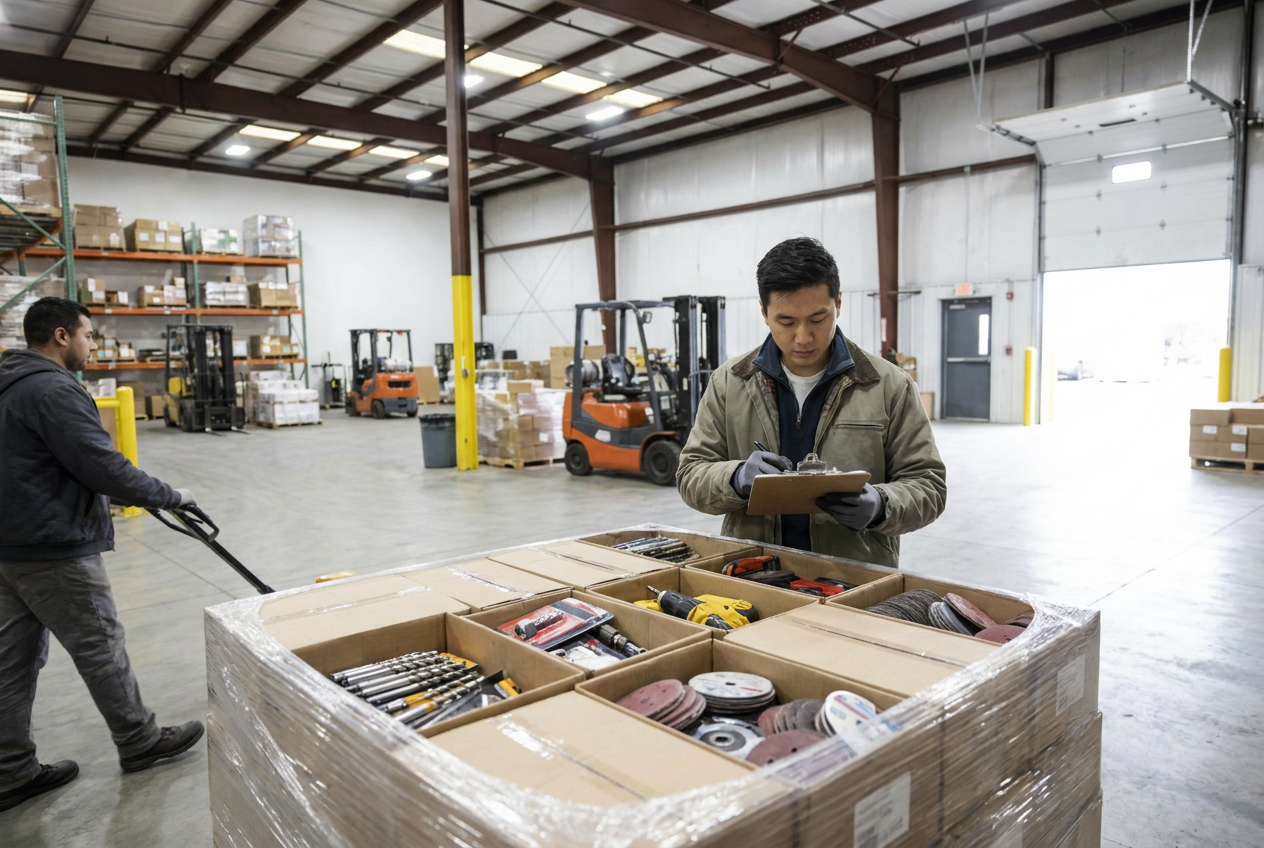
Prepare a clear receiving area, camera and copy of the order documents. At delivery, count handling units and inspect wrap, cartons and pallets for visible damage. Photograph the load before unpacking and record specific visible exceptions on delivery paperwork where applicable.
After unloading, reconcile the shipment with the order and manifest. Keep packaging, labels and records while investigating a discrepancy. Distinguish transport damage, missing handling units and item-level condition findings; they require different evidence.
All merchandise remains as-is for resale. Do not assume a return, refund, replacement or warranty is available because an accessory is worn, incomplete or incompatible. Review the refund and claims policy before payment for applicable eligibility, deadlines and procedures, and report concerns promptly with the order number, photographs and a precise description. Documentation supports review but does not guarantee a remedy.
During sorting, create separate groups for identified inventory, further research and quarantine. Avoid common mistakes: listing before inspection, calling an opened kit complete without counting it, merging different interfaces into one SKU, or performing improvised powered tests on damaged accessories. Follow manufacturer instructions and use qualified inspection when needed.
Frequently asked questions
Are power tool accessory lots compatible with every brand?
No. Some accessories use common interfaces, while others depend on exact dimensions, mounting systems or equipment models. Verify the accessory and tool specifications rather than relying on a brand or “universal” label alone.
Does a manifest guarantee usable quantities?
No. A manifest may describe packs, kits or individual pieces without confirming condition or completeness. Establish the counting method and inspection status before using its totals in a buying calculation.
Can customer-return accessories be sold as new?
A customer-return label does not establish that an item is new. Inspect each item and follow the selling platform’s condition rules, accurately disclosing wear, opened packaging, missing parts and testing limitations.
Is a pallet better than a truckload for a first purchase?
A smaller purchase can limit the amount requiring storage and sorting, but it does not guarantee a representative mix or better condition. Choose according to your receiving capacity, fitment knowledge and ability to document the inventory.
How does delivery work, and can unsuitable items be returned?
Every order ships free to the 48 contiguous states, with freight included in the listed price. Handling is 1–3 business days after payment clears, followed by typical transit of 3–7 business days from Dallas. Merchandise is sold as-is for resale; review the applicable policy before ordering rather than assuming unsuitable items are returnable.
Talk to PalletCove Liquidation
Choose identifiable fitment, documented condition and manageable processing requirements before chasing piece count. For listing details, manifests and receiving questions, contact our order desk, then review current inventory for available offers.
PalletCove Liquidation LLC
- Address: 4820 Cove Industrial Blvd, Dallas, TX 75236
- Phone: (713) 819-3904
- Email: sales@palletcoveliquidation.com
- Hours: Mon–Fri 8:00 AM – 6:00 PM CT, Sat 9:00 AM – 2:00 PM CT, Sun closed