

Selling expired cosmetics is not governed by one simple rule. In the United States, ordinary cosmetics generally do not have to carry expiration dates under federal law, but sellers still cannot distribute adulterated or misbranded products. Products that also qualify as drugs—including sunscreen and many acne treatments—require a different review.
For a liquidation reseller, the practical question is not just whether a bottle has passed a printed date. It is whether the product is correctly classified, safe and properly labeled, traceable enough to evaluate, and permitted on the intended sales channel. Missing dates and intact packaging do not answer all those questions.
This guide focuses on that decision. For the broader purchasing process, use our guide to buying liquidation pallets before committing to beauty inventory with uncertain shelf life.
1. Separate ordinary cosmetics from drug products
A cosmetic generally cleanses, beautifies, promotes attractiveness, or alters appearance. A drug is intended to diagnose, treat, prevent, or mitigate disease, or affect the body's structure or function. Intended use—including package claims and claims made in your listing—matters more than the aisle where an item was sold.
| Product example | Typical federal classification | Reseller checkpoint |
|---|---|---|
| --- | --- | --- |
| Lipstick, blush, ordinary fragrance | Cosmetic | Check labeling, condition, manufacturer guidance, and channel eligibility |
| Moisturizer without therapeutic claims | Cosmetic | Review dates, storage history, seals, and signs of deterioration |
| Sunscreen or SPF moisturizer | Drug, or both cosmetic and drug | Check Drug Facts, expiration, labeling, and storage requirements |
| Acne treatment containing a drug active ingredient | Drug, sometimes also cosmetic | Do not treat it as ordinary skin care |
| Antiperspirant or antidandruff shampoo | Drug, sometimes also cosmetic | Review active ingredients and therapeutic claims |
OTC means over-the-counter: a drug sold without a prescription. A Drug Facts panel is a strong signal that the product belongs in the drug-review queue, although missing required labeling does not turn a drug into a cosmetic.
Federal drug manufacturing rules generally require expiration dating supported by stability testing, with limited exemptions. Do not use those exemptions to infer that undated liquidation sunscreen is suitable for resale. FDA consumer guidance advises against using expired sunscreen; undated sunscreen of unknown age should not be treated as verified usable inventory.
The absence of a federally required cosmetic expiration date is not permission to sell an unsafe, mislabeled, recalled, or marketplace-prohibited product.
State and local requirements may add restrictions. Confirm the rules for your business location and destination market, especially before reselling OTC drugs. This is operational guidance, not a legal determination for a particular lot.
2. Understand expiration dates, PAO symbols, and lot codes
An expiration date identifies the manufacturer's stated usable period under specified conditions. A best-before date may communicate quality guidance, but its meaning should be verified rather than assumed. Preserve both exactly as printed.
A period-after-opening symbol, or PAO, commonly depicts an open jar marked with a duration such as 12M. It describes a recommended period after opening, not a manufacturing date or a guarantee that an unopened product lasts indefinitely. For a customer return with unknown opening history, you cannot reliably start that clock yourself.
A lot or batch code helps identify a production batch. It is not automatically an expiration date. Third-party batch-code websites may be incomplete or wrong; ask the manufacturer to interpret ambiguous codes and retain the response.
Heat, sunlight, freezing, moisture, and contamination can shorten usable life before any printed deadline. Odor, separation, discoloration, leaking, or swelling justify a hold, but the absence of these signs does not prove microbiological safety or drug potency.

Do not erase dates, cover batch codes, or replace a manufacturer's shelf-life statement with your own. If a date cannot be interpreted, keep the product on hold rather than listing it as unexpired.
3. Build a documented sorting and labeling check
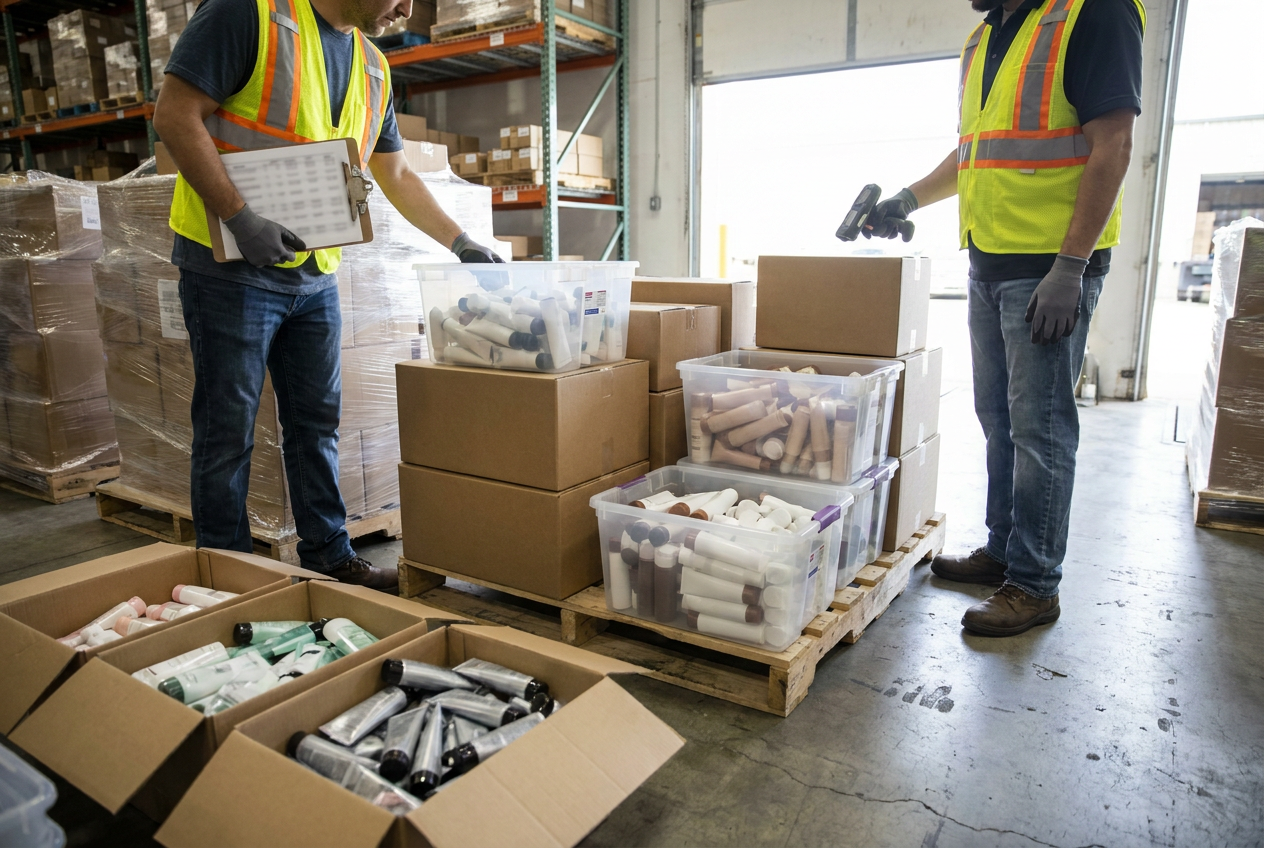
Sorting means separating incoming inventory into groups based on identification, condition, and resale eligibility. For cosmetics, establish distinct release, hold, and unsellable areas so questionable stock cannot accidentally reach shoppers.
Use this sequence for each product group, with unit-level checks where condition or dates vary:
- Identify the product. Record its name, size, UPC if present, batch code, and any expiration or PAO marking.
- Classify it. Review intended use, therapeutic claims, Drug Facts, and active ingredients.
- Inspect packaging. Look for leakage, tampering, broken seals where seals are expected, and missing labels. Not every legitimate cosmetic originally has a tamper seal.
- Review required information. Check applicable identity, quantity, ingredient, business-contact, warning, and drug-labeling requirements. Required information may appear on an outer carton that is now missing.
- Check recalls and authenticity concerns. Match the exact product and affected lot, not just the brand name.
- Decide and document. Release only after the relevant checks are satisfied; otherwise hold for clarification or route out of resale.
Our product recall screening guide for resellers covers the broader recall workflow. Record the search date and result because a recall check is a point-in-time review, not a permanent clearance.
Do not open sale units to smell or sample them as a routine inspection method. That can introduce contamination and change their condition. An intact outer box also does not justify describing a customer return as new.
Keep suspect inventory separate, including testers, products with uncertain use history, and items with missing mandatory information. Do not dilute, combine, decant, or relabel questionable stock to make it saleable. Repackaging or changing claims can create additional regulatory obligations.
4. Read the load description before calculating value
A liquidation pallet is a palletized wholesale lot; a truckload is a larger shipment, potentially a full trailer. Neither describes safety, shelf life, or condition. A manifest is an inventory list, not proof that each listed unit is present, unopened, unexpired, or eligible for your channel.
Condition grade is the seller's stated classification of merchandise. Grading systems vary, so read the listing's actual definition rather than importing assumptions from another supplier. Our guide to liquidation pallet types explains these broader distinctions.
- Overstock: Excess inventory; it can still be old or close-dated.
- Shelf pulls: Merchandise removed from selling shelves; packaging wear and date variation may occur.
- Customer returns: Returned products with potentially uncertain handling or opening history.
- Salvage: Merchandise requiring especially cautious evaluation; do not assume consumer-use eligibility.
- As-is: A contractual condition description, not an exemption from safety or labeling rules.
Start with the liquidation pallets inventory hub. The general merchandise category and truckload category are broader sourcing options, not promises of cosmetics availability.
Likewise, the Amazon General Merchandise Truckload listing and WM GM Truckloads Pallets listing should be evaluated only for their actual listed contents and condition. Their names do not establish that cosmetics are included. PalletCove is an independent reseller and is not affiliated with, endorsed by, or sponsored by any retailer named.
Ask whether the available manifest includes dates, batch information, and condition notes. If it does not, price the uncertainty explicitly rather than treating every listed beauty item as saleable.
5. Check the channel before choosing a pricing strategy
An online marketplace is a third-party platform that connects sellers and buyers. Its rules can be stricter than the legal minimum and may distinguish expired cosmetics, used cosmetics, testers, OTC drugs, and products without original packaging.
Review the platform's current restricted-product and beauty-category policies before purchasing, then again before listing. Check remaining-shelf-life requirements, fulfillment-center rules, invoice requirements, and whether the product's actual condition is allowed. Our eBay liquidation listing restrictions guide addresses the broader listing workflow without replacing current platform policies.
A bin store sells merchandise from bins, often using scheduled price reductions. A flea market is a venue where independent vendors sell from stalls or tables. Neither format removes product-safety obligations: shoppers must still be able to inspect required labels, and outdoor heat can create additional storage problems.
A pricing strategy is a repeatable method for setting prices based on eligible inventory, costs, demand, and time available to sell. For cosmetics, use only units cleared for the intended channel in your saleable-unit calculation:
Effective acquisition cost per cleared unit = listed lot price ÷ units cleared for resale.
Then account for labor, marketplace charges, packaging, storage, and appropriate disposal costs. Freight is included in PalletCove's listed price. For a broader budgeting method, see calculating a liquidation pallet buying limit.
Disclosing that something is expired does not override a marketplace prohibition or make an unsafe product acceptable. Avoid unsupported claims such as “safe past expiration” or “still fully effective.”
6. Confirm ordering, payment, and receiving arrangements
Before ordering, confirm the listing, actual condition grade, manifest limitations, quantities or stated estimates, and applicable claims terms. PalletCove sells category-level pallets and truckloads; do not assume item-level testing or a verified expiration audit unless the specific listing expressly establishes it.
Payment methods are those shown at checkout: card via a secure payment link, ACH, bank wire, and listed payment apps. Valid resale certificates are reviewed and applied where the buyer's state allows.
Free shipping is the only delivery option on every order to all 48 contiguous states, with freight included in the listed price. Buyers sourcing liquidation pallets in Texas and liquidation pallets in Florida should still plan appropriate receiving space and prompt indoor storage.
Handling takes 1–3 business days after payment clears. Transit from Dallas is typically 3–7 business days, giving an estimated 4–10 business days total. The processing cutoff is 2:00 PM Central Time, America/Chicago, Monday–Friday; after-cutoff confirmations begin the next business day. Weekends and applicable holidays do not count.
LTL means less-than-truckload freight, where shipments share trailer capacity. Whether receiving an LTL shipment or a full trailer, confirm access and unloading arrangements with the order desk. Scaling from pallets to truckloads should follow demonstrated sorting and storage capacity—not merely a lower apparent cost per unit.
7. Inspect delivery and separate claims from resale decisions
On delivery day, photograph the shipment before unpacking, document visible damage, retain labels and paperwork, and record shortages or leakage as discovered. Move cosmetics into suitable storage promptly and quarantine questionable products. Delivery acceptance is not product-safety clearance.
Request delivery-issue reporting within 48 hours so documentation can be reviewed promptly. This does not shorten eligible new-product returns. A past-date discovery should be documented against the listing and applicable terms; it does not automatically establish a particular remedy.
Under the United States Refund & Returns Policy, products explicitly listed as NEW ONLY qualify for defective and non-defective returns and exchanges within 30 calendar days of delivery. Returns are by mail; the customer is responsible for the return label and shipping. A restocking fee of 15% of the product price applies, and refund processing takes 10 calendar days after authorized return receipt and inspection, or approval where no physical return is required.
Mixed and used loads have separate claims terms, not routine change-of-mind returns. Overstock, shelf-pull, customer-return, and salvage descriptions do not establish NEW ONLY eligibility.
For unsellable items, follow recall instructions where applicable and check local waste rules, particularly for aerosols, alcohol-containing products, and drug products. Do not automatically donate rejected stock or pour contents down drains. Retain disposal and claim records separately.
Frequently asked questions
Is selling expired cosmetics illegal in the United States?
There is no single federal expiration-date ban covering every ordinary cosmetic. However, adulterated or misbranded cosmetics cannot lawfully be marketed, and state requirements or marketplace policies may prohibit a particular sale.
Can I sell expired sunscreen if I disclose the date?
Do not release expired sunscreen for consumer use merely because you disclose its date. Sunscreen is regulated as a drug, FDA advises against using expired sunscreen, and channel requirements may expressly prohibit it.
Does an unopened cosmetic without an expiration date qualify for resale?
Not automatically. Check labeling, recalls, storage history, package integrity, manufacturer guidance, and channel rules; an unopened package does not establish unlimited shelf life.
Can a batch-code website prove a product is unexpired?
No. Use the manufacturer's interpretation where possible, because a batch code may identify production information without establishing expiration or remaining usable life.
Should close-dated stock go straight into a discount bin?
Only after it passes the same classification, condition, labeling, and channel checks as other stock. Allow realistic time for sale and use, and keep printed dates visible rather than treating a discount as a substitute for eligibility.
Talk to PalletCove Liquidation
Selling expired cosmetics responsibly starts with knowing which products should not reach a sales channel. Classify first, verify dates and labels, quarantine uncertainty, and calculate costs using cleared inventory. For the wider sourcing process, return to our liquidation pallet buying guide.
PalletCove Liquidation LLC is located at 4820 Cove Industrial Blvd, Dallas, TX 75236. Call (713) 819-3904 or email sales@palletcoveliquidation.com. Hours: Mon–Fri 8:00 AM – 6:00 PM CT, Sat 9:00 AM – 2:00 PM CT, Sun closed.
Before ordering, contact our order desk about available listing information and review current inventory for actual contents, condition descriptions, and included-freight prices.