
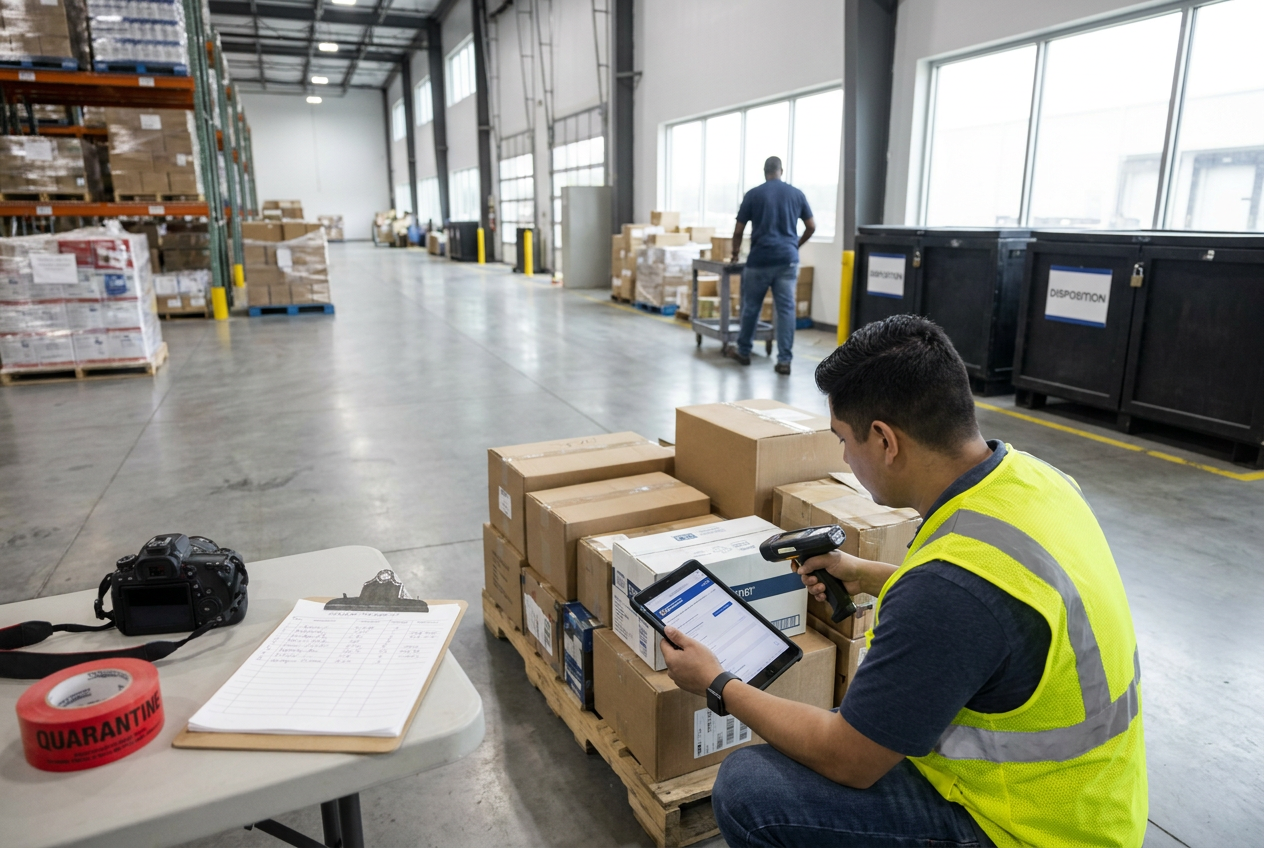
A liquidation item can look unused, power on normally and still be subject to a safety recall. Screening product recalls for resellers therefore belongs before display, listing or sale—not after a customer reports a problem. The useful question is not simply whether a brand has recalls, but whether the exact unit falls within an affected model, date, serial-number or lot range.
This guide focuses on U.S. recall screening for independent resellers buying category-level pallets and truckloads. For the broader purchasing process, use our guide to buying liquidation pallets. Here, the goal is a repeatable release-or-hold decision supported by identifiers, official notices and records.
1. Make recall clearance a release requirement
A recall is an action addressing an identified product problem, often involving a safety hazard and a specified remedy. Notices may direct owners to stop using a product, return it, obtain a repair or follow disposal instructions. A voluntary recall is not permission for resellers to ignore it: selling consumer products subject to applicable CPSC recalls is prohibited under federal law.
The Consumer Product Safety Commission, or CPSC, covers many household consumer products. Other agencies oversee categories such as food, drugs and motor vehicles. Apply the relevant agency’s rules and the particular recall notice rather than assuming every recall has the same remedy.
Make screening independent of your sales channel:
- A bin store, where shoppers select merchandise from open bins, needs release controls before products reach those bins.
- A flea market, where vendors sell from temporary booths or stalls, needs the same controls before booth stock is packed.
- An online marketplace, a platform connecting third-party sellers and buyers, needs clearance before listings go live.
Sorting means separating inventory into operational groups such as category, condition and sale eligibility. Put recall status ahead of your pricing strategy, the method used to set selling prices and markdowns. A discount or “as-is” description cannot legalize selling prohibited recalled goods.
A working product is not necessarily a safe product, and a database search is only as reliable as the identifiers you checked.
2. Plan screening before buying a load
A liquidation pallet consolidates goods into a pallet-sized purchase; a truckload involves a much larger shipment, commonly a full trailer. Category-focused loads can simplify identification, while general merchandise may require searches across several agencies. Review liquidation load types when matching screening capacity to purchase size.
A manifest is an inventory list, not proof of recall clearance. It may contain only descriptions, quantities or retailer stock codes rather than manufacturer model numbers. Ask what identifiers are available and plan to verify the physical goods.
A condition grade describes the seller’s stated merchandise condition; grading labels are not universally standardized. Overstock is excess inventory, shelf pulls are goods removed from retail shelves, customer returns were returned by buyers, and salvage generally indicates distressed inventory intended for recovery or parts under the listing’s terms. None of these labels establishes recall status. Treat merchandise as new only when explicitly supported by the actual listing.
When comparing general merchandise inventory with truckload inventory, account for identification labor and quarantine space. For example, examine the listed contents and available identifiers on the Bulk Hamilton Beach Truckload and Home Depot Tool and Hardware Truckload. These are purchasing references, not statements that those loads contain recalled products.
Build your buying limit around the listed lot price, screening labor, storage and possible lawful disposition costs. Do not treat manifest retail values as expected resale proceeds. PalletCove is an independent reseller and is not affiliated with, endorsed by or sponsored by any retailer named.
3. Capture identifiers before searching
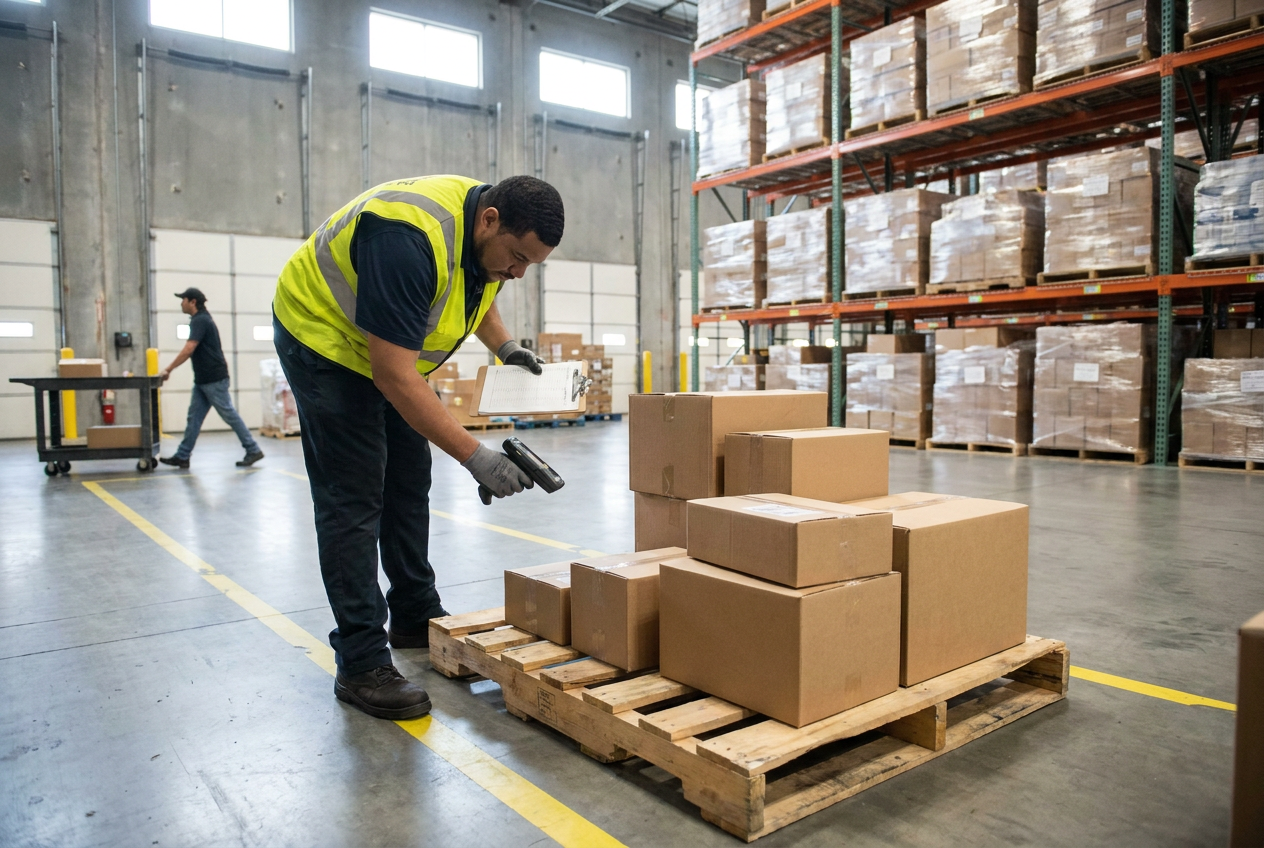
Assign each received lot an internal ID and connect individual items or traceable groups to it. Photograph labels before cleaning, repackaging or separating accessories. Keep the original packaging when it carries information missing from the product itself.
Capture these fields where available:
| Field | Why it matters |
|---|---|
| --- | --- |
| Manufacturer, brand and product type | Establishes the initial search scope |
| Model number, including suffixes | Distinguishes similar-looking variants |
| Serial number or serial range | May determine whether the unit is affected |
| Lot, batch and manufacturing date | Often narrows a recall to specific production |
| UPC or other barcode | Supports identification but may not establish coverage alone |
| Importer or distributor | Helps locate notices involving private-label goods |
| Internal lot ID and storage location | Connects the decision to physical inventory |
| Source invoice and label photographs | Preserves the identification trail |
A retailer SKU is not necessarily a manufacturer model number. Search both when useful, but never substitute a broad title such as “cordless drill” for a specific identifier. Compare labels on chargers, batteries and included accessories separately when they have their own model information.
If a required label is missing or unreadable, place the item on hold. Seek identification help from the manufacturer or recall administrator. A visual resemblance is not enough to clear it.

4. Search official sources and compare the full notice
Start with the regulator responsible for the product. General web searches and marketplace alerts can help locate a notice, but confirm the result at an official source.
| Official source | Main use in reseller screening |
|---|---|
| --- | --- |
| CPSC recall database | Household consumer products, including many appliances, tools, toys and furnishings |
| FDA recalls and safety alerts | FDA-regulated products, including many foods, drugs, cosmetics and medical devices |
| USDA FSIS recalls | Meat, poultry and processed egg products under FSIS jurisdiction |
| NHTSA recalls | Motor vehicles and related equipment, including tires and child car seats |
| Recalls.gov | Federal recall gateway when agency jurisdiction is unclear |
Use a consistent search sequence:
- Search the exact model number and brand. Repeat with meaningful variations in spaces, punctuation and suffixes.
- Search manufacturer, importer and product type to catch notices indexed under different names.
- Open potentially relevant notices and compare every scope-defining field—not just the photograph or headline.
- Read expansions, updates and remedy instructions. Follow the official notice’s manufacturer link when a serial-number checker or registration process is provided.
- Save the notice URL, recall number, search date, terms used, identifiers compared and reviewer’s decision.
For a hypothetical appliance recall limited to model AB-200 manufactured during specified months, the model match is only the first step. A unit lacking a readable date code stays on hold until its coverage can be resolved.
Record a negative result as “no matching recall found in sources checked on this date,” not “certified safe.” Older products may have older recalls; an absent search result does not resolve missing identifiers, unrelated defects or other compliance restrictions.
5. Quarantine matches and resolve uncertainty
Use clear inventory statuses: pending screening, hold—possible match, confirmed affected, released, and disposed or returned. Only released stock should feed sales channels.
Physically separate held goods in a marked area and block their internal IDs from listings, transfers and order picking. Pause existing listings and stop pending fulfillment when an affected item is identified. A removable sticker alone is a weak control if another worker can accidentally restock the product.
For confirmed or possible matches:
- Record the quantity, identifiers and exact storage location.
- Attach the official notice and hazard summary to the inventory record.
- Follow stop-use instructions; do not power on a hazardous product to confirm the problem.
- Contact the manufacturer or recall administrator using verified contact details from the official notice.
- Ask about reseller eligibility, required proof, available remedies and handling instructions.
- Notify the supplier with the invoice, lot ID and evidence, while keeping the recall process separate from any purchase claim.
Keep potentially hazardous batteries and other dangerous goods out of ordinary shipping or waste streams. Obtain appropriate handling guidance rather than improvising a return shipment.
6. Document lawful disposition and monitor released stock
Follow the recall’s prescribed remedy. Depending on the notice, this may involve an authorized repair, replacement, return, refund or specific destruction instructions. Do not assume every reseller qualifies for every remedy, or that a supplier credit makes an affected item saleable.
Do not donate, export, bundle or sell affected goods for parts as a shortcut around recall restrictions. Likewise, an ordinary recycler’s receipt does not by itself prove compliance with instructions requiring a particular treatment. Confirm the applicable requirements with the recall administrator and an appropriate disposal provider.
Release a repaired unit only after the required remedy is completed and you have confirmed resale is permitted. Keep unit-specific evidence rather than applying one repair receipt to an entire batch.
Maintain a record containing:
- Original identifiers, photographs and source transaction.
- Search results, recall notice and decision history.
- Quarantine quantities and movement records.
- Manufacturer correspondence and remedy authorization.
- Repair, return or destruction evidence tied to affected units.
- Final status, completion date and responsible reviewer.
Recheck long-held stock before sale and subscribe to relevant agency alerts. If a newly announced recall affects already-sold inventory, stop remaining sales, preserve transaction records and coordinate customer notification and reporting obligations with the manufacturer or regulator. Avoid promising a remedy you are not authorized to provide.
7. Fit the workflow into ordering, receiving and channel operations
Start with the listed descriptions in the liquidation pallets hub, then confirm your receiving capacity and screening workload before ordering. Whether considering liquidation pallets in Texas or liquidation pallets in Florida, the same federal recall-screening discipline applies.
PalletCove’s only delivery option is free shipping on every order to all 48 contiguous states; freight is included in the listed price. Confirm receiving arrangements for LTL, meaning less-than-truckload freight, or a full trailer as applicable. Handling takes 1–3 business days after payment clears; transit from Dallas is typically 3–7 business days, for an estimated 4–10 business days total.
The processing cutoff is 2:00 PM Central Time, America/Chicago, Monday–Friday. After-cutoff confirmations begin the next business day; weekends and applicable holidays do not count. Payment methods are those shown at checkout: card via a secure payment link, ACH, bank wire and listed payment apps. Valid resale certificates are reviewed and applied where the buyer’s state allows.
On delivery day, photograph shipment condition, count handling units and document visible damage or discrepancies. Request delivery-issue reporting within 48 hours, but recognize that receiving inspection does not replace unit-level recall screening.
Under the Refund & Returns Policy, U.S. products explicitly listed as NEW ONLY qualify for defective and non-defective returns and exchanges within 30 calendar days of delivery, by mail. Customers are responsible for return labels and shipping; the restocking fee is 15% of product price. Refund processing takes 10 calendar days after authorized return receipt and inspection, or approval where no physical return is required. Mixed/used loads have separate claims terms, not routine change-of-mind returns; the requested 48-hour delivery report does not shorten eligible new-product returns.
Common operational mistakes include searching only a brand, assuming sealed packaging means clearance, mixing held units into priced stock and treating a marketplace’s listing acceptance as safety approval. See eBay liquidation listing restrictions for the separate online listing workflow and selling liquidation at flea markets for booth planning. Starting a bin store, sorting and pricing inventory, handling unsellable items, and scaling from pallets to truckloads all depend on preserving this release gate—not bypassing it.
Frequently asked questions
Can I sell a recalled item with a warning?
A warning, discount or “as-is” label does not override a recall-related sale prohibition. Hold the item and follow the applicable notice and regulatory requirements.
Does a successful power test clear an item?
No. Recall hazards may involve overheating, structural failure or other problems that a brief function check cannot detect. Match identifiers against the official notice independently of condition testing.
What if the manifest has no model numbers?
Use it for receiving reconciliation, then collect identifiers from the physical products. If coverage cannot be resolved because required identifiers are missing, keep the item on hold.
Can I resell a product after a recall repair?
Possibly, if the required remedy was properly completed and resale is permitted. Obtain confirmation and retain evidence tied to the specific unit; do not assume a generic replacement part resolves the recall.
How often should I repeat screening?
Screen before initial release, recheck long-held inventory before sale and respond promptly to relevant new recall alerts. No search can guarantee that a product will not be recalled later.
Talk to PalletCove Liquidation
Recall screening works best when identification, quarantine and documentation are designed into purchasing—not added after inventory reaches customers. Return to our liquidation pallet buying guide for the broader buying process, and keep this workflow as a separate release checklist.
PalletCove Liquidation LLC is located at 4820 Cove Industrial Blvd, Dallas, TX 75236. Call (713) 819-3904 or email sales@palletcoveliquidation.com. Hours are Mon–Fri 8:00 AM – 6:00 PM CT, Sat 9:00 AM – 2:00 PM CT, Sun closed.
For questions about listed merchandise and available documentation, contact our order desk or review current inventory.