
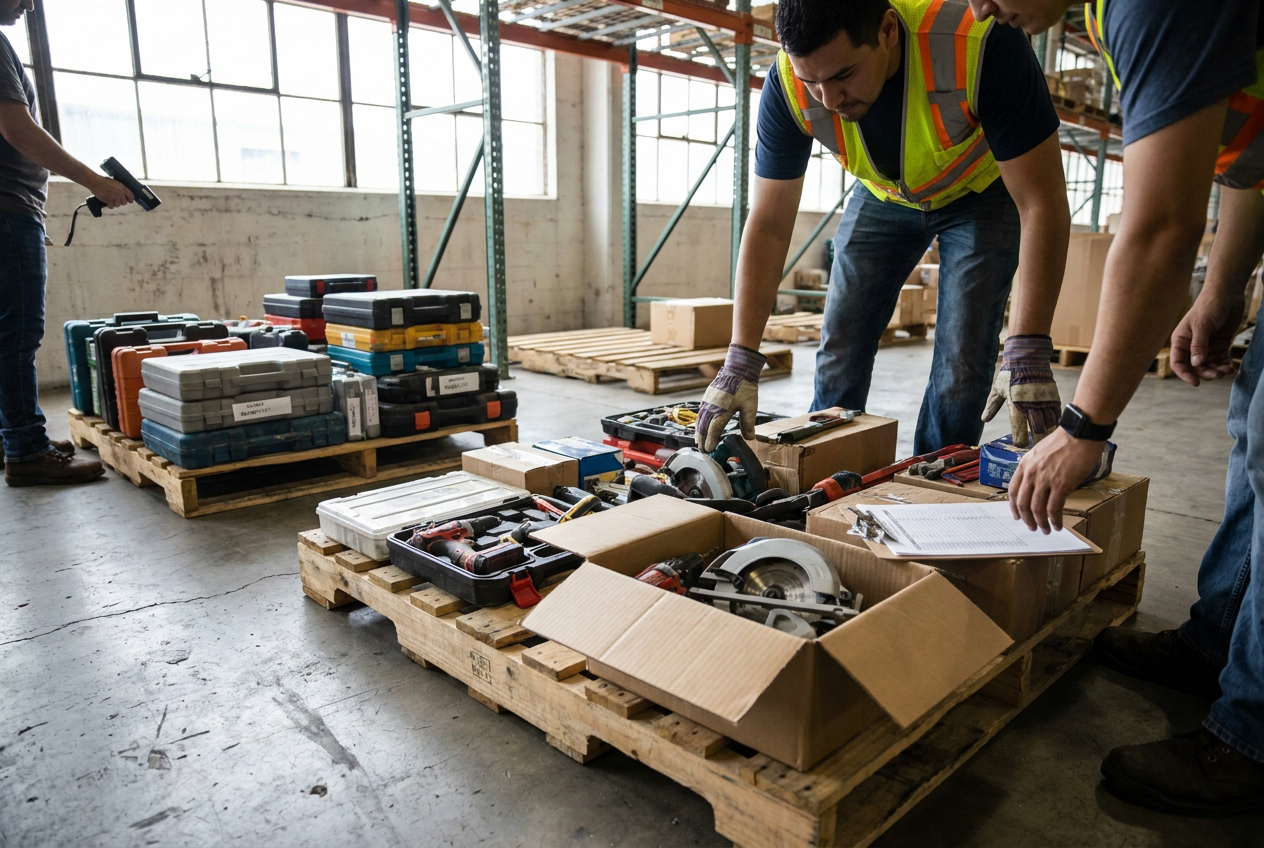
Tool liquidation pallets can contain cordless drills, saws, hand tools, fasteners, shop equipment and outdoor power equipment. Their usefulness to an independent reseller depends on more than recognizable brands or a long item list: completeness, battery compatibility, physical condition and the work required to evaluate each unit all matter.
PalletCove Liquidation supplies manifested and category-level liquidation pallets and full truckloads from Dallas, Texas. All merchandise is sold as-is for resale. A manifest or condition label helps describe a load, but neither should be treated as a promise that every item works, includes its accessories or is ready for a retail shelf.
This guide explains how to compare loads, budget for inspection, receive shipments and document individual tools accurately before resale.
What tool and hardware liquidation loads contain
A liquidation pallet groups merchandise for bulk sale. A truckload is a larger purchasing unit that may occupy a full trailer; confirm the actual pallet count, dimensions and contents rather than assuming every truckload has the same capacity.
Common load types include:
- Tool-focused loads: Cordless and corded tools, hand tools, cases, batteries and chargers in varying combinations.
- Hardware loads: Fasteners, hinges, locks, shelving components and other small packaged goods.
- Power-equipment loads: Pressure washers, compressors, lawn equipment or similar bulky machinery, depending on the listing.
- Mixed home-improvement loads: Tools alongside lighting, plumbing, fixtures and general merchandise.
A manifested load provides an itemized reference. A category-level load describes the merchandise category without necessarily providing a complete item-by-item inventory. Neither format independently establishes testing status.
Start with the liquidation pallets hub and the guide to different types of liquidation pallets. Compare Home Depot category listings with the broader truckload inventory category, checking each listing rather than treating a category name as a specification.
PalletCove is an independent reseller and is not affiliated with, endorsed by or sponsored by any retailer named.
Condition grades and packaging: what they actually tell you
Condition terminology varies among suppliers and listings. Ask what a condition grade means for the particular load, including whether it describes the merchandise, packaging or both.
| Description | General meaning | Tool-specific checks |
|---|---|---|
| --- | --- | --- |
| Overstock | Excess inventory offered through liquidation | Storage wear, corrosion, battery age and package contents |
| Shelf pulls | Merchandise removed from selling displays or shelves | Display use, missing labels and opened packaging |
| Customer returns | Merchandise returned by a previous buyer | Faults, substitutions, missing parts and signs of use |
| Salvage | Merchandise intended for repair, parts recovery or other limited use, as described | Safety hazards, repair feasibility and disposal needs |
| Mixed condition | Multiple condition types within one load | Item-level sorting rather than one assumption for the whole pallet |
An intact box does not establish that the tool inside is unused or functional. A torn box does not necessarily mean the tool is damaged. Separate packaging condition from product condition in your inventory records.
Look for broken seals, re-taping, water staining, crushed corners and mismatched model labels. A case can conceal an incomplete kit; a sealed-looking carton can still require verification. Do not treat a label such as “Tier 2” or “Tier 3” as a universal industry grade.
Reading a manifest without overestimating completeness
A manifest is a purchasing reference, not a substitute for physical inspection. Depending on the listing, it may include descriptions, model numbers, quantities, identifiers, condition notes or reference retail figures. Confirm which fields are available and what they represent.
Before ordering, check:
- Model identity: Does the description distinguish a bare tool from a battery-and-charger kit?
- Quantity units: Is one unit a single fastener, a bag, a boxed assortment or a complete kit?
- Accessories: Are batteries, chargers, guards, hoses and cases explicitly listed or merely pictured on packaging?
- Duplicates: Can your sales channels handle repeated models or specialized accessories?
- Testing scope: Is any testing documented, and does it apply to individual items or only a sample?
- Manifest limitations: Is the document complete, estimated or subject to stated discrepancies?
Reference retail figures are not evidence of present resale value. Discontinued models, incomplete kits and items needing repair require their own evaluation.
Use the liquidation pallet manifest guide for document review. When comparing the Home Depot Tool and Hardware Truckload listing with the HD GM Truckloads Pallets listing, verify the current descriptions and available documentation. Product names alone do not establish contents, availability or condition.
Testing tools, batteries and power equipment safely
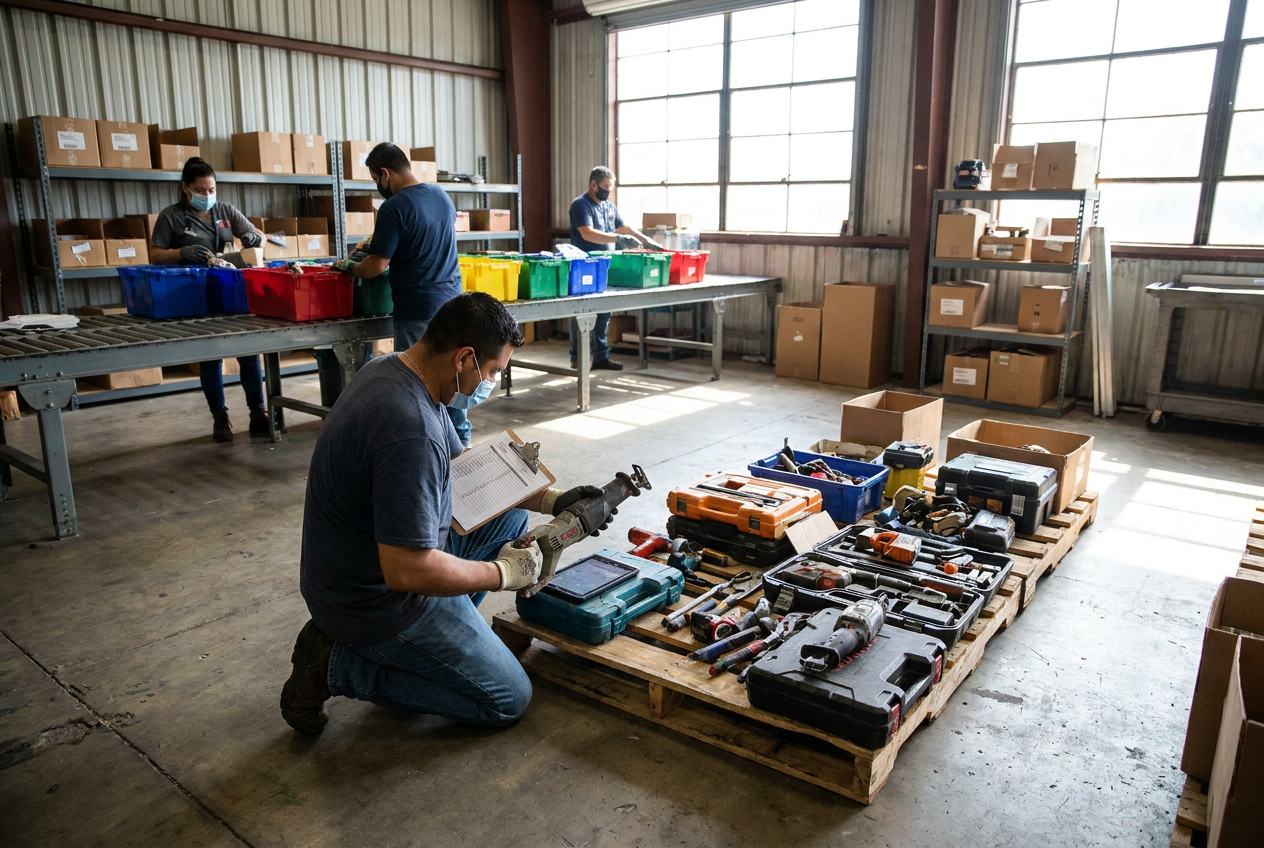
Set up a receiving workflow with separate areas for unchecked merchandise, inspection, verified items and safety holds. Label each item with an inventory number tied to its manifest row, where available.
Inspect before applying power
Check housings, cords, plugs, switches, guards, handles, battery contacts and attachment points. Look for cracks, corrosion, loose components, heat discoloration, fuel leaks or signs of modification. Check applicable recall information using the exact model and serial number before offering an item for resale.
Do not energize equipment with visible electrical damage, missing safety components or unknown modifications. Arrange qualified evaluation where needed; a quick startup does not establish electrical or mechanical safety.
Separate tool faults from battery and charger faults
Cordless tools need a compatible battery platform, not merely a battery that looks similar. Verify voltage, connector type and manufacturer compatibility information. If safe and appropriate, a known-good compatible battery or charger can help isolate which component is failing.
Do not charge swollen, leaking, punctured or heat-damaged batteries. Isolate them from saleable stock and obtain appropriate handling guidance. Check applicable battery transport and recycling requirements rather than placing damaged batteries into ordinary outgoing parcels.
Check the parts that make equipment usable
Common missing components include:
- Saw guards, fences, blade hardware and adjustment handles.
- Drill side handles, chucks, belt clips and cases.
- Pressure-washer hoses, spray guns, nozzles and inlet fittings.
- Compressor regulators, gauges, fittings and drain components.
- Lawn-equipment batteries, chargers, collection bags and safety keys.
Use model-specific parts diagrams when possible. Similar-looking parts may not fit or operate safely.
Fuel-powered equipment requires trained handling, appropriate ventilation and manufacturer-directed checks. Never run an engine indoors or in a trailer. Pressure systems and cutting equipment also require suitable procedures and protective measures.
Record exactly what was checked: visual inspection, charging response, startup, controls and any manufacturer-appropriate functional testing. “Powered on” is not equivalent to tested under normal operating conditions, and it says nothing by itself about battery runtime.

Pricing a load around the work it requires
The listed price is the merchandise purchase price with freight included. Free shipping is the only delivery option on every PalletCove order to all 48 contiguous states.
Your internal evaluation should also account for the work after delivery:
- Unloading, sorting and storage capacity.
- Inspection time and qualified repair labor, if appropriate.
- Replacement accessories and model-specific components.
- Repackaging, listing preparation and selling-channel costs.
- Responsible recycling or disposal of items unsuitable for resale.
Dividing the listed price by the manifest quantity gives an average acquisition cost per listed unit, not per usable tool. That distinction matters when a load combines machines, inexpensive hardware, incomplete kits and salvage.
Buy against documented contents and your inspection capacity—not an assumption that every boxed tool is complete or working.
The guide to buying liquidation truckloads can help you decide whether your space and workflow suit a full trailer or a smaller purchase. No load should be evaluated on promised profit or guaranteed resale value.
Ordering, payment and free shipping from Dallas
Before paying, confirm the load identifier, available manifest, condition description, order quantity and receiving requirements. Keep the listing and any written clarification with your purchase records.
PalletCove accepts credit/debit card, ACH bank transfer and domestic bank wire. Review the payment policy and use the order instructions provided for your purchase. Handling time is 1–3 business days after payment clears; transit is typically 3–7 business days from Dallas. Handling and transit are separate stages, and typical transit is not a guaranteed arrival date.
Sales tax on qualifying orders is covered by PalletCove. Ask whether your order qualifies and whether a resale certificate or other documentation is needed; do not assume every purchase has identical documentation requirements.
Smaller shipments may travel by LTL, or less-than-truckload freight, while larger loads may use a full trailer. Confirm the arrangement for the particular order and review the shipping policy.
Whether purchasing liquidation pallets in Texas or liquidation pallets in Florida, free shipping is the only delivery option, with freight included in the listed price. This applies to every order across all 48 contiguous states.
Delivery-day inspection and receiving records
Prepare before the truck arrives. Confirm vehicle access, unloading arrangements, pallet dimensions and weight where available. Have suitable handling equipment and enough clear, dry space to keep unchecked merchandise separate.
Use this receiving sequence:
- Match the shipment identifiers and visible pallet count against the delivery paperwork.
- Photograph the shipment before unloading or removing wrap when safe and permitted.
- Check for broken boards, leaning stacks, crushed cartons, punctures, wet packaging or disturbed wrapping.
- Record visible shortages or damage accurately on the delivery receipt before signing, following the carrier’s procedure.
- Photograph affected areas close up, preserving labels and shipment identifiers.
- Keep packaging and organize a detailed count after safe unloading.
Never climb an unstable pallet or attempt to catch falling equipment. Keep people clear of suspended loads and use trained equipment operators.
A delivery inspection documents visible shipment condition. It does not replace later item-level inspection, and a note on a receipt does not itself guarantee a claim outcome. Avoid calling every nonworking customer return “shipping damage”; those are different issues requiring different evidence.
Returns, claims and mistakes to avoid
All merchandise is sold as-is for resale. Do not assume a retail-style return window, manufacturer warranty coverage or eligibility for replacement accessories. Review the refund and claims policy before purchasing to understand applicable eligibility, deadlines, documentation and procedures.
If you discover a problem, preserve the order number, manifest, delivery receipt, photographs, packaging and affected item identifiers. Report it promptly through the stated process. Distinguish visible transit damage, an apparent order discrepancy and the underlying condition of returned merchandise. Available remedies depend on the applicable terms and circumstances; documentation does not guarantee a refund or replacement.
Common mistakes include treating every manifest line as a complete kit, charging unknown batteries without inspection, and listing hardware assortments without checking counts or sizes. Another is buying more units than your team can evaluate before storage becomes congested.
Avoid vague resale descriptions such as “fully tested” when only startup was checked. State observed defects, missing components and the actual testing performed. Do not sell recalled or unsafe equipment as ready to use; an as-is label is not a substitute for applicable product-safety obligations.
Frequently asked questions
Are tool liquidation pallets tested before sale?
Do not assume they are. Read the specific listing and ask what testing, if any, is documented, including whether it covers each item or a sample. All merchandise is sold as-is for resale.
Do cordless tools include batteries and chargers?
Not necessarily: a bare tool is different from a kit, and customer returns may be incomplete. Check the manifest and listing, then verify actual contents during intake. Match replacement components using model-specific compatibility information.
Is a manifested load guaranteed to match every line?
A manifest provides a reference, but its scope and accuracy terms depend on the listing and applicable policies. Ask about those limitations before ordering. Keep an itemized receiving record so any apparent discrepancy can be documented clearly.
How much does shipping cost, and how long does it take?
Free shipping is the only delivery option on every order to all 48 contiguous states; freight is included in the listed price. Handling takes 1–3 business days after payment clears, followed by transit typically lasting 3–7 business days from Dallas.
Can nonworking tools be returned?
Do not assume that a nonworking item qualifies for a return: merchandise is sold as-is for resale. Review the refund policy and the listing before purchase, and follow the applicable reporting process if an issue arises. Eligibility depends on the terms and circumstances.
Talk to PalletCove Liquidation
Ask about available manifests, condition descriptions and receiving requirements before choosing a load. You can contact our order desk or browse current inventory.
- Business: PalletCove Liquidation LLC
- Address: 4820 Cove Industrial Blvd, Dallas, TX 75236
- Phone: (713) 819-3904
- Email: sales@palletcoveliquidation.com
- Hours: Mon–Fri 8:00 AM – 6:00 PM CT, Sat 9:00 AM – 2:00 PM CT, Sun closed