
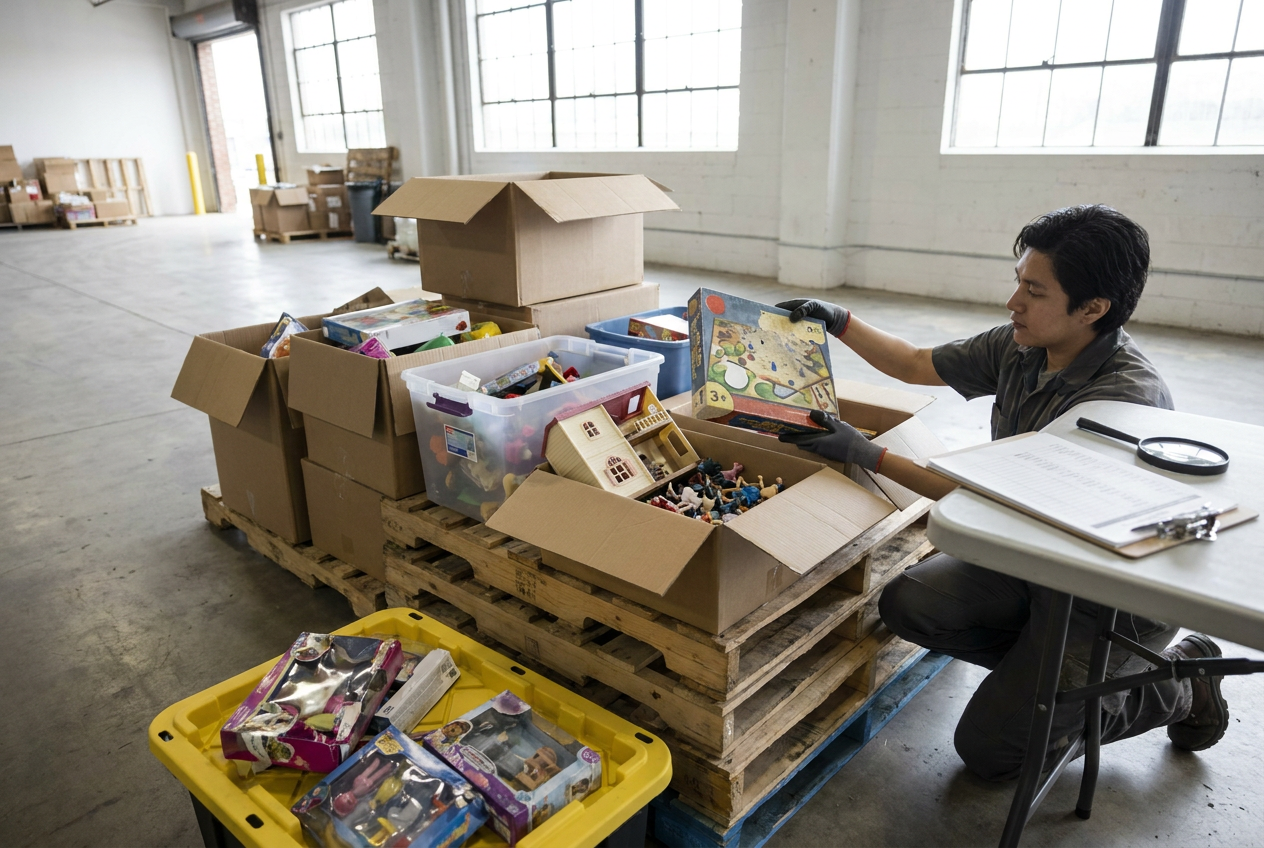
Toy liquidation pallets require more than a quick look at the outer cartons. A board game can appear untouched while missing its card deck, and a playset can contain its largest components without the connectors needed to assemble it. Packaging damage also matters when it removes age guidance, warnings or product identification.
For an independent reseller, the useful question is not simply whether a toy looks sellable. It is whether the exact item can be identified, checked for completeness, screened for safety concerns and described accurately. Those checks determine which units deserve further work and which should remain off sale.
PalletCove Liquidation supplies manifested and category-level liquidation pallets and full truckloads from Dallas, Texas. All merchandise is sold as-is for resale. This guide explains how to evaluate toy inventory without treating a manifest, condition grade or intact-looking box as a guarantee.
Understand load types and condition grades
A toy liquidation pallet is a consolidated shipment of toys offered as liquidation inventory. It may contain games, dolls, construction sets, electronic toys and playsets. A category-level load describes the merchandise category; a manifested load provides an inventory list with whatever fields the seller supplies. Neither description automatically establishes completeness.
Start with the liquidation pallets overview and compare the types of liquidation pallets before selecting a format. A single pallet limits the receiving workload, while a truckload or full trailer requires substantially more space and processing capacity.
| Inventory description | What it generally describes | Toy-specific verification |
|---|---|---|
| --- | --- | --- |
| Overstock | Excess stock that did not sell through its original channel | Check storage damage, seals and product identity |
| Shelf pulls | Merchandise removed from selling shelves | Look for display use, faded labels and opened packages |
| Customer returns | Merchandise returned after a customer transaction | Count components and inspect wear, batteries and operation |
| Salvage | Inventory offered with significant defects or recovery needs | Assess each unit; do not assume consumer resale suitability |
| Mixed condition | Multiple conditions within one load | Grade each unit rather than applying one label to everything |
Condition grade terminology is not universal. Request the definition used for the specific offer, including whether toys were opened, counted or function-tested. “Untested” does not mean working, and “open box” does not mean complete.
Read manifests and compare the actual purchase cost
A manifest may list descriptions, quantities, UPCs, model numbers and reference retail figures. Check whether its quantity field counts retail units, multipacks or cartons. A row reading “game assortment” is much less useful for completeness planning than an exact title and edition.
Ask whether the manifest describes the actual offered lot, when it was prepared and whether substitutions or discrepancies are addressed in the terms. Reference retail figures are not evidence of current selling prices or achievable resale value.
For broader sourcing, review the general merchandise category and truckload inventory category. Listings such as the Amazon General Merchandise Truckload and WM GM Truckloads Pallets are broader merchandise options; their names do not establish toy content. Confirm the current description and any available manifest before ordering.
PalletCove is an independent reseller and is not affiliated with, endorsed by or sponsored by any retailer named.
Compare the listed price for the entire offered lot, not just a headline unit count. Freight is included in the listed price. Separately budget your own inspection labor, storage, cleaning materials, replacement packaging, selling costs and disposal needs. An average acquisition cost per manifested unit is a planning calculation, not a prediction of how many complete toys you will receive.
Check game pieces and playset completeness systematically
Create a clean inspection station with trays, labeled bags and a camera. Keep each toy's contents isolated until counting is finished. Mixing pieces from several similar sets can make later identification harder and conceal which unit originally lacked a component.
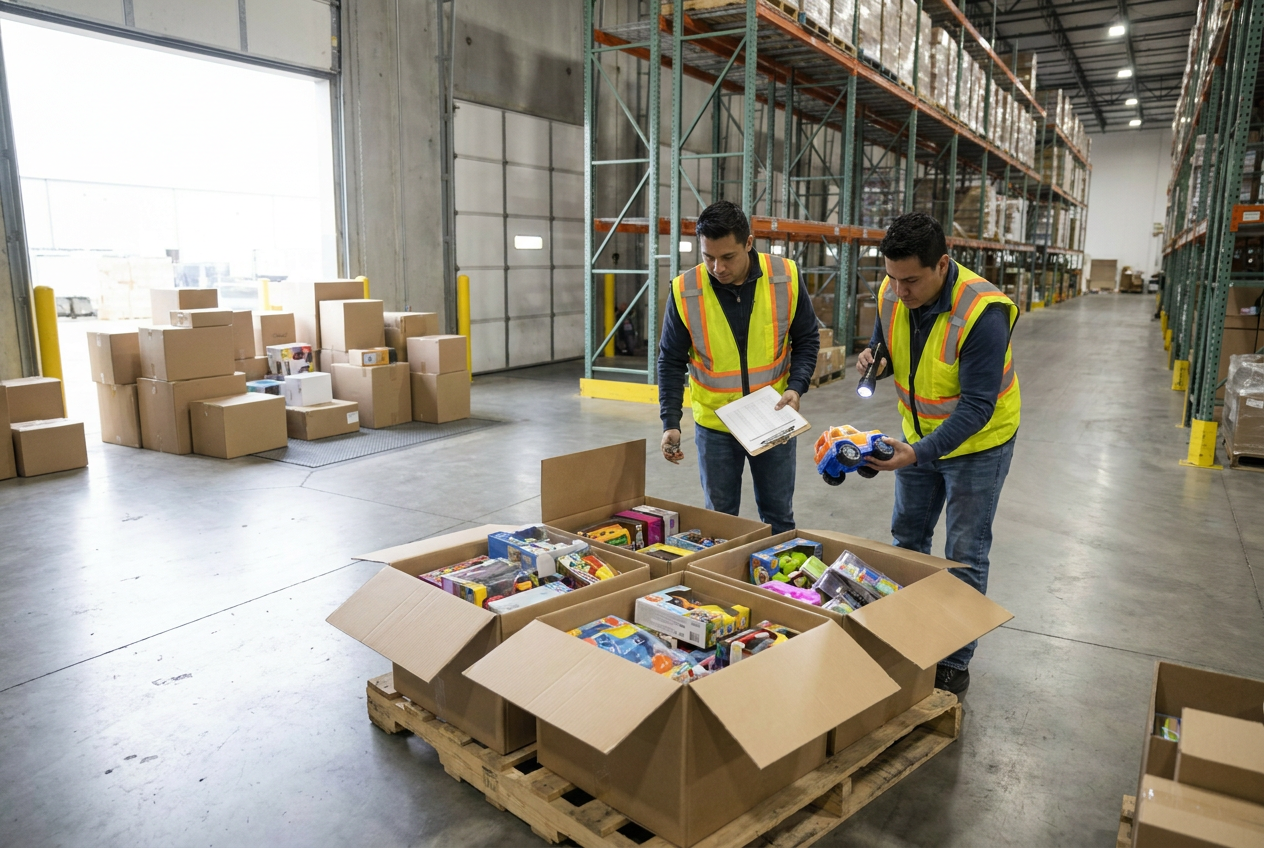
Use this sequence for each opened unit:
- Record the title, manufacturer, model, edition and UPC where available.
- Find the matching manufacturer's instructions or component list.
- Separate major parts, accessories, fasteners, cards and consumables.
- Count against the list and photograph the organized contents.
- Check fit and function only where safe and appropriate.
- Record missing, damaged or unverified components before assigning a resale status.
Board games and puzzles
Check more than the obvious playing pieces. Games may need a particular card distribution, spinner, timer, score pad, money set or electronic controller. A substitute pawn might not change basic play, but a missing unique card can make the game unusable as intended.
Matching a puzzle's printed piece count does not prove that every correct piece is present. Assembly provides stronger evidence of completeness. If you have not assembled it, do not describe the puzzle as verified complete solely because the count matches.
Playsets and construction toys
Inspect hinges, tracks, clips, supports, gates and connectors. A missing decorative accessory differs from a missing structural part. Avoid improvising load-bearing components, restraints, battery covers or other safety-related parts.
Use model-specific manufacturer information when considering replacements. The guide to missing accessories in liquidation lots provides a useful framework for deciding whether further sourcing effort is justified. Never describe a repaired or substituted set as factory-complete without support.
A toy is not verified complete just because its box is full; completeness depends on the correct components for that exact model and edition.
Verify age labels, warnings and product identity
Age grading is not interchangeable with a reseller's opinion of difficulty. It reflects the manufacturer's intended user group and may relate to hazards as well as developmental suitability. Do not lower the marked age range because a toy appears simple.
Check the package, toy and instructions for consistent identification. Where present, preserve model numbers, date or lot codes, manufacturer or importer details, age guidance and applicable warnings. Photograph these details before removing damaged packaging.
Important checks include:
- Small-parts warnings and any stated age restrictions.
- Secure battery compartments, especially for button or coin batteries.
- Loose or missing magnets, sharp edges, cracked plastic and exposed wiring.
- Projectile accessories and mechanisms that appear altered or damaged.
- Readable instructions needed for assembly or safe use.
- Signs that the toy and package belong to different versions.
Search the U.S. Consumer Product Safety Commission recall database and manufacturer notices using the model and available date or lot information. Selling recalled products is prohibited under federal law. Isolate a potentially affected unit until its status and applicable remedy are established; disclosure alone does not make it eligible for sale.
An absent age label is not permission to invent one. Seek authoritative information for the exact product. If identity, required warnings or safety suitability cannot be established, hold the unit off sale. A disclaimer such as “adult supervision required” does not resolve those uncertainties.
Separate packaging defects from product defects
Packaging can protect components, carry safety information and establish which version is inside. A dented carton with readable labels is different from a torn box missing its warning panel. Check seals, window panels, internal trays and evidence of moisture or contamination.

Distinguish packaging wear from damage to the toy itself in your records. Photograph crushed corners, torn flaps, marker writing, price stickers and broken seals. Do not call a resealed carton factory-sealed.
A practical sorting system uses four internal statuses:
- Verified for listing: identity, relevant checks and listing details are documented.
- Awaiting work: counting, cleaning or model-specific replacement sourcing remains unfinished.
- Parts evaluation: incomplete inventory requires a separate safety and suitability review before any parts listing.
- Hold from sale: recall concerns, unresolved identity, contamination or unsafe damage prevent listing.
These are workflow labels, not guarantees or substitutes for legal compliance. Parts-only wording does not permit selling recalled or otherwise prohibited merchandise. Keep original instructions with the matching toy whenever available, and avoid hiding warnings beneath replacement wrapping.
Order with receiving capacity and timing in mind
Before paying, confirm the lot identity, offered quantity, condition description and documents available. The guide to buying liquidation pallets can help structure those questions. Also decide who will receive the load and where unprocessed inventory will remain separated from ready-to-list stock.
PalletCove accepts credit/debit card, ACH bank transfer and domestic bank wire. Handling time is 1–3 business days after payment clears; transit is typically 3–7 business days from Dallas. These are separate stages, so schedule inspections after allowing for both.
Free shipping is the only delivery option on every order to all 48 contiguous states. Freight is included in the listed price. The same delivery framework applies when sourcing liquidation pallets in Texas or liquidation pallets in Florida.
Review the shipping policy and confirm receiving arrangements before ordering. Pallet shipments may move by LTL, while truckloads may use a full trailer; verify the arrangement for the specific order and ensure the receiving site can accommodate it.
Sales tax on qualifying orders is covered by PalletCove. Ask which documentation applies to your order, including whether a resale certificate is needed. Do not assume that every buyer or transaction qualifies without confirmation.
Inspect delivery and document potential claims
Delivery-day inspection and unit-level toy inspection serve different purposes. Receiving checks establish what arrived and its visible shipping condition. Later counting establishes what is inside individual packages.
At delivery:
- Match the shipment identifiers and pallet count to the order paperwork.
- Photograph the load before removing wrap, including visible damage.
- Note observable shortages or damage on the delivery receipt where applicable.
- Retain relevant labels, packaging and delivery documents.
- Separate affected inventory and report concerns promptly with supporting evidence.
After unloading, reconcile the inventory against the order description and manifest, if supplied. Document discrepancies precisely: “one missing wheel from model X” is more actionable than “bad toys.” Keep product-condition concerns distinct from apparent transit damage.
All merchandise is sold as-is for resale. Do not assume that missing pieces, opened packaging or nonworking toys automatically qualify for a return or reimbursement. Review the refund and claims policy before payment for applicable eligibility, procedures and deadlines. Photos and receipt notes support review but do not guarantee a particular outcome.
Avoid common toy-resale mistakes
The most expensive process failures often start with unsupported assumptions. Build checks into the workflow rather than relying on memory when writing listings.
- Treating an intact box as proof of untouched contents: inspect seals and describe only what you verified.
- Counting only large pieces: cards, connectors and fasteners can determine usability.
- Combining editions: similar-looking parts may differ in dimensions or game rules.
- Removing labels too early: preserve identification and warning information first.
- Testing with damaged batteries installed: isolate leakage or compartment damage before further handling.
- Writing “complete” after a sample inspection: sampled findings do not verify every unit in a load.
- Assuming disclosure solves safety problems: an accurate defect description does not override a recall or prohibition.
Track inspection time by toy type. A straightforward boxed toy and a complex construction set create different workloads. Those records help you select future loads that fit your staffing and storage capacity without relying on promised returns.
Frequently asked questions
Are toy liquidation pallets guaranteed to contain complete toys?
No. A manifest or condition grade does not establish that every component was counted. PalletCove merchandise is sold as-is for resale, so confirm any stated inspection scope and check individual units before making completeness claims.
Can incomplete games or playsets be resold?
Some non-recalled, otherwise lawful items may be suitable for clearly disclosed incomplete or parts listings. Missing structural or safety-related components require particular caution, and parts-only wording does not make unsafe or prohibited inventory acceptable.
What should I do when an age label is missing?
Identify the exact model and seek authoritative manufacturer information. Do not guess the age range or create unsupported warnings. Keep the toy off sale if required information or safety suitability remains unresolved.
Does free shipping apply to a single pallet?
Yes. Free shipping is the only delivery option on every order to all 48 contiguous states, with freight included in the listed price. Handling takes 1–3 business days after payment clears, and transit is typically 3–7 business days from Dallas.
Should I open every toy package before listing?
Use the item's condition, seal integrity and available documentation to determine the appropriate inspection. Do not claim that contents were counted when they were not, and do not confuse an apparently sealed package with verified completeness. Recall and identification checks still matter for sealed inventory.
Talk to PalletCove Liquidation
Discuss available manifests, condition descriptions and receiving requirements before choosing a load. For questions, contact our order desk, or browse current inventory for offered pallets and truckloads.
PalletCove Liquidation LLC
4820 Cove Industrial Blvd, Dallas, TX 75236
Phone: (713) 819-3904
Email: sales@palletcoveliquidation.com
Hours: Mon–Fri 8:00 AM – 6:00 PM CT, Sat 9:00 AM – 2:00 PM CT, Sun closed.