

Truckload detention fees are a common concern for resellers preparing to receive a full trailer of liquidation merchandise. In general trucking terminology, detention means equipment and a driver remain at a shipping or receiving facility beyond an agreed waiting allowance. Understanding that terminology helps you plan unloading and keep accurate records when a delivery takes longer than expected.
For PalletCove Liquidation orders, the delivery arrangement is straightforward: free shipping is the only delivery option on every order to all 48 contiguous states, and freight is included in the listed price. The industry definitions below explain scheduling and documentation; they do not introduce separate delivery billing for PalletCove customers.
A successful receiving plan starts before checkout. You need to understand the load, confirm that your site can receive it, and assign someone to record arrival, unloading, and departure. Those steps matter whether you operate a resale warehouse, a small retail store, or an online resale business with off-site storage.
What detention means—and how it differs from layover
Detention generally describes waiting at a pickup or delivery location beyond the time allowed under the applicable transportation agreement. There is no universal waiting allowance or rate that applies to every truckload. Avoid assuming that a familiar rule from another supplier governs a new delivery.
Layover is different: it generally involves a substantial delay that pushes a driver's next movement into another day or extended operating period. The boundary between detention and layover depends on the transportation agreement, not simply whether the truck remains past midnight.
Other delivery events also have distinct meanings. Recording the actual event is more useful than labeling every delay “detention.”
| Term | General industry meaning | What the receiver should document |
|---|---|---|
| --- | --- | --- |
| Detention | Waiting beyond an agreed loading or unloading allowance | Appointment, arrival, check-in, unloading, and release times |
| Layover | An extended delay affecting the next operating day or movement | Why work stopped and the confirmed restart plan |
| Redelivery | Another delivery attempt after an unsuccessful attempt | Original attempt, reason delivery failed, and new appointment |
| Driver assistance | Driver participation beyond the agreed receiving arrangement | Requested tasks and whether assistance was agreed beforehand |
| Storage | Merchandise or equipment held pending the next step | Location, custody, dates, and release instructions |
An early arrival does not automatically establish the start of a waiting period. Likewise, unloading completion and driver release can be different times if paperwork remains unfinished. Record each milestone separately instead of calculating a single unexplained “wait time.”
The most useful protection against delivery disputes is a workable appointment backed by accurate, contemporaneous timestamps—not an assumed industry rule.
Know the load before you schedule receiving
A liquidation pallet is a handling unit, not a standardized merchandise quantity. A truckload describes a larger shipment, but does not by itself tell you pallet count, loading configuration, weight, or how long unloading will take. Confirm whether merchandise is palletized or floor-loaded; loose cartons can require a very different labor plan.
LTL means less-than-truckload transportation, where shipments generally share trailer capacity. A full trailer requires planning around the complete load arriving together. Do not infer the actual transportation arrangement solely from a product name.
Start with the liquidation pallets hub, compare formats in the types of liquidation pallets guide, and use the liquidation truckload buying guide to organize larger purchases.
Manifests and condition grades
A manifest may list item descriptions, quantities, identifiers, and condition information. Check its date, level of detail, and relationship to the specific listing. A category-level load identifies the merchandise category but may not provide an item-by-item inventory; do not assume every load is fully manifested.
Common descriptions include:
- Customer returns: Previously purchased merchandise returned by customers; completeness, functionality, and packaging can vary.
- Overstock: Excess inventory that was not necessarily sold to an end customer; inspect the listing for packaging and condition details.
- Shelf pulls: Merchandise removed from selling shelves, potentially with handling marks, labels, or packaging wear.
- Salvage: Merchandise potentially requiring repair, parts recovery, or other evaluation before any resale use.
A condition grade is a sorting description, not a universal testing standard. Ask what the specific grade means and whether testing or completeness information exists. All PalletCove merchandise is sold as-is for resale.
Review truckload inventory categories and general merchandise liquidation to compare load types. Listings such as the Amazon General Merchandise Truckload and Shoes Truckload are starting points for reviewing current descriptions, not promises of availability or identical receiving requirements. PalletCove is an independent reseller and is not affiliated with, endorsed by, or sponsored by any retailer named.
Understand pricing, ordering, and delivery timing
Use the listed price for the selected lot or truckload rather than assuming all loads follow a per-item pricing formula. Freight is included, free shipping is the only delivery option, and every order ships free to all 48 contiguous states. PalletCove covers sales tax on qualifying orders; confirm qualification rather than treating every purchase as automatically qualifying.
Before paying:
- Confirm the listing, quantity being purchased, manifest availability, and condition description.
- Provide the complete delivery address, receiving contact, operating hours, and known site restrictions.
- Confirm the unloading arrangement and equipment needed for the actual load.
- Ask what business or resale certificate documentation applies to your order.
- Save the order confirmation and the listing information available at purchase.
Accepted payment methods are credit/debit card, ACH bank transfer, and domestic bank wire. Handling takes 1–3 business days after payment clears. Transit is typically 3–7 business days from Dallas, so transit time should not be treated as the entire payment-to-arrival timeline.
A delivery appointment is separate from a typical transit estimate. Do not schedule a full receiving crew around an assumed arrival date before the appointment is confirmed. Review the shipping policy while planning.
The same included-shipping arrangement applies to buyers exploring liquidation pallets in Texas and liquidation pallets in Florida. Geography can affect the route and appointment planning, but it does not change the free-shipping-only option.
Build an appointment your site can actually meet
A receiving appointment needs more than a date. Confirm the time window, local time zone, check-in location, contact number, and instructions for a driver arriving early or late. Identify who can authorize a revised plan if the warehouse is temporarily unavailable.
Check physical access before scheduling. A tractor-trailer needs a suitable approach, turning space, clearance, and a legal place to wait. A street address does not establish that a location can receive a full trailer. Gates, shared yards, security desks, narrow entrances, and appointment-only facilities all need advance coordination; the limited-access delivery planning guide offers related considerations.
Prepare the receiving area with:
- A usable dock or another unloading arrangement confirmed in advance.
- Appropriate equipment and trained operators for the load and site.
- Enough clear floor space for the shipment without blocking exits.
- A receiving lead, an alternate contact, and adequate unloading staff.
- A separate area for damaged pallets or cartons requiring documentation.
- Accessible delivery paperwork and a device for photographs and timestamps.
Do not assume the driver will supply unloading labor or that a pallet jack can solve a trailer-to-ground height difference. Confirm responsibilities before arrival. If access, staffing, or equipment changes, notify the order desk promptly rather than waiting for the truck to reach the gate.
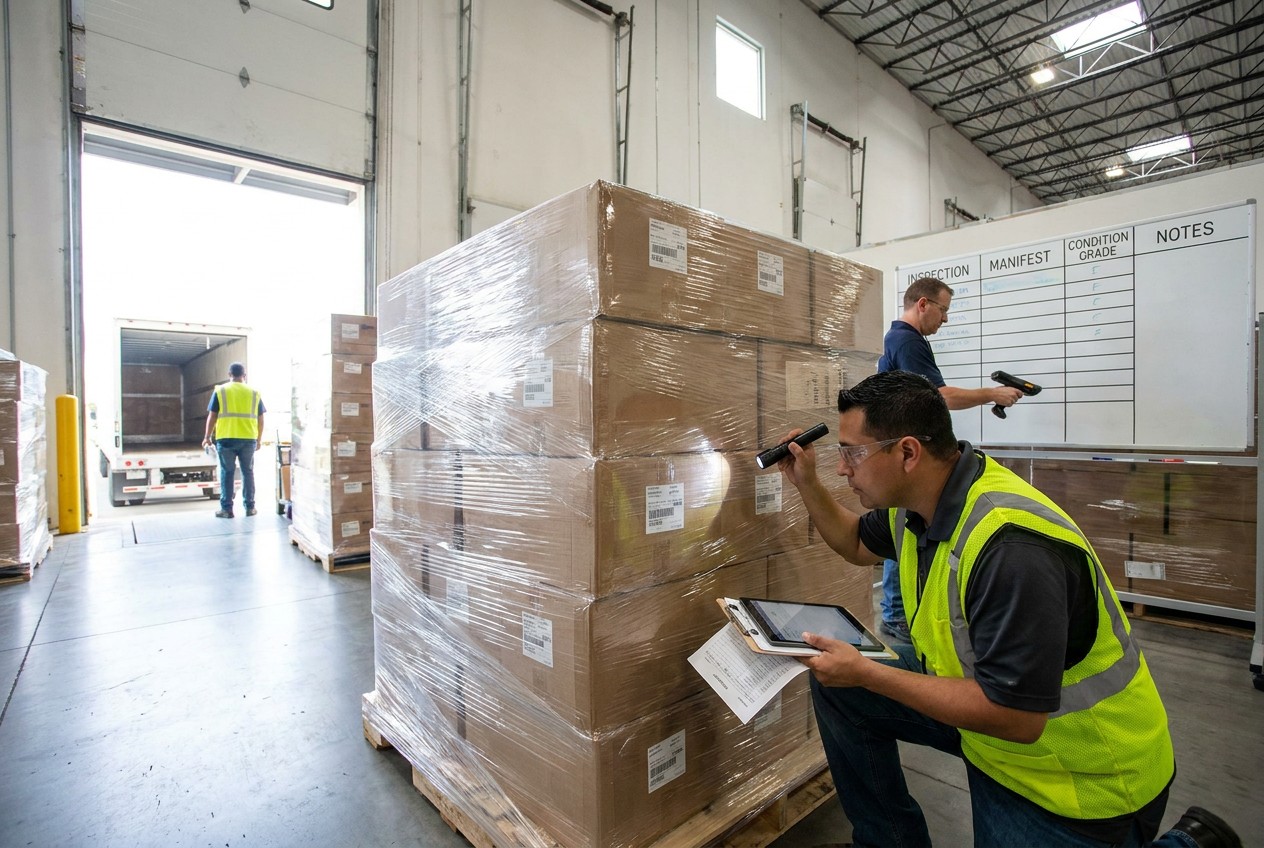
Record timestamps from arrival through departure
Assign one person to maintain the receiving timeline. Use a consistent clock and include the date and time zone. A message saying “the truck has been here a while” is much less useful than a documented arrival and check-in sequence.
| Milestone | Record to keep | Why it matters |
|---|---|---|
| --- | --- | --- |
| Appointment confirmed | Written window and reference number, if supplied | Establishes the planned schedule |
| Truck arrives | Gate or property arrival time | Separates arrival from facility processing |
| Driver checks in | Check-in time and receiving contact | Shows when the facility knew the truck was present |
| Trailer positioned | Dock-ready or unloading-ready time | Identifies access or dock delays |
| Unloading starts | Actual first movement of freight | Marks the start of handling |
| Unloading stops or finishes | Pause reasons and completion time | Explains interruptions and handling duration |
| Paperwork completed | Signature or release time | Separates physical work from administration |
| Truck departs | Actual departure time, when observable | Completes the receiving timeline |
For example, a truck might arrive at 9:10 a.m. for a 10:00 a.m. appointment, check in at 9:20, begin unloading at 10:15, and finish at 11:05. Record those events individually. They do not, by themselves, establish a billable detention period.
Support the timeline with appointment emails, messages, gate records, and receiving notes. If unloading pauses because equipment fails, note the pause and restart. If the driver and receiver record different times, preserve both accounts and explain the discrepancy rather than changing records to force agreement.

Inspect the delivery and preserve claim information
Receiving inspection should focus first on safe unloading and visible shipment discrepancies. It is not the same as testing every item for resale. Trying to fully sort a mixed load while the trailer waits can unnecessarily extend the receiving process.
Before and during unloading, where safe:
- Match the shipment reference and available delivery documents to your order.
- Photograph the trailer opening and visible load condition without entering unsafe areas.
- Record the seal number if a seal is present; do not assume every shipment uses one.
- Count handling units and compare them with the transport paperwork.
- Photograph visible crushed cartons, displaced wrapping, wet packaging, or other apparent damage.
- Note specific exceptions on delivery paperwork before signing, when possible, and keep a copy.
Pallet count and item count are different checks. A correct pallet count does not establish that every manifest line is present. Complete the detailed reconciliation after unloading, preserving labels and packaging associated with discrepancies.
As-is merchandise condition and apparent transportation damage should be documented separately. Report concerns promptly with the order number, delivery documents, photographs, timeline, and a factual description. Review the refund and claims policy for applicable requirements; do not assume a return, replacement, reimbursement, or claim approval. Ask for instructions before returning or disposing of disputed merchandise.
Common mistakes that create avoidable delays
The biggest receiving problems often come from assumptions rather than the distance traveled.
- Confusing transit with an appointment: Typical transit is a planning estimate, not a confirmed dock booking.
- Assuming every truckload is palletized: Verify loading configuration before assigning equipment and labor.
- Leaving paperwork until the crew leaves: Designate someone who can complete release documents immediately.
- Treating a condition grade as a guarantee: Read the specific description and plan post-delivery inspection.
- Signing an unqualified receipt despite visible discrepancies: Record objective exceptions without guessing their cause.
- Reconstructing times days later: Make entries as events happen and preserve original records.
- Sorting inventory at the trailer door: Move merchandise into a prepared staging area before detailed resale evaluation.
If a delay develops, communicate the current status, cause, and realistic next step. A clear update—“unloading paused at 10:40; replacement equipment expected at 11:10”—is more actionable than repeated assurances that work will resume soon.
Frequently asked questions
Does PalletCove add truckload detention fees to my order?
PalletCove's delivery offering is free shipping only on every order to all 48 contiguous states, with freight included in the listed price. The detention terminology in this guide describes general trucking operations, not an additional PalletCove delivery option or separate customer billing schedule.
How much unloading time should I plan for?
There is no single unloading duration suitable for every liquidation truckload. Confirm palletization, load size, equipment, staffing, and receiving requirements before setting the appointment; do not assume another supplier's waiting allowance applies.
Can I receive a full trailer without a warehouse dock?
That depends on the site, load configuration, and confirmed unloading arrangement. Tell the order desk about the lack of a dock before ordering so receiving feasibility can be addressed rather than improvised on delivery day.
What if the truck arrives outside the appointment window?
Record the actual arrival and check-in times, then notify the receiving lead and delivery contact. Confirm whether the truck can be accommodated or needs a revised appointment, and retain the written update.
Does signing for delivery confirm the condition of every item?
A delivery signature is not a substitute for item-level inspection, although the wording of the document matters. Read before signing, document visible exceptions, and reconcile the load afterward; all merchandise remains sold as-is for resale.
Talk to PalletCove Liquidation
Before purchasing, contact our order desk to discuss load information, delivery access, and receiving readiness. Browse current inventory and base your unloading plan on the specific listing and confirmed shipment details.
PalletCove Liquidation LLC
- Address: 4820 Cove Industrial Blvd, Dallas, TX 75236
- Phone: (713) 819-3904
- Email: sales@palletcoveliquidation.com
- Hours: Mon–Fri 8:00 AM – 6:00 PM CT, Sat 9:00 AM – 2:00 PM CT, Sun closed
Free shipping is the only delivery option on every order to all 48 contiguous states. Freight is included in the listed price.