
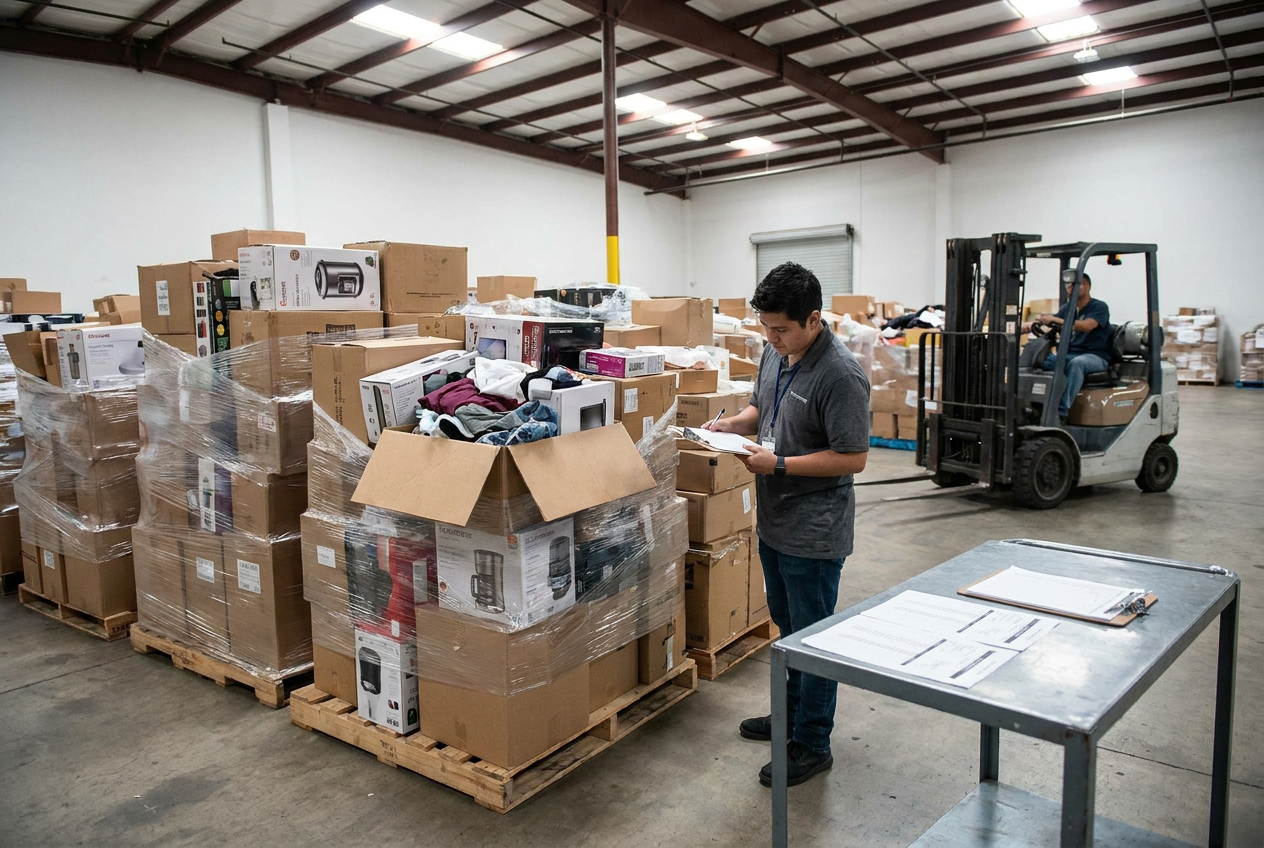
Liquidation pallets are bulk lots of merchandise packed on shipping pallets and sold for resale. They can contain customer returns, overstock, shelf pulls, or salvage inventory. A pallet might hold one product category or a mixture of unrelated items, with different packaging and conditions within the same lot.
For someone asking “what are liquidation pallets,” the important distinction is this: you are buying a defined bulk lot, not selecting individually inspected products from a retail shelf. Understanding the listing, manifest, and condition description matters more than the appearance of the top layer of boxes.
PalletCove Liquidation supplies manifested and category-level liquidation pallets and full truckloads to independent resellers from Dallas, Texas. This guide explains how these lots work, what to verify before paying, and how to receive and process inventory without treating uncertain outcomes as guarantees.
What liquidation pallets are and where they come from
Liquidation is a way for businesses to move inventory they no longer want to sell through their usual channels. Merchandise may enter liquidation through retailers, manufacturers, distributors, or businesses closing locations. It can pass through intermediaries before reaching a reseller.
Common sources include:
- Customer returns: Products sent back by customers for reasons ranging from buyer preference to damage or malfunction.
- Overstock: Excess inventory left after purchasing decisions, seasonal changes, or product-line updates.
- Shelf pulls: Merchandise removed from store shelves or displays, sometimes with labels, handling wear, or damaged packaging.
- Salvage: Inventory offered primarily for repair, parts recovery, materials recovery, or other specialized handling.
These terms explain why merchandise entered liquidation; they do not establish the condition of every item. An unused return may have missing accessories, while an overstock item may have storage damage.
Browse the liquidation pallets inventory hub to understand the available lot formats. PalletCove is an independent reseller and is not affiliated with, endorsed by, or sponsored by any retailer named in its listings or educational materials.
A liquidation pallet is a bulk inventory purchase, not a promise that every item is complete, functional, or suitable for your sales channel.
Pallets, category lots, and full truckloads
Load size and inventory detail are separate characteristics. A pallet can be manifested or category-level, and either format may appear in a larger truckload.
| Load description | What it tells you | What to verify |
|---|---|---|
| --- | --- | --- |
| Single pallet | Inventory is offered as one palletized lot | Dimensions, weight, quantity basis, and condition description |
| Multi-pallet lot | Several pallets are sold together | Total pallet count and whether descriptions cover the entire lot |
| Manifested load | An inventory document accompanies the offering | Document date, fields, limitations, and applicable lot number |
| Category-level load | Merchandise is described mainly by product category | Category mix, quantity basis, and available item detail |
| Truckload or full trailer | Inventory is offered at trailer scale | Loading format, pallet count if applicable, and unloading requirements |
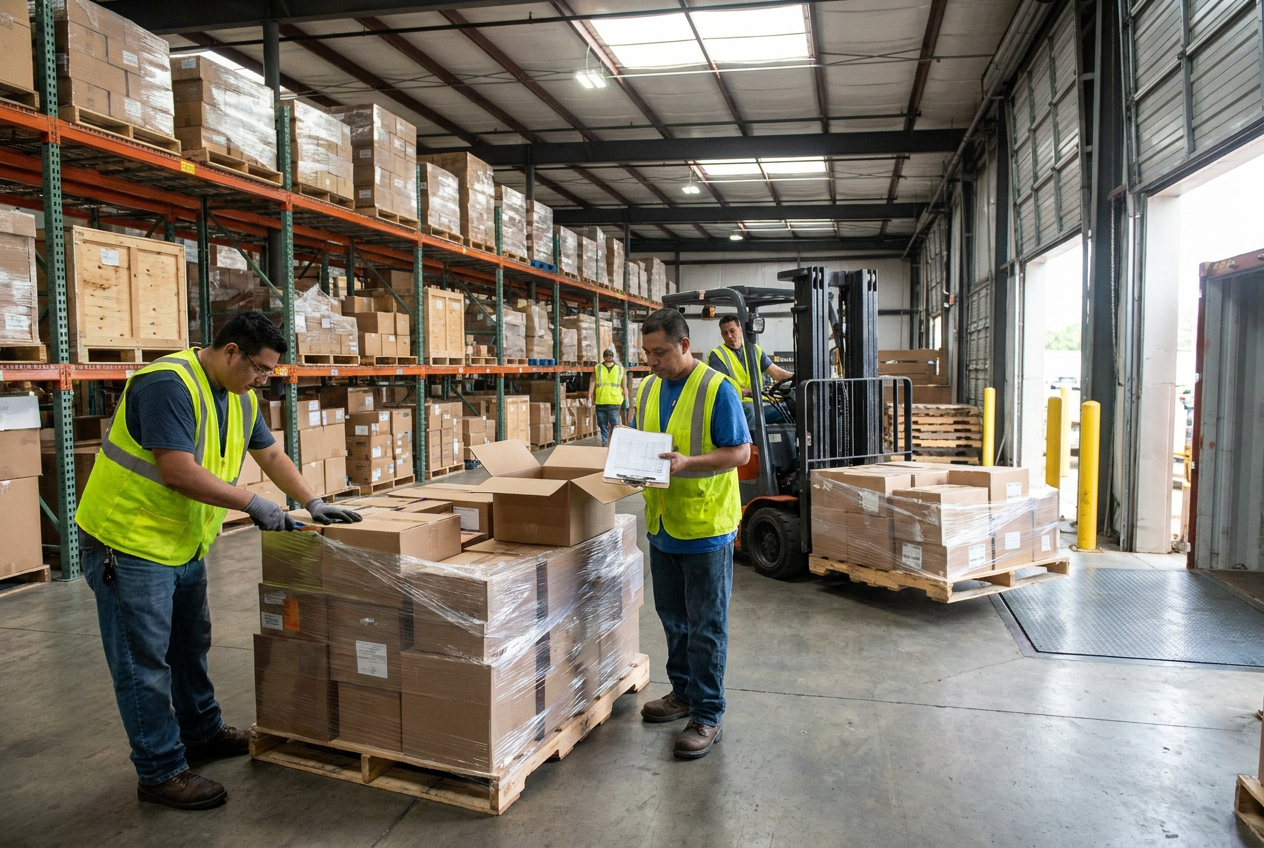
A truckload does not automatically contain a fixed number of pallets. Bulky goods, stacking limits, weight, and whether merchandise is palletized or floor-loaded affect the arrangement. A floor-loaded trailer contains goods loaded without pallets beneath every unit and requires a different unloading plan.
The guide to types of liquidation pallets provides a useful starting framework. Compare general merchandise lots with liquidation truckload offerings to distinguish mixed-category purchases from larger-volume commitments.
Specific listings such as the shoes truckload and bulk Hamilton Beach truckload illustrate different inventory focuses. Their current descriptions—not their names alone—should guide questions about quantity, condition, and availability.
How to read condition grades
A condition grade summarizes an assessment of merchandise, but liquidation grading is not universally standardized. One supplier’s “Grade A” or “Tier 2” may mean something different elsewhere. Never translate a grade into an assumed defect rate or resale outcome.
Common condition descriptions
- New or unused: Describes use status, but packaging, completeness, and testing still need clarification.
- Open-box: Packaging has been opened; the term alone does not establish functionality.
- Tested working: Ask which functions were tested, who performed the testing, and whether the description applies to every unit.
- Untested: Functionality has not been established by the stated inspection process.
- Mixed condition: The lot includes more than one condition level; the distribution may be unknown.
- Salvage or parts-only: Plan for nonworking, incomplete, or substantially damaged merchandise and possible disposal needs.
All PalletCove merchandise is sold as-is for resale. A source label, grade, or product photograph is not a guaranteed condition statement. Read any explicit listing qualifications alongside the grade.
The comparison of shelf pulls, customer returns, and overstock can help you separate inventory origin from item condition. That distinction is particularly important when estimating testing and sorting labor.
What a manifest tells you—and what it does not
A manifest is an inventory document describing a lot. Depending on the source, it may include product names, SKUs, UPCs, quantities, model numbers, category information, condition notes, and reference retail prices. Not every manifest contains every field.
Use it as a due-diligence tool, not a substitute for reading the sales terms. Unless expressly established in the listing and applicable terms, do not assume a manifest guarantees exact contents, functionality, or completeness.
Before purchasing:
- Match the document to the lot. Confirm the listing identifier and ask whether the manifest is the current version.
- Clarify quantity units. Determine whether a count means individual pieces, multipacks, sets, or cases.
- Check product identity. Similar names can hide different sizes, generations, voltages, or model variants.
- Review concentration. A large unit count may consist mainly of repeated low-demand products.
- Identify information gaps. Missing condition or accessory information should remain an uncertainty in your plan.
- Check reference prices independently. A retail figure does not establish current selling prices or expected proceeds.
For category-level lots, ask what detail is available instead of assuming an itemized manifest exists. Category descriptions can help you select suitable inventory, but they may not reveal the exact assortment.
Pricing, ordering, and accepted payments
PalletCove’s listed price includes freight. Free shipping is the only delivery option, on every order, to all 48 contiguous states. Sales tax on qualifying orders is covered by PalletCove; confirm whether your order qualifies rather than assuming that treatment applies universally.
The inventory price is only part of your operating budget. Resellers should also account for testing, cleaning, replacement parts, storage, marketplace fees, packaging, outbound customer shipping, and disposal of unsuitable goods. These are business expenses, not predictions about the lot’s resale value.
Dividing the purchase price by the stated unit count produces a simple average acquisition cost. It does not establish the cost per sellable item, because you may discover incomplete, restricted, damaged, or unsellable inventory.
A practical ordering sequence
- Select a lot that fits your category knowledge, storage space, and processing capacity.
- Review its manifest or category description, condition language, photographs, and quantity basis.
- Resolve questions about contents, receiving arrangements, and applicable policies before payment.
- Confirm the listed price, destination, order details, and sales-tax qualification.
- Pay by credit/debit card, ACH bank transfer, or domestic bank wire.
- Retain the listing, manifest, order confirmation, and payment records for receiving checks.
A resale certificate documents qualifying purchases for resale under applicable state rules; it is not a general business license. Ask what documentation is needed for your order and verify your own registration and tax obligations. PalletCove covering qualifying sales tax does not eliminate your obligations on later retail sales.
Use the first-time liquidation pallet buying guide to organize your pre-purchase review.
Free shipping and preparing for delivery
Handling takes 1–3 business days after payment clears. Transit is typically 3–7 business days from Dallas. These are separate stages, so transit should not be counted from the moment you submit payment. Typical timing is not a guaranteed arrival date.
Smaller pallet shipments may travel by LTL, meaning less-than-truckload transportation on a trailer shared with other shipments. Larger loads may move as a full trailer. Confirm the arrangement for the specific order.
Buyers researching liquidation pallets in Texas and liquidation pallets in Florida receive the same core delivery offer: free shipping, with freight included in the listed price. Coverage extends across all 48 contiguous states.
Before dispatch, provide accurate receiving details and discuss site access, unloading equipment, receiving hours, and available space. Do not assume a driver will move inventory inside, unpack cartons, or supply equipment suited to your location.
Review the PalletCove shipping policy and make sure someone is available to receive and document the shipment. Clear a stable unloading area and plan where incoming inventory will remain until counted and inspected.
Delivery-day inspection, returns, and claims
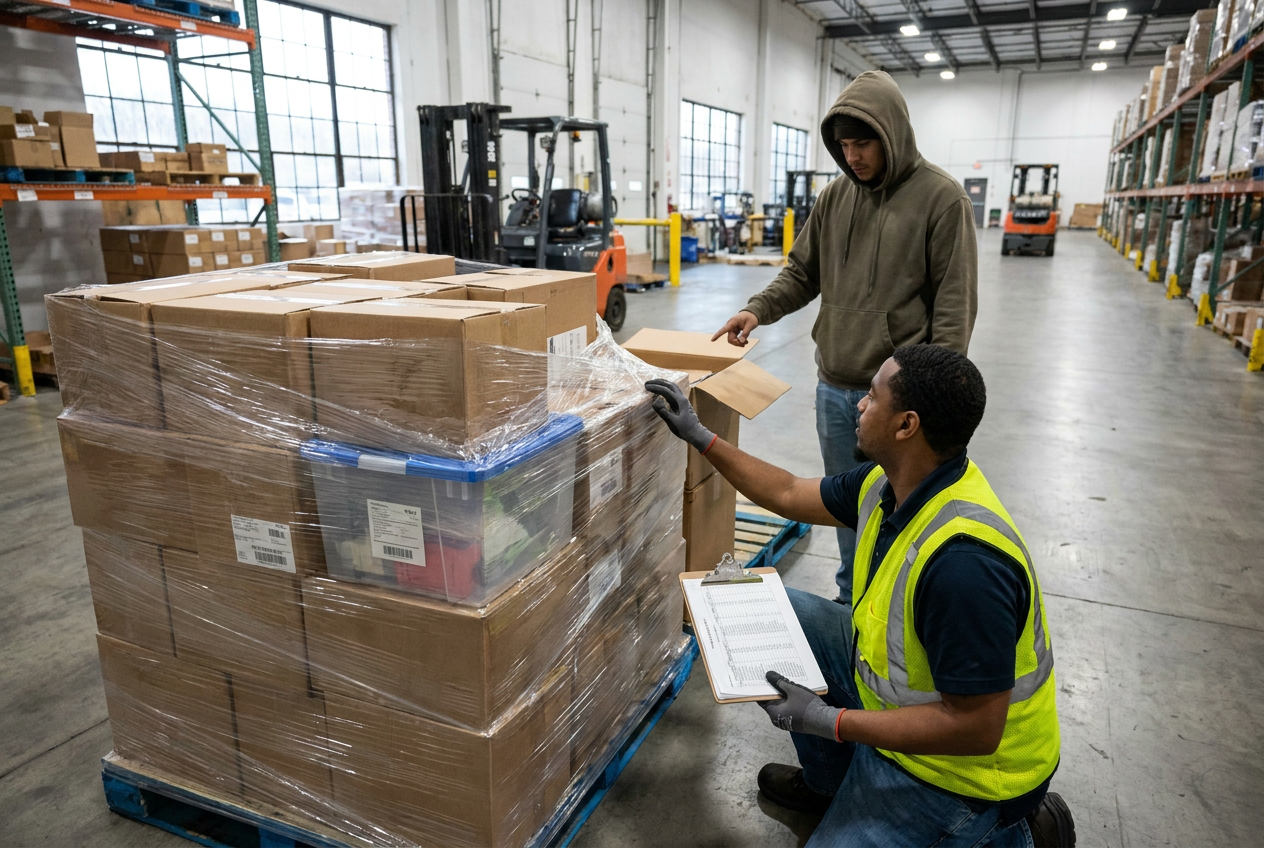
An organized intake process helps distinguish visible transportation issues from merchandise condition discovered during sorting. Neither kind of issue automatically creates a right to a return, replacement, or refund.
Inspect and document the shipment
- Compare the shipment identification and visible pallet or package count with the delivery paperwork.
- Inspect accessible surfaces for crushed cartons, broken wrapping, leaning stacks, moisture, or exposed merchandise.
- Photograph the load before moving or unwrapping it, when safe and permitted.
- Record visible damage or shortages accurately on delivery paperwork before signing, where possible.
- Retain copies of the delivery receipt, shipment labels, packaging, and supporting photographs.
- Count and inspect contents promptly, recording discrepancies against the applicable listing and manifest.
A delivery signature is not a substitute for a merchandise inspection. Conversely, opening every carton while the driver waits may not be practical. Document what you can actually observe rather than signing an unsupported statement about unseen contents.
Understand as-is terms before requesting a remedy
All merchandise is sold as-is for resale. Do not assume retail-style returns, an inspection-based cancellation right, or manufacturer warranty coverage. Review the returns and claims policy before ordering for applicable procedures, eligibility, evidence requirements, and deadlines.
If a problem arises, contact PalletCove promptly with the order number, delivery records, photographs, and an itemized description. Ask how to proceed before returning goods, discarding packaging, or making repairs that could obscure evidence. Documentation supports review; it does not guarantee an approved claim.
Common mistakes first-time resellers should avoid
Buying more than you can process. A full truckload can create a significant sorting and storage obligation. Choose volume based on available space and realistic labor capacity, not just unit count.
Treating retail references as expected revenue. Research recent completed sales for comparable products and conditions. Asking prices and original retail figures are not reliable substitutes.
Assuming every item is ready to list. Plan for cleaning, testing, photographing, measuring, and identifying missing accessories. Keep untested inventory separate from verified stock.
Ignoring safety and sales-channel restrictions. Check relevant recall notices, expiration dates, labeling requirements, and marketplace rules. Do not sell recalled or unsafe products; isolate questionable goods for appropriate handling.
Describing goods too optimistically. Disclose actual condition, defects, and missing components to your customers. Supplier terminology should not replace your own inspection.
Skipping inventory records. Assign internal identifiers and track acquisition, processing, sales, and disposal costs. Accurate records help evaluate your operation without assuming every purchased unit will sell.
Frequently asked questions
Are liquidation pallets the same as mystery boxes?
Not necessarily. A manifested pallet includes inventory information, while a category-level pallet may provide only broader assortment details. Evaluate the actual disclosure rather than assuming any bulk lot has fully known or completely unknown contents.
Are liquidation pallets all customer returns?
No. They can contain overstock, shelf pulls, salvage, customer returns, or a mixture. The source description and condition grade answer different questions and should both be reviewed.
Can I make money reselling liquidation pallets?
Results depend on acquisition costs, merchandise condition, demand, labor, and selling expenses. Profit is not guaranteed, and some inventory may be unsuitable for sale. Build a budget that accounts for uncertainty rather than assuming every unit generates revenue.
Do I need a resale certificate to order?
Requirements depend on the transaction and applicable state rules. Confirm the documentation PalletCove needs before ordering, and verify your own business and tax obligations. Sales tax on qualifying orders is covered by PalletCove.
How long does delivery take?
Handling takes 1–3 business days after payment clears, followed by typical transit of 3–7 business days from Dallas. Free shipping is the only delivery option on every order to all 48 contiguous states, with freight included in the listed price.
Talk to PalletCove Liquidation
Start with a lot you can receive, inspect, and process responsibly. For questions about manifests, condition descriptions, ordering, or receiving arrangements, contact our order desk and review current inventory.
PalletCove Liquidation LLC
- Address: 4820 Cove Industrial Blvd, Dallas, TX 75236
- Phone: (713) 819-3904
- Email: sales@palletcoveliquidation.com
- Hours: Mon–Fri 8:00 AM – 6:00 PM CT, Sat 9:00 AM – 2:00 PM CT, Sun closed