

Choosing where to buy liquidation pallets starts with a more useful question: what can you verify before paying? A low advertised price tells you little without the load description, condition grade, inventory documentation and written terms that explain what you are buying.
Independent resellers commonly source through direct liquidators, online marketplaces and local sellers. Each channel can suit a different business model, but none eliminates the need to check the seller and the merchandise. The right purchase fits your storage, testing capacity, sales channels and available working capital—not just your budget for inventory.
PalletCove Liquidation supplies manifested and category-level liquidation pallets and full truckloads from Dallas, Texas. This guide explains how to compare sources, interpret listings and document an order from purchase through delivery without assuming that any load will produce a particular resale result.
Compare the main places to buy liquidation pallets
A liquidation pallet is a palletized lot of merchandise sold in bulk for resale. Inventory may include customer returns, overstock, shelf pulls or salvage. Sellers can offer individual pallets, multiple-pallet lots or an entire truckload.
| Sourcing channel | How buying commonly works | What to verify first | Main limitation |
|---|---|---|---|
| --- | --- | --- | --- |
| Direct liquidator or wholesale supplier | Buy a listed lot or arrange a larger purchase with the seller | Seller identity, load-specific documentation and purchase terms | Inventory detail varies between lots |
| Online marketplace | Buy through fixed-price listings or auctions involving different sellers | Actual seller, platform rules, bidding terms and dispute process | Platform reputation does not establish every seller’s reliability |
| Local pallet seller | Review advertised lots and ask whether inspection is available | Whether photos show the exact lot and whether inspection is permitted | A visible top layer may not represent the entire pallet |
Direct liquidators and wholesale suppliers
Buying directly from a supplier can simplify communication about inventory and documentation. However, “direct” does not automatically mean merchandise comes straight from a retailer or that the seller has an exclusive supply agreement. Ask who is selling the lot and which written description governs the purchase.
PalletCove is an independent reseller and is not affiliated with, endorsed by or sponsored by any retailer named. Start with the liquidation pallets inventory hub to distinguish pallet offerings from larger loads.
Marketplaces and local sellers
On a marketplace, determine whether the platform or the individual seller handles payment questions and claims. For auctions, read the bidding rules, any buyer’s premium and payment deadline before bidding. Do not assume bids can be withdrawn.
With local sellers, request current photos and ask whether you can examine the actual lot before committing. An in-person view helps assess packaging and visible damage, but it does not establish that sealed boxes contain complete, working products. Location alone is not a substitute for documentation.
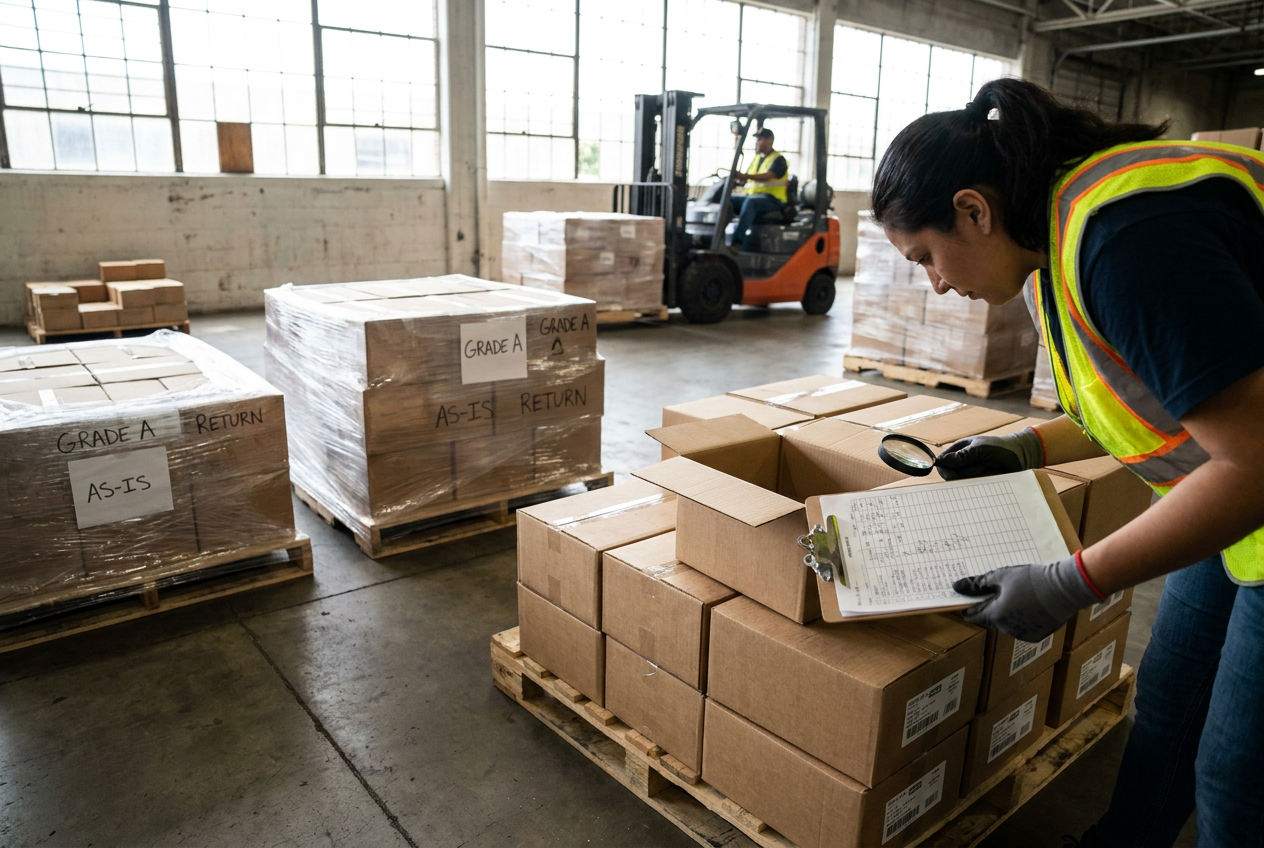
Understand load types and condition grades
Load format and merchandise condition describe different things. “Truckload” describes shipment scale; “customer returns” describes an inventory source. Neither tells you how many units are functional.
- Manifested pallet: Includes an inventory list with some level of item detail. Ask which fields are supplied and whether quantities are verified or estimated.
- Category-level pallet: Sold by merchandise category rather than a complete item-by-item list. Expect less visibility into exact models and assortment.
- Mixed general merchandise: May span several departments, requiring different testing, storage and selling workflows.
- Truckload: A larger lot intended for a full trailer movement. Confirm pallet count, loading format and unloading requirements rather than assuming every truckload is arranged identically.
The types of liquidation pallets guide explains format differences. Compare general merchandise inventory with truckload inventory according to what your operation can process.
What condition labels actually tell you
Overstock generally means excess inventory, but packaging can still show storage or handling wear. Shelf pulls are items removed from sales floors and may carry labels, display wear or damaged packaging. Customer returns can range from unopened merchandise to incomplete or nonfunctional products.
Salvage generally indicates inventory intended for parts recovery, repair or material recovery rather than ready-to-sell use. Condition grades are not standardized across sellers: a tier number or letter grade needs the seller’s written definition.
Ask whether “tested” means powered on, checked for basic operation or fully evaluated. Also ask whether that description applies to every unit or a sample. PalletCove merchandise is sold as-is for resale; a category label is not a guaranteed condition statement.
Product titles are starting points, not complete specifications. For example, compare the stated load details for a Macy’s Textile Truckload and a Shoes Truckload without assuming size distribution, completeness or uniform condition from either title.
Ask for these documents before paying
A credible purchase record connects the seller, the advertised lot and the amount paid. If a material detail is unclear, resolve it in writing before submitting payment.
- Seller identity and invoice: Confirm the business name, contact information, lot identifier and payment recipient. Independently verify unexpected changes to payment instructions.
- Current lot description: Save the listing, stated condition grade, quantity basis and any exclusions. Ask whether pictures show the actual merchandise or representative inventory.
- Manifest, when offered: Request the file associated with that specific lot, not an example from another shipment.
- Written purchase terms: Review as-is language, cancellation terms, return eligibility and the process for reporting discrepancies.
- Order and delivery information: Confirm the destination, receiving contact and handling timeline.
How to evaluate a manifest
A manifest may list descriptions, SKUs, UPCs, model numbers, quantities and reference retail prices. Fields vary, and a populated spreadsheet does not necessarily mean every item was individually inspected.
Check for duplicate rows, vague descriptions, missing model numbers and inconsistent quantities. Establish whether a “unit” means one item, a multipack or a case. Ask whether accessories and components are included and whether substitutions or quantity tolerances are addressed in the terms.
Reference retail figures are not evidence of current resale value. Research identifiable products using recent completed sales where available, while accounting for condition, missing parts, selling costs and demand. The guide to reading a liquidation pallet manifest provides a framework for reviewing inventory files.
For category-level loads without itemized manifests, request the available category description, quantity basis, condition information and photos. Less detail means more uncertainty; it should influence your purchase size and processing plan.
The most useful safeguard is a written record of the exact lot, the seller’s condition definitions and the terms that apply before payment.
Compare prices using a realistic operating budget
First establish whether a listing price covers one pallet, several pallets or an entire truckload. Then distinguish verified counts from estimates. A low cost per listed piece is not necessarily a low cost per sellable item.
For PalletCove orders, free shipping is the only delivery option on every order to all 48 contiguous states. Freight is included in the listed price. Sales tax on qualifying orders is covered by PalletCove; confirm whether your order qualifies rather than assuming every transaction has the same tax treatment.
Budget separately for the work after arrival:
- Labor for sorting, testing, cleaning, photographing and listing.
- Storage space and shelving while inventory awaits processing or sale.
- Replacement packaging, parts and consumables.
- Selling-platform and payment-processing costs associated with your resale activity.
- Customer service, resale returns and lawful disposal of unusable merchandise.
Do not divide your purchase price by every listed unit and treat the result as the cost of usable stock. Some items may require repair, remain unsold or be unsuitable for resale. Model several outcomes without treating any as guaranteed.
The same PalletCove free-shipping approach applies when sourcing liquidation pallets in Texas or liquidation pallets in Florida. Choose inventory based on operational fit rather than assuming a nearby destination changes the listed delivery arrangement.
Place the order and verify payment details
Use a repeatable purchasing process instead of relying on messages scattered across multiple channels. The liquidation pallet buying guide can help structure your pre-purchase review.
- Select the lot and confirm its availability, format and quantity basis.
- Resolve questions about the manifest, condition grade and actual-lot photos.
- Review the invoice, destination and applicable policies.
- Confirm receiving arrangements and provide accurate contact information.
- Pay through the confirmed business payment channel and retain the receipt.
PalletCove accepts credit/debit card, ACH bank transfer and domestic bank wire. Review the payment policy before sending funds. Do not assume submitting a transfer means payment has cleared, and independently verify bank instructions if they change unexpectedly.
Handling takes 1–3 business days after payment clears. Transit is typically 3–7 business days from Dallas; handling and transit are separate stages, and the transit range is not an appointment guarantee.
A resale certificate may be relevant to documenting a qualifying resale purchase. Requirements depend on the jurisdiction and transaction, so ask which documents are needed and retain the accepted records. A resale certificate does not replace any business licensing or tax obligations that apply to your own sales.
Prepare for delivery, inspection and possible claims
Pallet shipments may move through LTL, or less-than-truckload, networks, while larger orders may occupy a full trailer. Confirm the shipment format and what your location needs to receive and unload it safely. Consult the shipping policy before ordering.
Free shipping does not remove the need for a workable receiving plan. Confirm vehicle access, receiving hours, unloading arrangements and space to stage the merchandise. Do not assume pallets will be moved inside your building.

What to record when the shipment arrives
- Match shipment references and pallet counts to the available paperwork.
- Photograph the shipment before removing wrap or moving the contents.
- Record visible damage, disturbed wrapping or count discrepancies on receiving paperwork where possible.
- Photograph labels and affected areas clearly, retaining copies of signed documents.
- Preserve packaging and separate affected merchandise while seeking instructions.
Distinguish transit damage from missing inventory and from merchandise defects within the stated as-is condition. These are different issues and may require different evidence. If a serious problem is visible, seek instructions promptly rather than assuming refusal is always appropriate.
Review the refund and claims policy before paying for deadlines, exclusions and required evidence. As-is merchandise should not be treated as ordinary retail stock with an assumed right to return it. Reporting a problem does not automatically establish eligibility for a return, refund or other remedy.
Avoid common sourcing mistakes
The most expensive errors often happen before the pallet arrives. Keep these checks in your purchasing routine:
- Buying by retailer name alone: A source label does not establish model mix, condition or demand.
- Treating reference retail totals as revenue: Use item-level market research where identification is possible.
- Starting too large: A full trailer can overwhelm storage and testing capacity even when the purchase budget is available.
- Ignoring category obligations: Check recalls, safety requirements, restricted-product rules and platform policies before listing merchandise.
- Skipping data checks on electronics: Evaluate account locks and handle personal data appropriately before resale.
- Discarding evidence immediately: Keep listings, invoices, manifests and receiving photos together by order.
Start with inventory your team knows how to evaluate. Track actual processing time, usable quantities and selling results so later purchases reflect your own operating evidence rather than optimistic assumptions.
Frequently asked questions
Where should a beginner buy liquidation pallets?
Choose a seller that provides clear lot descriptions, identifiable business details and written purchase terms. A manageable pallet in a familiar category is generally easier to evaluate and process than an unfamiliar truckload.
Are manifested pallets guaranteed to match every listed item?
A manifest is an inventory document, not automatically an item-by-item guarantee. Ask whether counts are verified, whether substitutions are permitted and which discrepancy terms apply to the particular lot.
Does PalletCove offer free shipping on every order?
Yes. Free shipping is the only delivery option on every PalletCove order to all 48 contiguous states, and freight is included in the listed price. Handling takes 1–3 business days after payment clears, followed by typical transit of 3–7 business days from Dallas.
Can I return liquidation merchandise that does not work?
PalletCove merchandise is sold as-is for resale, so nonworking merchandise should not be assumed returnable. Read the applicable policy before purchase and promptly document any issue you believe falls within its claims process.
Is a truckload better value than a single pallet?
Not necessarily; the answer depends on the assortment, usable inventory and your capacity to process it. Compare the full operational commitment, including space and labor, rather than purchasing more solely because the listed cost per piece appears lower.
Talk to PalletCove Liquidation
Bring your category preferences, receiving details and questions about documentation before choosing a load. Ask for clarification whenever a listing leaves the quantity basis, condition description or purchase terms unclear.
PalletCove Liquidation LLC
- Address: 4820 Cove Industrial Blvd, Dallas, TX 75236
- Phone: (713) 819-3904
- Email: sales@palletcoveliquidation.com
- Hours: Mon–Fri 8:00 AM – 6:00 PM CT, Sat 9:00 AM – 2:00 PM CT, Sun closed
To discuss a specific lot, contact our order desk or review current inventory.