

Buying wholesale liquidation for bin stores starts with a weekly inventory plan, not the largest load available. Operators need enough shelf-ready merchandise for opening-day bins, scheduled replenishment and the next reset—without overwhelming their receiving area or tying up money in slow-moving stock.
PalletCove Liquidation supplies manifested and category-level liquidation pallets and full truckloads to independent resellers. The right purchase depends on your store’s unit demand, category preferences, processing capacity and storage space. A load can contain plenty of merchandise yet still leave a store short of suitable bin inventory.
This guide explains how to turn those operating constraints into a sourcing plan, evaluate listings and manifests, and manage the period between payment and the next store restock.
Understand the load types and condition language
A liquidation pallet groups merchandise into a pallet-sized lot. A truckload is a larger shipment occupying a full trailer or sold as a truckload lot; confirm its actual contents and loading configuration rather than assuming a fixed pallet count. LTL, or less-than-truckload transportation, typically moves smaller freight shipments alongside other freight.
A manifested lot includes an itemized inventory record. A category-level lot is described primarily by merchandise category, such as general merchandise or textiles, and may offer less item-level visibility. Neither description alone establishes condition or suitability for your bins.
Use the liquidation pallets inventory hub to explore smaller buying units. The guide to pallet types and truckload buying guide provide additional context for choosing a purchasing format.
| Condition or source term | General meaning | Bin-store screening priority |
|---|---|---|
| --- | --- | --- |
| Overstock | Excess inventory that did not sell through its original channel | Packaging, age, seasonality and duplicates |
| Shelf pulls | Merchandise removed from retail shelves | Labels, handling wear and completeness |
| Customer returns | Products returned by customers for varied reasons | Testing, missing parts and signs of use |
| Salvage | Merchandise generally intended for repair, parts or recovery | Whether any items fit your operating model |
| Mixed condition | More than one condition group in a lot | Sorting time and segregation requirements |
A condition grade is a seller’s classification, not a universal standard. Ask what the grade means for the specific listing, whether testing occurred and what exclusions apply. All PalletCove merchandise is sold as-is for resale; a source label does not guarantee an individual item’s condition.
Calculate weekly volume in units, not just pallets
Pallet counts are useful for receiving and storage, but they are weak measures of bin capacity. One pallet of bulky household products and one pallet of compact accessories can have very different unit counts and processing demands.
Start with four measurements:
- Units needed for the opening reset.
- Units reserved for scheduled midweek replenishment.
- Expected usable carryover from the previous week.
- A buffer based on your own demand and processing variability.
Your net weekly requirement is opening units plus replenishment units plus the desired buffer, minus usable carryover. Count only inventory that is inspected and ready for sale as usable carryover.
For example, a hypothetical store needing 1,800 opening units, 600 replenishment units and a 300-unit buffer, with 400 usable units on hand, needs 2,300 additional bin-ready units. These are planning assumptions, not expected results from any PalletCove lot.
Next, account for sorting losses and diversions. If that store’s documented history shows that four out of every five received units become bin-ready, it would plan around 2,875 incoming units to produce 2,300 ready units. A new operator without records should begin with a manageable purchase and measure outcomes rather than borrow another store’s conversion rate.
Track missing components, unsafe goods, damaged items and merchandise diverted to separate sales channels independently. This reveals whether a shortage comes from insufficient purchasing or a poor match between the load and the store.
The useful buying unit is a processed, bin-ready item—not a pallet, a retail-price total or an unverified piece count.
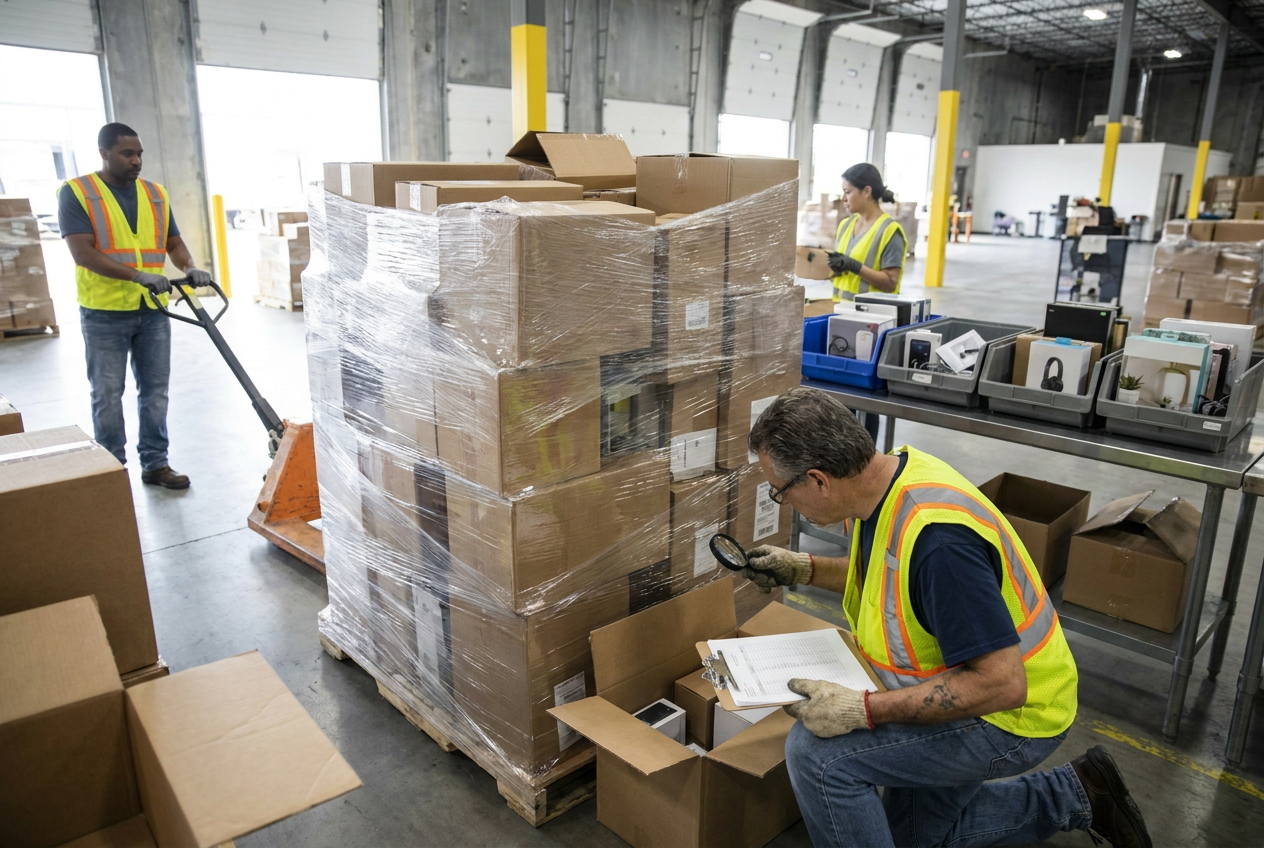
Build a category mix your store can process
Category mix should reflect what customers buy, what fits your fixtures and what staff can inspect. Broad variety is helpful only when the store can prepare and display the merchandise safely.
Use three operating groups:
- Core bin stock: Compact merchandise with manageable inspection requirements and demonstrated local demand.
- Controlled additions: Seasonal goods, unfamiliar categories or lots with substantial duplication that you are testing in limited quantities.
- Separate-channel stock: Oversized, fragile or testing-intensive products that need a different display or selling process.
Compare general merchandise liquidation with the broader truckload inventory category. These are starting points for evaluation, not assurances that every listing matches a bin-store format.
At the product level, review the Amazon High Piece Truckload listing for its current stated quantity and composition, and the Macy’s Textile Truckload listing for a category-focused comparison. Do not infer exact contents, current availability or testing status from a product name.
PalletCove is an independent reseller and is not affiliated with, endorsed by or sponsored by any retailer named.
Track units sold, leftovers and processing minutes by category across the weekly price ladder. A category that moves mainly on the lowest-price day may still serve a purpose, but it should not automatically displace stock needed for the opening reset. Repeated duplicates can also exhaust local demand even when the first batch sells quickly.
Read manifests as operational documents
A manifest can help estimate the workload behind a load. Look for item descriptions, SKU or UPC identifiers, quantities, stated condition and any included reference values. Fields vary, so establish what each column represents before making comparisons.
Ask these questions before ordering:
- Is the file specific to this lot, or merely representative of similar loads?
- Does quantity mean individual sellable units, multipacks or cases?
- Are listed quantities verified, estimated or subject to stated tolerances?
- Are condition notes item-specific or applied to the entire load?
- What testing, if any, supports the description?
- Are photographs of the offered lot or illustrative examples?
Check for concentrated quantities of a single SKU, seasonal products and items requiring accessories. A large piece count may include many identical products or goods that cannot go directly into bins.
Treat any listed retail value as a reference field, not a forecast of revenue or resale value. Your evaluation should focus on category fit, inspection needs, likely display routing and your own sales records.
For category-level lots without detailed manifests, request the available category breakdown, quantity basis and condition description. If the information cannot support a confident capacity decision, reduce your exposure or wait for a better-documented listing.
Match ordering cadence to the full replenishment cycle
PalletCove handling time is 1–3 business days after payment clears. Transit is typically 3–7 business days from Dallas. Those stages suggest a planning window of roughly 4–10 business days after cleared payment before allowing for receiving, sorting and stocking; this is not a guaranteed arrival date.
Work backward from the reset you need to support. Include staff availability, holidays, payment-clearance timing and any delivery scheduling requirements. Do not advertise a specific load’s restock before you have a dependable receiving and processing plan.
A practical weekly rhythm is:
- After reset: Count prepared reserve inventory and review opening-day demand.
- Midweek: Compare category sell-through with the planned replenishment quantities.
- Before ordering: Check incoming loads, unresolved receiving issues and available cash.
- At receiving: Separate unprocessed stock from inspected, sale-ready reserve stock.
- Before the next reset: Allocate opening stock and hold back scheduled replenishment.
Reorder when prepared stock plus realistically usable incoming inventory no longer covers expected consumption during replenishment lead time and your chosen buffer. Avoid counting the same inventory twice simply because it appears in both a manifest and a receiving worksheet.
The Texas liquidation pallets page and liquidation pallets in Florida provide state-specific starting points. Free shipping is the only delivery option on every order to all 48 contiguous states; freight is included in the listed price.
Compare prices and place a documented order
Compare the listed lot price against expected operational use, not a promised margin. Dividing the price by stated pieces gives an acquisition cost per listed piece; dividing it by your estimated bin-ready units gives a more conservative planning measure. Neither calculation guarantees sales or profit.
Keep an internal worksheet for labor, testing supplies, storage and disposal. Freight is already included in PalletCove’s listed price and should not be added again. PalletCove covers sales tax on qualifying orders; confirm qualification and what resale certificate documentation is needed for your business rather than assuming every order qualifies.
Before paying:
- Confirm the exact listing, quantity basis, condition description and manifest status.
- Save the listing, photographs, manifest and written answers to material questions.
- Verify the delivery address, receiving contact, access and unloading arrangements.
- Review the applicable shipping and claim terms.
- Confirm that staff and storage can accommodate the shipment.
Payment methods are credit/debit card, ACH bank transfer and domestic bank wire. Handling begins after payment clears, not simply when payment is initiated. Verify payment instructions through a trusted business contact if anything appears inconsistent.
Review the shipping policy before scheduling your receiving team. Free shipping does not remove the need to confirm that your site can receive the load safely.
Inspect the shipment before it reaches the bins
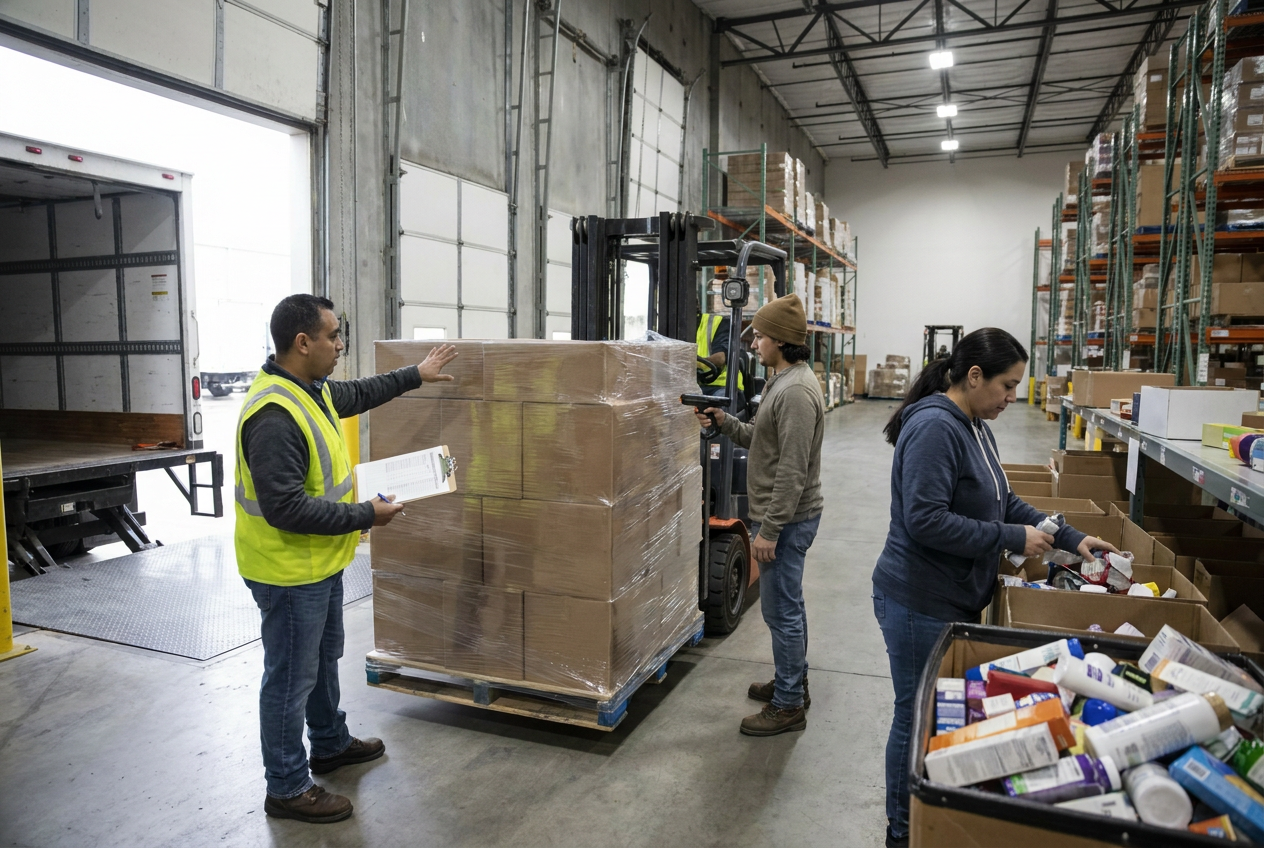
Prepare a clear receiving area, suitable unloading equipment and a place to quarantine merchandise requiring further checks. Keep the order documents accessible to the person accepting delivery.
On delivery day:
- Match shipment references to your order and transport paperwork.
- Count accessible handling units and compare them with the delivery documents.
- Photograph the load, labels, wrap and visible damage before disturbing the shipment.
- Record visible shortages or damage specifically on the delivery receipt before signing, following the carrier’s procedure.
- Preserve paperwork and packaging relevant to any discrepancy, then contact PalletCove promptly.
Signing for a pallet count is not the same as verifying every item inside it. Perform a second, item-level inspection during breakdown, recording discrepancies and condition findings by lot.
Use the liquidation truckload receiving checklist to organize responsibilities. Before selling, check applicable recalls and product-safety requirements, isolate suspect goods and prevent untested or incomplete items from being mixed into ready stock without an appropriate assessment.
Handle claims carefully and avoid repeat buying mistakes
As-is merchandise requires disciplined evaluation before purchase. Do not assume ordinary retail returns, exchanges or condition guarantees apply. Review the refund and claims policy for current eligibility, deadlines, evidence requirements and procedures; this article does not establish a separate return entitlement.
Distinguish a documented shipping shortage or damage issue from condition variation disclosed in the listing. Report concerns promptly with the order number, delivery paperwork, photographs and an itemized discrepancy record. Ask for instructions before returning, repairing or disposing of disputed merchandise; documentation supports review but does not guarantee reimbursement.
Common operational mistakes include buying by pallet count alone, committing all available cash to inventory, and scheduling a reset around an unconfirmed arrival. Others include ignoring duplicate concentration, treating every received unit as sellable and ordering faster than staff can process.
Review each completed load against your original assumptions. Update category allocations, labor estimates and reorder timing using actual results rather than increasing order size automatically.
Frequently asked questions
Should a new bin store buy pallets or a truckload?
Start with the quantity your team can receive, inspect and sell through responsibly. Pallets can limit initial exposure, while a truckload requires more space, working capital and processing capacity. Choose based on measured demand rather than purchase size alone.
How many liquidation pallets does a bin store need each week?
There is no universal count because unit density, condition and store demand vary. Calculate required bin-ready units first, then translate that requirement into suitable lots using available quantities and your own processing records.
Is a manifested load guaranteed to be ready for resale?
No. A manifest describes inventory according to its stated scope; it does not automatically establish functionality, completeness or safety. All PalletCove merchandise is sold as-is for resale.
Is delivery free, and how long does it take?
Free shipping is the only delivery option on every order to all 48 contiguous states, with freight included in the listed price. Handling takes 1–3 business days after payment clears, followed by typical transit of 3–7 business days from Dallas. Allow additional time for your own receiving and preparation.
Can I return a load that does not suit my bins?
Do not assume that a mismatch with your merchandising plan qualifies for a return. Check the current refund policy before purchase and raise any documented discrepancy promptly under its procedures. As-is purchasing makes pre-order evaluation especially important.
Talk to PalletCove Liquidation
Bring your weekly unit requirement, preferred categories, receiving capacity and target restock schedule when you contact our order desk. Compare those needs with current inventory before selecting a pallet or truckload.
PalletCove Liquidation LLC
4820 Cove Industrial Blvd, Dallas, TX 75236
Phone: (713) 819-3904
Email: sales@palletcoveliquidation.com
Hours: Mon–Fri 8:00 AM – 6:00 PM CT, Sat 9:00 AM – 2:00 PM CT, Sun closed