
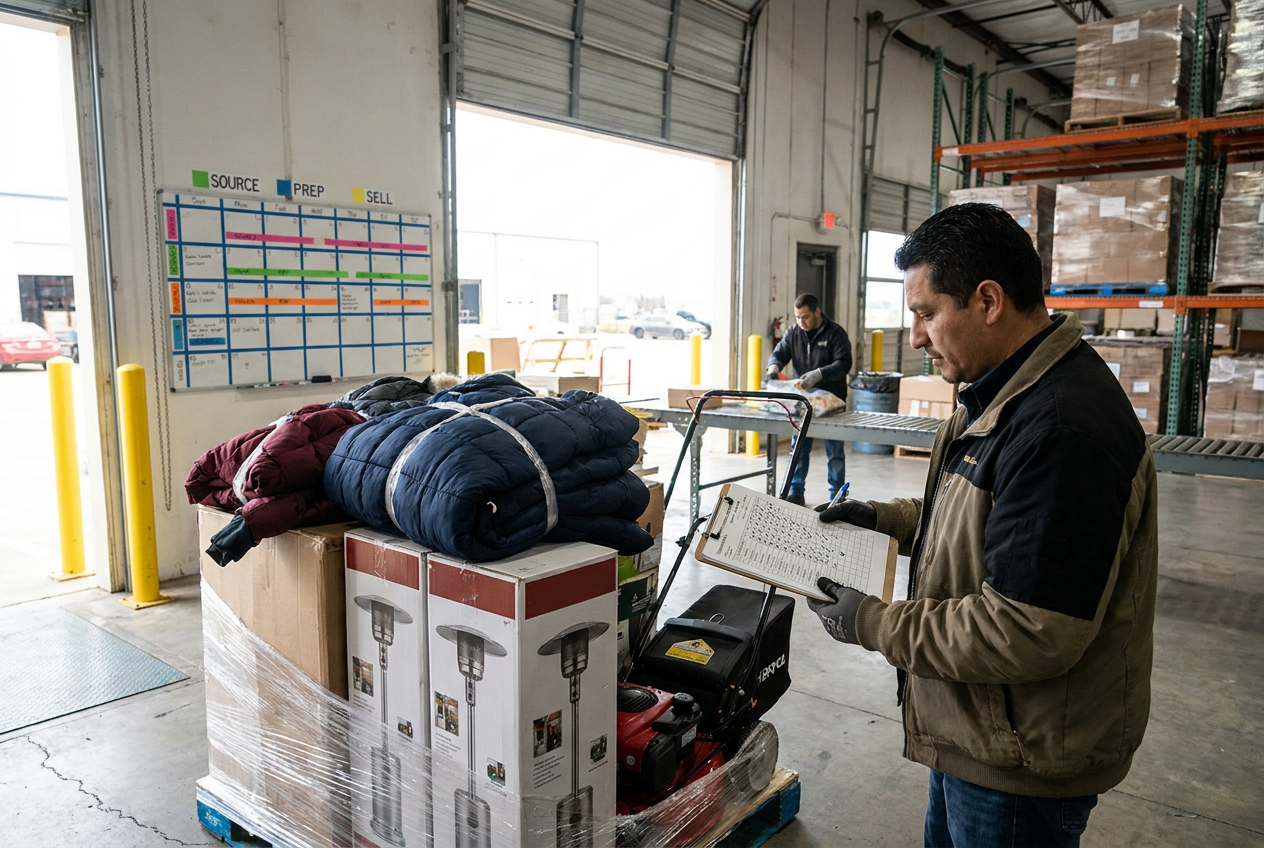
Seasonal inventory planning means working backward from when customers will buy—not forward from when a liquidation deal appears. For resellers, the calendar must include payment clearance, delivery, inspection, preparation and merchandising before the first useful selling day. Inventory that arrives during peak demand can still be late if it needs another week of work.
Apparel, home goods and outdoor power equipment follow different demand patterns and require different preparation. A holiday decoration has a narrow deadline; a lightweight jacket may sell across several months; a mower needs an appropriate local growing season and a safe, documented readiness assessment. The planning method is the same, but the inputs differ.
For the broader purchasing process, start with our guide to buying liquidation pallets. This article focuses on translating a seasonal opportunity into a backward calendar with buying deadlines, workload limits and an exit plan.
1. Define the selling window before choosing a load
Start with three dates: your first selling day, expected demand peak and exit deadline. Use your own sales history, local event schedules, climate and customer inquiries rather than a nationwide seasonal label alone.
A bin store is a retail format where merchandise is displayed in bins, often with prices changing on a scheduled cycle. A flea market is a venue where independent vendors sell from booths or stalls on scheduled market days. An online marketplace is a third-party platform where sellers publish listings and transact with buyers. Each creates a different deadline: floor readiness, the next market date or enough listing lead time for buyers to receive goods before an occasion.
For apparel channel choices, see where to sell liquidation clothing. Keep channel selection separate from your sourcing decision: an attractive lot is not automatically appropriate for your audience.
Create a planning record for each seasonal campaign:
- Customer use or occasion, geographic market and sales channel.
- First selling day, expected peak and final full-price review date.
- Preparation capacity, available storage and purchasing budget.
- Buy-by date, replenishment cutoff and exit route.
2. Build the backward calendar with real buffers
Use this formula: payment-clearance deadline = first selling day minus delivery allowance, preparation time, merchandising time and contingency. Build in business days for shipping and actual working days for your team. These are not interchangeable with calendar days.
At PalletCove, handling takes 1–3 business days after payment clears. Transit from Dallas is typically 3–7 business days, giving an estimated 4–10 business days total. The processing cutoff is 2:00 PM Central Time, America/Chicago, Monday–Friday; after-cutoff confirmations begin the next business day. Weekends and applicable holidays do not count.
For an illustrative campaign, allow the upper end of the estimated delivery range, seven working days for preparation, three for merchandising and five contingency days. That requires payment clearance approximately 25 working/business-day slots before launch, adjusted for holidays and your operating schedule. This is a planning allowance, not a delivery guarantee.
| Backward milestone | What must be complete | Decision if behind schedule |
|---|---|---|
| --- | --- | --- |
| First selling day | Display or listings are live | Launch only verified, ready merchandise |
| Three working days earlier | Photos, descriptions and shelf placement | Reduce launch scope rather than omit disclosures |
| Ten working days earlier | Receiving, sorting and preparation started | Assign labor or move unsuitable items out of the campaign |
| Before the delivery allowance | Payment has cleared | Recalculate the realistic ready-to-sell date |
| Before committing funds | Lot fit and exit plan are reviewed | Decline inventory with too little remaining demand |
Keep contingency as a separate line. If receiving delays consume it, do not also assume it remains available for repairs or photography.
The useful deadline is when merchandise becomes sellable, not when the pallet reaches your receiving area.

3. Adjust the plan for apparel, home goods and equipment
The following lead times are illustrative internal planning ranges, not PalletCove service commitments. Replace them with measured throughput after each campaign.
| Merchandise | Demand trigger | Preparation allowance to evaluate | Main missed-window risk |
|---|---|---|---|
| --- | --- | --- | --- |
| Seasonal apparel | Temperature changes, school calendars, occasions | One to two working weeks for size sorting, care, measurements and listings | Wrong climate, size mix or late listing date |
| Seasonal home goods | Holidays, hosting, moving and decorating | One to two working weeks for completeness checks, cleaning and packaging | Date-specific stock remains after the occasion |
| Outdoor power equipment | Local growing season and property-maintenance needs | Two to four working weeks if qualified assessment or parts are needed | Equipment is not safely ready while demand is strongest |
Apparel: plan by size and climate
Separate cold-weather layers, warm-weather clothing and occasion-specific pieces. Sorting means physically separating inventory by attributes such as category, condition, size and readiness. A large unit count can conceal a weak size assortment or substantial preparation work.
Review the Macy’s textile truckload listing only against its current description and manifest, if provided. “Textile” does not establish an apparel assortment, particular sizes or seasonal suitability.
Home goods: distinguish evergreen from date-specific
Kitchen and household items may have uses beyond a holiday, while dated decorations have fewer fallback options. In the general merchandise category, evaluate actual contents rather than assuming a seasonal mix. Reserve extra time for fragile-item packaging and missing-component checks.
Outdoor power equipment: schedule assessment before promotion
Confirm model, power source, included components and listed condition. Batteries, chargers, guards, attachments and instructions can affect readiness. Do not advertise an item as operational without an appropriate basis; unsafe or uncertain equipment belongs outside the selling queue pending qualified assessment.
The Home Depot tool and hardware truckload listing is a sourcing reference, not evidence that outdoor power equipment is included. Verify contents before putting a seasonal equipment campaign on the calendar.
Local demand also matters. Buyers reviewing liquidation pallets in Texas and liquidation pallets in Ohio should use their own climate and customer patterns rather than identical outdoor-season launch dates.
4. Match load type and condition to your capacity
A liquidation pallet is a palletized wholesale lot. A truckload is a larger shipment whose actual pallet count, contents and space requirements depend on the listing. Smaller shipments may move through LTL, or less-than-truckload freight, while a full trailer can require significantly more receiving space and labor. Confirm arrangements instead of assuming shipment configuration from a product name.
Use the liquidation pallets hub to explore pallet options and the truckloads category for larger lots. Before scaling from pallets to truckloads, review the truckload buying guide; volume is useful only if preparation finishes within the selling window.
A condition grade is the seller’s stated classification of merchandise condition. Grading systems vary, so read the actual listing:
- Overstock: excess inventory; the term alone does not establish new condition.
- Shelf pulls: items removed from retail display or shelves, potentially with handling or packaging wear.
- Customer returns: previously returned merchandise with potentially varied completeness and functionality.
- Salvage: inventory that may require repair, parts recovery or another appropriate disposition.
- As-is: a sale description that requires careful review of disclosed condition and applicable terms, not an assumption of functionality.
A manifest is an inventory document that may identify products, quantities or other lot details. Ask what its fields represent, whether quantities are approximate and whether it describes the current lot. An unmanifested lot calls for a wider preparation allowance and less reliance on a specific seasonal assortment.
5. Budget for readiness and place the order
Freight is included in PalletCove’s listed price. Free shipping is the only delivery option, on every order, throughout the 48 contiguous states. Your operating budget should separately allow for labor, storage, supplies, qualified repairs when appropriate, selling-platform costs and outbound customer fulfillment.
A pricing strategy is the rule set used to establish and adjust selling prices based on condition, demand, costs and time remaining. Do not base it solely on a manifest’s retail-value field. Compare relevant completed sales where available and account for differences in condition and completeness; neither a manifest nor a seasonal calendar guarantees resale value or profit.
Before ordering:
- Confirm current availability, actual listed condition and lot contents.
- Estimate ready-to-sell units, not just total units.
- Check receiving space and weekly preparation capacity.
- Recalculate the buy-by date using payment clearance, not order submission.
- Reserve money and space for slower or unsuitable merchandise.
Payment methods are those shown at checkout: card via a secure payment link, ACH, bank wire and the listed payment apps. Valid resale certificates are reviewed and applied where the buyer’s state allows.
6. Receive, inspect and release merchandise in stages
Prepare a receiving area before arrival. Photograph the shipment as received, note visible damage or discrepancies on delivery paperwork where possible, and retain labels, packaging and order records. Compare received merchandise with the listing and available manifest before combining it with existing stock.
Request delivery-issue reporting within 48 hours so documentation can be reviewed promptly. This reporting request does not shorten eligible new-product return rights.
Under the Refund & Returns Policy, in the United States, products explicitly listed as NEW ONLY qualify for defective and non-defective returns and exchanges within 30 calendar days of delivery. Returns are by mail; the customer is responsible for the return label and shipping, and a restocking fee of 15% of the product price applies. Refund processing takes 10 calendar days after authorized return receipt and inspection, or approval where no physical return is required. Mixed/used loads have separate claims terms, not routine change-of-mind returns.
Route merchandise into ready, preparation-needed and hold areas. Check applicable recall information before release using the workflow in product recalls for resellers. Keep recalled, unsafe or uncertain items out of sales channels pending appropriate resolution.
Release completed batches rather than waiting for the entire load. Your sorting and pricing workflow, online marketplace listing workflow and handling of unsellable items should have separate work queues so difficult pieces do not delay ready inventory.

7. Set replenishment and exit rules before demand fades
Review available units, ready units, units sold, labor backlog and weeks remaining every week. Estimate weeks of supply by dividing ready inventory by recent average weekly unit sales, while recognizing that seasonal demand may change sharply.
Stop replenishing when expected delivery and preparation would leave too little selling time. A lower purchase price does not restore a missed occasion.
Common mistakes include:
- Buying for the peak rather than the first selling day.
- Treating every received unit as immediately sellable.
- Scaling volume without additional preparation capacity.
- Ignoring marketplace buyer-delivery deadlines.
- Holding dated inventory without evaluating storage costs.
Choose the fallback early: adjust prices, bundle suitable complementary goods, shift channels or carry durable evergreen items into a later campaign. Do not use bundling to conceal defects. Starting a bin store or selling at flea markets introduces its own operating demands; neither is an automatic outlet for unwanted stock.
Frequently asked questions
How early should seasonal inventory planning begin?
Begin before the payment-clearance deadline calculated from your launch date. Leave additional time to compare lots, review documents and reject unsuitable inventory rather than making the delivery estimate your entire sourcing window.
Should a beginner buy seasonal pallets or a truckload?
Choose the volume your receiving, storage and preparation process can handle before demand fades. A smaller liquidation pallet can help establish actual throughput before a larger commitment.
Does free shipping make a late purchase worthwhile?
No. Freight is included in the listed price, but delayed readiness can still consume the selling window and tie up storage, labor and cash.
Can unsold seasonal inventory be returned?
Do not build a buying plan around returning leftovers. Eligibility depends on the explicit listed condition and policy terms described above; mixed/used loads do not have routine change-of-mind returns.
What if the manifest lacks seasonal detail?
Ask for clarification before purchasing and avoid assuming sizes, models or seasonal proportions. If uncertainty remains, reduce the campaign’s dependence on that lot or choose inventory with clearer information.
Talk to PalletCove Liquidation
A practical calendar connects customer demand to payment clearance, receiving capacity and merchandise readiness. Use the liquidation pallet purchasing guide for the broader buying framework, then set a firm deadline for each seasonal campaign.
PalletCove Liquidation LLC is an independent reseller and is not affiliated with, endorsed by or sponsored by any retailer named here. To discuss listing details and timing, contact our order desk or review current inventory.
- Address: 4820 Cove Industrial Blvd, Dallas, TX 75236
- Phone: (713) 819-3904
- Email: sales@palletcoveliquidation.com
- Hours: Mon–Fri 8:00 AM – 6:00 PM CT, Sat 9:00 AM – 2:00 PM CT, Sun closed